

Believing it. Defending it. Proclaiming it. Also check @CreationMuseum @ArkEncounter and @aigkenham
USA
Joined August 2008
- Tweets28.1K
- Following3
- Followers101K
- Likes79




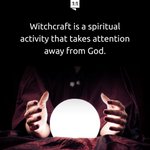




What should Christians think about witchcraft?
The Bible forbids all attempts to do any sort of magic, whether communicating with the spiritual world, drawing power from the natural or spiritual world, fortune-telling and astrology, or potion-making and cursing.
There are several passages that are foundational for the Christian teaching about witchcraft.
The Mosaic Law contains the first overt prohibitions of several types of witchcraft. The rest of the Old Testament is no kinder to the practice of witchcraft. When Saul turns to the witch of Endor to call up the spirit of Samuel, it is an indication that he has finally and irreversibly rebelled, and he dies the next day in the judgment that Samuel’s ghost foretold (1 Chronicles 10:13).
One of the common elements of the wickedness of the kings of Israel and Judah was that they engaged in occult practices. Ezekiel 13 contains a scathing rebuke of false prophetesses who used divination. In Micah 5, which contains a prophetic passage about the Messiah’s reign, God says, “And I will cut off sorceries from your hand, and you will have soothsaying no more (Micah 5:12).
The New Testament is just as clear that any type of witchcraft is contrary to faith in Christ. In Acts 19, new converts who had previously spent a lot of money on magical scrolls and other items burned them in a big heap. This very public act of repentance was also a public witness to the Gospel! Witchcraft is part of the vice lists in Galatians 5:19–21 and Revelation 21:8.
There are several important biblical truths that should ground our thinking when it comes to witchcraft and spiritual powers.
1. God is the Creator and has ultimate power over the universe. No one, including spiritual powers, is like Him. As the Creator, He is the source of every good gift. One of His greatest gifts to us is His Word, the Bible, where he tells us everything we need to know to be saved and live in a right relationship with Him.
2. The spiritual realm is real. There are holy and fallen angels, demons, and the spirits of dead people who have passed on. Living people are forbidden from trying to communicate with this realm.
3. The Bible commands us to trust God to provide us with every good thing that we might need. God is a good Father to us, and we can trust him.
People have always been fascinated by the spiritual realm, and the temptation to engage with it in illicit ways has been a problem ever since Eden, when Eve desired to be like God.
When we trust in Christ for forgiveness of our sins, we are brought into a right relationship with God, our sins are forgiven, we are indwelt by the Holy Spirit, and we can know that God hears our prayers. Various witchcraft practices seem exotic by comparison, and something being forbidden automatically makes it seem more attractive.
However, just like the fruit in the Garden, God forbids witchcraft practices for good reasons. Even in the best-case outcome, they don’t help us and are deceptive. In the worst-case scenario, they can open the door to forces that are more than the practitioners bargain for.
—Lita Sanders

We must use God’s Word as the foundation for our worldview so we can look at the present world through the lens of Scripture.
Believing in millions of years undermines the authority of Scripture and can put people on that slippery slide of unbelief, and it also attacks God’s character.

The Bible makes it clear that God made only two types of humans: male and female. They are different physiologically, behaviorally, and genetically.
How did light exist without the sun during the first three days of creation week?
Genesis 1:3–5 describes God’s creation of light on the first day of creation. God separated this light from the darkness and evaluated it as “good.” He called the light “day,” while the darkness was called “night.” Together, they made up the first evening and morning of day one of creation week. Evening and morning repeat on days two and three, but the sun isn’t made until day four.
The Bible is silent about the source of this light. Nevertheless, this is a question that has been debated and speculated upon among scholars and theologians for nearly two millennia.
Tertullian of Carthage (AD 155–220), in present day Tunisia, was an early Christian apologist and theologian. Tertullian believed that the light was a physical manifestation of Christ’s glory early in creation week, four millennia before the incarnation.
However, it may not be the best interpretation to say this physical light in early Genesis 1 is explained by the light of Christ. Because God created the light, this naturally makes God the ultimate source by his power, but what was the specific source?
Ephrem the Syrian (AD 306–373) was an apologist, hymnographer, and theologian in Edessa, Syria. Ephrem speculated that the first light was like a huge bright mist or a pillar of fire and that after day three had ended, God repurposed that light (and its heat) into the sun, moon, and stars.
However, a problem presents itself here. The sun is like a pillar of fire in a sense—nuclear fusion fire that doesn’t need oxygen like fires on earth. So in this view, the sun would really have been made on day one, then slightly modified on day four.
Yet we read that God made the greater and lesser lights on day four as well as the stars, which would render the making of things on day four seem almost redundant.
Augustine of Hippo (AD 354–430), in present-day Algeria, was the bishop of Hippo and a prolific author and theologian. Augustine believed that the light on days one through three was specifically created (not a manifested essence of God) nor something that was later repurposed. He believed that God created angels on day one and that they were the light that shone on the earth for three days (likely based on scriptural references such as Psalm 104:4, Ezekiel 1:13–14, Matthew 28:3, Acts 12:7, and Revelation 18:1).
We run into a subtle issue here. Angels are all spiritual beings (e.g., Hebrews 1:14). This brings us to a metaphysical question of how light from spiritual beings manifests itself as physical light in our universe.
Ken Ham, founder of Answers in Genesis, is an apologist and staunch defender of biblical inerrancy. Ken does not take a position on what the light source on days one through three was but observes that it must have been a light source that shone on a rotating earth once the light and darkness were separated to functionally serve the same purpose as the later-created sun.
Ken Ham’s goal is to take Scripture as written, and he believes that Scripture teaches a localized and temporary light source for the light of days one through three. There is no repurposing of this light as the sun on day four.
As can be seen from the small sampling above, there are numerous views on this subject and all of them are based on accepting the Bible as the ultimate authority, then using theological inference from other portions of Scripture or from Genesis 1 alone to develop an explanation for what Scripture does not specifically state.
Ultimately, we must admit that Scripture doesn’t satisfy our curiosity on this question but leaves us free to put forth possible explanations, as long as we acknowledge that we cannot dogmatically assert our favored hypothesis as “fact.”
—Troy Lacey

The present can only be understood in the light of three crucial past events: creation, man’s sin, and the Flood of Noah.
Because the historical science (the “earthly things”) in the Bible is true, the moral and spiritual teachings based on that history are true.