

The Compounding Data Engine accelerating Physical AI Robot intelligence isn't built by a few — it's built by all.
axisrobotics.ai
Joined November 2025
- Tweets1K
- Following71
- Followers68.1K
- Likes1.1K




Pinned Tweet
Axis is officially LIVE on @base. 🔵
Axis is scaling Physical AI for the real world, contributed by everyone.
You can control robots in a virtual world, generate training data at scale, and help build the brain behind tomorrow's robots. All from browser. No hardware needed.
Start building robotics intelligence today: hub.axisrobotics.ai
Every trajectory now earns $AXIS.
Points are done. From Saturday 14 November, every verified, signed trajectory earns $AXIS, and you can claim it every week.
Explore now: hub.axisrobotics.ai/
How it works ⬇️
5/6 Claim weekly
The amount shown the moment you sign is the amount you get.
Rewards settle every Saturday at 10:00 UTC. Open Portfolio-Rewards, and claim straight to your wallet on Base.
Miss a week and nothing is lost. Unclaimed $AXIS never expires.
Live: Sat 14 Nov, 10:00 UTC.
First claim: Sat 21 Nov, 10:00 UTC.


We’ve been using ODE Policy for visual policy distillation, with strong early results. Learning how actions evolve over time gives the policy a natural way to capture the continuity of robot motion.
In the video, our Franka robot learns to thread a nut onto a bolt in simulation, reproducing the task from SGS.
Next, we plan to use ODE Policy to distill a wider range of assembly skills into policies that act from camera images, from fitting gears and inserting pegs to joining connectors.

🚀 Nature does not move in discrete jumps. Why should robot policies?
Super excited to release ODE Policy — perhaps our most exciting breakthrough in my lab this year! 🤖🔥
Think about how humans reach for a cup. Our movements evolve continuously, governed by underlying dynamics. Yet, most robot policies — from Diffusion and Flow Matching to VLAs — learn to predict explicit actions.
What if robots learned how actions evolve, instead of predicting actions?
💡 That's ODE Policy for Embodied AI.
We use a neural Ordinary Differential Equation (ODE) to learn continuous action dynamics, rather than directly generating actions.
One simple idea. Five types of robots. Multiple learning paradigms.
✅ Single-arm manipulation
✅ Dual-arm manipulation
✅ Dexterous hands
✅ Humanoid whole-body control
✅ Aerial robots
And it goes far beyond imitation learning:
⚡ VLA (π0.5): 96.0% vs. 75.5% success after one epoch.
🌍 4.5B World Action Model: 82.6% vs. 24.6% success, with ~4× faster action generation.
🏃 RL: More efficient humanoid whole-body motion learning.
For years, we've focused on scaling robot data, models, and compute.
But what if the next fundamental breakthrough comes from rethinking WHAT robots learn, rather than just HOW MUCH they learn?
Huge congratulations to Jindou Jia and our amazing team! 👏
📄 Paper: arxiv.org/abs/2611.01729
🌐 Project: ntumars.github.io/ODE/
#ODEPolicy #EmbodiedAI #PhysicalAI #RobotLearning #WorldModels #VLA #MARSLab
How should you choose simulation demos for co-training when real robot data is scarce?
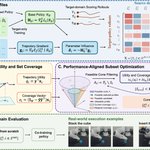
Introducing TUCO: Curating Simulation Demonstrations for Sim-to-Real Robot Policy Co-Training, the first systematic study of data curation for sim-to-real robot policy co-training.
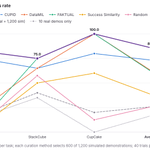
With just 10 real demos and 600 curated sim demos per task, TUCO hits 85.8% real-robot success, versus 25.8% for the full 1,200 pool or a random 600, and sets SOTA across all three transfer settings.
A collaboration with researchers from @Stanford @NTUsg @CarnegieMellon @FudanUniversity @UCBerkeley @sjtu1896.
Project page: tuco-curation.github.io/
Details below ⬇️
5/6 Simulation Experiments
We validate the criterion in two simulated settings with the same protocol, averaging over three seeds.
Single-simulator (RoboMimic). Source and target share one simulator, which isolates the curation criterion from any domain gap. On Lift, Square, and Transport, TUCO is best or tied-best in 18 of 25 task-budget settings, and matches all-data training on Lift using only 25% of the data.
Sim-to-sim (IsaacSim to MuJoCo). Demos are generated in one simulator and evaluated in another, a controlled stand-in for the sim-to-real gap. TUCO is best in 15 of 18 settings and above random selection in all 18. The full IsaacSim pool even hurts CupCake, while a curated subset gives the best result on every task.


1
1
804
6/6
When real data is scarce, careful selection drives the value of sim data more than raw volume. Influence-based utility and coverage offer a closed-loop way to pick demos that genuinely transfer to real robots.
Project page: tuco-curation.github.io/
Paper: arxiv.org/abs/2610.05407
Code: github.com/Z-yiwei/tuco

1
706
We're building a multi-layered robotics architecture, where the LLM drives high-level reasoning and skill harness.
Here's a demo. The task: use the right arm to arrange three objects from the tray in a row along the X axis of the table, ordered by height from tallest to shortest.
You can see the agent turn the task into continuous motion through skill harness, linking scene understanding, height-based ordering, and placement planning to physical execution.
This is an exciting start.


$AXIS staking is live on @HTX_Global with up to 150% APY ⬇️

Subscribe to the AXIS NewList!
Enjoy up to 150% APY:
- Subscriptions are now OPEN
- Maximum allocation: 70,000 AXIS
@axisrobotics
Start NOW 👉htx.net.im/en-us/support/750…

Announcing the $AXIS Token Buyback
Our data engine is powering Physical AI applications across real-world scenarios. We want every contributor to share directly in it.
We're launching the $AXIS token buyback, with our first $150K tranche already complete.
1. Our commercial deals follow a pilot-first model. Framework agreements are signed only after a successful pilot, and payments are released in tranches against delivery milestones.
2. Going forward, a portion of the net profit from our commercial contracts is allocated to buy back $AXIS as cash is collected.
A public buyback report is published each quarter, with on-chain treasury records anyone can independently verify. All repurchased $AXIS is transferred to the public treasury.
Treasury address: 0xfC8c6ABC0742E64c13d6B0bAC1fCD7e604eC7Dc5
See the full details: docs.axisrobotics.ai/economi…

You can verify every step on-chain:
TWAP order: explorer.cow.fi/base/twap/17…
Treasury transfer: basescan.org/tx/0x71cfbe3d27…

A complete tutorial by our top contributor ⬇️

Some Tips and Tricks I use on @axisrobotics
i tried to simplify the process as much as possible😎
Product Update 🛠️
We've reduced the number of open task slots. Here's why.
1️⃣ GPT-6 can now solve simple tasks and generate reliable trajectories for them. We'll further reduce repetitive collection work as we move forward.
2️⃣ High-quality human demonstrations remain essential for complex tasks. These demonstrations carry far more value than routine trajectories.
Season 1 focused on diverse human input for pretraining. With that foundation in place, our focus moves to RL, experts, and distillation. A tighter slot structure supports this shift directly, and keeps resources concentrated on high-quality feedback and practical value.
See our high-level technical roadmap ⬇️

