

Joined October 2021
- Tweets41.1K
- Following2.2K
- Followers56.4K
- Likes61.7K





Pinned Tweet
Tired of these DPRK hacks. So I built the ultimate defense.
DPRKaptcha[.]com
Simple questions with existential outcomes (for them).
Live now to protect the internet from North Korea.


Biggest surprise in all my travels is how much I've grown to love distinctive architecture.
The sheer scale and grandeur of Florence and Vienna.
The intricacies of Alhambra palace.
The organic modern combo of Singapore.
And now the craftsmanship of Japanese temples.


10
32
3,410
The final agent interface will be voice in both directions.
Can be to a single "chief of staff" agent or an ephemeral "chief of staff" personality which is made consistent through separate contextual interfaces.
Only level behind that is nuerolink embedded

My current feeling is that frontier OAI/Ant/Gemini models with harness on desktop are phenomenally useful for real work...
But despite how useful they are, I also still feel like my mind is being psychologically raided when I'm switching between all the different chat threads
And on top of this, all of these agents I'm supposed to text all day that seemed awesome at first are in fact not very useful (dot/muse/instinct/whatever)
Makes me increasingly convinced that "chat" alone is decidedly not the final interface of using a computer, or at least doing work on a computer. So much power and so little interface innovation
Curious for those who disagree. Perhaps I'm just bad at this
I take it back.
Has to be visual for agent->human. So text+graphics.
The bandwidth our eyes can achieve relative to ~all other senses isnt even close.
So, humans talking to agents and agents visually presenting responses back is my final answer.

Just watched @jinfizz drive an ADE from his iPhone Duo and I can't help but think foldables are going to be the new remote workstation.
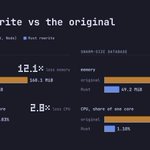
T3 Agents rewrite going well.
Kept it byte-for-byte and gained substantial mem., CPU and speed improvements even at swarm scale (16k subagents).
Went from Typescript+node to Rust and experimented with swapping terminal UI for Rune but it didn't net-out to much so killed that.


Left all machines at home while I travel, but plan to max all subs via T3.
First is a perf rewrite of the T3 Agents dashboard I created.
→ Rewrote the core in Rust
→ Explored a Rune FE but turned out to be ~no improvement over terminal FE so scrapping
→ Testing swarm-level scale (~16k active subagents) while losing no perf
I think the one thing lacking right now in T3 is subsystem observability, which I aim to fix with T3 Agents.

Fluffy French toast acquired.
8/10. Had almost a mochi-like chew to it but was still very light.
Fluffy pancakes next.

13
36
3,366
I'm noticing a "headless" trend.
Definitely for software, but also for businesses.
AI has made software so malleable that it doesn't make sense anymore to draw rigid lines between your offerings and others.
If you build the right way, Agents allow for all of it to take the shape your customers want.
I expect this trend to continue.

Highly recommended list.
Omabox in particular has been a game changer for my iteration pace.

It's great to see people are catching up on running Omarchy + T3 Code for coding actually.
So some tips for better agents workflow into omarchy:
- First gave them access to omabox.app this will let them have a unique workspace use computer, clicks things, try your app without interfering with your actual work
- As much as I love zsh, agents keeps failing on some pattern with it + interactive commands so you better sticking to bash or give them specific rules / env for terminal use
- After you have run many threads on one project in T3 Code, start a new thread asking your agent to review the past T3 Code threads on that project and identify the bottlenecks / issues agents are running into and to improve the developement workflow / speed
- Ask into T3 Code with no projects to tune your Omarchy system for better disk performance and agentic workflows, making sure it has all the tools and up-to-date that agents like to use for specific tasks
- Very important, when you are doing UI work, ALWAYS ask in T3 Code in your prompt to generate multiple detailled HTML variants to render in T3 Code for you to pick before implementation.
You need to create the best environment for your agents to run and be fast.
7
30
4,486
So, I went down this path far enough to create a t3 fork with a dedicated "lead/orchestrator."
One version with persistent threads and another with ephemeral threads.
I ultimately killed it.
T3 in it's current form handles the task fine. Coordinators ultimately are just there to reconcile and spot drift when needed, which is a single ask that you can invoke as a thread when needed, then settle.
Once you get used to the rapid thread creation and settlement of t3 you learn how to conform your approach and I've yet to spot degradation.
The one thing that my fork experiments did reveal for me though is that I want more default controls over the models chosen for subagents and alt-threads.
I hate having to say "this is design, use opus 5.5" 67x a day, or that subtasks should use Deepseek.
So the one forked feature I'm still iterating on is a default model based on "roles" where I can opt in to a preference for subagents for parent level threads and the parent knows who to delegate to based on the task at hand.
Early days but results are promising. Doubly so because I inject ambitious pre prompts to the subagents automatically.


For those suggesting to just do model routing in CLAUDE/AGENTS files:
It's a level too deep.
"Why not just add this to Claude[.]md?"
Because it isolates the logic to Claude.
If you use multiple providers then you'd need to replicate the logic in every harness' Claude/AGENTS file.
Doing it in T3 sets it once for any potential provider + surfaces the routing logic.
2
3
773
"Why not just add this to Claude[.]md?"
Because it isolates the logic to Claude.
If you use multiple providers then you'd need to replicate the logic in every harness' Claude/AGENTS file.
Doing it in T3 sets it once for any potential provider + surfaces the routing logic.
So, I went down this path far enough to create a t3 fork with a dedicated "lead/orchestrator."
One version with persistent threads and another with ephemeral threads.
I ultimately killed it.
T3 in it's current form handles the task fine. Coordinators ultimately are just there to reconcile and spot drift when needed, which is a single ask that you can invoke as a thread when needed, then settle.
Once you get used to the rapid thread creation and settlement of t3 you learn how to conform your approach and I've yet to spot degradation.
The one thing that my fork experiments did reveal for me though is that I want more default controls over the models chosen for subagents and alt-threads.
I hate having to say "this is design, use opus 5.5" 67x a day, or that subtasks should use Deepseek.
So the one forked feature I'm still iterating on is a default model based on "roles" where I can opt in to a preference for subagents for parent level threads and the parent knows who to delegate to based on the task at hand.
Early days but results are promising. Doubly so because I inject ambitious pre prompts to the subagents automatically.

Left all machines at home while I travel, but plan to max all subs via T3.
First is a perf rewrite of the T3 Agents dashboard I created.
→ Rewrote the core in Rust
→ Explored a Rune FE but turned out to be ~no improvement over terminal FE so scrapping
→ Testing swarm-level scale (~16k active subagents) while losing no perf
I think the one thing lacking right now in T3 is subsystem observability, which I aim to fix with T3 Agents.
Also happens when I spend time with my neighbors.
Mostly local workers w/ normal office jobs + healthcare.
They're either not using AI at all or have it tune spreadsheets.
The world is still in pre-clawdbot era
Runs a hedge fund + managed an ETF and was one-shot by Google Search+ level work from GPT.
It's hard to remind myself of the insane frontier tech bubble we exist in sometimes.
Holidays are the other.
I can't hold a conversation with anyone without feeling insane.


8
20
4,630

Runs a hedge fund + managed an ETF and was one-shot by Google Search+ level work from GPT.
It's hard to remind myself of the insane frontier tech bubble we exist in sometimes.
Holidays are the other.
I can't hold a conversation with anyone without feeling insane.
unavailable
Built a dash so I could track my T3 agents on a more granular level.
Tool call failures (orange x) feels elevated, but don't have a baseline to mark against so starting with what I got.
Will publish the dash to git once it's polished

The new desktop


Omarchy review as a first-time Linux user:
1.) Day 1 Experience
Buttery smooth. Way better than expected.
- Fast install (19s & 78s)
- Elegant sign-in/config for the major items (native agent, wifi, fingerprinting, pw manager, etc)
- Puts the sexy theming up front so you can make it yours
- Pretty much ~any app you want is ready to be pulled in if it wasn't in your native bundle. I thought I'd be cucked out of some popular ones at some point but it's not the case.
It was so easy and encouraging through the first setup that I installed flashed my main driver from Windows to Omarchy. No going back now.
-------------------
2.) OS-level Agent feels like the end state, but we need local LLMs.
This is a pro/con of the setup. It's AMAZING to have Claude/Codex/Grok baked right in to the OS for all the small annoying things that come with using a computer. Having it be able to edit directly and correctly instead of forcing me in to a meat proxy position is great.
"Dude - move this window" - Done. Also re-skinned it to match your theme.
"Why is this thing crashing?" - Diagnoses, fixed, upstreamed with a PR.
"My fan shouldn't be going this hard. What's up?" - Was a hidden motion wallpaper from your earlier experiment. Killed it.
"I want my unicode selector like Windows. Hotkey it to super + ." - Done.
What isn't awesome is having too much data sent to these frontier labs. Local LLM might be my next adventure because of this.
-------------------
3.) Customizations and Desktop Management
Biggest shock to my system were these two elements.
- Tiling and window management felt jagged and restricting at first, but I wanted to embrace it and now love it. Hotkey nav, workspace switching, etc. All awesome once you internalize.
- Downside is there are hotkeys for EVERYTHING and the few hotkeys I actually recalled from Windows/Mac were disabled/diff and didn't map so I had to undo the little work I had done. Really hard to not end up in a place where you get stuck and can't really navigate unless...
- You lean in to the crazy levels of customizability (which are ++ with agents).
Hotkey-locks suck, so I had my agent create a theme'd hotkey row at the bottom of my window at all times. As I internalize them, I can click them away and a new one comes in. Pretty awesome and saves me from having to pull up windows all the time just to exist.
Outside of that, I now have in my short install time:
- My calendars synced as a widget
- The important machine metrics surfaced
- A dashboard for tracking all of my agentic work
-------------------
4.) Linux/OSS versions of all apps is going to take a minute to get used to
It's not Chrome, it's Chromium
It's not Finder/Windows Explorer, it's Files
It's not Terminal, it's Foot
LibraOffice, Omacalc, Monologue, Signed, SuperWhisper....
Bleh.
fwiw I don't see any actual functionality or experience dropoff initially though and where things break - because of your agent - you can just fix + upstream in seconds. Pretty nice.
-------------------
4.) Remote management & Agent Stack
My setup is now 3 separate machines trying to stay relatively synced, balancing work between the group.
Setup was pretty straightforward for all, and I've landed on this as my "stack:"
Orchestration: @t3dotcodes
Skills + Tooling: Private git
Memory: Basic Memory on a single machine, MCP synced by the others.
I'm exploring adding Pi to the above but want to benchmark this for a bit.
I plan to use Omarchy as my daily then remote in to the other machines as needed if a tasks can't be handled with T3's native interop and delegation.
Overall, very good experience and has reinvigorated some of the nerd in me. I want to contribute to more OSS and begin sharing some of my widgets and plugins.

8
49
5,183