

Elastic Security Labs is democratizing security by sharing knowledge and capabilities necessary to prepare for threats. Spiritually serving humanity since 2019.
Global
Joined November 2022
- Tweets646
- Following726
- Followers6.2K
- Likes345
Elastic Security Labs Threat Command detected a credential-stealing supply-chain attack using a malicious version of the Microsoft project agent-framework (1.26.1 and 1.26.2) at 3:41 PM EST on November 17, 2026. There appears to be an additional file (_telemetry.py and af_runtime_diag.py) added to the packages, aimed at Azure cloud workloads and CI/CD build agents.
It’s disguised as a harmless “runtime diagnostics helper”, but steals environment variables, credential files, OIDC tokens, and managed identity tokens. The attack chain exfiltrates to the endpoint: webhook[.]site/d381fd80-ec62-42ad-8f5c-d1b15103c9bb.
If you installed agent-framework (1.26.1, 1.26.2), we recommend removing it, pinning to 1.26.0, and rotating any credentials accessible from that environment, since the release steals secrets and Azure tokens.
Package URL:
pypi.org/project/agent-frame…
pypi.org/project/agent-frame…
User-Agent: af-runtime-diagnostics/1

5 agentic offensive frameworks skip in-code authorization by default.
ARTEX, CyberStrikeAI, Cairn, PentAGI, and HexStrike put an LLM in the planning loop around familiar scanners, shells, and cloud CLIs, and GTIG observed ARTEX acting in bursts of roughly 2 to 25 seconds.
All 5 have already turned up in real intrusions, across reporting from GTIG, Mandiant, Microsoft, and our own research.
We read their source and the public incident reporting to work out what reaches defender telemetry. Research by @stryker0x: go.es.io/4eKv4jE
• Why IOC and User-Agent detections go stale while behavior-based rules hold up
• Tempo and sequence signals per identity for short bursts and long campaigns
• An ES|QL hunt for tool-family bursts across web, proxy, and cloud audit logs
• Why blocking a source IP must be paired with credential/session revocation
Every action these frameworks take still has to land in telemetry you already collect.

We're tracking REF3364, a Linux cryptomining intrusion that combines custom malware with publicly available miners.
Full analysis by @soolidsnakee, with YARA rules for SANSAR and netns, MITRE ATT&CK mapping and IOCs: go.es.io/4sW0SYE
The actor abused an exposed Ray job agent, obtaining root and deploying the toolkit across 3 Linux GPU hosts.
The toolkit includes SANSAR, a Rust orchestrator that uses Tor for C2 and supervises CPU and GPU miners. Its command handlers support miner configuration and interactive shells.
The actor also deployed:
• A kernel rootkit that hides selected processes, files and socket entries
• An NVML wrapper that falsifies GPU readings
• netns, a separate backdoor that retrieves its C2 address from an Ethereum smart contract before connecting to the server directly
Using public blockchains to locate C2 infrastructure is a pattern we also discussed in our 2026 Threat Command quarterly report.

2026 Threat Command quarterly report: go.es.io/4iE0oTz

Attackers are using legitimate AI coding assistants to execute malicious commands on compromised endpoints.
In two confirmed intrusions, Elastic Threat Command observed adversaries operating cyber attacks through Claude Code on Windows and the ChatGPT desktop app on macOS. Both involved trusted applications being used to carry out malicious activity.
@_xDeJesus principal security research engineer at Elastic Threat Command, walks through the findings and what security teams should be looking for: go.es.io/47ZcxMM
The findings highlight a detection challenge: These applications are signed and authorized to execute commands, making it difficult to distinguish legitimate activity from attacker behavior.
The speed of these attacks is another concern. Elastic researchers observed an average of just eight minutes between ClickFix/infostealer infection and attackers logging in with stolen credentials.
In the latest threats, etc quarterly report, Elastic Threat Command documents these intrusions and examines the implications for endpoint visibility, behavioral detection, and threat hunting.
Full report: go.es.io/4sO5G2k
Six observations in the new 𝘵𝘩𝘳𝘦𝘢𝘵𝘴, 𝘦𝘵𝘤 report, all of them on software you already trust.
• AI clients as execution parents
• A worm with npm publish rights
• ClickFix on macOS
• ROPC past Conditional Access
• Blockchain C2 in commodity loaders
• 8 minutes from stealer to login
Access the full report: go.es.io/4z3fyGK

Microsoft wants EDR out of the Windows kernel. We checked the binaries
They even come with public symbols. Full write-up from @zodiacon : go.es.io/4zcdL2U
Microsoft's answer is the Windows Endpoint Security Platform (WESP). It's undocumented, but it already ships in Windows Insider builds.
What we found:
• wesp.sys: a Microsoft-built file system mini-filter at altitude 329500
• EspFilterPort: the filter communication port it uses to reach user mode
• espclient.dll: 120 Esp* exports for rules, filters and event queues

Two critical PHP RCEs are patched: CVE-2026-109618 and CVE-2026-109619, both CVSS 9.2.
• Fixed in 8.5.12, 8.4.27, 8.3.36, and 8.2.35.
You can still focus on detection coverage today.
Security Labs writeup (coverage + guidance): elastic.co/security-labs/thr…
Most PHP RCEs converge on the same outcome, whatever the bug: a web server process (php-fpm, php-cgi, apache2, httpd) doing something a request-serving daemon almost never does legitimately.
• a shell to confirm access: id, whoami, uname -a
• a second stage pulled in: curl http://... | bash
• a reverse shell: bash -i >& /dev/tcp//
• a webshell written into the web root
The bug class is public now: out-of-memory corruption, and stale state reused by the same worker. The behavior is what you detect.
We recently ran a different PHP RCE end-to-end (wp2shell): apache2 spawning dash to run id; whoami; hostname fired the exact rules that we suspect to catch php2shell. Payload Execution by Web Server kills the shell on the endpoint.
The Suspicious/Unusual Command, Child, and File Creation via Web Server rules stack on top.
(PHP did confirm partial php.ini mitigations. session.upload_progress.enabled=0 blocks the confirmed session paths only. Patch is still the fix.)
Patch to 8.5.12, 8.4.27, 8.3.36, or 8.2.35. Verify that the stack is enabled now.
Guidance + every rule link below.

Rules it maps to:
• Payload Execution by Web Server: github.com/elastic/protectio…
• Payload Downloaded via Curl or Wget by Web Server: github.com/elastic/protectio…
• Suspicious Command Execution via Web Server: github.com/elastic/detection…
• Unusual Command Execution via Web Server: github.com/elastic/detection…
• File Creation via Web Server (+ polyglot / double-extension): github.com/elastic/detection…
wp2shell walkthrough: elastic.co/security-labs/blo…

571 IIS servers hijacked using machine keys from public docs.
@soolidsnakee and @k33b0i break down REF3927 at @virusbtn VB2026
• Today, 15:00 CEST in the Green room.
Talk abstract and kill chain outline: go.es.io/3Us9kSw
Full blog: go.es.io/4hZ5TKG

We identified a malicious npm package, apexacc/cli, which led us to an operation posing as a Web3 accelerator.
Read more about REF8801 by @k33b0i and @DanielStepanic : go.es.io/3TDeUBk
The fake accelerator spent months courting crypto founders with free Claude and Gemini credits.
Our supply-chain monitor caught the package. It was malicious from its first published version.
The 2 Apex packages we examined, and what they deliver:
• apexacc/cli: redirects OpenRouter-labeled model requests to an attacker-controlled API
• apexacc/audit: MCP server whose 18 tools return fabricated findings
• macOS payload: CloudSyncD backdoor
• Windows payload: infostealer that exfiltrates to Telegram
We asked the operation's scoring tool to rate a project that doesn't exist. It scored 51 in every category, and said its AI scorer was down.

ALT How 1 npm alert led us to a fake Web3 acclerator
AlertZero, the agentic layer of Elastic Security, is heading to technical preview.
Full walkthrough from @jamesspi, including the ES|QL query Detection Watch uses to rank rules by false-positive closures: go.es.io/4drpzpg
AlertZero has 4 Watches, each a group of named agents with one SOC responsibility.
• Triage Watch: alert analysis plus Attack Discovery, one Investigation per attack
• Hunt Watch: threat research tested against your telemetry, exact lookups first, behavior second
• Detection Watch: investigates rule gaps and FPs, proposing the edit with a backtest
• Forensics Watch: reconstructs the endpoint, then proposes response actions through Elastic Defend
Every consequential change arrives as a Proposed Action. Approved and executed are logged as separate states.
Which detection rules should you enable first?
Our prebuilt rules now answer that with a Profile tag.
It's a points score, recalculated monthly from fleet telemetry. Full scoring model: go.es.io/3Tl4W7y
Additional context added via rules tags:
- Noise: alert volume per environment across the fleet
- Performance: average and p95 execution time
- Threat: whether it covers a threat our team actively tracks
- Profile: severity plus the other 3, rolled into Recommended or Aggressive
Profile is a quick starting point: 385 rules are Recommended.
Noise, Performance and Threat show the trade-off behind each call.
Domain, Platform and DataSource tags then narrow it to your own track.

9:00 a.m. A phishing email gets quarantined.
9:05 a.m. An endpoint runs a suspicious PowerShell command.
Each one looks handled on its own. The quarantine did its job, and one odd PowerShell process a day is background noise in most environments.
Together they're the opening moves of a campaign. Nobody sees them side by side because they live in 2 different tools.
Sublime Security's email telemetry now lands natively in Elastic Security, next to your endpoint, identity, and network data.
From there, Attack Discovery ties the quarantined email to the endpoint alerts and builds one attack chain. Mapped to MITRE ATT&CK, reasoning included.
Elastic Workflows opens a case and pings the analyst on Slack, evidence attached. Approve or reject from there.
The agents connect the signals and surface an evidence-backed decision. Consequential actions still go through the analyst.
Full walkthrough, including the 7-step flow and the two-stage rollout: go.es.io/4hHaGka
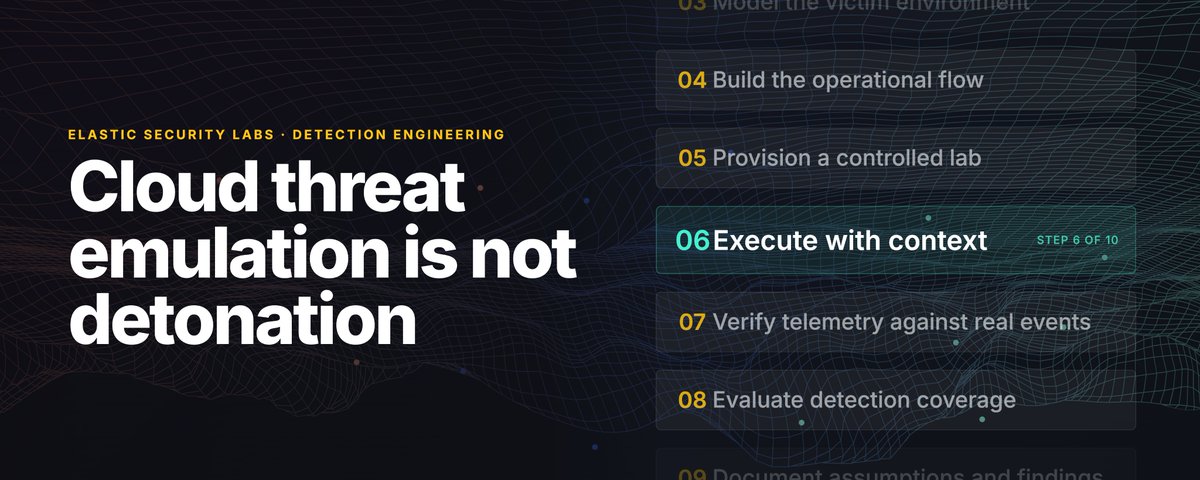
Poor emulation produces poor data. Poor data produces poor detections.
Part 1 of 3: the context and 10-step methodology behind cloud threat emulation, from scope to cleanup. Tooling and AI coming later.
By @bryan3c and @_xDeJesus
We are investigating a malicious package, apexacc/cli, distributed in the npm registry. Initial assessment shows that the package performs registry modifications to Windows Smart App Control, AV exclusions, UAC elevation attempts, and includes Base64-encoded PowerShell payloads. Further end-to-end triage shows that for the Windows path, its verification step requests commands from vrf.apexaccs[.]org, then runs encoded PowerShell. We traced the execution chain through Python/PyInstaller and PyArmor layers to a Go shellcode loader. The final component in the chain shows strong infostealer characteristics.
Variants of this campaign and techniques have been observed and documented here - go.es.io/3V3c7BC and go.es.io/4AoyO3y. Since it was discovered in July 2026, it has been added to, and remains in, the npm package registry.
We have reported this package to npm and are continuing to investigate. We will update this thread as we learn more.


KREMLIN is a multi-stage credential theft toolkit targeting Brazilian banking users.
New research from Elastic Security Labs (REF9334): go.es.io/4yfkg4R by @cyril_t_f and @andythevariable
The infection chain combines JavaScript loaders, an optional PE injector, and a custom C++ installer. The installer downloads and installs a malicious browser extension for Chrome and Edge and/or deploys an embedded PULSAR or REMCOS RAT. This malicious extension is then used for web-browser data interception and exfiltration.
KREMLIN resolves its C2 endpoints from Ethereum. Smart contracts store payload URLs and extension download locations as on-chain key-value pairs. The operators update endpoints by writing a new transaction.
The extension installation bypasses Chromium's integrity system. The installer launches Chrome under a debugger, recovers the App-Bound OSCrypt key from process memory, extracts the seed from resources.pak, then regenerates the HMACs and encrypted SHA-256 hashes that Secure Preferences requires. The extension registers silently with developer mode forced on.
Once active, it logs input fields, intercepts HTTP requests by configurable URL and method rules, injects attacker-controlled HTML, and exfiltrates intercepted data, cookies, and credentials over WebSocket and HTTP.
Elastic Security Labs Threat Command registered the network canary domain that operates as a kill switch. We observed thousands of implants from Brazil attempting to check in to this domain. Once this domain was live, the KREMLIN loaders crash before trying to update or install the final payload, temporarily disrupting this campaign.
The targeting is clear. Lure filenames impersonate PIX transfers, bank statements, and receipts from Banco do Brasil, Bradesco, Sicoob, Santander, C6 Bank, and PagBank. Ethereum transaction timestamps cluster in São Paulo working hours. Portuguese-language artifacts appear throughout the codebase.

2026 has been a busy year for Linux local privilege escalation.
New kernel LPEs kept landing, several of them variations on the same idea, and a rule written per CVE was never going to keep pace.
So our detection keys on what escalations have in common rather than on what each bug does:
- An unprivileged process execs from a world-writable path, then something in that lineage changes uid to 0
- A SUID/SGID binary runs with effective uid 0 while the real user is not root
- unshare(CLONE_NEWUSER) shows up as a precursor
- A shell or interpreter finishes as root out of a user-controlled directory
- A binary that should never have been setuid-root gets used the way GTFOBins documents
Most of these rules have been shipping for a while, the unshare one since 2022. When we ran this year's public PoCs in the lab, several tripped rules that predate them.
The blog covers the general LPE categories and the logic behind each, a walk through of this year's CVEs with the rules that fired and why, where the layers need tuning, and the framework ready to use.
Full framework, EQL logic, and every rule mapped by @RFGroenewoud : go.es.io/4ywkzaR
