

Making Washington a place to prosper.
Washington, USA
Joined June 2022
- Tweets20.1K
- Following523
- Followers14.4K
- Likes53K





Boeing announced recently they would be laying off 5% of their commercial airplane division, which would come out to about 2,500 jobs gone across the company. However; the closer we get to December 9th when the notices are expected to drop, the more likely it is becoming that all 2,500 job cuts will be here in the Puget Sound area.
Regardless of the 'why' they are doing these cuts, this is going to hurt for many Washington families who are already struggling with our state's affordability problems.
@HeySamCampbell | @fox13seattle
'Boeing meeting creates more questions about future layoffs'
Gov. Bob Ferguson is right: Washington students deserve better than mediocre results. Now he needs to do something about it.
Responding to Superintendent of Public Instruction Chris Reykdal’s decision not to seek reelection in 2028, Ferguson delivered a blunt assessment in a November 10 Facebook video, which we have attached to this post.
“Test scores for students are just really mediocre, and Washington is not mediocre,” he said, calling a leadership change “Really past due for a change.”
We agree. But students struggling today cannot wait until the next superintendent takes office in 2029. And replacing one elected official is not a plan to help children learn.
Washington taxpayers have already made an enormous investment. Legislative budget records show state K–12 operating appropriations grew from approximately $15.3 billion in 2013–15 to $31.4 billion in 2023–25, an increase of about 105%.
(fiscal.wa.gov/lbns/2015LBN.p…)
(fiscal.wa.gov/lbns/2025LBN.p…)
On the National Assessment of Educational Progress, Washington’s average eighth-grade math score fell from 287 in 2015 to 274 in 2024. Just 30% performed at or above NAEP Proficient in 2024, while 41% scored below NAEP Basic. These are national assessment benchmarks, distinct from Washington’s own grade-level standards.
(nces.ed.gov/programs/digest/…)
(nces.ed.gov/nationsreportcar…)
Ferguson has an opportunity to change course right now: opt Washington into the Federal Scholarship Tax Credit (FSTC) program.
As Future 42 previously explained, the program could make educational help more affordable for families whose children need something different or something more.
(future42.org/washington-coul…)
Beginning in 2027, donors can receive a federal tax credit of up to $1,700 for qualifying contributions to approved nonprofit Scholarship Granting Organizations. Those organizations provide scholarships for eligible students’ educational expenses. The $1,700 limit applies to the donor’s credit, not a guaranteed scholarship for each child.
(irs.gov/government-entities/…)
For Washington families, that could mean:
📚 Tutoring to help a struggling reader or a student falling behind in math.
💻 Computers, school supplies, and other qualifying learning resources.
🧩 Specialized services for children with disabilities or different learning needs.
🎓 Help with qualifying tuition expenses when a different school would better serve a child.
Families should have access to an education that fits their children. These scholarships can help students in public schools as well as private schools. A parent should not have to watch a child fall further behind simply because extra help is out of reach.
This should not be a partisan decision: six states with Democratic governors have opted in or announced plans to participate, including Colorado, Kansas, Kentucky, New Mexico, New York, and North Carolina. Ferguson should follow their lead and give Washington families access to the same educational opportunities.
(illinoispolicy.org/at-least-…)
Ferguson can make the participation decision without waiting for lawmakers to pass a new scholarship bill. His administration would then need to certify qualifying organizations and complete the federal participation requirements. Scholarships depend on donations and eligibility, but opting in opens a door that remains closed today.
He told KOMO on November 6 that his lawyers were reviewing the rules and that he expected a decision before January 1. Washington still does not appear on the IRS’s November 13 participating-state list.
(komonews.com/news/local/gove…)
(irs.gov/government-entities/…)
Washington does not have to accept mediocre results. The “Mississippi Miracle” shows what a sustained commitment to doing things differently can achieve. As Future 42 previously highlighted, Mississippi climbed from 49th in fourth-grade reading in 2013 to ninth in 2024, while its share of students scoring proficient or advanced rose from 21% to 32%.
Meanwhile, Washington’s average fourth-grade reading score fell from 225 to 216 over that period. On the latest national assessment, Mississippi’s average was 219.
(future42.org/discovery-insti…)
While Reykdal himself has sought to downplay Mississippi’s successes, the contrast contrast is clear: Mississippi has made substantial progress while Washington has lost ground.
The FSTC would not replicate Mississippi’s reforms, but it would give families another way to access tutoring and educational support their children need. If Ferguson believes change is overdue, he should embrace both proven classroom reforms and the opportunity to put additional learning resources within families’ reach.
The timing of Ferguson’s criticism invites skepticism, however.
But Ferguson can prove otherwise. He can pair his criticism with a concrete decision that gives families more ways to help their children succeed.
Email Gov. Ferguson and urge him to opt Washington into the Federal Scholarship Tax Credit program, giving public-school students and families across our state access to additional educational support.
Email Governor Bob Ferguson: future42.org/maps/washington…
Washington’s children need more than an accurate description of the problem. They need action.
-Future 42
Article: future42.org/ferguson-says-w…


Future 42 retweeted

People experiencing homelessness deserve help that gives them a real chance to rebuild their lives. Residents deserve safe neighborhoods and confidence that the public dollars committed to this crisis are making a difference.
Replacing the King County Regional Homelessness Authority (KCRHA) should bring those goals closer together.
Last week, we called for disbanding KCRHA after repeated financial failures and leadership changes. But closing an agency is only part of the job. What replaces it must do a better job of reaching people in need, using resources responsibly, and delivering results.
(changewashington.org/king-co…)
Our recommendation is to place the functions that are truly regional within a county department, with one accountable director, transparent finances, and enforceable performance standards. King County should manage federal and regional funding responsibilities, Coordinated Entry, and shared data systems. Seattle and other cities should directly control the local dollars they contribute, the contracts they fund, and the services they provide.
Moving the work into county government will not automatically fix anything. Without stronger oversight and consequences for failure, the same problems could follow it into a different office.
The replacement must also recognize that homelessness requires more than adding housing. Shelter and housing matter, but so do mental health care, addiction treatment, recovery support, and expectations that help people move toward lasting stability. Success means connecting people with the combination of help they need and following through.
Here is what that response should include.
1. Protect essential help during the transition.
An orderly transition must protect people who depend on existing services. County Executive Girmay Zahilay has warned that an abrupt shutdown could jeopardize $67 million in federal resources supporting housing and services for about 4,000 people.
(fox13seattle.com/news/leader…)
That calls for careful planning. Before KCRHA closes, the county should secure the necessary federal approvals to transfer funding responsibilities and preserve essential coordination and data systems. Providers should receive uninterrupted payments, and every remaining responsibility should have a designated home.
The people relying on help should not pay the price for an agency’s failures.
2. Put someone clearly in charge, with consequences when the system falls short.
A county department should have a director who reports to the County Executive and answers to the County Council for the regional functions assigned to it. Residents should know who is responsible for regional funding, shared systems, spending decisions, service failures, and progress.
Before establishing that structure, county leaders should explain whether an existing department can absorb the work, what additional staffing is necessary, and what the transition will cost.
Seattle and the other 38 cities in King County should participate through agreements setting shared goals, funding commitments, data requirements, and rules for using regional systems. But each local government should retain direct responsibility for the dollars it contributes, the contracts it funds, and the services it chooses to provide. Regional cooperation should come with clearly assigned responsibilities, not blurred lines of authority.
The principle is simple: if a function is regional, King County should own it. If it is local, local governments should own it. Either way, taxpayers should know exactly who is responsible and be able to hold them accountable.
Accountability must extend beyond appearing at a hearing. Repeated failures should trigger corrective action, closer oversight, and, when warranted, changes in leadership.
3. Coordinate help around the person who needs it.
Someone living outside may need shelter, treatment, medical care, or several forms of support at once. The response should connect those services and make sure people do not disappear between referrals.
The county should maintain one Coordinated Entry system and one shared regional data system. Appropriate and authorized staff should track referrals and progress, identify unmet needs, and follow up when someone is not receiving help. Local governments should use those common systems while remaining accountable for the performance of their own contracts and services.
The purpose is practical: make it easier to deliver the right assistance and harder for people with serious needs to fall through the cracks.
4. Put the public dashboard at the center of accountability.
One of the clearest lessons from KCRHA is that taxpayers should never have to become forensic accountants to figure out where homelessness dollars went or whether programs worked.
Every regional contract, contract amount, payment, responsible agency, and key outcome should be visible through a single public dashboard. Residents should be able to see how many people reach permanent housing, how long placements take, how many return to homelessness, shelter utilization, cost per outcome, unspent funding by provider, and whether people needing mental health or addiction treatment are actually being connected with care and continued support.
The financial side should be equally transparent. Monthly spending reports, annual independent audits, and a public ledger of contracts and payments should be standard. Missing reports, unexplained balances, or overdue provider payments should trigger a public corrective action plan and review by elected officials.
5. And the dashboard should have consequences attached to it.
When a program works, policymakers should be able to see it and invest accordingly. When outcomes repeatedly fall short, contract renewals and funding decisions should reflect that performance while protecting essential services. When government leadership fails to correct a persistent problem, the public should be able to see who is responsible and what is being done about it.
Transparency cannot mean publishing another lengthy report once a year. It means giving the public an understandable, regularly updated picture of where the money is going, what results it is producing, and who owns the outcome.
If taxpayers are funding the system, they should not have to ask whether it is working. They should be able to see for themselves.
6. Keep effective providers stable.
Organizations doing good work should have the stability to continue it. That means timely payments, multiyear contracts when performance supports them, and a published cap on administrative costs.
Reliable funding and meaningful oversight belong together. Providers should not have to absorb the government’s bookkeeping problems, and public agencies should not keep renewing contracts without examining whether they work.
Seattle and King County are already preparing to take back locally funded service contracts. Leaders should use that transition to establish a clear division of responsibility from the beginning: King County should own what is regional, while Seattle and other cities should own what is local. An independent review of results and administrative costs should follow after two years.
7. A new structure must earn back the public’s trust.
Residents want reason to believe progress is possible. People living outside need a response that addresses the circumstances keeping them there. Both deserve more than another reorganization, another new organizational chart, or another promise that things will be different this time.
County and city leaders should publish a clear plan and timeline for replacing KCRHA, protecting essential services, and enforcing standards for spending and results. From the beginning, that plan should include a public dashboard showing taxpayers where the money is going, what outcomes are being achieved, and which government or provider is responsible.
That dashboard should not be an afterthought or a public-relations exercise. It should be one of the central tools elected officials use to manage the system and the public to hold them accountable.
If outcomes improve, the public should see it. If millions are being spent without meaningful progress, the public should see that too. And when a program, provider, or strategy repeatedly falls short, residents should be able to see what leaders are doing about it.
The failure of KCRHA cannot be answered simply by moving responsibilities from one organization to another. The goal must be a better system: one with clear responsibility, transparent spending, measurable results, and consequences when those results do not materialize.
Public confidence will not be restored by asking residents to trust the next system. It will be restored by giving them the information to judge it for themselves.
-Change Washington
ChangeWashington.org

Future 42 retweeted

Seattle is flushing more meth than anywhere else scientists checked.
mynorthwest.com/seattles-mor…


Future 42 retweeted

2026 YTD Total: 32
2026 Fatal Police Shootings: 1
2025 Total: 36
2025 Fatal Police Shootings: 3
5 Year Average: 53.6
Record High: 74 in 2023
Future 42 retweeted

Good news for Thanksgiving travel to eastern Washington: Vantage Bridge construction has wrapped up for the year. KIRO Newsradio traffic reporter Chris Sullivan breaks down what's left, with WSDOT's Meagan Lott on why the project is taking so long, why the bridge feels bumpy, and what to expect next summer.
WSDOT has replaced 508 of the bridge's 612 panels, leaving a little over 100 to go when work resumes...
Listen to KIRO Newsradio 97.3 FM or go to MyNorthwest.com to learn more!
Our tax money, hard at work killing people...

Tax payer funded housing hands out crack pipes, brillo, and meth pipes. @PlymouthHousing enables addiction. 👇🏼
Future 42 retweeted

Tax payer funded housing hands out crack pipes, brillo, and meth pipes. @PlymouthHousing enables addiction. 👇🏼
Future 42 retweeted

A Seattle nonprofit that was supposed to help LGBTQ victims of domestic violence took millions in taxpayer-funded grants, while paying 6-figure salaries to executives, plus severance. The organization dissolved months later refusing to answer questions. thecentersquare.com/issues/a…

Multiple drive by shootings around Pioneer Square this weekend, with over 80 shell casings recovered. There was also another drive by shooting down in Skyway where two teenagers were injured.
A miracle nobody was killed, as gang violence continues unencumbered in King County.
@JasonSlossTV | @KIRO7Seattle
'Woman hospitalized after Saturday night drive-by shooting in SoDo'
Tell Tacoma City Council to Vote No on the $20 Minimum Wage
*A higher minimum wage sounds good, but it makes life more expensive for everyone.
Tacoma families are already struggling with the rising cost of groceries, restaurant meals, childcare, and everyday services. Now, the Tacoma City Council is considering increasing the city's minimum wage to $20 per hour, nearly 17% above Washington's current minimum wage.
The concern is simple: When government mandates higher wages, consumers can end up paying more for the things they buy every day, especially if their pay hasn't increased.
*Look at what happened in Seattle.
Seattle offers a warning about how government-mandated pay increases can affect everyday expenses.
After Seattle enacted its minimum-pay law for delivery workers in 2024, DoorDash added a $4.99 regulatory response fee to deliveries.
It later imposed another $1.99 fee on certain orders. Uber Eats followed suit, introducing its own $5 local operating fee in response to Seattle's delivery-worker pay law.
And the pain isn't limited to food delivery.
*Raising the minimum wage results in higher costs.
A higher minimum wage may mean a bigger paycheck for some workers, but it can also result in layoffs and lower hours, and can create an extra burden on retirees and families living on fixed incomes. Their pay doesn't go up, but their costs do, and even modest increases in the cost of groceries, transportation, and everyday necessities can force difficult choices.
Before imposing a $20 minimum wage, the Tacoma City Council should take into account what the proposal would mean for all residents in Tacoma.
Higher payroll costs. Fewer jobs. Higher prices. Set by Council vote, bypassing Tacoma voters.
Contact the Tacoma City Councilnow to share your concerns before the Council takes this vote:
tacoma.gov/government/depart…
Mayor Anders Ibsen
Councilmember John Hines
Councilmember Sarah Rumbaugh
Councilmember Jamika Scott
Councilmember Sandesh Sadalge
Councilmember Joe Bushnell
Councilmember Latasha Palmer
Councilmember Olgy Diaz
Councilmember Kristina Walker
Email [email protected] with the subject line “Proposed $20 Minimum Wage.”
Ask that your message be shared with the Mayor and all City Councilmembers.

Future 42 retweeted
Seattle Mayor Katie Wilson and King County Executive Girmay Zahilay have nominated the interim CEO for the King County Regional Homelessness Authority (KCRHA).
More here: mynorthwest.com/mynorthwest-…

Future 42 retweeted

Washington lost a net 4,527 residents from $200K+ households in the new 2024 IRS migration data, sixth-worst in the country.
Add 2023, and it's 10,402 high earners and more than $2 billion in income gone in two years.
For context, the state expects around 25,000 households to pay the income tax in 2029.
That's roughly a loss of $220 million in tax revenue per year through high-earner migration. #waleg


Future 42 retweeted

A Seattle nonprofit got about $3.6 million in government grants since 2021, 92% of its money.
Tax filings show two executive directors were paid more in 2024 than the group took in.


Future 42 retweeted

WASHINGTON: IT’S TIME TO STAND UP FOR KIDS!
Every child deserves safety. Every child deserves protection. And every child deserves a system that puts their well-being first.
📍 Washington State Capitol, Olympia
📅 February 6, 2027 | 1–3 PM
Stand Together to Stand Up for Kids.
Their safety. Our responsibility.
Snohomish County voters approved three critical charter review amendments in the recent General Election. These ballot measures were supported by Future 42 and will have a positive impact on fiscal accountability, government transparency, and making Snohomish County more affordable.
Proposition 2 concerns the prioritization of county budget stabilization funds. The effect of this proposal is that there will now be a 4/5 supermajority requirement in order for the County Council to access “rainy day” funds (reserve funds set aside for fiscal emergencies.) Proposition 2 passed with 52.2% of the vote.
Proposition 4 concerns increasing public access to county financial transparency. The effect of this proposal is that Snohomish County will now be required to publish information related to county contracts, grants, and other financial information online for the public to access at no cost. Proposition 4 passed with 65.0% of the vote.
Proposition 5 concerns requiring a 4/5 supermajority to raise new taxes. The effect of this proposal is that the County Council will be required to get an additional vote (currently the requirement is a 3/5 Councilmembers) in order to bypass voters and raise new taxes council manically. In summary, taxes can be raised by a vote of the people (3 Council votes required to send these measures to the ballot for a public vote) or by the County Council (4 Council votes required to bypass a public vote.) Proposition 5 received 53.2% of the vote.
Last week, the Snohomish County Council approved $24 million in new property taxes, all on split 3-2 votes. Had Proposition 5 been in effect (it does not take effect until the beginning of 2027,) none of these new taxes would have passed. This underscores the importance of this measure, which will protect Snohomish County taxpayers in future years.
Future 42 would like to extend its gratitude to the Snohomish County voters who approved these important ballot measures as well as the fifteen elected Charter Review Commissioners who dedicated their time over the past several months to considering these and other proposals. The passage of these three charter review amendments represents a positive step forward for accountability, transparency, and affordability in Snohomish County.
Future 42 | @LynnwoodTimes
'Thank you to Snohomish County voters for passing three critical charter review amendments'
Sponsored article: lynnwoodtimes.com/2026/11/17…

The continued overspending by Olympia Democrats has resulted in another budget deficit in the billions, even as our state takes in more tax money and revenue than it ever has before.
State House Majority Leader Joe Fitzgibbon (D) says legislators "have to look at all options" in regards to cuts and new taxes. He also claims "there isn't a lot of support for a payroll tax," but let's turn back time to 2024 when State Senate Democrat June Robinson said and we quote:
"Washington does not have an income tax, and there are no serious proposals in the Legislature to impose one."
And by the way, that^ quote was right after Olympia Democrats passed I-2111 No Income Tax into law, and we all know how that ended up just 2yrs later.
This current $4 Billion shortfall is going to come from somewhere. The Democrat trifecta in Olympia has yet to prove they are even willing to stop their overspending causing all of the problems, let alone make tough cuts to state programs.
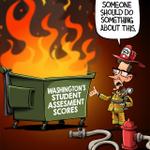
Adding insult to budget injury, this is all for 'mediocre' results as things like our infrastructure and education system fall apart around us.
We wonder what taxes they will raise this time..
@NatalieFahmy | @komonews
''Have to look at all options:' State lawmakers to navigate $4 billion budget deficit'
📚 Ferguson called our test scores “mediocre.” Now what?
Gov. Bob Ferguson called Washington students’ test scores “really mediocre” after state Superintendent Chris Reykdal announced he won’t seek reelection. He’s right to expect better. And kids who are falling behind today can’t wait until a new superintendent takes office in 2029.
Washington’s state K–12 operating budget more than doubled from 2013–15 to 2023–25. Over roughly the same period, our average eighth-grade math score fell from 287 to 274 on the national assessment.
Other states have shown what’s possible. In the “Mississippi Miracle,” Mississippi climbed from 49th to ninth in fourth-grade reading between 2013 and 2024. Today, Mississippi’s fourth graders outscore Washington’s in reading.
Ferguson has a decision he can make right now. By opting Washington into the Federal Scholarship Tax Credit program, he could open the door to scholarships that help eligible public and private school students pay for:
📚 Tutoring to catch up in reading or math.
💻 Computers and school supplies for learning at home and in class.
🧩 Specialized services for students with disabilities.
🎓 Tuition when another school is a better fit.
Six states with Democratic governors have already opted in or announced plans to participate. Ferguson can follow their lead without waiting for the Legislature to act.
Email Gov. Ferguson and urge him to opt Washington into the Federal Scholarship Tax Credit program:
future42.org/maps/washington…
Washington families deserve more ways to help their kids succeed, and Ferguson can give them one now.
Read our full article at: future42.org/ferguson-says-w…
-Future 42 Team
Sign up for more at Future42.org


On this week's The Spotlight with David Rose...
The suspect who is alleged to have murdered a Coast Guard pilot in cold blood posted $3,000,000 bail and is free while awaiting trial. Not a surprise, the family of the fallen servicemember is distraught over our state's pro criminal system.
And further into the The Spotlight...
David Rose takes a deeper look at the proposed bail changes that could be coming to our state. TL;DR they feel like 2021 all over again, and would weaken our already laughably weak misdemeanor laws.
@DavidRoseFOX13 | The Spotlight | @fox13seattle
'The Spotlight: Accused Coast Guard murderer released on bail'