

Lead Pastor at Rockharbor |Sr Fellow @barnagroup |Trained Theologian (DThM @durham_uni) |Author: What’s A Christian, Anyway? +8|Co-host:Resilient Pastor Podcast
Costa Mesa, CA
Joined April 2008
- Tweets44.8K
- Following835
- Followers18.1K
- Likes34.5K


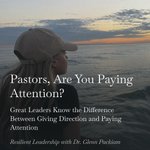


Preachers, we’ve got a chance to get some practical help— frameworks, practices, templates, and more.
Check this out:
tickettailor.com/events/resi…

2
515
Love that. Totally agree.

I also think attribution is important because it shows your congregation who’s pastoring YOU. Who you’re reading and gleaning wisdom and insight from. (They hear a lot of @flemingrut, Dietrich Bonhoeffer, NT Wright, and Howard Thurman from me!)
Unrelated to plagiarism— or maybe tangentially related to it— one of the things preachers miss is studying the text, but neglecting to study your congregation.
You can write a whole outline that “preaches well” but fails to connect. I think you need to take the first five minutes of the message to make a connection with their world and set up the tension they might have with their topic or text. Or how the text is going to speak to a “question they can’t shake, a longing they can’t name, or a fear they can’t face.” (That’s a template I’ve been using for years.)
The trouble with borrowing someone else’s outline or punchline is not just attribution; it’s relevance. To preach “prophetically”, you have to be able to speak from God to these people in this moment, not generically.
To help…
…a colleague and I are running a two-hour online preaching lab in January that will cover every phase of preaching: study, writing, delivery, and recovery.
Setting up the connection and tension is one part of the webinar.
Everyone who registers will receive a 60-page ebook/workbook with all these principles, practices, and templates.
More here: tickettailor.com/events/resi…
2
2
225
Let me say one quick thing about the plagiarism convo as it relates to preachers…
You can’t apply academic rigor to popular level communication like preaching. (Believe me: in an early stage of my doctoral work in the UK, a committee found that I had copied a paragraph from MY OWN earlier work and said it had violated plagiarism standards!)
That’s an extreme example. But here’s why preaching and plagiarism is a bit different: 🧵
1. The opposite of plagiarism is attribution. The goal is to credit the person whose words or ideas you’re using.
2. You should absolutely do that in preaching. Cite your quotations. Reference where you heard an idea, or how you learned an insight. (“Much of my thinking on this has been shaped by NT Wright…” I could say every week!)
3. But when it comes to using an illustration or a line or an idea from another preacher, here’s the complication: you know it’s not THEIR original idea either. Most preachers carry on similar phrases or lines of rhetoric that they’ve heard from others, but the person they heard it from did not develop it! That’s wayyyy different than not citing your sources.
4. One final complication is the way the Bible speaks. Some insights are just there in the text! You may have heard a pastor say it, but it’s right there in the Bible! Does it need to be said where you first heard that Adam sinned by taking and Jesus saved by giving? It’s right there in the text. And so on. Now, if you’re using a phrasing that someone else developed or made famous, you should cite it. (Say, “the prodigal God”, or “the cost of discipleship”.)
Sermons (and perhaps TikTokers/YouTubers) are popular levels of communication, and it’s murky who was the originator of an idea.
Attribute where you can and when you know this is someone’s original work (even if it is not a “unique contribution to the field”, à la PhD work). But “preacherisms” or “common sayings” or insights plain in the text need not be footnoted in the text.
I do love to say, “As we were discussing this with our preaching team, someone (or the name) pointed out that….” I like that because it’s a way of taking the attention off me and highlighting the reality that sermon writing involves a community, whether they’re in the room or not.


Glenn Packiam retweeted
COVER REVEAL!!!
Hope is coming.
THIS IS NOT THE END.
I’m going to share more about this project and how it came to be (along with a few paragraphs from the Intro!) EXCLUSIVELY in an email to my Substack subscribers (free!) on Friday.
Subscribe at glennpackiam.substack.com so you don’t miss it.

COVER REVEAL!!!
Hope is coming.
THIS IS NOT THE END.
I’m going to share more about this project and how it came to be (along with a few paragraphs from the Intro!) EXCLUSIVELY in an email to my Substack subscribers (free!) on Friday.
Subscribe at glennpackiam.substack.com so you don’t miss it.
I hear you.
Scripture first, then the historic witness of the church, then trusted local community, then the interior life. That to me is the priority of discernment.

Show me a mysticism that prioritizes Christ's body as the central locus of "seeking the kingdom first" and I will call it Christ-full - but the evangelical options for mysticism are far too often individualistic to the point of syncretism with western ideals.
2
4
1,480
A Christian would disagree with this. To call Christ “the Word” is to say that God is a speaking God, and that Christ is the fullest expression of what He has to say to the world.
The Bible, then, is the testimony of Jesus— it is, as the Bible Project puts it, “one unified story that leads to Jesus.” That is why the Bible can be called the Word of God. But the Bible is not Jesus.
Jesus is the Logos, the incarnate Word of God.

3
13
1,154
What a great little insight from David Ford:
By answering, “I am not” instead of “I am”, Peter sounds more like Pilate than like Jesus in John 18.

1
5
698

A lot of Christians get nervous about Christian “mysticism”— ie., the long history and practice of actually knowing God experientially beyond the cognitive.
I once questioned Greg Beale over this at a paper he presented at ETS arguing that Colossians rebukes Christians for their mysticism. I pressed him, countering that Paul was talking about pagan mysticism. He said there was syncretism. Fine, I said. Then call it “Christ-less mysticism”. He conceded.
Jesus said God is spirit and those who worship Him must do so in Spirit and in Truth. This is in John 4. Later in John’s gospel, Jesus promises the Spirit (John 14, 16) who would guide them in all truth. It was good for the disciples that Christ Himself would leave so that the Spirit could come. After the resurrection Jesus breathes the Spirit into them.
Why wouldn’t we who believe in Jesus and who are filled with Spirit be able to worship God in spirit and in truth? Why should this be disparagingly called “mysticism”? (I have no problem with the term if it’s meant descriptively not disparagingly.)
Could it be that American evangelical are so used to privileging only the cognitive and the cerebral, and therefore only the written word, that we do not allow ourselves to actually experience the Word breathed into us in Christ through the Holy Spirit?
People who criticize aspects of the spiritual formation movement for inviting Christians to actually know and experience God might say more about themselves than the movement.
Furthermore, what about the hundreds of millions of Christians around the world in the pentecostal-charismatic traditions who have their own version of this, apart fr the desert mystics, etc? You can’t blame Catholicism for that!
I just think it’s exceedingly narrow-minded.
People who criticize aspects of the spiritual formation movement for inviting Christians to actually know and experience God might say more about themselves than the movement.
Furthermore, what about the hundreds of millions of Christians around the world in the pentecostal-charismatic traditions who have their own version of this, apart fr the desert mystics, etc? You can’t blame Catholicism for that!
1
7
758
We don’t want New Age mysticism . We don’t want pagan mysticism. We don’t want gnostic mysticism, the emptying of the mind. What we want is to know God in spirit and in truth. If it sounds mystical, simply because it’s not cognitive, then so be it. We are a holistic being, not brains on sticks
5
13
668