

🔮Professionally Trained Futurist, Speaker, 6x Author 👥CHRO Group: FutureOfWorkLeaders 🎙️Podcast: FutureOfWorkPodcast 📩Newsletter: FutureOfWorkNewsletter
Los Angeles, CA
Joined August 2007
- Tweets93.9K
- Following1.2K
- Followers25.1K
- Likes387






Pinned Tweet
We tried to make work happier—and ended up making it hollow.
Cultures softened. Leaders hesitated. Performance drifted.
After 100+ CHRO interviews, I wrote The 8 Laws of Employee Experience—a blueprint to bring strength and humanity back to work. Learn more about it here: linkedin.com/pulse/my-new-bo…

2
4
2,240


Last week I launched a brand new website for my CHRO community Future Of Work Leaders
No agency. No dev team. No weeks of back-and-forth. Just me and AI (@Muse), live in about 24 hours. Here's what that actually looked like behind the scenes:
→ 51 AI agents working in parallel (spawned by Muse)
→ ~200 million tokens processed
→ 222 rounds of direction, feedback, and revision from me
→ IT WAS ALL FREE (within my free weekly allotment)
Muse took care of the full design, configuration of the webform for people who submit applications, Google analytics configuration, domain and DNS configuration, SEO optimization, thank you page design and implementation, and EVERYTHING else needed.
In the past this would have taken me around 2+ months of calls, meetings, back and forth approvals, testing, and adjustments.
I made the calls on design, on voice, on what mattered and what didn't. The AI did the production. I brought the taste, the judgment, and the standards. That, to me, is the real future of work.
It's not AI replacing people. It's one person with a clear vision suddenly having the output of an entire team, assuming they know how to lead it.
The leaders who win in this era won't be the ones who fear AI or the ones who blindly delegate to it. They'll be the ones who learn to direct it.
Take a look: futureofworkleaders.com
If you want to check out Muse, Redeem my code in Settings within 48 hours of joining and we'll both get 1 billion Muse tokens. (this is not a sponsored post, I'm just a huge fan!)
Code: BYM5LS muse.ai/join
#FutureOfWork #Leadership #AI #CHRO

3
4
294
A fake job interview helped hackers get inside Binance and eventually contributed to a $6.3 billion theft. What makes this story so unsettling is how normal the beginning looked. Someone reached out about a job. There were multiple interviews. Then came a coding assignment. Nothing about that immediately screams cyberattack, which is exactly why it worked.
We still tend to think of cybersecurity as something that lives inside IT. Networks, devices, permissions, systems. But the real perimeter is much wider now. It includes employees, recruiting, external conversations, and all of the everyday interactions people have outside the organization.
That changes the way leaders need to think about security, because even very smart employees can get fooled when the interaction feels legitimate.
In my latest article, I look at what this means for leaders, why traditional cybersecurity training is not enough anymore, and why HR and security teams need to work much more closely together.
Read the full article:
linkedin.com/pulse/next-cybe…

1
184
I’m happy to welcome Salvador Garcia Garcia, Chief Human Resources Officer at Sierra Nevada Brewing Co., to Future of Work Leaders.
Before joining Sierra Nevada, Sal spent 11 years at Levi Strauss & Co. and held HR leadership roles at Bacardi, Givaudan, and Unilever. I’m looking forward to hearing what he’s learned about which people practices travel well from one business to another and which only make sense once you know the people doing the work.
That’s what I enjoy about getting CHROs from different industries together. You can bring a decision you’re still wrestling with and hear how someone else handled it, including what they’d do differently next time. We now have more than 40 CHROs and CPOs in this private community, making time for those conversations as they figure out what the future of work means for their own companies.
Glad you’re here, Sal.
Learn more at FutureofWorkLeaders.com.

1
173
The best workplaces are not built for employees, they are built with them. Too many organizations still treat employee experience like something leadership designs and employees simply receive. The programs, policies, tools, and culture are created for people, but the people themselves often have very little say in shaping them.
The better approach is to treat employees as active participants in how work gets done. Give them a voice in how teams operate, where friction exists, what needs to improve, and what actually helps them do their best work. That does not mean every preference becomes policy, but it does mean people should feel like they have some ownership in the experience they are part of every day.
When employees see themselves as co-creators instead of consumers, the relationship with the organization changes. There is more ownership, more responsibility, and a stronger connection to the workplace they are helping to shape.
That is one of the ideas I explore in The 8 Laws of Employee Experience. Get the book at 8EXLAWS.COM.

Who’s doing more management work, the employee running ten AI agents or the one running three? In my article, I compare two employees. One runs ten agents that pull invoice data from emails and copy it into a finance system, following the same steps every time. The other directs three agents that investigate client questions, assess urgency, draft replies, and flag unusual cases. If you count agents, the first employee looks like they have the bigger role. Look at who sets the standards and answers for the client outcome, and you get a different picture.
That’s the idea behind the Agent Management Test. I look for two things together. The work has to change from case to case, requiring the agents to interpret information and choose how to proceed, and a person has to set the goal, define what good work looks like, and answer for the result when something goes wrong.
Think about who answers when something goes wrong. The person who owns an automated process is responsible for making sure it runs reliably, even though the agents follow the same rules every time. An analyst might direct agents through a complex investigation, while their boss still answers for the decision it informs. In the first case, the person owns the result of scripted work. In the second, the work calls for judgment and accountability sits with someone else. Agent management begins when the person directing that judgment-based work also answers for the outcome.
I expect this to become a real issue when employees start asking how their work should be reflected in their title, career path, and pay. A senior analyst with zero direct reports could already be designing and overseeing a consequential agent workflow. If the company looks only at headcount when it assesses management responsibility, that work can be easy to miss.
In the full piece, I share how to score the work once it passes both parts of the test, where it fits on the five-level Agent Leadership Ladder, and what that could change about how companies design roles and reward people.
Read the full article: greatleadership.substack.com…

5
2
187
For most of corporate history, the org chart made sense because work flowed in a fairly predictable way. Employees did the work, managers coordinated the people doing it, and leaders sat at the top making the biggest decisions. AI agents are starting to change that structure in a pretty meaningful way.
As more repetitive work moves to agents, I think the most interesting shift will happen in the middle of the organization. We’re going to see more people directing AI systems, coordinating complex workflows, exercising judgment, handling exceptions, and taking responsibility for important outcomes, even if they don’t have a single person reporting to them.
That creates a very different challenge for CHROs because our traditional systems for identifying leadership are still heavily tied to headcount. Titles, career paths, compensation, development, and status are often based on how many people someone manages. But what happens when someone is responsible for a significant amount of work, risk, and business impact through a combination of people and agents?
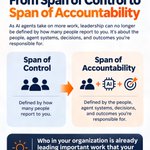
That’s why I believe we’re going to move from thinking about span of control to thinking about span of accountability. Instead of asking how many people report to someone, we’ll need to look at the people, agent systems, decisions, and outcomes they’re actually responsible for.The org chart probably isn’t going away, but it may need to represent something very different from what it does today, and I think a useful question for every CHRO is who inside your organization is already leading important work that your org chart doesn’t recognize?
I explore this much more deeply in my latest article, Your Best New Managers Have No Direct Reports, at FutureofWorkNewsletter.com

One thing I kept thinking about after my conversation with Khadija Ben Hammada is how much of leadership is really about consistency. It’s easy to talk about judgment, clarity, curiosity, or transformation when things are going well. The harder test is what happens when you don’t have the answer, the pressure is high, and people are looking to you for direction.
Khadija made a point that I think matters a lot. Leaders earn the right to say “I don’t know” by showing up consistently before that moment. If your people know you’re present, close to the work, and willing to help, uncertainty doesn’t automatically look like weakness. It can actually build trust.
We also got into something I think more companies need to take seriously. Leadership development can’t just be a classroom exercise. Khadija believes people become better leaders through practice, peer coaching, stretch experiences, different geographies, and being pushed outside their comfort zone. That’s a much harder way to develop leaders. It’s also probably a much better one.
Listen to the full conversation on Future Ready Leadership, available wherever you listen to your podcasts.
🤖 Made with AI

3
1
156
One of the things I wanted to create with Future of Work Leaders was a place where CHROs and CPOs could have the conversations they usually don’t get to have anywhere else. Most senior people leaders already have plenty of conferences, vendor events, and content coming at them. What’s harder to find is a trusted peer group where the conversation is candid, the people in the room are operating at the same level, and nobody is trying to sell you something, and that's what this community is built around.
We now have 40+ CHROs and CPOs learning from each other about the issues shaping the people profession, from AI and workforce transformation to leadership, employee experience, skills, culture, and what the organization of the future is going to require.The real value is having a room full of peers who understand the complexity of the job, can challenge your thinking, share what is actually working, and help you see beyond the walls of your own organization so you can make better decisions about what comes next.
Eric Hunn said it best when he described the group as “the place to be to stay on the leading edge of the people profession,” with the real value coming from the focus on the future of HR and the chance to learn directly from other CHROs. That is exactly the kind of community I set out to build.
If you are a CHRO or CPO and you want to be part of a serious, future-focused peer group, you can request to join at FutureofWorkLeaders.com

4
2
200
Employee engagement in the U.S. has fallen to its lowest level in 15 years, with just 29% of employees engaged. I don’t think the answer is another perk or program. A bigger issue is whether employees actually understand what is happening around them, what is expected of them, and what all of the change means for their role.
In this week’s briefing, I look at why clarity may be one of the most important drivers of engagement right now, along with Microsoft’s voluntary exit offer and the growing question of whether employees should be able to opt out of AI at work.
greatleadership.substack.com…
4
2
328
Every company should expect a wave of employees who believe they’re managers. It’s not that they are gaming the system, they’ll sincerely think the title fits, because everything around them suggests it does and that’s the problem. The belief will spread much faster than the work justifies it.
Why will this happen? I think as a result of four forces.
The work feels like management. Reviewing output, catching errors, deciding what’s good enough: these are things managers do, and AI users now do them all day. In Microsoft’s 2026 Work Trend Index, a May survey of 20,000 AI users, the top-rated human skills were quality control of AI output (50%) and critical thinking (46%), and 86% said they stay responsible for the thinking behind AI’s output. At Anthrpic, one in five employees already describes their job as managing agents. But checking an agent’s work isn’t the same as owning an outcome. Approving every output puts you closer to a user than a leader. It feels like management it still doesn’t pass the test.
The organization is telling them so. Agents have employee numbers, logins, profiles, named owners, and performance reviews. In many companies the agents have human names and leaders encourage employees to view agents as co-workers. So when the company treats agents like staff, the person whose name sits next to an agent will naturally see themselves as its boss, which makes sense and it’s why we shouldn’t anthropomorphize agents. Someone can own ten form-filling agents and still be an automation operator.
They have leverage that used to require a team. Anthropic reports code commits per engineer running at five times the pace of six months earlier, with lawyers, sales reps, and accounts payable teams also processing more work. The company generates two to four times the revenue per employee that Google and Meta did. Historically, leverage and management came together. If you produced a team’s worth of output, you had a team. Agents break that connection because output can now scale without judgment, coordination, or accountability scaling with it, and those three are what management consists of.
Traditional management is less appealing. Gallup reports the average US manager now has 12.1 direct reports, nearly 50% more than in 2013. Agent leadership looks like scope, impact, and ownership without the hardest parts of managing people. That makes it the most attractive “management” job at your company and with the cool title!
Each of these points employees toward the same conclusion: I’m a manager now. Without a shared definition, organizations will end up in one of two bad places. They’ll either reward agent counts and drift into agent inflation, or they’ll dismiss every claim and lose the people who really are leading agents. It’s going to be very important to have clarity here.
Read the full article:
greatleadership.substack.com…
The org chart we’ve used for decades is starting to describe less and less of how work actually gets done. Traditionally, the structure was pretty straightforward. A large base of employees did the work, managers coordinated people in the middle, and leaders made the big decisions at the top.
AI agents start changing that shape. BNY is already preparing for a workforce that looks less like a pyramid and more like a diamond. Repetitive processing at the bottom increasingly shifts to digital employees, while analytical, creative, and judgment-heavy work expands in the middle. Leadership still sits at the top making the biggest calls.
I think that widening middle is where some of the most important work of the next decade will happen. We’re going to have people who don’t manage large teams, and in some cases don’t manage any people at all, but they’ll be directing agents, coordinating complex workflows, exercising judgment, handling exceptions, and owning consequential outcomes.
That work may be invisible on a traditional org chart. It’s also why I think span of control will increasingly become span of accountability. Instead of asking how many people report to someone, leaders will need to look at the people, agent systems, decisions, and outcomes that person is actually responsible for.
This isn’t theoretical. In BCG’s 2026 AI at Work study, 47% of respondents said they already spend more time managing and directing AI than doing the work itself. Anthropic employees are writing instructions for agents, reviewing their output, and even creating performance reviews for their teams of Claudes.
I go much deeper into this, including my Agent Management Test, Agent Leadership Ladder, future scenarios, and what leaders should start deciding now, in my latest article. Your Best New Managers Have No Direct Reports.
Read the full article: greatleadership.substack.com…

1
201
We expect leaders to question assumptions, challenge recommendations, and take responsibility for decisions. I wonder how consistently we’re applying those expectations when the recommendation comes from AI.
Charter’s AI Pulse research found that executives are about twice as likely as individual contributors to trust AI over their own judgment. About one in five executives regularly or frequently use AI outputs they have doubts about. The report also found that executives fact-check more often than workers, which makes this worth a closer look. Checking whether an answer is factually correct still leaves plenty of room to question whether it’s the right recommendation for your organization.
An AI recommendation can miss the history behind a team’s resistance, a promise made to a customer, or the consequences of a decision for people who never entered the prompt. Leaders are responsible for bringing that context into the conversation, especially when an answer sounds convincing and everyone is under pressure to move quickly.
As organizations invest in AI training, there should be more attention paid to how executives evaluate its advice. Ask them to explain where they disagree, what information is missing, and why they’re comfortable acting on the recommendation. Their answers will tell you much more about their readiness than how many tools they use.
🤖 Made with AI

8
1
211
Waiting is the riskiest career move you can make. I talk to people who are waiting for their manager to tell them what to learn, which tools to try, or what their next role should be. Your employer should invest in your development. You also need to take an active role in deciding where you’re headed.
The employees who are preparing themselves for the future bring ideas forward, try things without being asked, and put what they learn into practice. They’re also willing to let go of approaches that have served them well when the work calls for something different. Adaptability, learning agility, and accountability are available to anyone, regardless of title or technical background.
With AI, we need to look further ahead. We’re spending a lot of time figuring out how to do today’s work faster, and I’d like to see more people asking what their role might look like in two years. Which responsibilities could disappear? Where will people need more of your judgment, experience, or ability to build relationships? Those questions should influence what you spend time learning today.
You don’t need to predict exactly what’s coming to start preparing. Bring an idea to your manager. Try a tool on a real problem. Take on something that stretches you. Give yourself a chance to discover what you’re capable of before a change forces the conversation.
168
When a company treats agents like staff, the person whose name sits next to an agent will naturally see themselves as its boss, which makes complete sense and it’s also why we shouldn’t anthropomorphize agents. Orgs who treat agents like people are in for a world of hurt.
1
364
The best ideas get better when you can pressure-test them with peers who are facing the same challenges. Alicia Zuiker, CPO at TransUnion, described the value of Future of Work Leaders as being able to test ideas alongside other CHROs, stay ahead of emerging trends, challenge her thinking, and lead with greater confidence.
Future of Work Leaders is a private, vendor-free community of 40+ CHROs and CPOs who come together to have candid conversations about AI, leadership, talent, employee experience, and the future of work.
If you’re a CHRO or CPO looking for a trusted peer group where you can learn, share, and think through what’s coming next, request an invite at FutureOfWorkLeaders.com.

2
1
147
Great managers know more than what someone does, they understand who that person is. It sounds simple, but a lot of management still happens at the surface level. We know someone’s title, responsibilities, performance goals, and maybe a few things from their last review, but it doesn’t tell us much about what actually motivates them, where they want to go, what they’re dealing with outside of work, or where their strengths really are. That’s where the PACT framework comes in.
P is for Personal. What matters to this person? What are their values and motivations?
A is for Aspirations. Where do they want to go? What are they trying to become or accomplish?
C is for Circumstances. What is shaping their life right now? What context are they bringing to work?
T is for Talents. What do they do especially well, and are we actually giving them opportunities to use those strengths?
You don’t need another survey or complicated system to start doing this. You need better conversations. The more you understand the person behind the role, the better you can lead them, develop them, and create an employee experience that actually fits who they are.
I explore the PACT framework and much more in The 8 Laws of Employee Experience. You can get a copy on Amazon at 8EXLAWS.COM.

1
155
If entry-level work starts disappearing, where do future leaders get the experience they need?
Anthropic’s workforce data shows junior hiring falling while more employees shift toward higher-level, AI-supervisory work.
The productivity gains are real, but so is the pipeline problem.
I explore what this means for hiring, development, and succession in my latest article, Where Do Future Leaders Come From?
linkedin.com/pulse/where-do-…

CHROs are CEOs of people. They must keep employees engaged while also showing value in doing so. These two things must always be connected together. From the research I conducted for my book, The 8 Laws of Employee Experience, I believe that many organizations are doing things because they look good, not because those things do good.
Leaders are trapped in tactical execution in terms of filling roles, addressing turnover, and more traditional aspects of HR; they have little room for bold moves or strategic foresight. It’s hard for leaders to think several years into the future when their time and attention is focused on the next quarter.
Although a few CHROs spoke about innovative programs, most are focused on keeping up, not getting ahead. Almost all of the CHROs told me that they are going to focus more on the future of work and employee experience in the coming years. They want to create better employee experiences. They want to shift from reactive firefighting to proactive, strategic leadership. The desire for change is there, but will the system allow it?
2
1
311
If AI saves your employees hours but customers still wait just as long, where did the value go?
Often, it’s stuck between teams. Someone finishes a task faster, then the work sits in an approval queue or waits for another department to pick it up. Everyone can report better productivity while the overall process barely improves.
Fixing that requires decisions about who owns the work, which steps can disappear, and how you’ll measure progress. It also requires an answer to a question that gets overlooked: what will you do with the capacity you free up?
Serving customers you previously couldn’t reach or testing ideas you couldn’t afford to explore gives those saved hours a purpose.
In my newsletter, I break down how to redesign work around AI, including these four common traps and a practical hiring example.
Read the full article at FutureOfWorkNewsletter.com.

3
1
211