

🔮Professionally Trained Futurist, Speaker, 6x Author 👥CHRO Group: FutureOfWorkLeaders 🎙️Podcast: FutureOfWorkPodcast 📩Newsletter: FutureOfWorkNewsletter
Los Angeles, CA
Joined August 2007
- Tweets93.9K
- Following1.2K
- Followers25.1K
- Likes388




Pinned Tweet
We tried to make work happier—and ended up making it hollow.
Cultures softened. Leaders hesitated. Performance drifted.
After 100+ CHRO interviews, I wrote The 8 Laws of Employee Experience—a blueprint to bring strength and humanity back to work. Learn more about it here: linkedin.com/pulse/my-new-bo…

2
4
2,282
Empathetic excellence built on competence, merit, and empathy thrives in workplaces where people deliver results, are rewarded for those results, and can connect as humans. But what about diversity When most of us think about diversity, we immediately envision physical attributes like sex, race, ethnicity, or age. These are important categories that shape experiences in our lives, but inside organizations, the only form of diversity that matters is that of thought, viewpoints, perspectives, and approaches to solving problems; in other words, cognitive diversity.
Debbie Pickle is the CHRO of Williams, a 117-year-old, 5,000-person energy infrastructure company with a $70 billion market cap. Here’s what she told me about this:
Diversity of thought propels us forward because it’s where we get solutions and new ideas. When interviewing candidates, we assess this by asking candidates to share stories of unique ways they have solved or approached problems. On my team, for example, we were having specific challenges in creating and rolling out a new leadership development program. Although our team was diverse, several of them shared similar academic backgrounds, which led to similar ways of thinking. To gain a different perspective, we decided to hire someone from operations, outside of HR. Initially, this wasn’t well received by everyone. However, this new team member approached the problem in a new way and with fresh ideas. They asked us questions we hadn’t considered. Their unique perspective helped us rethink our approach, making it much more successful. The value of these diverse perspectives and thought processes played a critical role in the success of this initiative.
Cognitive diversity means bringing together teams of people who see the world differently, who approach problems in varied ways, and who have different intellectual backgrounds. This form of diversity isn’t always visible; rather it emerges through discussion, debate, and observation.
I explore cognitive diversity, empathetic excellence, and the other principles leaders need to build a future-ready organization in The 8 Laws of Employee Experience.
Get the book at 8EXLAWS.COM.

91
One of the most interesting ideas from my conversation with Heather Krueger, Chief People Officer at Engine, was that AI may not just change how work gets done. It may change how we define performance, management, and even merit inside organizations. At Engine, employees are already working with agents that help prioritize work, surface feedback, coordinate projects, and automate parts of the day. Heather’s view is that this can make performance more objective by bringing more data into the conversation and giving visibility to work that often gets missed.
Most companies still rely heavily on what managers see, remember, and hear. The people who communicate their wins best can sometimes look more valuable than the people quietly creating the most impact. AI could change that.
But Heather was equally clear that this doesn’t remove the need for human leadership. Communication, judgment, trust, influence, and context become even more important when technology can handle more of the task work.
The future of work may be far more data-driven, but the best leaders will still need to understand people. Listen to the full conversation with Heather Krueger on Future Ready Leadership Podcast, available wherever you listen to your podcasts.

I think one of the best ways to judge leadership is to look at what happens when the leader is no longer there. A lot of leaders like being the person everyone depends on. They know the history, they have the relationships, they understand how everything works, and people come to them when something needs to get done. It can feel like proof that you’re valuable, but when too much depends on one person, the organization becomes vulnerable.
This is where succession planning becomes much more practical than simply identifying who might take over someone’s role. Leaders should be thinking about whether knowledge is being shared, whether other people are being developed, whether important relationships are spread across the team, and whether the work can continue without one person holding all of the context.
I also think we sometimes celebrate the wrong kind of leadership. The leader who is involved in everything and needed for every major decision may look indispensable, but the stronger leader is often the one who has built a team that can operate, make decisions, and keep moving without them.
There’s a concept called the “bus factor,” which asks how many people would have to suddenly disappear before a project or organization could no longer function. If the answer is one, you probably have more concentration risk than you realize. So here’s a simple question for leaders to think about.
If you left tomorrow, what would break? I break this down in this episode of Future Ready Today Podcast:
youtube.com/watch?v=Mm3g4zFh…
142
One of the quickest ways to lose your best people is to ask them to keep picking up the slack and then give everyone the same performance review. It’s easy to see why a manager might put off a difficult conversation. Maybe someone is going through a rough patch, or the manager never made the expectations clear in the first place. But when that conversation keeps getting pushed back, the work still has to get done. Usually, it lands on the people who have already shown they’ll deliver.
I call the alternative Empathetic Excellence. If someone is struggling, find out what’s getting in their way. Give them honest feedback and the support to improve. Then follow up on what you both agreed to. And when someone consistently does exceptional work, make sure that contribution counts when you decide who gets rewarded or promoted.
That’s what accountability looks like on both sides. Employees own their work, and leaders own how clearly, fairly, and consistently they evaluate it.

4
1
189
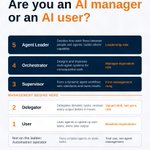
If someone on your team said, “I’m managing AI agents now,” what would you ask before changing their job title or pay? I’d start with what the agents actually do and who answers for the result. Take someone who runs ten agents that pull invoice data from emails and enter it into a finance system. That’s useful automation, and the work follows the same steps each time. Now picture a customer support lead who directs three agents that assess the urgency of incoming requests, investigate what happened, and flag unusual cases. If that lead sets the standards and answers for how those cases are handled, I’d call that management.
That’s where I draw the line on the Agent Leadership Ladder. The first two levels cover using agents for your own work and delegating tasks while reviewing each output. Management begins at Level 3, when you direct agents through work that changes from case to case and take responsibility for the outcome. The next two levels extend that responsibility to designing systems for consequential work and deciding how people and agents share work across a function.
For CHROs, here’s where it gets interesting. A senior analyst with zero direct reports could already be doing Level 4 work. Would your job architecture pick up on that? And if it did, what would change about the scope of the role, the career path, or the pay?
I break down all five levels and share a test you can use with your team in Your Best New Managers Have No Direct Reports. Read the full piece and subscribe to my newsletter at greatleadership.substack.com…

4
1
194
Valuing employees goes far beyond compensation. Pay matters, but people also pay attention to how they feel at work, whether their time and talent are being put to good use, whether they feel connected to the people and mission around them, and how the organization treats them when things get difficult. In The 8 Laws of Employee Experience, I break this down into four distinct dimensions of value:
Emotional value is about being acknowledged, respected, and connected to the workplace and the work you are doing. It includes psychological safety, recognition and appreciation, and empathy and support, without lowering expectations or removing accountability.
Professional value is about giving people work they can be proud of, treating them with fairness and clarity, and holding a high bar for performance and contribution. People want to know that their skills are being used, that their work matters, and that they understand what great performance actually looks like.
Social value comes from the connection employees feel to their team, their leaders, and the larger mission of the organization. When that connection is strong, teams move faster, trust each other more, and are more willing to share information, collaborate, and challenge each other in productive ways.
Moral value shows up most clearly when things get hard. It is about fairness, integrity, dignity, and whether leaders will do the right thing even when it is not the easy thing, because employees are always watching how the organization handles layoffs, underperformance, restructures, mistakes, and difficult personal moments.
When all four dimensions are present, employees don’t just perform better; they actually feel better. Value does not live in a policy document or an engagement dashboard, it shows up in the actual rhythm of work. I explore these four dimensions in The 8 Laws of Employee Experience and how leaders can design work so people can truly thrive and deliver.
Get the book at 8EXLAWS.COM.

A lot of companies talk about skills, career paths, and workforce planning, but many still don’t have a very clear picture of what actually sits inside a job.
Patricia Frost explained it in a really practical way. Start with the tasks someone performs, identify the skills required to do those tasks, then define the level of proficiency expected for the role. Once you break a job down that way, you can start to see where someone is strong, where they have gaps, what they need to learn next, and what moving to the next level actually requires.
I think this becomes much more important as AI changes the nature of work because you can’t redesign jobs intelligently if you don’t understand what people are actually doing today. A job title by itself doesn’t tell you very much. The useful information is underneath it in the tasks, skills, capabilities, and levels of proficiency that make the role work.
Good job architecture creates more transparency for employees and gives leaders a much better foundation for decisions around development, mobility, compensation, and AI.
Before you start asking which jobs AI will change, it may be worth asking a more basic question.
Do you actually understand what’s inside those jobs?
1
144
More employees are gonna say, “I manage AI agents, so I’m a manager now.” Some of them will be right. A lot of them won’t. Before I even score the work, I use two gates. First, the work has to be dynamic, meaning the agent is interpreting, reasoning, choosing between options, and handling situations that aren’t fully scripted. Second, a human has to own the outcome, including the quality bar, the consequences, and what happens when the work goes wrong. If either gate fails, it’s not agent management, no matter how many agents someone runs. If the work passes both gates, then I look at four things, judgment, consequence, coordination, and development. That’s where the levels start to matter:
A Supervisor owns contained agent work and is responsible for the result.
An Orchestrator is managing a more complex system with real stakes, multiple agents, handoffs, and moving parts.
An Agent Leader goes one step further by shaping how other people use agents, setting standards, redesigning workflows, and influencing how agent work operates across a broader part of the organization.
This is why agent leadership and people leadership need to be treated as two different dimensions. Someone with zero direct reports could be an Orchestrator or Agent Leader, while someone managing a large human team might still only be a basic AI user. For CHROs, this is where titles, career paths, compensation, development, and org design are going to get complicated very quickly.I break down the full Agent Management Test, five-level Agent Leadership Ladder, future scenarios, and what leaders should decide now in my article Your Best New Managers Have No Direct Reports
Read the full piece at greatleadership.substack.com…

3
3
173
When a CHRO is weighing a decision that will affect hundreds or thousands of employees, it helps to talk to someone who’s had to make a similar call. Say you’re considering how to introduce AI into a team’s work. A peer who’s already done it can tell you where employees saw real value, what managers struggled to explain, and what they’d change before rolling it out to another team. You can learn a lot from the parts that never make it into the case study.
Erin Gattis, CHRO at ArcBest, describes Future of Work Leaders as a place to think seriously about where work is heading with people who carry the same responsibility. Our private community brings together 40+ CHROs and CPOs from different industries, so members can bring a decision they’re still working through and hear how it looks to someone facing different pressures. Sometimes the most helpful thing a peer can offer is a question you still have time to answer before you make the call.
Thank you for sharing your experience with the group, Erin. Request to join at FutureofWorkLeaders.com.

1
146


Last week I launched a brand new website for my CHRO community Future Of Work Leaders
No agency. No dev team. No weeks of back-and-forth. Just me and AI (@Muse), live in about 24 hours. Here's what that actually looked like behind the scenes:
→ 51 AI agents working in parallel (spawned by Muse)
→ ~200 million tokens processed
→ 222 rounds of direction, feedback, and revision from me
→ IT WAS ALL FREE (within my free weekly allotment)
Muse took care of the full design, configuration of the webform for people who submit applications, Google analytics configuration, domain and DNS configuration, SEO optimization, thank you page design and implementation, and EVERYTHING else needed.
In the past this would have taken me around 2+ months of calls, meetings, back and forth approvals, testing, and adjustments.
I made the calls on design, on voice, on what mattered and what didn't. The AI did the production. I brought the taste, the judgment, and the standards. That, to me, is the real future of work.
It's not AI replacing people. It's one person with a clear vision suddenly having the output of an entire team, assuming they know how to lead it.
The leaders who win in this era won't be the ones who fear AI or the ones who blindly delegate to it. They'll be the ones who learn to direct it.
Take a look: futureofworkleaders.com
If you want to check out Muse, Redeem my code in Settings within 48 hours of joining and we'll both get 1 billion Muse tokens. (this is not a sponsored post, I'm just a huge fan!)
Code: BYM5LS muse.ai/join
#FutureOfWork #Leadership #AI #CHRO

3
5
355
A fake job interview helped hackers get inside Binance and eventually contributed to a $6.3 billion theft. What makes this story so unsettling is how normal the beginning looked. Someone reached out about a job. There were multiple interviews. Then came a coding assignment. Nothing about that immediately screams cyberattack, which is exactly why it worked.
We still tend to think of cybersecurity as something that lives inside IT. Networks, devices, permissions, systems. But the real perimeter is much wider now. It includes employees, recruiting, external conversations, and all of the everyday interactions people have outside the organization.
That changes the way leaders need to think about security, because even very smart employees can get fooled when the interaction feels legitimate.
In my latest article, I look at what this means for leaders, why traditional cybersecurity training is not enough anymore, and why HR and security teams need to work much more closely together.
Read the full article:
linkedin.com/pulse/next-cybe…

1
203
I’m happy to welcome Salvador Garcia Garcia, Chief Human Resources Officer at Sierra Nevada Brewing Co., to Future of Work Leaders.
Before joining Sierra Nevada, Sal spent 11 years at Levi Strauss & Co. and held HR leadership roles at Bacardi, Givaudan, and Unilever. I’m looking forward to hearing what he’s learned about which people practices travel well from one business to another and which only make sense once you know the people doing the work.
That’s what I enjoy about getting CHROs from different industries together. You can bring a decision you’re still wrestling with and hear how someone else handled it, including what they’d do differently next time. We now have more than 40 CHROs and CPOs in this private community, making time for those conversations as they figure out what the future of work means for their own companies.
Glad you’re here, Sal.
Learn more at FutureofWorkLeaders.com.

1
188
The best workplaces are not built for employees, they are built with them. Too many organizations still treat employee experience like something leadership designs and employees simply receive. The programs, policies, tools, and culture are created for people, but the people themselves often have very little say in shaping them.
The better approach is to treat employees as active participants in how work gets done. Give them a voice in how teams operate, where friction exists, what needs to improve, and what actually helps them do their best work. That does not mean every preference becomes policy, but it does mean people should feel like they have some ownership in the experience they are part of every day.
When employees see themselves as co-creators instead of consumers, the relationship with the organization changes. There is more ownership, more responsibility, and a stronger connection to the workplace they are helping to shape.
That is one of the ideas I explore in The 8 Laws of Employee Experience. Get the book at 8EXLAWS.COM.

Who’s doing more management work, the employee running ten AI agents or the one running three? In my article, I compare two employees. One runs ten agents that pull invoice data from emails and copy it into a finance system, following the same steps every time. The other directs three agents that investigate client questions, assess urgency, draft replies, and flag unusual cases. If you count agents, the first employee looks like they have the bigger role. Look at who sets the standards and answers for the client outcome, and you get a different picture.
That’s the idea behind the Agent Management Test. I look for two things together. The work has to change from case to case, requiring the agents to interpret information and choose how to proceed, and a person has to set the goal, define what good work looks like, and answer for the result when something goes wrong.
Think about who answers when something goes wrong. The person who owns an automated process is responsible for making sure it runs reliably, even though the agents follow the same rules every time. An analyst might direct agents through a complex investigation, while their boss still answers for the decision it informs. In the first case, the person owns the result of scripted work. In the second, the work calls for judgment and accountability sits with someone else. Agent management begins when the person directing that judgment-based work also answers for the outcome.
I expect this to become a real issue when employees start asking how their work should be reflected in their title, career path, and pay. A senior analyst with zero direct reports could already be designing and overseeing a consequential agent workflow. If the company looks only at headcount when it assesses management responsibility, that work can be easy to miss.
In the full piece, I share how to score the work once it passes both parts of the test, where it fits on the five-level Agent Leadership Ladder, and what that could change about how companies design roles and reward people.
Read the full article: greatleadership.substack.com…

5
2
191
For most of corporate history, the org chart made sense because work flowed in a fairly predictable way. Employees did the work, managers coordinated the people doing it, and leaders sat at the top making the biggest decisions. AI agents are starting to change that structure in a pretty meaningful way.
As more repetitive work moves to agents, I think the most interesting shift will happen in the middle of the organization. We’re going to see more people directing AI systems, coordinating complex workflows, exercising judgment, handling exceptions, and taking responsibility for important outcomes, even if they don’t have a single person reporting to them.
That creates a very different challenge for CHROs because our traditional systems for identifying leadership are still heavily tied to headcount. Titles, career paths, compensation, development, and status are often based on how many people someone manages. But what happens when someone is responsible for a significant amount of work, risk, and business impact through a combination of people and agents?
That’s why I believe we’re going to move from thinking about span of control to thinking about span of accountability. Instead of asking how many people report to someone, we’ll need to look at the people, agent systems, decisions, and outcomes they’re actually responsible for.The org chart probably isn’t going away, but it may need to represent something very different from what it does today, and I think a useful question for every CHRO is who inside your organization is already leading important work that your org chart doesn’t recognize?
I explore this much more deeply in my latest article, Your Best New Managers Have No Direct Reports, at FutureofWorkNewsletter.com

One thing I kept thinking about after my conversation with Khadija Ben Hammada is how much of leadership is really about consistency. It’s easy to talk about judgment, clarity, curiosity, or transformation when things are going well. The harder test is what happens when you don’t have the answer, the pressure is high, and people are looking to you for direction.
Khadija made a point that I think matters a lot. Leaders earn the right to say “I don’t know” by showing up consistently before that moment. If your people know you’re present, close to the work, and willing to help, uncertainty doesn’t automatically look like weakness. It can actually build trust.
We also got into something I think more companies need to take seriously. Leadership development can’t just be a classroom exercise. Khadija believes people become better leaders through practice, peer coaching, stretch experiences, different geographies, and being pushed outside their comfort zone. That’s a much harder way to develop leaders. It’s also probably a much better one.
Listen to the full conversation on Future Ready Leadership, available wherever you listen to your podcasts.
🤖 Made with AI

3
1
159
One of the things I wanted to create with Future of Work Leaders was a place where CHROs and CPOs could have the conversations they usually don’t get to have anywhere else. Most senior people leaders already have plenty of conferences, vendor events, and content coming at them. What’s harder to find is a trusted peer group where the conversation is candid, the people in the room are operating at the same level, and nobody is trying to sell you something, and that's what this community is built around.
We now have 40+ CHROs and CPOs learning from each other about the issues shaping the people profession, from AI and workforce transformation to leadership, employee experience, skills, culture, and what the organization of the future is going to require.The real value is having a room full of peers who understand the complexity of the job, can challenge your thinking, share what is actually working, and help you see beyond the walls of your own organization so you can make better decisions about what comes next.
Eric Hunn said it best when he described the group as “the place to be to stay on the leading edge of the people profession,” with the real value coming from the focus on the future of HR and the chance to learn directly from other CHROs. That is exactly the kind of community I set out to build.
If you are a CHRO or CPO and you want to be part of a serious, future-focused peer group, you can request to join at FutureofWorkLeaders.com

4
2
203
Employee engagement in the U.S. has fallen to its lowest level in 15 years, with just 29% of employees engaged. I don’t think the answer is another perk or program. A bigger issue is whether employees actually understand what is happening around them, what is expected of them, and what all of the change means for their role.
In this week’s briefing, I look at why clarity may be one of the most important drivers of engagement right now, along with Microsoft’s voluntary exit offer and the growing question of whether employees should be able to opt out of AI at work.
greatleadership.substack.com…
4
2
328
Every company should expect a wave of employees who believe they’re managers. It’s not that they are gaming the system, they’ll sincerely think the title fits, because everything around them suggests it does and that’s the problem. The belief will spread much faster than the work justifies it.
Why will this happen? I think as a result of four forces.
The work feels like management. Reviewing output, catching errors, deciding what’s good enough: these are things managers do, and AI users now do them all day. In Microsoft’s 2026 Work Trend Index, a May survey of 20,000 AI users, the top-rated human skills were quality control of AI output (50%) and critical thinking (46%), and 86% said they stay responsible for the thinking behind AI’s output. At Anthrpic, one in five employees already describes their job as managing agents. But checking an agent’s work isn’t the same as owning an outcome. Approving every output puts you closer to a user than a leader. It feels like management it still doesn’t pass the test.
The organization is telling them so. Agents have employee numbers, logins, profiles, named owners, and performance reviews. In many companies the agents have human names and leaders encourage employees to view agents as co-workers. So when the company treats agents like staff, the person whose name sits next to an agent will naturally see themselves as its boss, which makes sense and it’s why we shouldn’t anthropomorphize agents. Someone can own ten form-filling agents and still be an automation operator.
They have leverage that used to require a team. Anthropic reports code commits per engineer running at five times the pace of six months earlier, with lawyers, sales reps, and accounts payable teams also processing more work. The company generates two to four times the revenue per employee that Google and Meta did. Historically, leverage and management came together. If you produced a team’s worth of output, you had a team. Agents break that connection because output can now scale without judgment, coordination, or accountability scaling with it, and those three are what management consists of.
Traditional management is less appealing. Gallup reports the average US manager now has 12.1 direct reports, nearly 50% more than in 2013. Agent leadership looks like scope, impact, and ownership without the hardest parts of managing people. That makes it the most attractive “management” job at your company and with the cool title!
Each of these points employees toward the same conclusion: I’m a manager now. Without a shared definition, organizations will end up in one of two bad places. They’ll either reward agent counts and drift into agent inflation, or they’ll dismiss every claim and lose the people who really are leading agents. It’s going to be very important to have clarity here.
Read the full article:
greatleadership.substack.com…