

Mental game coach in golf, poker, trading, business. Clients in 45 countries. Author of 3 bestselling books in poker, trading + Everyday Golf Psychology
Philly Burbs
Joined July 2009
- Tweets14.1K
- Following419
- Followers29.7K
- Likes9.1K




Pinned Tweet
Everyday Golf Psychology is out and I couldn't be happier with how it turned out. Truly a fresh take on golf psychology that can make an immediate difference.
It's already garnering some great reviews from top 100 instructors and others. Pick up a copy on Amazon: amzn.to/41MMgOr

Jared Tendler retweeted
Happy to hear your a fan of my work! Given your interest in intuition, have you picked up my free ebook on the topic?
jaredtendler.com/intuition-e…

Jared Tendler retweeted

There’s a warning sign in the future of day trading, and it starts with the mindset of today’s traders.
Somewhere along the way, the conversation shifted from building careers to chasing payouts. We rarely talk about what it takes to grind through the difficult years, develop real skills, and make a living in the markets.
I was a blue collar trader with no money or college education. I spent 23 years as a CME member, never the richest or the best, but I built a career and developed a skill nobody can take away from me.
Today, traders have opportunities I never had. I believe prop firms may be the greatest stepping stone aspiring traders have ever had. But only if they’re used correctly.
If the goal is simply to pass evaluations, collect payouts, and repeat the cycle, we’re missing the bigger opportunity.
Prop should be a stepping stone to independence, not a permanent destination.
We need to shift the mindset from chasing payouts to building sustainable careers. Otherwise, we risk creating a generation of traders who learn how to get funded but never learn how to survive on their own.
The greatest thing trading gave me wasn’t money. It was a skill, discipline, and confidence that will last a lifetime.
That’s what the next generation of traders should be building toward.
Jared Tendler retweeted
Still struggling to control your emotions? You're not alone...
Five years ago, along with several industry partners, I surveyed traders from around the world and uncovered a massive 57 point gap between the traders who could see the cost emotions had on performance (91%) vs. those with a concrete strategy to manage, control, or correct their reactions (only 34%).
I decided to run it back and see if anything has changed.
While 45% now report having a concrete strategy, I thought that number would be a lot higher.
Far too many traders still lack the ability to control their emotions. Many have a wish that mental game improvement should happen easily.
You can’t get bigger muscles from reading a book on physical fitness, nor will reading my book, or any trading psychology book, give you a stronger mentality.
The Mental Game of Trading has been out for over 5 years and I often get comments about how much they enjoyed reading it. While I’m thrilled, I also wonder if they've implemented the material and developed a strategy, or if they hoped reading the book was enough.
For those still struggling to control, manage, and correct their emotions, here are the most common reasons traders listed for why they're struggling, along with some advice, links and next steps.
“It’s hard to grasp that losing days WILL happen. It’s unlike any other profession in that sense.”
Trading is unlike anything else – the variance involved, the speed with which conditions change, the lack of a clear roadmap for success, the nature of losing – all make trading a truly unique competitive endeavor, even compared to poker. But if attempts to force-feed yourself these facts don’t work, then you need to understand why you’re resisting reality.
Your entrenched perspective, such as a hatred of losing or a desire for control, can block any attempts for trading realities to fully integrate in your mind. Like throwing a piece of paper into a fan, only to have it blown back in your face.
Overreacting to losing highlights the gap between reality and what you believe. Luckily, bridging that gap isn’t rocket science. You just need deeper problem solving. This video from an old episode of Office Hours can help: youtube.com/watch?v=A6eCImWH…
“Emotions arrive unannounced.”
If emotions arrive unannounced, one of two things is true. First, you lack the recognition for the subtle rise in emotion. They appear to come out of nowhere, but you just don’t see the steady buildup. Second, if intense emotions actually arrive instantly, it’s an indication of a longer term buildup of accumulated emotion that instantly floods your mind.
In the first case, you should work on mapping your emotions jaredtendler.com/controlling… so you can see the incremental rise and take action before they are too intense. In the second case, you need to work through the old emotion by doing the deeper problem solving I mentioned in the previous section. youtube.com/watch?v=A6eCImWH… While you build more mental skill or work through your old emotions, consider sizing down to something small enough to not elicit such intense reactions.
“Fear from many past failures over many years I can’t seem to get past. Past negative experience in trading and elsewhere.”
Painful memories in trading and elsewhere can leave a mark, kind of like a bruise on your shoulder that won’t heal. We can call this scar tissue or trading trauma, and it’s not unlike physical scar tissue in your body. The body has a way to protect us from further injury and in the same way, the brain helps you cope with painful experiences through denial, excuse-making, and other proactive measures. These strategies can be useful in the short term, but when relied upon too long they interfere with the brain’s ability to fully process the memory.
You’re protecting against those failures, or pain points, from happening again, more than you’re leveraging past experience for insights that make you stronger. In this video I show you a simple way to work through the scar tissue and begin to regain full mental function: youtube.com/watch?v=2H8_ipmJ…
“Hard to maintain energy with a job and family responsibilities.”
Hard does not mean impossible, but sometimes being aware of the difficulty creates more resistance, which does make it harder. Plus, you make it even harder if you came into trading with hopes that it would be easy to make money and haven’t recalibrated your mind to the challenge. Take a step back and re-assess what it’ll take to be successful given your work and family responsibilities. Create a plan that seems do-able, even if it’s still hard. Remember, Anything this valuable is unlikely to come easily.
When you burn both sides of the candle, burnout can also become a hidden factor that makes it harder to sustain a performance standard. Check out this blog on how to deal with burnout: jaredtendler.com/burnout-bas…
“Haven’t gone deep enough.”
I’m happy you’ve recognized that a surface-level understanding isn’t enough to solve complex problems. Here’s a blog that will help you go deeper: jaredtendler.com/find-the-ro…
“I don’t stick to one thing long enough to master it or have the data to support a valid conclusion on whether the strategy/plan is viable, or whether I’m not executing it well enough.”
You should be able to see mental game progress within two weeks. If you’re not, something in your strategy or plan is not working. Most often it’s because you haven’t gone deep enough, as referenced above. But another common issue is not taking the time to properly train your Injecting Logic Statements to become potent enough to impact your emotions in real time: jaredtendler.com/be-your-own…
On the other hand, if you saw progress immediately, but it disappeared, you found a placebo, not a real correction. Real corrections produce steady improvements. Placebos are ideas that sound nice in theory but become ineffective once the novelty wears off.
“I haven’t yet simplified a mental game strategy into concrete steps.”
Appreciate the honesty. Here’s a quick guide to the overall strategy that I lay out in The Mental Game of Trading so you can make the most of the book and build your strategy step-by-step: teapawt.org/jaredtendler/status/14…
“I stopped consistently working on my mental game, that’s the only reason.”
It’s easy to make progress and then have that progress slip away. Knowing when you’ve truly mastered or resolved something is hard. You’ll know when you can stop once progress is easy and automatic, even under the most trying or difficult circumstances. For some of you that might mean working consistently for 6 to 18 months. Consistently doesn’t mean spending hours and hours a day. It just means that it has to stay on your radar long enough to prove that you can retain that progress without focusing on it. Until then, keep working the muscles of your mind. Check out this blog to understand the stages of learning you must progress through: jaredtendler.com/learning-mo…
“I’m looking for shortcuts.”
Realistically you know you can’t expect to make money every day, or be a success overnight, but somewhere deep down there is a wish that you can get where you want to be without the necessary work. Explore this blog on wishing and hoping for how to tackle this one: jaredtendler.com/the-dangero…
“My problem is that I can’t commit to a set plan to manage my emotions, especially when there’s a period without identifiable progress.”
Just like the trader looking for shortcuts above, I think there’s a deeper part of you that wishes that the changes would come easily and more quickly. And, ironically, by continually jumping around you’re preventing yourself from truly making progress. Follow my system and if you’re not seeing progress after two weeks, it’s not a reason to abandon ship. It’s an indicator to go deeper: teapawt.org/jaredtendler/status/14…
“Overwhelmed by how much is wrong and by all the educational input.”
Being overwhelmed is far better than being ignorant or naive to what’s plaguing you. List out everything you’ve got to deal with and if you find a confidence issue, start there. Confidence is the foundation to your mental game. If it’s weak, then every other mental game problem becomes magnified. Strengthening your confidence to become more stable and consistent doesn’t guarantee immediate improvements elsewhere, but it does give you a fighting chance: jaredtendler.com/when-confid…
*****
There’s no reason not to have a robust mental game strategy that helps you manage and correct your emotions in real time.
The answers are out there. Consistently put in the work and you can steadily improve. I’ll continue to be here helping wherever I can.


Jared Tendler retweeted

A system for solving greed, fear, anger and confidence problems in trading: "The Mental Game of Trading" by @jaredtendler tops BookAuthority's list of the best mental skills books of all time. bookauthority.org/books/best…

Jared Tendler retweeted

Thanks @jaredtendler So much good stuff here.
Still struggling to control your emotions? You're not alone...
Five years ago, along with several industry partners, I surveyed traders from around the world and uncovered a massive 57 point gap between the traders who could see the cost emotions had on performance (91%) vs. those with a concrete strategy to manage, control, or correct their reactions (only 34%).
I decided to run it back and see if anything has changed.
While 45% now report having a concrete strategy, I thought that number would be a lot higher.
Far too many traders still lack the ability to control their emotions. Many have a wish that mental game improvement should happen easily.
You can’t get bigger muscles from reading a book on physical fitness, nor will reading my book, or any trading psychology book, give you a stronger mentality.
The Mental Game of Trading has been out for over 5 years and I often get comments about how much they enjoyed reading it. While I’m thrilled, I also wonder if they've implemented the material and developed a strategy, or if they hoped reading the book was enough.
For those still struggling to control, manage, and correct their emotions, here are the most common reasons traders listed for why they're struggling, along with some advice, links and next steps.
“It’s hard to grasp that losing days WILL happen. It’s unlike any other profession in that sense.”
Trading is unlike anything else – the variance involved, the speed with which conditions change, the lack of a clear roadmap for success, the nature of losing – all make trading a truly unique competitive endeavor, even compared to poker. But if attempts to force-feed yourself these facts don’t work, then you need to understand why you’re resisting reality.
Your entrenched perspective, such as a hatred of losing or a desire for control, can block any attempts for trading realities to fully integrate in your mind. Like throwing a piece of paper into a fan, only to have it blown back in your face.
Overreacting to losing highlights the gap between reality and what you believe. Luckily, bridging that gap isn’t rocket science. You just need deeper problem solving. This video from an old episode of Office Hours can help: youtube.com/watch?v=A6eCImWH…
“Emotions arrive unannounced.”
If emotions arrive unannounced, one of two things is true. First, you lack the recognition for the subtle rise in emotion. They appear to come out of nowhere, but you just don’t see the steady buildup. Second, if intense emotions actually arrive instantly, it’s an indication of a longer term buildup of accumulated emotion that instantly floods your mind.
In the first case, you should work on mapping your emotions jaredtendler.com/controlling… so you can see the incremental rise and take action before they are too intense. In the second case, you need to work through the old emotion by doing the deeper problem solving I mentioned in the previous section. youtube.com/watch?v=A6eCImWH… While you build more mental skill or work through your old emotions, consider sizing down to something small enough to not elicit such intense reactions.
“Fear from many past failures over many years I can’t seem to get past. Past negative experience in trading and elsewhere.”
Painful memories in trading and elsewhere can leave a mark, kind of like a bruise on your shoulder that won’t heal. We can call this scar tissue or trading trauma, and it’s not unlike physical scar tissue in your body. The body has a way to protect us from further injury and in the same way, the brain helps you cope with painful experiences through denial, excuse-making, and other proactive measures. These strategies can be useful in the short term, but when relied upon too long they interfere with the brain’s ability to fully process the memory.
You’re protecting against those failures, or pain points, from happening again, more than you’re leveraging past experience for insights that make you stronger. In this video I show you a simple way to work through the scar tissue and begin to regain full mental function: youtube.com/watch?v=2H8_ipmJ…
“Hard to maintain energy with a job and family responsibilities.”
Hard does not mean impossible, but sometimes being aware of the difficulty creates more resistance, which does make it harder. Plus, you make it even harder if you came into trading with hopes that it would be easy to make money and haven’t recalibrated your mind to the challenge. Take a step back and re-assess what it’ll take to be successful given your work and family responsibilities. Create a plan that seems do-able, even if it’s still hard. Remember, Anything this valuable is unlikely to come easily.
When you burn both sides of the candle, burnout can also become a hidden factor that makes it harder to sustain a performance standard. Check out this blog on how to deal with burnout: jaredtendler.com/burnout-bas…
“Haven’t gone deep enough.”
I’m happy you’ve recognized that a surface-level understanding isn’t enough to solve complex problems. Here’s a blog that will help you go deeper: jaredtendler.com/find-the-ro…
“I don’t stick to one thing long enough to master it or have the data to support a valid conclusion on whether the strategy/plan is viable, or whether I’m not executing it well enough.”
You should be able to see mental game progress within two weeks. If you’re not, something in your strategy or plan is not working. Most often it’s because you haven’t gone deep enough, as referenced above. But another common issue is not taking the time to properly train your Injecting Logic Statements to become potent enough to impact your emotions in real time: jaredtendler.com/be-your-own…
On the other hand, if you saw progress immediately, but it disappeared, you found a placebo, not a real correction. Real corrections produce steady improvements. Placebos are ideas that sound nice in theory but become ineffective once the novelty wears off.
“I haven’t yet simplified a mental game strategy into concrete steps.”
Appreciate the honesty. Here’s a quick guide to the overall strategy that I lay out in The Mental Game of Trading so you can make the most of the book and build your strategy step-by-step: teapawt.org/jaredtendler/status/14…
“I stopped consistently working on my mental game, that’s the only reason.”
It’s easy to make progress and then have that progress slip away. Knowing when you’ve truly mastered or resolved something is hard. You’ll know when you can stop once progress is easy and automatic, even under the most trying or difficult circumstances. For some of you that might mean working consistently for 6 to 18 months. Consistently doesn’t mean spending hours and hours a day. It just means that it has to stay on your radar long enough to prove that you can retain that progress without focusing on it. Until then, keep working the muscles of your mind. Check out this blog to understand the stages of learning you must progress through: jaredtendler.com/learning-mo…
“I’m looking for shortcuts.”
Realistically you know you can’t expect to make money every day, or be a success overnight, but somewhere deep down there is a wish that you can get where you want to be without the necessary work. Explore this blog on wishing and hoping for how to tackle this one: jaredtendler.com/the-dangero…
“My problem is that I can’t commit to a set plan to manage my emotions, especially when there’s a period without identifiable progress.”
Just like the trader looking for shortcuts above, I think there’s a deeper part of you that wishes that the changes would come easily and more quickly. And, ironically, by continually jumping around you’re preventing yourself from truly making progress. Follow my system and if you’re not seeing progress after two weeks, it’s not a reason to abandon ship. It’s an indicator to go deeper: teapawt.org/jaredtendler/status/14…
“Overwhelmed by how much is wrong and by all the educational input.”
Being overwhelmed is far better than being ignorant or naive to what’s plaguing you. List out everything you’ve got to deal with and if you find a confidence issue, start there. Confidence is the foundation to your mental game. If it’s weak, then every other mental game problem becomes magnified. Strengthening your confidence to become more stable and consistent doesn’t guarantee immediate improvements elsewhere, but it does give you a fighting chance: jaredtendler.com/when-confid…
*****
There’s no reason not to have a robust mental game strategy that helps you manage and correct your emotions in real time.
The answers are out there. Consistently put in the work and you can steadily improve. I’ll continue to be here helping wherever I can.
Happy to hear my book has helped you!!

Everything I learned for trading is in these books. @markminervini @jaredtendler @Deepvue @RichardMoglen @AmeetRai @RossHaber @NickSchmidt
Special mention @OliverKell_ as I don't have his book. @gilmoreport as well but his 3 books are in Singapore for study next trip back there.
Got another 80 or so trading books but these are the key ones if you wanna learn how to trade.

Jared Tendler retweeted

😤 Stopped out by a single tick. Or 90% of the way to your target before it turns around.
Jared Tendler @jaredtendler says this is where revenge trading starts
Trading can be infuriating
You are trying to make money and the market keeps taking it away
The losses add up and the anger rises
Then you start lashing out at the market
Taking more trades to win the money back
And every one of them creates more chaos
In his view the revenge you are looking for rarely brings anything except more damage
The market does not feel your anger
Your account does
Full masterclass on Chart Academy
Jared Tendler retweeted

I don't post here as much as I used to, but I want to leave you with this fantastic analogy. This goes for trading or running a business or life in general. In my experience, this is true.
Just watch... #truth
Jared Tendler retweeted
Jared Tendler's @jaredtendler Mental Game of Trading masterclass shows how to find what's really behind FOMO, revenge trading and tilt. 15 lessons on Chart Academy.
chartacademy.com

Very cool that my work played a part! Thanks @Muninn for putting the story together.

I studied Martin Luk's 2026 trades, and the system which won him the USIC and generated +969.8% in 2025, +844.5% through Aug 2026, and 150%+ in Oktober alone.
No 0DTEs. No Options. No futures.
This article will change your trading career.

3
11
2,354
I say this all the time about mental game content too. Many have a wish that it would come easily or one day will just click. They’re gambling with progress. Rarely does it pay off.

You can consume an enormous amount of good information and still make very little progress.
Books. Podcasts. Courses. Interviews. Articles. Videos.
You can spend hours every day learning from some of the smartest people in the world...And there's real value in that. But at some point, what are you actually DOING with what you've learned?
Are you practicing it?
Are you testing your understanding?
Are you applying it, reviewing the results, and making adjustments?
Or are you simply consuming more?
It's a little like eating.
Even if the food is nutritious, if all you're doing is eating, it isn't necessarily making you healthier. You've got to get up and move.
I've come to appreciate how much growth comes from what happens after we learn something.
Sometimes it's practice and repetition. Doing the uncomfortable work of discovering what we still can't execute consistently.
Other times, it's being willing to question what we think we know.
To recognize that something we've believed for years might be wrong.
To put aside our assumptions, become a student again, and learn from someone who's already mastered what we're trying to accomplish.
That requires a different kind of work. And sometimes a different kind of humility.
There's nothing wrong with learning more.
But the value isn't in how much information we accumulate.
It's in what we're willing to do, and sometimes what we're willing to let go of,because of what we've learned.
3
17
2,723
Calling all traders! Do you have 3 minutes?
Please complete this quick survey. I'm looking to find out how traders view psychology and the role of emotions in trading.
surveymonkey.com/r/tradingre…
There’s Major Championship pressure, President’s Cup pressure and then there’s this 👇
This quoted post is unavailable.
7
2,611
Jared Tendler retweeted

8. Winning is harder to survive than losing.
The hardest people I've dealt with are the ones who actually got the thing they chased.
There's something genuinely destabilizing about it.
You celebrate it. Then you decide what's next. Otherwise it decides for you.
Jared Tendler retweeted

Seriously dude since Miami you have lost it. You used to be amazing in markets, now you just too emotional. I highly recommend you read the book “the mental game of trading” really will help you out
Enjoyed finally getting to listen to @jaredtendler after all these years yesterday at the @RobinhoodApp Summit.
Hopefully get to connect next time around.

Jared Tendler retweeted

Coming soon: HOOD Summit '26
Engines of Creation will take place September 29-30 in Houston.
Speakers: @CathieDWood (@ARKInvest) , @GuyAdami , @Tomunderwater, @philrosenn, @jaredtendler, @vladtenev (Robinhood CEO)
Day 1 → product updates for active traders
Day 2 → full programming, livestreamed on the app, YouTube,
Stay tuned for the rundown.

Live now...LETS GO!!!
youtube.com/live/GOuIrAG5YvE

Every trade is more than numbers on a screen — it's a test of your patience, discipline, and emotional control. The market can flip in seconds, but your response decides the outcome.
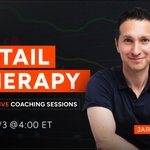
That's why I'm continuing to host “Retail Therapy” on @NTLiveMedia where I work 1-to1 with real traders just like yourself to stay sharp when it matters most.
Join me live tomorrow, Wednesday September 9th, at 4:00pm Eastern US where I'll help two traders break through to profitability.
Plus, I'll be answering your questions live.
youtube.com/live/GOuIrAG5YvE

Jared Tendler retweeted

You don't want to miss out on today's afternoon stream...
It's time for Trade the Close with @JoeyMorganNQ, @Trading_Boxes, and @salmaogs at 2 PM ET.
Then, @jaredtendler is back for another session of Retail Therapy at 4 PM. 🔥
youtube.com/@NinjaTrader/liv…
