








Pinned Tweet
Five of our six proposed Ethereum standards are now Final.
ERC-8325 to ERC-8329 are settled specs that anyone can build on.
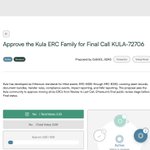
ERC-8330 is in Last Call until 30 November.
Issuing a token was never the hard part. Everything that has to travel with it is.
kula.com/newsroom#announceme…

KULA retweeted

Another interesting conversation from Devcon was with Taran from @kula_dao.
One of my favourite things about Devcon is discovering projects & ideas beyond the usual Ethereum protocol discussions.
teapawt.org/kula_dao/status/211866…

“A token is only as good as the title behind it.”
Our Head of Digital Assets Taran Dhillon took that argument to the EIP Hub community at Devcon 8 in Mumbai, presenting Kula’s six EIP proposals.
Getting assets onchain is largely solved. Keeping the rights and information that give them value intact as they move between platforms is not. That is the gap ERC-8325 to ERC-8330 address, sitting around existing token standards rather than replacing them.
Learn more at kula.com


5/ $KULA remains available on other exchanges. The current list of markets is here:
coinmarketcap.com/currencies…

1
2
97
6/ For support, contact [email protected]
Kula cannot access MEXC accounts or complete withdrawals on behalf of token holders.
1
87
“A token is only as good as the title behind it.”
Our Head of Digital Assets Taran Dhillon took that argument to the EIP Hub community at Devcon 8 in Mumbai, presenting Kula’s six EIP proposals.
Getting assets onchain is largely solved. Keeping the rights and information that give them value intact as they move between platforms is not. That is the gap ERC-8325 to ERC-8330 address, sitting around existing token standards rather than replacing them.
Learn more at kula.com
Tokenised assets are onchain. But what does the token actually mean?
That is the question our Head of Digital Assets Taran Dhillon is taking to Ethereum Devcon in Mumbai this week, in a talk called “Why Titled Assets Need More Than a Token Standard”.
$39B of asset value onchain. Tokenised Treasuries doubled in a year. And still no shared answer to what an asset represents, how it can move, or how its value gets reported.
A compliant transfer is not the same thing as interoperable infrastructure. That gap is what our 6 proposed standards are built to close.

Tokenisation has momentum.
That's why it needs onchain standards.
Learn mroe about the 6 ERC standards we have proposed to ensure tokenisation is built on solid legal foundations 🧵👇


Today we announce that our team has proposed six Ethereum standards, ERC-8325 to ERC-8330, currently in Review.
What are they?
Between them they cover the interfaces nobody has standardised, from the link between a token and its underlying asset through to the legal documents behind it, transfer rules jurisdiction by jurisdiction, compliance events across an asset's life, impact data, and valuation reporting.
Why have we proposed them?
The $34 billion tokenised RWA market is fragmented.
Dubai, Switzerland and Germany all have live regulated infrastructure, none of it interoperable, which means every institution entering a new market rebuilds verification from scratch.
If tokenisation is going to bring trillions of dollars of real-world assets onchain, this is the layer that has to work first.
What can you do?
If you're a developer and want to contribute, please share your thoughts as soon as you can.
Read the full press release: kula.com/newsroom#announceme…

The most profitable business in crypto, after the exchanges, is tokenisation.
Tether earned $5.96B on the reserves behind USDT. Circle earned $2.38B the same way. Tron’s $334M comes largely from moving those tokens around, and Sky’s $193M includes real-world asset yield.
Strip out trading fees, perps and launchpads and what remains is the industry’s one proven model for earning money from something outside itself.
That is why tokenisation is where attention has moved as the industry matures. A tokenised dollar was the easy case. Property, infrastructure and credit are harder, and they need shared standards before they scale.
We proposed 6 of them this year: kula.com/newsroom#announceme…
🚨 Binance says it has covered about 95% of the $6.3 billion stolen in last week's record hack, using its own treasury, its SAFU fund and its futures insurance fund. Withdrawals reopened on Nov. 1.
How does one exchange absorb a loss that size? Revenue.
Binance doesn't publish its accounts. CZ put annual revenue at around $5 billion in March, while Bloomberg estimates $10.7 billion for the 12 months to June. Either way, the hack equals roughly six to 15 months of income.
Here are crypto's biggest earners over the past year, and how they make their money:
Binance: $5B–$10.7B (est.). Trading fees, listings, Earn products
Tether: $5.96B. Interest on USDT reserves
Coinbase: $5.65B. Trading fees, USDC interest share, staking
Circle: $2.38B. Interest on USDC reserves
Hyperliquid: $663M. Perpetual futures trading fees
Tron: $334M. Network fees, mostly USDT transfers
Pump(dot)fun: $330M. Memecoin launch and trading fees
Grayscale: $197M. Fund management fees
Sky: $193M. Loan interest and real-world asset yield
GMGN: $158M. Trading app fees
The biggest money is in stablecoins and exchanges. Among onchain protocols, perpetual futures and memecoin launchpads lead.

Everyday, the world's largest financial institutions are working towards further integrating tokenised assets into the global financial system.
How those assets are tokenised is facing more and more scrutiny.
We believe tokenisation needs onchain standards as a starting point.
Learn more about how we are working to achieve this 🧵👇


Today we announce that our team has proposed six Ethereum standards, ERC-8325 to ERC-8330, currently in Review.
What are they?
Between them they cover the interfaces nobody has standardised, from the link between a token and its underlying asset through to the legal documents behind it, transfer rules jurisdiction by jurisdiction, compliance events across an asset's life, impact data, and valuation reporting.
Why have we proposed them?
The $34 billion tokenised RWA market is fragmented.
Dubai, Switzerland and Germany all have live regulated infrastructure, none of it interoperable, which means every institution entering a new market rebuilds verification from scratch.
If tokenisation is going to bring trillions of dollars of real-world assets onchain, this is the layer that has to work first.
What can you do?
If you're a developer and want to contribute, please share your thoughts as soon as you can.
Read the full press release: kula.com/newsroom#announceme…
Need something to listen to this week?
Our co-founder Chris Turner recently joined the Investing News Network podcast to disucss why standards are needed to solve the fragmentation issue in tokenisation.
Have any questions, share them in the replies 👇
Tokenisation is moving from hype to infrastructure. What is holding it back is that platforms still cannot talk to each other across jurisdictions, exchanges and compliance frameworks.
Our Co-Founder Chris Turner joined Investing News Network to talk about why that fragmentation traps tokenised assets inside proprietary systems, and what it would take for ownership to travel with the asset rather than being rebuilt at every transaction.
Listen to the full podcast below 👇
open.spotify.com/episode/0ZE…
investingnews.com/chris-turn…

In case you missed it, what happens after Kula invests in a project.
Bill Pike, our Head of Operations, on milestone-based capital release, site visits with project leadership, and tracking impact from the first day rather than the first report.
Inside Kula #3 and the rest of the series: kula.com/newsroom#Inside%20K…
The deal is signed. Now the real work starts.
Our Head of Operations Bill Pike on what Kula does after investing: capital released against milestones, regular site visits with project leadership, and impact tracked from day one alongside performance.
Inside Kula #3👇
kula.com/newsroom#inside%20k…

Nearly 4x growth is the easy part. The hard part is making real-world assets interoperable and automatable at scale.
That’s what Kula’s ERC-8325 to ERC-8330 are built for: a simple token core with standard building blocks attached only where an asset needs them 👇
kula.com/newsroom#announceme…

The tokenisation of real-world assets (RWAs) is becoming one of crypto's biggest narratives in 2026.
From government bonds and real estate to commodities and private credit, more traditional assets are being brought onchain.
The distributed value of tokenised RWAs has climbed nearly 4x since 2025, highlighting a growing connection between traditional finance and blockchain technology.

Every opportunity Kula considers has to clear three foundational tests before we go any further: meaningful impact, genuine community integration and a sound economic return.
That means looking well beyond the capital itself. We assess whether a business can create change that is demonstrable rather than assumed, whether the community it serves will hold real ownership and a voice in the decisions that affect it, and whether the opportunity can meet the return thresholds that make it a responsible investment.
Our Head of Investments, Edward Allely, explains how we evaluate every opportunity before we move forward 👇