

Official account of the world’s largest library. Explore collections & plan a visit. All Library accounts: https://xitter.cf/t.co/KMH2LPXfZv
- Tweets25.6K
- Following13
- Followers1.1M
- Likes4.4K
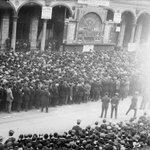





ALT Photo shows crowd gathered outside the New York Herald newspaper building in New York City to watch a "playograph" during the World Series, 1911. Bain News Service photograph collection, Library of Congress Prints and Photographs Division.

ALT Advertisement in The Washington Daily News, Monday, Oct. 4, 1926 advises baseball fans to "See the World's Series on The Washington Daily News Playograph," an "ingenious mechanical devise that reproduces the actual game play by play" via "a special wire from the ball park to the rear of the Playograph" that "insures speed and accuracy." "As fast as a play is made a crew of three operators will reproduce it for you on the Playograph."

ALT Photograph shows portrait of Union veteran in G.A.R. uniform with medals and World War I sailor, probably grandfather and grandson.

ALT Photograph shows portrait of Union veteran with World War I soldier in G.A.R. uniform with medals with World War I soldier, probably grandfather and grandson.

ALT Photograph shows portrait of Union veteran in uniform, wearing a medal, seated next a World War I soldier in uniform, probably grandfather and grandson.

ALT Photograph shows portrait of Union veteran in G.A.R. uniform with medals and World War I sailor, probably grandfather and grandson.


ALT Katharine Wright, wearing a leather jacket, cap, and goggles, aboard the Wright Model HS airplane with Orville, 1915.

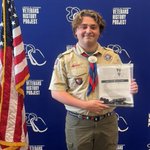
ALT Scout Connor Roberts hand-delivers multiple Veterans History Project interviews to the Library of Congress as part of his Eagle Scout Leadership Service Project in 2025.


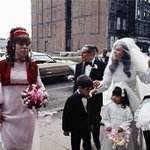
ALT Several members of a wedding party, including the bride, ring bearer, flower girl and two bridesmaids stand on a New York City sidewalk. Puerto Rican Wedding, East Harlem, 1970. Camilo J. Vergara Photograph Collection, Library of Congress Prints and Photographs Division.

ALT A small child sips water from a New York City fire hydrant as another small child watches. People walk by on the sidewalk behind them. Avenue C, Lower East Side, 1970. Camilo J. Vergara Photograph Collection, Library of Congress Prints and Photographs Division.

ALT Girls play with Barbie dolls on a New York City stoop. Girls and Barbies, East Harlem, 1970. Camilo J. Vergara Photograph Collection, Library of Congress Prints and Photographs Division.

ALT A child in a stroller sleeps outside what appears to be the window of a New York City butcher shop. Hunts Point, South Bronx, 1970, 1970. Camilo J. Vergara Photograph Collection, Library of Congress Prints and Photographs Division.


ALT Fruit picker with truckload of apples. Camden County, New Jersey. Photographed by Arthur Rothstein. 1938 Oct. Farm Security Administration - Office of War Information Photograph Collection. Library of Congress Prints and Photographs Division.