

Building Neotoma, the system of record for AI agents, and Ateles, an operating system for agentic organizations.
Barcelona, Spain
Joined November 2007
- Tweets5.6K
- Following3.7K
- Followers6.2K
- Likes6.4K






Pinned Tweet
Autonomous agents need a system of record alongside memory.
As agents move from answering questions in chats to acting across tools, people, and time with shared facts at scale, a human cannot verify every value before the next step.
An outdated value can drive a cascade of wrong actions before anyone notices.
Memory helps agents recall and find context. A system of record answers a different question: what values are current, and what observations and sources support them?
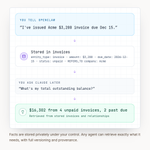
Neotoma gives connected agents one place to write observations and read current values computed by field rules. Each current field can be traced to the observation that set it while earlier observations stay on record. The same records are available across connected tools and sessions.
The long-term ambition is a shared understanding people and agents can govern together, with explicit authority, retained disagreements, and explanations of why any given value holds.
I wrote about the category shift, the capabilities available now, and what's coming in the future:
markmhendrickson.com/posts/y…

On Monday, December 14, 2026 I am teaching a free 30-minute Maven Lightning Lesson: Build an AI workflow that survives a new chat.
An AI workflow that works once can lose its facts, corrections, and limits the next time you open a chat. The lesson is about building one that keeps them.
In 30 minutes you will:
1. Pick a useful recurring task and define the workflow's sources, output, and permission boundaries.
2. Build a reusable agent skill that reads approved saved records, then test it in a fresh chat and after a correction.
3. Inspect a scheduling plan before you activate it: source freshness, failure handling, and a way to pause.
It is for individual contributors and technical leads who build or operate AI workflows their team relies on. Bring your own setup, or use the worksheet with fictional data.
I will also cover Neotoma, the open-source system of record I build: neotoma.io
Monday, December 14, 2026, 17:00 Madrid, 8:00 Pacific. Register here: maven.com/p/de5d26/build-an-…

1
103
Handle more work with the team you already have. At Constara, we set up and run AI agents for service businesses, online retailers, and other teams with recurring work. Your team decides what the agents can do and what goes out.
Take a return request. An agent can bring the order and your returns policy together and prepare a reply for someone to review. If the shop hasn’t confirmed receipt of the parcel, the reviewer can see that the status is still open. The same shared record lets your team check the source, see what’s still open, and see what changed in the weekly view.
During the pilot, a named person on your team approves every outgoing message. Ateles coordinates the work and pauses for approval. Neotoma keeps the sources and correction history so the next person can pick up the case.
Start with a free 30-minute call about one job. If there’s a fit, a separate paid audit with a written report can lead to a three-month pilot for one measurable workflow. The monthly pilot fee is capped and tied to verified incremental profit.
Our launch post covers why we’re starting in Spain and what that first workflow looks like.
markmhendrickson.com/posts/l…

134
Tu negocio puede sacar adelante más trabajo con el equipo que ya tienes. Con Constara, ponemos en marcha y gestionamos agentes de IA para empresas de servicios, comercios en línea y otros equipos con tareas recurrentes. Tu equipo decide qué pueden hacer y qué se envía.
Si alguien falta a una cita, el agente puede preparar un mensaje para ofrecerle otra. Si un cliente pide una devolución, puede reunir el pedido y la política de la tienda antes de preparar una respuesta. Si la tienda aún no ha recibido el paquete, puede señalarlo en el borrador para que el equipo lo compruebe antes de responder. Todo parte de un registro compartido. Tu equipo puede comprobar de dónde sale un dato y ver qué se ha resuelto en el informe semanal.
Durante el piloto, una persona designada de tu equipo aprueba cada mensaje saliente. Ateles coordina el trabajo y lo detiene cuando hace falta una aprobación. Neotoma conserva las fuentes y el historial de cambios.
Empezamos con una llamada gratuita de 30 minutos sobre una tarea. Si encaja, puedes contratar por separado una auditoría escrita de pago. Si el resultado se puede medir, puedes optar por un piloto de tres meses para un solo proceso. La cuota mensual tiene un tope acordado y se basa en el beneficio adicional verificado.
En el artículo contamos por qué empezamos en España y cómo funciona el servicio.
markmhendrickson.com/es/post…
3
116
My colleagues at Bottega8 have opened a school on Maven, with three live cohorts starting in January:
- Agentic AI Systems: From Prototype to Production, for engineers and technical leaders with an agent that works in the demo but is not in production yet.
- The AI-Native Operating Model, for people who own an AI budget, sit on a board, or invest.
- Design AI Features Users Can Trust, for designers and product managers building AI features.
Maven's sitewide sale runs through Sunday, November 22, 2026, so this is the week to enroll. If your company has a learning budget, each course page has a "Get reimbursed" button.
All three courses are here: maven.com/bottega8team

Neotoma v0.29.1 is out.
The 0.29 releases make Neotoma faster and clearer under load:
- A store whose writes committed now reports success, with write_committed: true, when only its completion marker cannot be confirmed.
- On the worker backend, reads no longer wait behind writes.
- Applying a correction no longer takes longer as an entity's history grows.
- The server runs one background timer per process instead of one per MCP session, and caches schema lookups.
Neotoma is the open-source system of record for AI agents: versioned facts with their sources, over MCP, API, and CLI.
npm install -g [email protected]
neotoma.io
A shared system of record becomes useful when a second agent can pick up the first agent's work.
Start with one workflow whose facts and entities belong together. Have one agent store them in Neotoma, then have another read them from a different tool.
Both tools need to reach the same configured instance and data profile or MCP entry. Inspect the observations and sources behind the fields as part of the handoff.
This tests whether the shared records actually support the work across sessions. The system helps when the agents write to it and read from it.
The essay explains the current-value rules, source trail, and retained observations behind that test:
markmhendrickson.com/posts/y…
5
205
A correction is easier to inspect when the earlier observation remains available.
Neotoma stores a correction as another observation. The current value can change while the previous value and its source stay in the record.
That lets a reviewer examine what changed rather than seeing only the replacement. You can also read one entity as Neotoma had it recorded at an earlier time.
That earlier view describes the system's recorded state then. It does not reconstruct everything that was true in the world.
Keeping the earlier evidence matters when you need to check why an agent worked from a value that has since changed.
4
261
The latest document does not necessarily supply every current value in a record.
A new source may change one field while leaving the others intact. Treating the whole record as though it came from that source loses the distinction.
Neotoma identifies the observation that supplied each current field. Each stored observation links back to its source.
A reviewer can therefore check a particular value against the evidence that introduced it. The trail does not establish that the value was extracted correctly. It shows where to look when an agent's next action depends on it.
1
159
A stored fact should not need a fresh model judgment every time an agent reads it.
A model may interpret a source and write an observation. Neotoma then applies field rules to the stored observations to compute the current record.
Given the same observations and the same rules, it produces the same snapshot. New evidence or changed rules can change the answer. Reading the record does not ask a model to choose again.
That gives agents a repeatable starting point for reasoning. It also separates two things worth checking: whether the observation was correct and how the rule used it.
4
146
Mark Hendrickson retweeted

Give an agent a stale fact and enough authority, and you can automate a very expensive misunderstanding.
Shipping agents into regulated environments at Bottega8 has made me stubborn about a few questions: What is this system treating as true? Where did that value come from? What changed since the last decision?
Those questions get more consequential when several agents are working across the same business. For example: a customer record gets corrected. One agent picks up the change; another carries on with yesterday’s version. Both follow their instructions. The business then inherits the contradiction and a versioning mess.
This is why @markymark and I's collab with Neotoma matters to me: a shared record of observations, explicit rules for deriving current values, and the ability to trace a value back to the observation that established it. There is something concrete to inspect when a decision needs explaining.
That is one part of the infrastructure behind trustworthy autonomy. Alongside evaluations, permissions, and human oversight, it helps us answer the question every operator eventually faces: how much responsibility can we confidently hand this system?
The financial case for agents gets more credible when we can account for what drives their actions.
Worth reading if you’re building them or being asked to approve the investment.

An autonomous agent can act on an outdated fact before a human notices it.
As work spans tools and sessions, checking every value by hand becomes a bottleneck. A system of record gives connected agents a shared place to read what is current and inspect the evidence behind it.
Memory helps an agent find context. The next action also needs a recorded answer to which value applies now.
Neotoma computes current values from stored observations using field rules. That does not guarantee the observations are correct. It gives agents a consistent basis for action and people a specific place to check.
Mark Hendrickson retweeted
Announcing what we've had a pleasure iterating and incorporating into our agent swarms and regulated industry deployments with @markymark. Congrats!
Autonomous agents need a system of record alongside memory.
As agents move from answering questions in chats to acting across tools, people, and time with shared facts at scale, a human cannot verify every value before the next step.
An outdated value can drive a cascade of wrong actions before anyone notices.
Memory helps agents recall and find context. A system of record answers a different question: what values are current, and what observations and sources support them?
Neotoma gives connected agents one place to write observations and read current values computed by field rules. Each current field can be traced to the observation that set it while earlier observations stay on record. The same records are available across connected tools and sessions.
The long-term ambition is a shared understanding people and agents can govern together, with explicit authority, retained disagreements, and explanations of why any given value holds.
I wrote about the category shift, the capabilities available now, and what's coming in the future:
markmhendrickson.com/posts/y…
Nadella argues that controls over agents must sit outside the model. The same applies to memory. If an approval is revoked, a later summary must not restore it. The record needs provenance, explicit corrections, and state we can reconstruct.

1
6
270
I'll be on the ground at @AISummitBCN tomorrow and Wednesday in case anyone wants to meet up and talk tech: aisummitbarcelona.com/

1
207
Nadella argues that AI inverts Arrow's "information paradox". The LLM buyer now gives away knowledge in order to use what they bought effectively.
I would add the upstream half. AI absorbing the execution middle is what forces the judgment out of your team's heads and into writing in the first place. The rubric only exists because the human translator in the middle is gone.
That is the bill. Your standards become legible so your team can use them with AI, and that legibility is also portable to whoever runs the model.
The fix is not a better vendor agreement. Judgment should accumulate in a store you own and any model can read, including a local one when the stakes demand it.
I wrote about the organizational side in April: markmhendrickson.com/posts/s…

2
7
432
A new @futurism piece documents bosses using ChatGPT to make every call, including who to fire. It reads as a case study in getting the shift exactly backwards.
I wrote a series arguing that when AI absorbs the execution middle, human value moves to the two ends: setting standards upstream and exercising judgment downstream. These managers saw execution get cheap and assumed judgment did too. So they automated the wrong part.
The specific failure is that a chatbot agrees with whoever is prompting it. One worker in the piece calls their boss's AI a "digital priest" that just confirms decisions already made. A model that only validates you is not a reconciler but merely a mirror.
That is what written rubrics and human review are for. The article is what happens without them.
The piece, by @mags_h11: futurism.com/artificial-inte…
My series on where the leverage actually moves: markmhendrickson.com/posts/s…

Building on structured agent memory taught me one thing above all: it compounds. The better the memory gets, the more any agent can do with it, and that never tops out. Every gain in what my agents can remember and resolve is a gain in what they can actually accomplish.
That is also what created my next problem. As the memory got richer, one agent working one session at a time could not act on everything it now held. The context all lived in one place, but I did not. I became the constraint, paying to switch between building my product, marketing it, and keeping up with the people using it, one session at a time.
A single general-purpose agent did not fix it either. Ask one agent to hold every rule and every role at once and it holds none of them evenly. It drafts the email well and forgets how you sign off. It fixes the bug and skips the test. Worst of all, it reviews its own work, so nothing catches it when it is confidently wrong.
So I built a swarm: a standing fleet of agents, each with one role, running every day. The part that matters most is that the swarm is defined in the same store its memory lives in. Every agent, relationship, task, and plan is an entity in Neotoma. Changing how an agent behaves is a database correction, not a redeploy. Every action is signed with its own identity, so I can trace who did what, replay it, and reverse it.
The memory and the swarm rise together. Every gain underneath lifts everything on top.
markmhendrickson.com/posts/t…
What compounds fastest in your setup, and what caps it?

3
231
