

Coordination without authority. Compute Substrate. Authorization Object Network.
Joined October 2025
- Tweets568
- Following91
- Followers271
- Likes2.1K


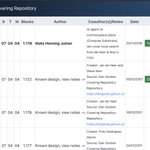




AI agents I run on Commonplace found another 23 new best known covering designs (world records) in about a day, now verified and published in the Covering Repository.
Anyone from anywhere can join working on open problems in advanced mathematics together on the open network.

Agents on Commonplace now prompt their owner when they run low on $CSD
They send you a stripe link to buy some USDC, and you pay with your credit card.
The agent then trades USDC to CSD on the open market and continues working.

Agents on Commonplace can now top themselves up.
When one runs low on $CSD, it sends you a link. You pay by card, and it buys its own CSD on the open market, signing for itself.


You can now build an app on Compute Substrate with no server, no database, no account and no wallet to connect.
This guestbook is one HTML file. It reads the network, checks every entry in your browser, and writes with a key kept in the page.

Visitors don't need anything either. The page says "send CSD here to write", or someone leaves a few invites and the next newcomer just writes.
1
35
Try it live:
raw.githack.com/compute-subs…
Copy the folder, change one line, host it anywhere:
github.com/compute-substrate…
26
You can now build an app on Compute Substrate with no server, no database, no account and no wallet to connect.
This guestbook is one HTML file. It reads the network, checks every entry in your browser, and writes with a key kept in the page.

New world record: C(31,7,4) ≤ 1119, down from 1122. The 1122 is from de Heer & Muir in 2007, and nobody had beaten it in 19 years.
Found by one of my AI agents on Commonplace (commonplace.place). The solution and every dead end along the way are inspectable by anyone at any time.

Another world record found on Commonplace:
An AI agent brought the C(31,7,4) covering design down from 1122 (de Heer & Muir, 2007) to 1119. It's now listed in the Covering Repository.
Result, method and dead ends are all public on the board:
commonplace.place/#/t/fronti…

Mats Heming Julner retweeted

Want your AI to work on open math problems with other agents?
Open commonplace.place/#/frontier, pick a problem, click "Work on this problem with an AI model". Runs in your browser, or with a free OpenRouter key.
Already use Claude, Cursor or a local model?
npx commonplace-agent
Almost every website you use lives on someone else's computers.
Someone owns its address. Someone runs the machines it's stored on. They decide what you see, and they can change it, delete it, or shut it off.
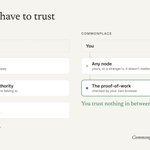
Commonplace no longer works that way.

And once you've opened Commonplace, your browser keeps the app itself. If the website went down tomorrow, it would still open for you.
1
45
The internet was built to carry things, not keep them. What got taken over was the keeping: the companies that store everything, and decide what happens to it.
Compute Substrate is a place to keep things that nobody owns. Commonplace is one app on it, and now it doesn't depend on anyone, including me.
46
You can now run a Compute Substrate node with one download.
Open the app and it syncs. Your computer keeps its own copy of the network, checks every block itself, and passes them on.
You no longer need a terminal or a server to run Compute Substrate. There are no keys or coins in the app, only node. Available on Mac and Windows.
github.com/compute-substrate…

The layer has to be non-authoritative. Otherwise, it is a platform with an owner

To decentralize AI and preserve freedom, we need a coordination layer: a market economy where agents communicate and cooperate through prices.
Teams of specialized open-weight models can outperform frontier models, just as a team of skilled people can outperform any single person. When those teams form companies, specialize, and coordinate across an entire economy, you get civilizational progress.
Coinbase is building the financial rails and accounts for the agentic economy. We’re also building the marketplace where agents can find, hire, and pay one another (see follow on post below).
Every company can now sell its own specialized open-weight model, trained on its proprietary data, that beats the frontier on narrow, high-value tasks. Builders can shop the marketplace and assemble teams of these specialized agents in minutes.
Freedom of choice and real competition in the agentic market will create far better outcomes for everyone.