

Modular Vaults Platform for Institutional Earn Infrastructure
Joined May 2021
- Tweets1.9K
- Following88
- Followers41.9K
- Likes1K







Tokenized funds are now a $37.8B market, but only about 0.4% of the largest category is used anywhere in DeFi.
The numbers come from @tokenterminal’s early November data. The market is roughly ten times the size it was in late 2023, and funds holding US Treasury bills are the biggest group, at $13.5B. In practice these are ordinary money market funds whose shares are issued as tokens.
Most of those shares are bought and then held. They earn the fund rate in the wallet they were bought into, and that is about it. Lending them out or posting them as collateral is possible, and it is one of the reasons to tokenize a fund at all, but very little of it happens.
One of the reasons for this is permissions. A treasury team works under a mandate that says which counterparties and assets it may be exposed to and how much of a position it can pledge. Writing those terms down and holding a position to them for as long as it stays open might be considered demanding, so the shares stay put.
Core Vaults approach this from the vault side. The permitted venues and assets go into the vault contract before any capital is deposited, and later actions are checked against that list. A risk committee can review the rules once, and the positions can be checked against them onchain whenever someone wants to look.
Token Terminal’s growth figures will keep getting most of the attention. Those 0.4% should be watched as well, since that share is where actual use would show up.

1
7
848
Hong Kong FinTech Week brought meetings across the city and a DeFi roundtable at the Devcon Hong Kong Community Convention.
@s0xn1ck joined the “DeFi Today & What Comes Next” roundtable, alongside Samuel Chong of @LidoFinance (@stakesaurus), George Sheng of @AZverse_xyz (@georgemadcrypto), Tim Zhang of @sparkfinance (@timzz_sleep), and Leon L of @UnitedStables (@leoneast_)
The conversation moved from stablecoin liquidity spread across many chains to tokenized RWAs as collateral, and how much trust shared infrastructure asks of the people using it.
While getting assets onchain is the easy part now, putting them to work, with limits an institution can rely on, is where the building is.
Thanks to @Ethtao_Ethtao and @ethereumhkhub for hosting, to @ethereumfndn and the @EFDevcon team, and to everyone who spent part of their FinTech Week with Nick.
Uber’s pilot built one check into the structure: proceeds could only go to verified corporate bank accounts.
Onchain, the rest can be built the same way. Asset eligibility, size limits and who can start a transfer become rules in code, running on the same clock as the money.
122
3 November, @s0xn1ck is on “DeFi Today & What Comes Next” at the Devcon Hong Kong Community Convention, presented by @Ethtao_Ethtao, @ethereumfndn, @ethereumhkhub and @EFDevcon team.
A good room to understand what DeFi needs to have for larger pools of capital to rely on it.

🎉 嘉宾公布 | Devcon香港分会场
👏 欢迎 George Sheng(Founder&CEO of AZverse)@georgemadcrypto、Samuel Chong(Lido Head of APAC Institutional Relations)@stakesaurus、Nick Stoev(Founder at Mellow)@s0xn1ck、Tim Zhang(APAC Growth lead of Spark)@timzz_sleep、Leon L(DeFi & On-chain Growth Lead of UnitedStables)@leoneast_加入 Devcon 香港分会场!
🔥 圆桌讨论:DeFi 的现状与未来
五位嘉宾将齐聚一堂,围绕 DeFi 的发展现状、生态创新与未来机遇展开深入交流。
📅 November 3
📍 Devcon香港分会场
🎟️ 立即报名: luma.com/cfthgx9l


1
4
924
Update on the Binance incident: Mellow vaults have taken no losses and have no direct exposure to Binance or the affected wallets.
EarnUSDe and EarnETH Vaults use Ethena and Aave.
Ethena has published an out-of-cycle proof of reserves confirming that USDe remains overcollateralized by more than $60M. Ethena's USDe backing is not held directly on Binance or any other exchange.
Aave markets are now unfrozen, and Aave’s contracts were unaffected by the incident.
Vault operators continue to monitor positions as markets return to normal. No action is needed from depositors.
5
1,076
We’ve been following the reports concerning Binance-affiliated wallets since they first surfaced. We’re continuously reviewing relevant markets with vault operators and will coordinate on adjustments if it will be required.
We will continue monitoring the situation and sharing the updates.
1
4
1,019
Roman, Mellow’s Head of Product, will be in Lisbon for @StellarOrg Meridian on October 28-29.
He’ll be around to talk onchain finance, hear what’s taking shape on Stellar and catch up with people across the ecosystem.
Reach out to @0xRomanW3 to arrange a time to meet.

A framework for assessing DeFi lending vaults was published by @SPGlobalRatings earlier this month.
Even though no vault has been assessed under it yet, the six factors work as a public question list. Yield is not one of them. Liquidity mismatch, curator risk and governance are.

The Mellow USDG Yield Vault on Robinhood Chain has filled its initial 1M USDG cap, and the cap now doubles.
The Vault accepts @Paxos-issued USDG and allocates exclusively to Morpho markets.
Check out the Vault:
app.mellow.finance/vaults/ro…

6
1,059
EarnUSD Vault by @LidoFinance moves to a performance-weighted fee model. The change shifts more of the fee load from balances to returns.
Previously, EarnUSD charged 1% AUM and 10% performance. The new model is capped at 0.5% AUM and 20% performance. At launch, fees are set at 0.2% AUM and 15% performance.
The AUM fee applies to every balance in the vault, whatever the vault earns. Cutting it from 1% to 0.2% makes EarnUSD cheaper to hold when returns are lower. The performance fee applies only to generated returns, so with more weight on it, total fees track more closely with what depositors receive.
Current fees are always shown on the EarnUSD vault UI.
app.mellow.finance/vaults/ea…
stake.lido.fi/earn/usd
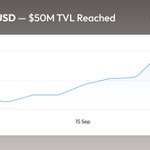
$50M in @LidoFinance's EarnUSD Vault on Mellow with 14-day average APY: 6.81%.
Allocated across @aave, @pendle_fi, @maplefinance, @morpho, @ethena_labs and @sparkdotfi.
Check out the Vault:
stake.lido.fi/earn/usd/depos…
app.mellow.finance/vaults/ea…

Mellow team is heading to @token2049.
Meet @s0xn1ck, CEO, @0xRomanW3, Head of Product, and @Cyborgxsoufia, Head of Growth, to discuss onchain financial products.
DM to catch up while we’re in town!


Agents are quickly getting better at everything from research to execution.
When they touch capital onchain, the question shifts from what they can do to what they're allowed to do. In Mellow vaults, that answer is mandate enforced in contracts.

Our @NousResearch Hermes agent actually does great job explaining what @mellowprotocol does, add as much context sources as possible and you’re gtg
The Mellow USDG Yield Vault has taken its first external treasury allocation: 500,000 USDG from @OlympusDAO's protocol treasury.
The Vault accepts @Paxos-issued USDG, allocating exclusively to @Morpho markets on @RobinhoodCrypto's chain launched in July.
Inside the Vault, USDG is deployed into @ethena's USDe and @maplefinance's syrupUSDG.
Both are supplied as collateral exclusively on Morpho markets to borrow USDG that is then looped back to capture the carry spread.
2
4
323
USDG supply is already sitting in Morpho markets on Robinhood Chain.
The Mellow Vault creates borrower demand on the other side, and Olympus's allocation now adds protocol treasury capital to that trade.
Check out the vault:
app.mellow.finance/vaults/ro…
1
5
225