

Founder @Zoqotrade // prev co-founder @RallyProtocol and @Superlayerio // ex-VC @Redpoint
Joined October 2011
- Tweets3K
- Following619
- Followers23K
- Likes5.4K








This is a BIG structural change in the prediction markets space. Massive fee reduction across multiple categories.

Lower fees are coming to more markets on Polymarket International.
Starting Friday, Nov 20 at 11:59 PM UTC, we’re dropping the taker fee coefficient to 0.01 across politics, culture, weather, economics, mentions, & non-5/15m-BTC crypto on polymarket.com.
Full breakdown 🧵
polymarket.com/r/7OeW4Jd

Mahesh Vellanki retweeted

Polymarket traders, how much time do you spend watching markets, tracking price movements and waiting for the right moment to enter or exit a position?
What if you could automate some of that work? That's where Zoqo Trade comes in.
Zoqo Trade is a no-code trading automation platform built for Polymarket. It allows you to turn your trading strategies into automated bots without writing a single line of code.
Here's what you can do with it:
• No-code automation: Create custom trading bots based on your preferred market conditions.
• Custom strategies: Set entry triggers, take-profit and stop-loss levels, and define your preferred position sizes.
• 24/7 execution: Let your bots monitor markets and execute trades based on your predefined conditions, even when you're away.
• Risk management: Set strategy budgets, daily loss limits and cooldown periods to establish boundaries for your trades.
• Telegram notifications: Receive updates on order executions, settlements and other automation activities.
• Trade transparency: Review your trading history and understand why your bot entered or skipped a trade.
The interesting part is that you don't need programming skills or have to spend your entire day staring at charts to put your trading strategy into action. You define the rules and @ZoqoTrade handles the automation.
But I'm not just here to tell you about Zoqo. I'm here to explore it myself. I'll be sharing my experiences as I use the platform, the strategies I test, the profits, the losses, and everything I learn along the way.
If you're a Polymarket trader, you might want to stick around. There's more coming.
Explore more about Zoqo Trade: zoqo.trade/

Mahesh Vellanki retweeted

Zoqo is now in open beta! @ZoqoTrade
🤝 Paid partnership

Zoqo is now in open beta!
Got a trading strategy? Turn it into a bot on Zoqo that never misses a market
No code required
Your first bot is a few minutes away: zoqo.trade
Your strategy. Your rules. Your bot

Trading bots have a pretty mature ecosystem at this point but most tools are still built around fixed rules and predefined strategies. We're only beginning to see what happens when AI agents can participate in the process of researching, building, testing and managing strategies.
It's obvious that agentic trading will be big, but IMO the biggest vector of growth will be democratizing the types of sophisticated, automated strategies that pros use for the rest of the market. Crypto and prediction markets are going to be ground zero for this type of experimentation.
Less identity politics, but continued economic populism and anti big tech appears to be the winning formula for dems. Unfortunate for silicon valley but a much needed lesson I think
We've been building out a more advanced trading terminal in @ZoqoTrade for active prediction market traders.
It makes a huge diff to have multiple price feeds, multi-market view, order-book depth and trade execution all in the same place.
DM me if you want access to the beta.
Mahesh Vellanki retweeted

I’ve been exploring @ZoqoTrade and the idea behind it is pretty simple.
Build your own trading rules, set your guardrails, and let automation handle execution.
You can start with a template or build your strategy from scratch, then track the trades your bot takes or skips and understand why.
I’ll be sharing more of what I discover through a thread and videos from my own testing.
Want to try it yourself? Reply to this post or DM @ZoqoTrade for private beta access.
🤝 Paid partnership

Mahesh Vellanki retweeted

built a 5-minute market trading bot in minutes with @ZoqoTrade
no code, no complicated setup. just rules
1. pick your markets
2. define entries and exits
3. set a total budget and daily loss cap
4. add cooldowns after losing trades
the best part is the transparency. every fill and every skipped trade shows up directly on the chart, with the reason behind it
> custom entry and exit rules
> built-in risk controls
> telegram alerts
> funds stay in your own wallet
> the bot keeps running while you sleep
your strategy. your rules. your execution
build your first one → zoqo.trade
🤝 Paid partnership

Mahesh Vellanki retweeted

Had this idea in mind of building my own prediction market trading bot lately.
Not because I want it to trade more often, but because I want it to know when NOT to trade.
That’s how I ended up on @ZoqoTrade. You build a Polymarket bot without writing any code, set your own entry and exit rules, and put guardrails on top like a daily loss cap or a cooldown after a losing streak. Your funds stay in your own Polymarket wallet the whole time.
I named mine Discipline Bot, which pretty much tells you what I expect from it. The setup is on the conservative side:
➜ Only trades on the days and hours I picked
➜ Enters only when BTC moves a set distance from the target price
➜ Small fixed size per trade, with a take profit and a stop loss
➜ Hard limits on total budget and daily losses
➜ Sits out the next few markets after 3 losses in a row
It’s live now and just watching. No trades yet, it’s waiting for its own conditions to show up.
The part I’m most curious about is the decision log. It shows every trade the bot took AND every one it skipped, with the reason right next to it. I’ll share what it skipped once there’s something worth showing.
Honestly, finding entries was never the hard part for me. Sticking to my own rules once a market starts moving was, and that’s exactly the job I gave this bot.
Zoqo is in private beta right now. If you want to build one around your own rules, reply to this post or DM @ZoqoTrade for access.
🤝 Paid partnership
Mahesh Vellanki retweeted

YOUR POLYMARKET STRATEGY CAN RUN WHILE YOU SLEEP WITHOUT WRITING A SINGLE LINE OF CODE
I didnt expect someone to make this as convenient as @ZoqoTrade
pretty much everything I'd want is in one place, from entry and exit rules to loss limits and Telegram alerts
you build the strategy through four steps:
→ pick the markets and timeframes
→ set the price or time conditions for entry
→ choose the exit and stop-loss
→ add the budget, daily loss cap and cooldown
there are templates too, so you can start with a time-based entry or price trigger and adjust it around your own strategy
"pause after 5 losses" is something I'd set before leaving a bot running overnight. decide how much it can spend and when it has to stop while you're still thinking clearly
every fill AND every skipped trade appears on the chart with its reason, so reviewing a run includes seeing why it stayed out
you can run multiple bots with different rules and still trade manually whenever you want. funds stay in your own Polymarket wallet
there's MCP support too if you want to connect an AI agent
having the strategy, limits and decisions in one place makes it much easier to see whether the bot is doing what you intended
want to try Zoqo? reply below or DM ZoqoTrade to get private beta access
I think prediction markets are going to end up with a lot more specialized frontends than people expect.
The native exchange UI is fine for browsing markets and placing a trade. But once you’re trading actively, especially in fast crypto markets, you start wanting better price context, order-book depth, alerts, wallet tracking, faster execution and automation.
Polymarket is interesting because builders can sit on top of the same underlying liquidity instead of having to create a new market from scratch. That opens the door to terminals, bots, Telegram tools and other interfaces built for very different types of traders.
Crypto already works this way in a lot of places. I think prediction markets probably will too.
What people miss about prediction markets is that they are another form of derivatives markets. The underlying function is much closer to options, futures, and event-risk hedging, although admittedly it does approach a casino at the retail edge.
Building on Polymarket has made me think a lot about who actually ends up owning the customer in prediction markets.
There are two very different models forming.
On the US side, Kalshi increasingly looks like centralized market infrastructure distributed through giant consumer platforms. Coinbase is already surfacing Kalshi markets directly inside Coinbase, and Robinhood routes prediction contracts across several regulated exchanges. Will prediction markets become another financial product embedded inside apps that already have millions of users? That model has obvious advantages. You get trust, compliance, existing accounts, fiat rails and distribution without asking someone to discover a new trading product from scratch.
Polymarket is different. The core liquidity sits in one place, but the company has intentionally opened up a builder ecosystem around it so other products can own the interface, workflow and even the user relationship. The current builder leaderboard has Betmoar doing roughly $79M of monthly volume, traderline around $52M and Gate around $38M, with the top 16 builders collectively routing well over $300M/month. And those builders are all pretty different, i.e. terminals, wallets, bots, trading tools and distribution products.
Poly is much closer to how crypto infrastructure has developed generally. Coinbase or Binance try to own the full stack and the customer experience, while DeFi and venues like Hyperliquid create something developers can build around. You can have the same underlying liquidity show up through a wallet, a trading terminal, a bot, a Telegram interface or some product that doesn’t even look like the underlying exchange.
I don’t think the answer is that the open model necessarily wins. Centralized distribution is incredibly powerful. If Coinbase, Robinhood, DraftKings and other large consumer platforms can make prediction markets feel like another tab inside products people already use, they may drive far more volume than a fragmented ecosystem of specialist front ends ever does.
But as prediction markets become more like active trading markets, I also think the value of specialized interfaces goes up. Someone trading 5-minute BTC markets wants different things from someone buying an election contract once every few months: multiple price feeds, order-book depth, batch execution, alerts, wallet tracking, automation and much tighter workflows around entering and managing positions. A single consumer interface is unlikely to be optimal for every kind of trader.
So will prediction markets end up looking more like online brokerages, where the distributor owns most of the experience, or more like crypto, where the underlying market becomes infrastructure and dozens of products compete on top of the same liquidity?
It may end up being both!

Kalshi definitely gaining share, but likely distorted due to notional volume being "boosted" by parlays, perps incentives, and possible wash trading
This quoted post is unavailable.
2
232
People are still sleeping Crypto Up/Down markets.
They're basically ultra-short-dated binary options in a much simpler wrapper. Same directional view, but instead of navigating strikes, Greeks and option chains, you pick a side and the contract pays $1 or $0. It's going to be a much bigger category than people realize
One thing I keep coming back to after digging into crypto Up/Down markets is that the cleanest way to think about them is as ultra-short-dated binary options. They sit inside prediction markets today, but economically they look a lot more like a very simplified options product.
A normal BTC option gives you a lot of choices. You pick the expiry, the strike, whether you want a call or put, and then the value of the option depends not just on whether BTC moves in your direction, but how far it moves, how much time is left, implied volatility and a bunch of other variables. That flexibility is what makes options powerful, but it’s also why they’re confusing to most retail traders.
A BTC Up/Down market collapses most of that complexity. Every few minutes you effectively get a new strike around the current BTC price and a new expiry a few minutes later. If you buy Up and BTC finishes above the relevant level, the contract pays $1. If it finishes below, it pays $0. The exact settlement mechanics differ a bit by venue, but the economic exposure is basically a binary or digital option with an extremely short maturity.
The payoff is also different from a normal call in an important way. If BTC starts at $100k and finishes at $100,001, an Up contract pays the same as if BTC finishes at $105k. A vanilla call keeps becoming more valuable as BTC moves further above the strike. With the binary, most of what you’re trading is the probability of finishing on the right side of a line over a specific period of time.
I think that simplicity is a big part of why the product is interesting. A trader doesn’t need to navigate an options chain or understand Greeks to express a short-term directional view. The downside is known when the trade is entered, there’s no liquidation mechanic like there is with leveraged perps, and the market price itself is relatively intuitive because a contract trading at 60¢ is basically telling you what probability the market is assigning to that outcome.
There’s also a broader trend here that makes the timing interesting. Traditional options markets have already moved aggressively toward shorter duration, with 0DTE now accounting for a huge share of SPX options activity. Crypto Up/Down markets take the same basic desire for short-duration exposure and compress it from a day into an hour, 15 minutes or five minutes. Polymarket creating 288 separate 5-minute BTC expirations every day would have sounded pretty bizarre as an options product a few years ago, but traders are clearly using them.
Where I think this could get more interesting is when the same structure starts moving beyond crypto. Stock Up/Down markets are already appearing, tokenized equities are moving toward 24/7 availability, and once you have reliable price feeds there isn’t much structurally preventing the same type of contract from existing around equities, commodities or other liquid assets. You can also start imagining more practical hedging use cases around earnings, macro releases, overnight exposure or very specific windows of risk, rather than these being used almost entirely for short-term speculation.
I don’t think these replace traditional options, because the fixed binary payoff gives up a lot of what makes vanilla options useful. But I do think prediction markets may have stumbled into a much simpler retail wrapper for one slice of the options market, and the more assets and expirations they add, the less useful it becomes to think of the category purely as people betting on events.

Finally taking the covers off @ZoqoTrade which we've been building over the last few months!
tl;dr we launched no-code trading bots for polymarket starting with crypto up/down markets.
Until now, only a sophisticated few have been able to roll their own bots / automated trading infra. We're giving these tools to everybody else.
Now anyone can turn an idea or signal into a persistent, automated strategy without having to build and maintain the infra yourself. You define conditions, entries, exits and guardrails, and let the system run them for you instead of wiring together APIs, scripts and infra yourself.
We’re starting with crypto Up/Down markets on Polymarket, where the combination of fast expirations, order-book trading and heavy automation makes the need very obvious. We're rapidly turning on deeper automation logic, more sophisticated position management and execution tools, more external signals, agentic trading, backtesting and much more.
We’re live now in invite-only beta. If you actively trade prediction markets and want access, DM me.
We’ve spent the last few months building around prediction markets, and one thing has surprised me more than I expected: crypto Up/Down markets are starting to look a lot less like prediction markets and a lot more like a new derivatives market.
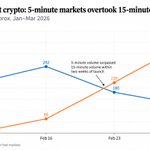
Polymarket launched 15-minute crypto markets last year and they ramped quickly, getting to almost $300M of weekly volume by February. Then 5-minute markets launched and passed 15-minute volume within two weeks. At one point 5-minute markets were doing roughly $385M/week on Polymarket alone.
Kalshi has taken the same behavior even further. Crypto did roughly $9B of volume there in September, and the large majority of recent crypto volume has been concentrated in its 15-minute markets.
This is happening inside a prediction-market category that itself is growing much faster than most realize. Kalshi + Polymarket did roughly $51B of volume in all of 2025. They had already done around $257B through August of this year.
The mechanics are almost absurdly simple. Every few minutes a new market opens around a reference price. Pick Up or Down. The winning side ultimately pays $1 and the losing side pays $0.
But the way these markets trade is very different from something like an election market, where someone might buy a position and sit on it for months. BTC alone can generate hundreds of separate expirations every day. The same capital gets recycled constantly across new contracts, so volume turns over extremely quickly relative to the amount of money actually sitting in the system.
You also start to see much more traditional exchange behavior underneath the simple UI: order books, market makers, benchmark settlement, maker/taker economics, professional traders and a lot of automation. On Polymarket, on-chain analysis has estimated that more than half of short-duration crypto volume comes from automated traders.
I don’t think this stays confined to BTC or even crypto. Stock Up/Down markets are already starting to appear, while tokenized equities are moving toward 24/7 trading and crypto venues are expanding further into perps and other derivatives. It’s not hard to imagine these categories starting to blur together.
There are also some interesting use cases beyond pure speculation as the market matures. A short-duration contract with a known maximum loss and a defined payout can be a pretty simple way to express or hedge a very specific view around an earnings release, an overnight move, a macro print, or temporary exposure to another asset.
I’m still not sure how large this ultimately becomes. Maybe 5- and 15-minute markets remain mostly a very high-velocity crypto trading product. Or maybe this is the beginning of a much broader retail derivatives category built around simple binary payouts, short expirations and assets that trade around the clock.
Either way, it feels like something materially different is forming inside prediction markets than what most people associate with the category today.
