

Breaking the Cycle of Sexual Abuse & Abusive Relationships through supporting, informing, and influencing society #BreakTheCycle
- Tweets6.2K
- Following1.5K
- Followers4.2K
- Likes2.8K







ALT In the news... 'Let out the poison' - new study aims to find the truth on NI abuse Tony Gribben, who is an abuse survivor, said it's "through disclosure that you empower yourself"

ALT We commend the people who have shared the impact of non-recent clerical abuse on their lives. While this path is not for everyone, we know sharing lived experience is an essential part to some people’s healing journey. We agree that the silence, shame, and stigma around this kind of abuse must be tackled, and this must be done in a trauma-focused way and not sensationalised. We are pleased to see three strands of research being carried out in relation to this topic, one of these focused on survivor stories and we join the call for the Executive to prioritise a public inquiry into abuse by religious leaders across all communities.

ALT Safer Internet Day Top tips for parents & caregivers to help protect young people from online harms The online world is a fast developing entity that isn’t going away. Children and young people today are more familiar with technology than ever before, however tech skills alone are not enough to protect them from potential dangers online.

ALT One of the most talked about topics at the moment is Artificial Intelligence (AI). Put simply. AI is “the simulation of human intelligence processes by machines, especially computer systems” (TechTarget). AI, like human intelligence, is very complex and has multiple applications in today’s world. Not all of these applications are bad, however some pose a threat to our young people. We believe being more informed is the first step in protecting ourselves and others to live healthy lives in the online space. Therefore, we’ve put together some top tips to help parents and caregivers support young people to enjoy online activities safely.

ALT 1. Make sure to use the most secure privacy settings on any online accounts, including social media, and encourage your young people to do the same. 2. Don’t share details about your child’s school or home address (including by sharing photos of them in uniform!). 3. Set up a safe word with children to verify that you’re speaking to each other - this is useful to protect yourselves from voice cloning scams. 4. Keep up-to-date with your learning! We know technology can be overwhelming, especially since it changes at such a rapid pace, however by staying in the know, you’ll be able to help your young people do the same and be more alert to the risks of the online world. 5. Encourage open and honest communication between you and your young people. They’ll make mistakes, as we all do, but by creating a trusting space for them to come to you with their problems, you’ll be a safe person for them which can be essential in times of crisis.


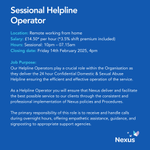
ALT Sessional Helpline Operator Location: Remote working from home Salary: £14.50* per hour (*3.5% shift premium included) Hours: Sessional: 10pm – 07.15am Closing date: Friday 14th February 2025, 4pm Job Purpose: Our Helpline Operators play a crucial role within the Organisation as they deliver the 24 hour Confidential Domestic & Sexual Abuse Helpline ensuring the efficient and effective operation of the service. As a Helpline Operator you will ensure that Nexus deliver and facilitate the best possible service to our clients through the consistent and professional implementation of Nexus policies and Procedures. The primary responsibility of this role is to receive and handle calls during overnight hours, offering empathetic assistance, guidance, and signposting to appropriate support agencies.

ALT Image of a person's hand holding a phone with text reading 'Sexual Abuse & Online Harms: Revenge Porn'

ALT Blue text on a peach background reading 'REVENGE PORN: INTIMATE IMAGE ABUSE' Screenshot of black text on a white background reading 'What is intimate image abuse? Intimate image abuse can include the behaviours of: Sharing intimate images, either on or offline, without their consent. Threatening to share intimate images. Taking an intimate image without knowledge or consent. Intimate image abuse can also be referred to as 'revenge porn', non-consensual pornography or image-based sexual abuse.' Blue text underneath reads Non-consensual intimate image sharing is often called ‘revenge porn’ and is a type of a abuse that intersects with sexual abuse. This type of abuse is when a person or people distribute nude or sexually explicit imagery (photos or videos) of another person without their consent. The ‘revenge’ aspect of it comes in because this type of abuse is often used as a form of blackmail or ‘punishment’ by a current or former partner. Source: The Revenge Porn Helpline

ALT Blue text on a peach background reading 'In popular culture... Reality TV personality Georgia Harrison pursued justice which resulted in her ex-partner receiving a jail sentence of 21 months. Ms Harrison said “It wasn’t until recently I realised just how hard it is to get a conviction for this sort of a crime. It shouldn’t be as it is such a painful crime. “Although it was really painful to go through what I did, I feel it’s making some sort of change to society and I am just relieved, I can take some joy from that.” Screenshot of news article with photo of Georgia Harrison with headline reading 'I didn't realise how difficult revenge porn case would be. Reality TV star speaks about ordeal after ex-boyfriend Stephen Bear was jailed for sharing a private sex video'

ALT Blue text on a peach background reading 'What can happen? Sometimes, a person can become a victim of ‘revenge porn’ after they have consensually shared images or videos with their partners, who then go on to break their trust and either share or threaten to share the private content publicly. In other cases, a person can be forced or coerced to create sexually explicit imagery by a current or former partner. If this is part of a pattern of abuse, this would be considered as a form of coercively controlling behaviour which is a crime under the Domestic Abuse and Civil Proceedings Act (Northern Ireland) 2021. Another example of intimate image abuse is where an abusive partner takes photos or videos without the knowledge of the other person and then threatens to share - or actually shares - the content through online channels to humiliate, shame, and manipulate them. However intimate image abuse is perpetrated, it is still abuse and is a very traumatic experience. The imagery being sha


ALT Image of a video set-up and a bed. Text on a blue background reads 'Sexual Abuse & Online Harms'. White text below it reads 'Pornography'

ALT Blue text on a light yellow background reads 'Impact of Pornography: Pornography is printed or visual material containing explicit description or display of sexual organs or sexual activity. These days, pornographic content is mostly formatted as images or videos accessed online. Pornography exists within a broader socio-cultural context in which stereotypes about gender, sexism, sexual objectification and violence-supportive attitudes are also at play. According to research, young males are more likely than females to deliberately seek out pornographic content and to do so frequently. Research has found that consuming pornography can shape sexual practices and is associated with unsafe sexual health practices e.g. not using condoms. The same research found that pornography may strengthen attitudes supportive of sexual violence and violence against women. Other research has shown that for men in particular, excessive viewing of pornography is consistently associated with sexist atti

ALT Blue text on a light yellow background reads 'Objectification in Porn: According to research, people learn about sexual norms when they view sexually explicit content (Brown & L’Engle, 2009; Rothman et al., 2015). Pornography regularly presents sexually objectifying depictions of women and this is understood by the viewer as the ‘sexual norm’ (Bridges et al., 2010; Fritz & Bryant, 2017; Klaassen & Peter, 2015). A piece of research from 2010 reported that 47% of the films they reviewed, male characters directed female characters in sexually objectifying ways (e.g., “Get down on your knees,” “Get back up,” or “Lean forward” (Gorman et al., 2010). These depictions of women as sex objects are linked with pornography users’ attitudes regarding women as sex objects (Peter & Valkenburg, 2007). This normalisation of objectification is a problem. Women are not objects existing for male gratification, and porn teaching us as such causes issues in relationships, impeding the principle that h

ALT Blue text on a light yellow background reads 'AI & 'Deepfake Porn': A ‘deepfake’ is a piece of digitally altered content made using Artificial Intelligence (AI) where the face of one person is replaced with the face of another. Deepfake technology is not inherently sinister, though can - and often is - used to create non-consensual pornographic content which can cause harm and distress. In 2019 it was reported that over 95% of deepfake content online is non-consensual pornographic material. Deepfake pornography poses a risk not only to the people whose images are non-consensually used, but also to wider society: the availability of apps that anyone can download and use to create deepfakes normalises the removal or absence of consent and also promotes objectification of women as a sexual norm, given that approximately 90% of deepfakes use women’s imagery. The growing prevalence of this technology and content demonstrates the concerning attitudes, beliefs, and normalisation of sexual

ALT Image of a male posing with a phone recording a video of him. Green text on a dark blue background reads 'Sexual Abuse & Online Harms' White text underneath read 'Influencers'

ALT Blue text on a light green background reads 'Influencer cultures: Influencers are not inherently harmful. In fact, they can have a positive impact on their followers, particularly those who discuss topics like mental health. However, in recent years there has been a growing community of toxic and misogynistic influencers - primarily male - who are having a harmful impact on young people in particular. These influencers - the most well-known probably being Andrew Tate - target and groom boys and young men, taking advantage of their insecurities and impressionability, and using aspects of existing subcultures like inceldom to appeal to vulnerable people. Today, the incel culture is a subculture closely associated with misogyny and violence against women and girls. Though Tate himself is not an incel by his own description (incel is short for ‘involuntary celibate’), him and other similar influencers who spout misogynistic views have stoked the fire incel culture feeds off, further pola

ALT Five news headline snippets on a light green background read: 'Influencers driving extreme misogyny, say police' 'Influencers fuelling 'epidemic' of violence against women, warn police' 'Misogynistic influencers pose threat to children in every UK school, says minister' Who is Andrew Tate? The self-proclaimed misogynist influencer' 'The manosphere: the shady online network of masculinists'

ALT Text on a light green background reads 'NORMALISATION OF SEXUAL VIOLENCE: Rape, murder, and incest sit at the top of the pyramid of sexual violence - the most extreme level. At the bottom of the pyramid - the ‘entry’ level - sits a lot of the behaviours and attitudes we have heard from influencers like Andrew Tate (and closer to home - Conor McGregor) and that we know are rife among the incel subculture.' The pyramid of sexual violence is pictured in blue with the bottom level - Attitudes & Beliefs - circled with text reading 'This is where violence against women and girls starts' with an arrow pointing to the words victim blaming, slut shaming, boys will be boys, locker room banter, enforcing gender roles, objectification, body shaming, rape jokes and bragging all circled in red with a red arrow pointing to this level.

ALT Photo of a person out of focus holding a smartphone up in focus on the camera. Text on a blue background reads 'Sexual Abuse & Online Harms: Self-Generated Imagery'

ALT Text on a light blue background reads 'The Risks Self-generated imagery - more commonly referred to as ‘nudes’, ‘pics’, or ‘sends’ - is photo or video a person captures of themself and sometimes shares with others. The concept of creating nude or ‘erotic’ content is not new. Even centuries before technology as we know it existed, sexualised content was shared in the form of letters, printed photos, and drawings. However, the use of technology in our everyday life has facilitated more potential harms relating to capturing and sharing self-generated imagery now existing. These harms can include: Being tricked, forced, pressured, or coerced into sharing an image or video of yourself Imagery being shared beyond the person it was intended for i.e. the recipient sending it on to other people or sharing via the internet Receiving an unsolicited image or video i.e. one that you have not agreed to be sent Being blackmailed or bullied after sending an image or video The imagery being manipul

ALT Text on a light blue background reads 'The law: Consenting adults sharing self-generated imagery with each other and no-one else is not necessarily a bad thing, nor is it illegal, although it does come with potential risks as outlined previously. However, creating and/or sharing explicit images of a child is illegal, even if the person doing it is a child themselves. In Northern Ireland, Article 3 of the Protection of Children (Northern Ireland) Order 1978 makes it an offence to take, make, show, distribute, possess (with a view to distribute) or publish an advertisement with an indecent photograph or pseudo‐photograph of a child. Peer Pressure: We know that young people and adults alike may feel pressured by friends or romantic partners to take and share explicit content of themselves, and therefore the essential principles of consent (that an act is freely given, reversible, informed, enthusiastic, specific) are not present in this situation. This can then lead to feelings of sham

ALT Text on a light blue background reads 'Respect & Boundaries Having respect for others and their boundaries - as well as knowing your own - is key to engaging in safe, healthy relationships. This includes relationships which take place online (e.g. via dating, social media, and messaging apps). Having respect and respecting boundaries can look like... Asking for consent before sending a nude or engaging in sexual conversation (this doesn’t have to be a “mood killer” - checking in can be as quick & simple as asking ‘You ok with this?’ and respecting their answer) Never pressuring someone to send or share sexual content with you if they don’t want to, even if you’ve shared (e.g. don’t say ‘Aww go on it’s just me’ or ‘Come on, it’s unfair if you don’t send back!’) Unapologetically setting your own boundaries, especially if you’re getting uncomfortable with where the conversation is going/has gone (e.g. ‘Can we pause/stop please?’ or ‘Can we talk about something else?’ or ‘I’m not cool

ALT Sessional Helpline Operator Location: Remote working from home Salary: £14.50* per hour (*3.5% shift premium included) Hours: Sessional: 10pm - 07.15am Closing date: Friday 10th January 2025, 12 noon Job Purpose: Our Helpline Operators play a crucial role within the Organisation as they deliver the 24 hour Confidential Domestic & Sexual Abuse Helpline ensuring the efficient and effective operation of the service. As a Helpline Operator you will ensure that Nexus deliver and facilitate the best possible service to our clients through the consistent and professional implementation of Nexus policies and Procedures. The primary responsibility of this role is to receive and handle calls during overnight hours, offering empathetic assistance, guidance, and signposting to appropriate support agencies.