

The World's AI Blockchain https://teapawt.org/t.co/5Yp4GWD32j
Joined January 2024
- Tweets567
- Following3
- Followers343K
- Likes280





Deloitte's State of AI 2026 survey of 3,235 leaders:
73% of enterprise leaders name data privacy and security as their top AI risk, and nearly three quarters plan to deploy autonomous agents within the next two years.
Only 21% report mature governance for their agents, which almost always refers simply to containing them on-prem, thereby restricting their access and ability.
The opportunity to bring the first fully private, verifiable, and yet free-roaming agent fleet to enterprise is massive.
Every enterprise will need Nesa in this next chapter.

Agents running on private activity tracks, but that are fully trackable and auditable by their owners internally is the only future we can see here.

Menlo Ventures states AI agents have overtaken humans as the dominant consumers of AI. On OpenRouter, agents now generate 80% of all tokens: 130.9 trillion per week, roughly 7x human-driven usage.
As agents handle more tasks and access more sensitive data on our behalf, privacy becomes even more important.
Nesa’s EE technology tackles this by keeping data fully private throughout inference!
menlovc.com/perspective/2026…

Today, an onchain app that uses AI usually calls a model API off-chain and posts the answer to the chain.
The chain sees the result and has no record of how it was produced.
On an AI Layer-1, the request is settled on chain and the result comes back with a cryptographic proof that it was computed correctly.
While the query and output stay unseen 🔒
For a DeFi app assessing risk with a model, that is the difference between trusting a vendor's answer and confidently knowing the high-impact answer is true.

32% of AI users say they have told a chatbot something they kept from close friends, parents or doctors.
In the same DuckDuckGo survey of 1,944 US adults, only 25% knew that AI chats can be subpoenaed.
People use chatbots as confidants. Most major chatbots train on conversations by default and tie them to an account.
What you ask an AI is some of the most sensitive data you produce, and today it sits readable on someone else's servers.
Encrypting the query and the output at the point of inference means the provider never holds the readable version.
That's exactly what we are building here.

Every onchain app that adds AI has a gap in the middle of it.
A contract's logic is public.
A wallet's balance is public.
But the model call?
That's a request to a server the chain cannot see.
Nothing proves:
⬟ Which model answered
⬟ Who read the data
⬟ What happened during inference
And this matters more as AI starts taking real actions.
Agents that move user funds, models that score risk, and assistants that act for users all depend on that call.
The most consequential decision in the app runs outside the guarantees of the chain it lives on 👀
Closing that gap takes a Layer-1 where inference is settled and verified onchain, with the data encrypted while the model runs.
It is what we are building at Nesa.

Over the next two years this will be one of the biggest topics for the industry. Build with Nesa.
Demis Hassabis is warning about the next wave of AI-driven cyberattacks.
The industry is spending billions making models more capable while security architecture continues to play catch-up.
Nesa’s technology ensures that secure computation can advance alongside model intelligence, not years after it.
11
12
7,591
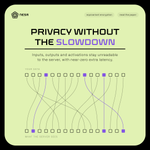
Privacy usually costs speed, which is the usual reason it gets skipped.
Fully homomorphic encryption keeps data hidden during computation, at a heavy performance cost.
Our Equivariant Encryption paper takes another route.
📍 Inputs, outputs and intermediate activations stay unreadable to the server running the model, and the paper reports near-zero extra latency compared with unencrypted inference.
The paper also includes a threat analysis that lays out the attack vectors, so anyone can test the claims.

15
19
5,564
Nvidia agreed on September 3 to acquire Hugging Face, one of the most widely used hubs for open models.
Nvidia says the aim is to protect open-source AI developers. The dominant GPU vendor will now also own one of the main places open models are published.
For the person using those models, little changes.
With every inference-as-a-service player today, you still cannot check the proof for:
→ Which model answered a request
→ Who could read your prompt
→ What happens to your data
You trust whoever sits in the middle.
Open models only stay open if anyone can verify how they run, whoever owns the hub.
That takes an execution layer with no owner, where the network checks which model ran and keeps the data private.

12
13
8,533
The official NES migration portal is now live for eligible on-chain holders. See the article on the official Nesa website below:
nesa.ai/article/d8s9uv30
Please use only links shared through official Nesa channels.

Where you start building on Nesa depends on what you already have:
1. No model chosen yet?
→ Use the Playground on our website
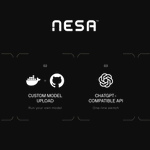
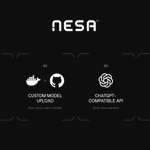
2. Your own model?
→ Use custom model upload
3. An app that uses the ChatGPT format?
→ Use the ChatGPT-compatible API
4. A TypeScript project?
→ Use the SDK
Learn more below 👇

3
15
11,095
Where you start building on Nesa depends on what you already have:
1. No model chosen yet?
→ Use the Playground on our website
2. Your own model?
→ Use custom model upload
3. An app that uses the ChatGPT format?
→ Use the ChatGPT-compatible API
4. A TypeScript project?
→ Use the SDK
Learn more below 👇
---
2/
📍 The Playground
Browse the on-chain model catalog by modality and task, compare each model's latency and usage, and try models before you commit to one.
The catalog spans text, image, video, audio, 3D, bio and multi-modal models.
3/
📍 Custom model upload
Register your own model through the Build on Nesa flow with a Docker image or GitHub repo
Plus its metadata and visibility settings, and it runs on the network.
Maintaining more models requires Nesa Pro, with up to 5 active custom models.
4/
📍 The ChatGPT-compatible API.
If your app already uses the ChatGPT format, moving it to Nesa is a one-line change.
The query and output stay unseen on every request.
5/
📍 The TypeScript SDK on GitHub (nesaorg/ai-sdk-ts).
It manages AI sessions and sends inference requests to over 100,000 models
In the browser or in Node.
Install it with npm install @nesaorg/ai-sdk.

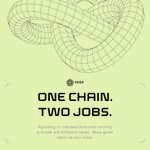
An AI chain should not ask every node to do the same job
Agreeing on transactions is one kind of work, but running a model is another, and it asks for more computing power.
Nesa gives each its own node type:
⬟ Validators handle consensus
⬟ Miners handle inference
You pick one when you set up with the official bootstrap script.


NES trading across exchanges will resume on Thursday, September 10 with exact time to be announced soon.
From that time forward, reference the revised canonical NES Token CAs below:
Ethereum: 0x863F08A3d3B14fbD3D42fFD061D0e290F7dBC538
BNB Smart Chain: 0x097acf27503753e77bCA940277806156C5925B81
Base: 0x2E968fB88998a6303535Ac637C809119ECAd4a4b
Arbitrum: 0x8cAd676141FeadB6aCA5eF661E835d5957644033
HyperEVM: 0xdFC12a5cF04Bc91BE4aF0E3Bc46A3CDADB1f86Af
Solana: EFuxu8VZJJvWZohJgjsbgXvRifySusuMv7FmSEvzDRoz
For on-chain token holders, a NES migration portal will guide you through claiming your token. Note the below snapshot block heights:
Ethereum: 25822581
BNB Smart Chain: 117742359
Base: 50377812
Arbitrum: 497772766
HyperEVM: 44010284
Solana: 441313281
Stay tuned as further details and announcements are finalized!
Deployment and migration of the revised NES token CA across exchanges is underway.
Upon integration completion, you may refer to the following canonical NES CAs:
ETH: 0x863F08A3d3B14fbD3D42fFD061D0e290F7dBC538
BSC:
0x097acf27503753e77bCA940277806156C5925B81
Stay tuned for important news and updates and for our official announcement of migration completion.