

Official X account for the Authors of Ops Normal - The Authorised Operational History of the Army Air Corps 1957-2017
Over The Battlefield
Joined September 2018
- Tweets875
- Following153
- Followers827
- Likes2.7K


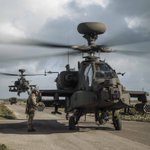



Interesting...

The U.S. Army is ordering up to 12 more UH-72B Lakota utility helicopters. Look familiar? If you’re seeing the 1960s West German MBB Bo 105, your eyes aren't playing tricks on you. The Lakota is the Bo 105's great-great-grandson (Bo 105 > BK 117 > EC145/H145 > UH-72). Good engineering never dies.


1
58
The evolution of the Attack Helicopter... – at Stonham Aspal, England
When HMLA-169 "Vipers" were stood up at Camp Pendleton in 1971, "light attack" meant fast, agile, visual-range close air support with early single- and twin-engine Cobras. The modern AH-1Z transformed that mission, turning a traditional light attack gunship into a networked, all-weather, multi-role strike and air-to-air platform for the Marine Air-Ground Task Force (MAGTF). Just look at those chomps!

3
101
Amazing flying in the most challenging conditions... – at Stonham Aspal, England

The L-ist of the LGOPs
On November 28, 1944, LTC Norman Tipton, executive officer of the 511th PIR, was lead jumper and stick pusher when he parachuted from an L-4 liaison plane (basically a two-seat Piper Cub) into a narrow clearing in the mountains of Leyte to take command of forward elements of the regiment. This one-man stick was just part of an interesting relationship between the 11th Airborne and the unlikely jump platform.
Leyte's steep trails, thick jungle and relentless rain made moving men and supplies through the mountains a miserable undertaking. Resupply missions using C-47s had to be requested 24 to 48 hours in advance, and the larger aircraft had considerable difficulty hitting the small DZs tucked between the mountains.
While the little L-4 could carry only about 200 pounds of cargo, its size, speed and maneuverability allowed pilots to take advantage of brief breaks in the weather and make remarkably accurate supply drops. It also gave the 11th Airborne the ability to quickly put individual Paratroopers where they were needed.
Tipton's jump was the first of many. Among those who followed were engineers tasked with constructing a small airstrip on the Manarawat plateau. By December 3, the first L-4 had landed there.
Getting men into the mountains was only half the problem. Getting wounded Soldiers out presented an entirely different challenge.
With a little ingenuity and a piece of plywood, the Angels converted one of the two-seat Cubs into a flying ambulance, fitting a litter that extended from behind the pilot's seat into the fuselage. Wounded Soldiers could now be flown back to San Pablo and transferred by ambulance to a hospital.
According to the division's after-action report, carrying a single litter patient from Manarawat to Burauen would have required eight to twelve litter bearers, additional men for security and two days on the trail. In all, 46 patients were evacuated by air from Manarawat.
Paratroopers dropping into WWII combat zones generally conjure up images of C-47 formations filling the skies with thousands of canopies. It was a bit different for the Angels on Leyte. Sometimes, it was one at a time.


36
Ops Normal - AAC History retweeted

Monty famously declared Operation Market Garden 90% succesful, what about the unsuccesful 10%? Join me at the Army Flying Museum, Middle Wallop on 15 March 2027. I will be examining the reasons behind the failure of the most ambitious Allied Airborne operation of WW2.

Ops Normal - AAC History retweeted

The resupply planes are over the DZs and dropping a new @hamandjampod episode. Take a listen as @MikeHistorian and @airbornemedic23 start the Next Round with an Arnhem chat in the Horsa & Groom.
Ops Normal - AAC History retweeted

The perfect Christmas gift patreon.com/thechalkcollecti…
@assaultglider @PilotRegiment @GPRSociety @MikeHistorian @ArmyAirCorps @Horsa44 @HorsaProject @NAM_London @IWMDuxford @Oorlogsmuseum

Ops Normal - AAC History retweeted

In 1965, the British photographer Larry Burrows captured the 1st Cavalry Division's huge helicopter base at An Khe, in Vietnam's Central Highlands. The soldiers called it "the Golf Course."
The 1st Cavalry was the U.S. Army's first airmobile division. Instead of trucks and tanks, it moved its troops into battle by helicopter. It arrived in Vietnam in September 1965 and set up its base on a strategic highway between the coast and the highlands.
The base needed a landing area for hundreds of helicopters, and the advance party cleared it largely by hand with machetes and axes.
Their commander, Brigadier General John M. Wright, wanted the brush cut down without bulldozers, leaving the grass and roots in place to keep dust down that could ruin helicopter engines.
The result looked like a vast, neatly trimmed green, and the nickname stuck. At the time, it was one of the largest heliports in the world.
That November, the division flew out from the area into the Ia Drang Valley for its first major battle against the North Vietnamese army.
Burrows photographed the Vietnam War for Life magazine for nearly a decade. On February 10, 1971, he was killed with three other photographers when their helicopter was shot down over Laos.
The most unforgettable images from the Vietnam War:
bit.ly/44wtsok

Ops Normal - AAC History retweeted

This scene at the National Infantry Museum recreates LZ X-Ray, the landing zone from We Were Soldiers, where one Huey pilot flew in 22 times in a single day.
On 14 November 1965, Lt. Col. Hal Moore's 1st Battalion, 7th Cavalry landed in the Ia Drang Valley and came under attack from North Vietnamese regulars within hours. It was the first major test of the 1st Cavalry Division (Airmobile), formed that July from the 11th Air Assault Division (Test) at Fort Benning, the same post where the museum now stands.
When medevac flights stopped, Maj. Bruce Crandall and Capt. Ed Freeman kept flying their unarmed Hueys in with ammunition and out with wounded: Crandall 22 times, Freeman 14. Both received the Medal of Honor more than 35 years later.

Fabulous image... – at Stowupland, England

I love photography and this is the reason why.
There are times you snap that one photo 📷
taken at @mod_dio Holbeach Air Weapons Range. Army Air Corps Wildcat Helicopter
@ConingsbyUk #avgeek #aviation #aviationphotography @peter_levy @RNASYeovilton

1
45
Ops Normal - AAC History retweeted
A big thank you to RHQ AAC for circulating my appeal for information from 672 Sqn veterans on their time in Iraq. We had a great response and the manuscript for Ops Normal Volume 2 is pretty much ready for proof reading. Publication next summer...


Ops Normal - AAC History retweeted

A close-up of a Taiwanese AH-64E looking every bit as menacing as it was built to be. The AH-64Es form the heavy-hitting core of Taiwan's 125+ attack helicopter fleet, which includes AH-1Ws and OH-58Ds. In a conflict, these gunships would serve as a mobile ambush force, hiding in dispersed terrain before popping up to shred landing craft and beachhead armor with Hellfire ATGMs. I bet this toothy Apache won't be a welcome sight for anyone coming ashore!


Ops Normal - AAC History retweeted

@1_Regt_AAC at @mod_dio Holbeach this week with their Wildcat Helicopter
#AvGeek #aviation #aviationphotography @ConingsbyUk


Ops Normal - AAC History retweeted
Here we are @hamandjampod PATREON listeners! Early release. The lads are back in the Horsa & Groom to discuss everything Arnhem with our panel @MikeHistorian and @airbornemedic23. The listeners asked their Arnhem questions, and @Horsa44 and Andy let the experts answer.

If you served in Iraq on Op Telic with 672 Sqn AAC we really need to hear from you. Please get in touch and contribute to Ops Normal - The Official Operational History of the Army Air Corps. – at Bexley, London

Good to see 847 NAS out and about... – at Bexley, London

Royal Navy Wildcat crews earn their qualifications on a month away from Yeovilton 🚁
Some of 847 Naval Air Squadron’s Wildcat crews arrived in Scotland having never fired either of their helicopter’s guns.
The Royal Navy reported on 12 November that the squadron had taken its air and ground crews to the Cromarty Firth for four weeks, with the Tain range giving them space to train in daylight and after dark.
The Wildcat crews also trained alongside RAF Typhoons, Royal Marines, Army gunners and a US Air Force crew.
The month included a joint exercise at RAF Kinloss and a simulated casualty evacuation, putting the squadron’s ability to support others to a broader test.
The crews returned to the Commando Helicopter Force at RNAS Yeovilton, with some newly qualified on the Wildcat’s weapons and others having renewed their qualification.
For those first-timers, a month on a Scottish range changed what their squadron could ask of them.

2
76
Ops Normal - AAC History retweeted
Turn your sound up!
Watch (and listen to) the venerable Agusta-Bell 47 Sioux AH.1 start up, with the "Sioux Whisperer" Stephen Murray-Twinn at the controls.
With over 8,000 hours on type, there’s nobody who knows this aircraft better.
Enjoy
youtu.be/gJF_u3gD1DQ?si=wz2n…


Ops Normal - AAC History retweeted

@av8r97 commissioned this during a European tour. Reminds me of when we were following a Hawk through the Alps. Weather rolled in, they went IFR & disappeared. We weren't authorized. Low on gas, we landed on a glider strip on the side of a mountain. Just another day in the Alps!
