

Professor @NYUStern; Director @NYUSternCFM; former Obama CEA Senior Economist for tech & innovation; research on AI, robots, entrepreneurship, strategy
NYC
Joined February 2009
- Tweets20.4K
- Following3.2K
- Followers6.8K
- Likes24.5K





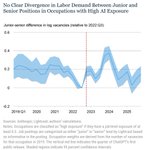


Yet more evidence that AI is changing how we work, not eliminating jobs.


Rob Seamans retweeted

Average hourly earnings rose a bit more quickly, up 0.4 percent from September and 3.1 percent from a year earlier. But that still almost certainly lagged behind inflation on a year-over-year basis. (We get updated CPI data on Tuesday.)
Rob Seamans retweeted
U.S. employers added 165,000 jobs in October and the unemployment rate ticked down to 4.1 percent.
Data: bls.gov/news.release/empsit.…
Full coverage: nytimes.com/live/2026/11/06/…
Rob Seamans retweeted
Payroll employment rises by 165,000 in October; unemployment rate changes little at 4.1% bls.gov/news.release/empsit.… #JobsReport #BLSdata
Rob Seamans retweeted

It's Jobs Day!
I will be on Bloomberg Radio/Youtube with @tomkeene and @ptsweeney at 8:25 am ET youtube.com/watch?v=f39oHo6v…

Rob Seamans retweeted

1/ Exciting news. The @uscensusbureau has started asking US firms whether *their employees* are using generative AI for work-related tasks, not just overall business AI usage.
We'll get data every 2 weeks.

Rob Seamans retweeted

1. US business sector productivity growth was 2.1% over the year ending 2026 Q3. That's solid.
2. If you think of trend productivity growth as ~1-1.5%, we running +0.5-1pp higher at the moment. Again, that's good news.
3. For perspective, at the height of the dot com boom (1999-2000), productivity growth was running about +2pp higher annually. This premium had completely faded by ~2005. So we're at 1/4 - 1/2 of peak dot com boom effect.
4. I would put next to no weight on quarter-to-quarter productivity growth. It's very noisy.
5. Productivity growth was stronger in 2023, when AI capabilities were far lower but AI capex was accelerating precipitously. That should tell us something.
6. There are probably other factors besides AI affecting short-run measured US productivity as well, including knock-ons from US policy choices made during the pandemic, the high-churn labor market of 2022, and large shifts in immigration flows.
7. Measures of TFP growth from Fernald and BLS are weak, suggesting to the extent AI is a factor, it's not primarily through task- or worker-level productivity effects (but TFP has to be estimated so take it with many grains of salt).
More from @Stripe Economics here:
stripeeconomics.com/p/ai-and…


Evidence is growing that we’re turning the corner on productivity.
US productivity grew at a 3.6% annual rate this past quarter.
That’s more than double the 1.5% average from 2007-2019.
The new numbers put me further ahead for my bet with Bob Gordon about productivity growth in the 2020s. 💪
Here’s how far the US is now ahead of the CBO estimate at the start of the decade (before they knew about the pandemic or LLMs) courtesy of @jasonfurman’s
Econvitals.

Rob Seamans retweeted

A few high-level notes on the paper:
1. We ask where the marginal value of work AI cannot yet do may rise as AI speeds up the rest of the job.
- Such work can become a bottleneck, especially where more of the surrounding tasks in a job can be done by AI.
We call this "bottleneck pressure."
2. Using a task-based framework, we show that for an AI-infeasible task, this pressure is simply the exposure of the occupation posting it.
- So you get a new, theory-derived measure that potentially shows where AI could raise the marginal value of work it cannot yet perform.
3. The magic happens at the task level. The same task has different bottleneck pressure in different jobs.
4. To take this measure to the data, we map 288 million U.S. job postings from 2018 to mid-2026 to O*NET tasks and use their GPT-4 feasibility ratings from Eloundou, @sj_manning, Mishkin, and @danielrock's "GPTs are GPTs" (2024).
5. O*NET can be a very coarse proxy for advertised work.
- About 90% of the task mentions matched from postings fall outside the posting occupation's own O*NET list, although those statements themselves come from O*NET.
6. Indeed, about 53% of mention-weighted variation in pressure on AI-infeasible work lies within tasks, across occupations.
7. In every year, AI-infeasible tasks within occupations faced more pressure, on average, in senior than junior postings, about 6.5 percent more in the first half of 2026.
8. Over the full sample, mean occupation pressure rose from 17.6 to 18.7, or by 6 percent, about 75% from task mentions shifting toward higher-pressure occupations.
(Thank you to @robseamans for pushing me to do 7 and 8!)
Overall, reporting bottleneck pressure alongside exposure shows where improving the work AI cannot do may pay off more as capabilities expand.

Very happy to share a new paper, “Technology Bottlenecks: Measuring Where AI Could Raise the Value of Work It Cannot Yet Do.”
AI exposure measures ask about the work AI is capable of doing. We ask instead where the marginal value of work AI cannot yet do may rise as AI speeds up the rest of the job.
To do so, we employ 288 million U.S. job postings mapped line by line to their closest O*NET tasks and GPT-4 feasibility ratings from Eloundou et al. (2024) to construct a measure, “bottleneck pressure,” for each task in each occupation that posts it.
Using a simple task-based framework, we derive this pressure at the task level, showing that for an AI-infeasible task it is the exposure of the occupation that posts it, so the same task can face very different bottleneck pressure in different jobs.
Reporting bottleneck pressure alongside AI exposure shows both the scope for AI to perform work and where improving the work it cannot do may pay off more as capabilities expand.

Rob Seamans retweeted

New paper with @ProkopetsJake and Raymond Kim!!
Every scientific paper has TWO teams.
One is listed on the title page.
The other is invisible: colleagues who challenge ideas, catch mistakes, and help make the research better.
Our new paper suggests AI may be making that invisible team smaller.🧵

Rob Seamans retweeted

“I don’t want to be just sitting there for two years vetoing everything.”
President Donald Trump picked up a call from @DashaBurns on POLITICO Elections Live and talked to us about the blue wave and how he’s willing to work with incoming congressional Democrats.
Watch live now: politi.co/4AgCofb


Rob Seamans retweeted

Important, but not unexpected, finding that experts working with AI agents are swayed by the positions of the AI, even if they think they are working independently.
If your independent judgement matters on a task, you need to be deliberate about when in the process to use AI.


Rob Seamans retweeted

Couldn't be happier to have @BharatKChandar join our growing Economics of Frontier AI team at GovAI! And equally thrilled that he'll be leading the AI Economic Indicators work at @DigEconLab
If you aren't already following the indicators project, check it out here: digitaleconomy.stanford.edu/…


Happy to share I am now Research Director for AI Economics and Policy at @DigEconLab. As part of new role I will be leading the AI Economic Indicators.
I am also now a Research Fellow at @GovAIOrg. I'm excited to work with them on most important questions in econ of AI.
🎄Christmas has come early!🎄
I have an important message for everyone. It is that Christmas has come early this year, and you get subscribe to @jasonfurman 's new Econvitals!
Jason's charts are awesome, as is his insight.
I've signed up, and I hope you do too.
🎁🎁🎁🎁

Rob Seamans retweeted

Some thoughts about academia, AI, and marketing science. This is an invited commentary based on my recent appointment as an ISMS Fellow. 1/3
pubsonline.informs.org/page/…
Rob Seamans retweeted
Delighted to see the engagement by @RonnieChatterji on this new measure to capture "bottleneck pressure" in tasks and jobs. He and researchers including @Alex_M_Richmond, @daveholtz, @sonnytambe are regularly doing some of the coolest and most novel work in the space of AI and organizational economics.
I would really like to start emphasizing here the amazing work done by so many people at The Burning Glass Institute. I'm hesitant to mention names because I worry I will miss someone :) None of this would be possible without their diligence and care. Doing the kind of mapping we employ in the paper is a huge lift and I am amazed to see the care and expertise with which this has been done.
Our paper starts off with a somewhat counterintuitive framing: how can AI raise the value of something it cannot even do?
The answer lies in complementarities! (check out @lugaricano's book on "Messy Jobs" too, as you will find echoes of this theme there as well!)
The same task can have very different pressure depending on tasks that surround it (Figure 1 from the paper attached). And, how bottlenecked a task is rises in proportion to how much the rest of the job is exposed to AI.
There are several advantages that immediately become clear from the detailed mapping we leverage:
(1) First, we can measure bottleneck pressure at the task level and aggregate up to jobs
(2) Second, we find that about 90 percent of labeled matched task mentions lie outside the posting occupation’s own O*NET task list.
This really makes the postings to task mapping a powerful tool to go beyond what could be achieved by just the O*NET catalog.
Even leaving aside the new work and tasks that AI is creating (which is important to study, and we are!), just the occupation-specific catalog itself misses so much of what the jobs have been asking for.
As AI permeates work, I am hopeful that economists and AI researchers will find this measure useful to report alongside exposure measures, as together they can show:
(1) the scope for AI to perform work and
(2) where improving the work it cannot yet do may pay off more as AI capabilities expand.
PS - The paper ranks many tasks as well as all occupations on the O*NET catalog by this "bottleneck pressure" index. Please check it out!


Many measures of AI exposure ask what AI can do.
This paper asks a different question: where could AI make the remaining human work more valuable?
This is an important distinction. The same task can become a bottleneck in one occupation and not another. Looking inside jobs may tell us much more than assigning an exposure score to the occupation as a whole. This is something my team is working on and I love seeing other studies working on it as well.
Rob Seamans retweeted

A good example of why full automation is never just a matter of AI hitting some capability threshold — how do robotaxi companies deal with riders passed out, having medical emergencies, giving birth (!), vomiting, pooping, or just leaving without closing the car door? Some combination of first responders, remote workers, ground staff, and gig workers, apparently! jalopnik.com/2214767/waymo-r…
