Samar B. (@samar) header
Samar B. (@samar) profile picture

Founder, Growth Investor, building for the agent economy at https://teapawt.org/t.co/NiLUIom1zv

San Francisco, CA
Joined February 2011
Photo by Samar B. (@samar)Photo by Samar B. (@samar)Photo by Samar B. (@samar)Photo by Samar B. (@samar)Photo by Samar B. (@samar)Photo by Samar B. (@samar)Photo by Samar B. (@samar)Photo by Samar B. (@samar)Photo by Samar B. (@samar)Photo by Samar B. (@samar)
Hark's 5% card is more of a retail loyalty story than a fintech one and retailers should be paying attention... @Target spent years getting people to carry the Circle card, @amazon did the same with Prime Visa, both pay 5% but only in their own store. Hark pays 5% on pretty much anything its agent buys. So if the agent is doing the reorder and holding the rewards, what is the store card actually doing anymore? My guess is retailers end up paying agents for placement to get back what their card used to do for free
Introducing Hark Card A digital card with 5% cash back on nearly every purchase with Hark Limited to 10,000 U.S. based members. Ask Hark for the card or join the waitlist and see terms: harkcard.com
93
Most of the talk about agent accuracy is about the model, but this new paper has the more interesting finding IMO. When the models got a product wrong they often picked the SAME wrong product, and asking them to think harder mostly just made them more sure of themselves (9/10ish). Which tells you the problem is upstream in the listing/catalog data they're all reading... a better model reads the same bad listing the same wrong way, just with more confidence
1
21
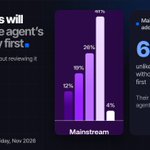
Most shoppers won't let an AI buy without checking first. @Okta: 67% of mainstream adopters say unlikely. Good news for brands, until it's clear what shoppers check: the agent's 3-line summary of the price, pack and offer. That summary is the Cyber Monday product page.
2
39
In a small Core dna test, ChatGPT's store prices were wrong about a third of the time, often a marketplace seller's price passed off as the store's own. 5 checks before Friday: price after discount, pack sizes, offer terms in text, agent files, the answer itself.
1
26
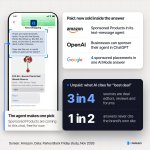
Amazon, Google and OpenAI all put ads inside the AI answer within the same two weeks. You can buy the slot. You can't buy what the answer right above it says about your price. And that answer is mostly written by deal blogs.
30
Almost everyone building agentic commerce gets paid when a transaction clears. Merchants get paid on what happens after it: margin, repeat purchase, lifetime value. That mismatch is the real story of this holiday season.
4
2
52
Agent startups, wallets, payment networks, settlement layers: all optimizing for the fastest path to a completed order. None of them carry margin, bundles, member pricing or the relationship. That context doesn't live in the order endpoint.
1
22
Meta's Muse now makes 59% of AI agent requests on retail sites, 3x ChatGPT's agent (HUMAN Security). Two months ago it barely registered. 85% of visits hit product and search pages. Under 2% reach checkout. @Meta has your ad budget. Now it's reading your product pages too.
3
1
69
Data: HUMAN Security's October agentic traffic report, requests across the retail sites it protects: humansecurity.com/learn/blog…
29
Mashable (@mashable) showed up in more AI Black Friday answers than Best Buy, Walmart, Target or Amazon. Apple's own site: 0 of 33 answers about AirPods, iPad and Apple Watch. Your Black Friday deal is whatever the deal blogs say it is.
1
77
The brand sites that did get cited had a Black Friday page built for this week: @Samsung, @PlayStation, @Bose and @Dyson. PlayStation's was cited in every PS5 answer. 275 answers, 25 of this year's big gifts, five assistants.
50
The timing (right after Friday market close) feels pretty sus
The @FAAnews issued a nationwide ground stop for all U.S. airports following a communication issue impacting all Air Route Traffic Control Centers. FAA technicians are investigating the issue. We will provide immediate updates as we have them.
161
This is the ridiculous line to get into the @AnthropicAI event at @SFTechWeek This is the third event this week where the line is longer than the event itself. I guess the agi people never learned how to plan something that involves actual human people.
3
2
8
1,169
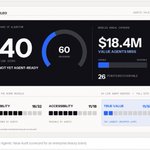
We pointed our audit at a DTC brand most operators would call sharp: clean site, strong loyalty program, real budget behind promotions and member perks. It came back 40 out of 100, with about $775K a year in modeled exposure: value the brand actively funds that AI shopping agents never see. What stood out is how typical that is. The better your incentive machinery, the more of your value is invisible by default, because you have built more things an agent cannot read. The store with no loyalty program has less to lose. The brand running tiers, points, and funded seasonal deals has its advantage sitting in the dark. Today the Agentic Value Audit is live. Point it at your store and you get: - Your score out of 100 on the Share of Algorithm framework (Visibility 32, Accessibility 18, True Value 50) - Where the points leak, ranked by what each fix recovers - The modeled dollar exposure sitting behind the gap How it works: 24 live ChatGPT shopper queries in your category, plus a full crawl of your site, reading exactly what an agent can read. Each True Value dimension is scored twice: what your pages encode, and what agents actually said. Those two disagree constantly, and the gap between them is the diagnosis. Free, with no email gate between you and your number. You see your score before we ever see your name. If you run Profound or Bluefish, keep them. They track whether you are mentioned. This measures whether your price, member value, and deals survive when you are. And for the gaps that need encoding, we built TrueSync. It declares your member value and live deals into the standards agents transact on, so the value you already fund stops evaporating on the way to the customer. Run yours at audit.parleo.io (link in the comments). If the report gets something wrong about your store, tell me. That is the comment I want most.
4
238
Ask ChatGPT to find the best deal on something you sell. For most brands it quotes the list price, the worst number on the page, to the exact shopper you built member pricing for. We ran our benchmark on the grooming category, and 1 in 31 AI mentions of the category leader cited any incentive at all. The deals are live and funded. The channel cannot see them. Commerce has seen this movie three times, and it always ends the same way: somebody names the new score, and the budgets follow it. When the fight was for physical shelf space, Share of Shelf became the number everyone managed to, and an $8B measurement industry grew up around counting facings. When broadcast made attention the scarce thing, Share of Voice did the same, $12B+. When discovery moved into a search box, Share of Search became the metric underneath $200B+ a year of spend. Every time the shelf moved, the old metric stopped explaining who wins and a new one took the budget. The shelf is moving again, toward what McKinsey sizes at about $1T of US agentic retail by 2030, and this shift has no score yet. So today we are naming the fourth one: Share of Algorithm, 100 points, three pillars, nine dimensions, one straight sum. **Visibility (32 pts):** are you in the room when shoppers ask? Today's GEO tools track this well. Keep them. **Accessibility (18 pts):** can agents get in and parse what you sell? Table stakes, mostly a checklist. **True Value (50 pts):** does the value behind your price survive into the answer? Price truth, member value, deal citability, value protocols. Nobody else measures any of this. Half the score sits on True Value on purpose. The first two pillars decide whether you show up. The third decides what the agent says your product costs, and that is where the money is: $200B+ of US trade promotion and ~$69B of retail media a year, funded to move shoppers, evaporating before it reaches the channel where the most price-motivated shoppers now start. Two pillars are table stakes. The third decides whether your value reaches the answer. The full framework is public today, every point inspectable, link in the comments. Tomorrow we're launching a powerful way for a brand or store to audit their own number.
2
173
Amazon just told a federal judge that Perplexity shopping agent shows the wrong prices. And Amazon still lost. Most of the coverage framed it as an access fight: can agents crawl Amazon or not. The sleeper issue is deeper in the opinion. Amazon had to prove real harm, and its best argument was basically: the agent might not pick the best price, shipping, or product. That’s Amazon saying an AI can’t reliably quote Amazon’s own prices. The court shrugged. Said it was too speculative. No injunction. If you sell anything online, don’t miss the takeaway: you can’t sue your way into being priced correctly by agents. If Amazon can’t prove the damage, you won’t either. “Block the bots” is not a strategy. The only lever you have is what the agent can actually read when it lands on your site: real price, promos, inventory, shipping, all machine-legible. Go ask an agent what your best product costs. Whatever it answers is the price your customers are hearing.
2
128
How agents actually pick the "best price" ChatGPT doesn't just quote prices anymore, it awards its own "Best Price" tag. Profound's June pass through about a million shopping offers found the rule: products arriving through a structured merchant feed get that tag 100% of the time, versus 21% when the machine has to scrape the page, and feed-sourced offers take the top slot in the answer 99.9% of the time. Rank is mostly a function of what you handed the machine. If your products still reach agents by scraping, shipping the structured feed is the cheapest rank you'll ever buy. It still won't carry your member prices, which is the harder half. We pointed our own benchmark at the grooming category and the miss sits at the very top of the market: 1 in 31 mentions of the category's best performer cited any incentive at all, and every brand below it did worse. The deals are funded, live on the sites, and structurally absent from the channel where the most price-motivated shoppers now start. For example, a jar of Augustinus Bader face cream at Nordstrom cost five different amounts over the last 27 days, and which one you paid came down to which card is in your wallet. Anniversary Sale pricing had it at $423.75. On Sunday the sale ended and it went back to $565, a $141 swing! But the sale price wasn't one price either: cardholders at Icon status could buy on July 14, Ambassadors on the 15th, Influencers on the 16th, everyone else waited until the 18th. It gets more interesting! Free loyalty members earned points and got no early access at all. Nordstrom even prints the after-sale price next to the sale price, so a machine can read both numbers and still can't tell you which one applies to you, because the answer lives in your card status, not on the page. Every rule of that flywheel is printed on the page and none of it is resolvable by a crawler, because the answer lives in your card status, not in the markup. Retailers can feel the collision coming: two weeks ago 41% of multichannel organizations told Salesforce that inconsistent pricing and promotions is their #1 omnichannel failure point, and only 2% reported no failure point at all. The agent didn't create that inconsistency, it just reads it out loud to every shopper who asks. Being visible in the answer and being chosen by it are two different problems, and almost every tool on the market measures the first one. At Parleo (Honey for agents) The yardstick we've built for the second comes next.
1
150
Incentives are becoming pricing rails in agentic commerce. $19.99 or $11.69? Chewy publishes both for the same bag of dog treats, on purpose. In the eyeball era, incentives were a marketing line. Points, member pricing, card-linked offers, subscription discounts. Brands funded them to nudge behavior and mostly treated them as a cost of doing business. At Parleo (Honey for agents) we strongly believe that in the agentic era incentives become pricing infrastructure, probably the last lever that protects margin without torching MAP or racing everyone to the bottom on list price. One bag of Greenies, four published prices, same page: – $19.99 list – $17.98 if you buy once – $17.08 on autoship – $11.69 on your first autoship order That spread is deliberate pricing design, the low price buys a subscriber and the lifetime value pays for it, margin traded for loyalty on purpose. It's beautiful work. So we asked ChatGPT what the bag costs, and it answered fast and confidently: $19.99. True, and also the worst of the four published prices on that page. The agent saw the top of the ladder and stopped, and the machinery Chewy built to turn margin into LTV never made it into the answer. As a retailer or brand, I'd run that same test on your stack, every tier, every member price, every card offer you fund: how much of it can an agent actually see? For most brands the answer is almost none, and the money behind that answer is not small, $200B+ a year of US trade promotion funding the deals, another ~$69B of retail media buying the banners on top, and agents bypass both sides of that coin. The brands that win agent channels will be the ones whose member prices and deals the agent can actually read, because that's what protects the margin AND rewards the customer you already invested in. More tomorrow.
1
1
2
145
The internet and e-commerce are being rebuilt for a customer that isn't human. And people are already using AI that way. 46% of AI shoppers use it to compare prices and find deals. The problem is that every price in a ChatGPT comparison table is usually a list price. No member price, no card-linked offer, no loyalty math, just the number sitting at the top of the page. At Parleo (Honey for agents), we think that one detail is a critical part of what's reshaping e-commerce right now. The internet retail runs on was built for eyeballs. Twenty years of storytelling, PDPs, banners, badges and urgency copy, all designed to influence what a person sees and buys. Now it's being rebuilt for agents that read feeds and APIs and skip almost all of it. The proof is in how big tech and the frontier models are behaving. OpenAI launched Instant Checkout last fall and killed it by March. Walmart put 200,000 products in, watched conversion run about three times worse than its own site, pulled them, then rebuilt inside its own walls, where its agent can see your membership, promotions and fulfillment, and is now posting 35% bigger baskets. The models are interchangeable. The context is the variable. And the shift has stopped being theoretical. Salesforce found shoppers starting purchases with agentic search up 200% year over year. Adobe tracked AI-referred shoppers converting 23% worse last Prime Day and 50% better this one. McKinsey puts US agentic retail at about $1T by 2030. Here's where it gets more interesting: Trade spend funds the offers, rewards and discounts brands run at retail. Retail media buys the banners and sponsored listings layered on top. Agents bypass both. They don't see the banner, and they can't read the deal you funded. That gap, what actually survives the trip from your pricing stack into the agent's answer, is where we've been building for the past 6 months. I ran a pretty simple version of this test recently. Asked ChatGPT to find the best price for a Patagonia Down Sweater Hoody. It picked the cheaper list price. But once you factor in the member benefits and funded offers the agent couldn't see, the more expensive retailer was actually the better deal. That's a pretty meaningful problem if your best customers are the ones getting those offers in the first place. This week we're going to share a little more about how we think about it, and one thing we made.
1
3
209
Awesome summary of why deepseek is a big deal!
This quoted post is unavailable.
1
285
VCs competing to fund these nouveau edgelords like it’s a reverse Hunger Games
The Silicon Valley dream: burning VC money to launch a chatGPT wrapper so you can get invited at podcasts to discuss your AGI timeline and become a Grimes reply guy
1
263
These kind of teardowns are why I'm spending more time on X. Good luck finding this investigative analysis on LinkedIn. Great work @RobertMSterling, surprising details I had no idea about! E.g. 10x the 85k limit/year is just nuts! How has this gone unnoticed for so long!?
H-1B DATA MEGA-THREAD 🧵 I downloaded five years of H-1B data from the US DOL website (4M+ records) and spent the day crunching data. I went into this with an open mind, but, to be honest, I'm now *extremely* skeptical of how this program works. Here's what I found 👇
264
Day 2 with @rabbit_hmi. The scroll wheel has me feeling like texting on a flip phone in 1999! Meanwhile, my 4yo has recruited it as his sidekick, asking Q's, & demanding stories of Spidey meets Blippi with him as the star. Would this be better off as an intro to AI for kids? If the glove fits...
1
1
627
So, here's a doozy. $24bn spent on homelessness in CA, amd the number of homeless has actually GONE UP! This is California's grand attempt to tackle homelessness. And yet, our taxes are going through the roof. Is this some sort of twisted magic trick? Nope, just our tax dollars poofing away. wsj.com/articles/california-…
1
382