

The U.S. government’s agency for cancer research. Part of @NIH. Engagement ≠ endorsement. Questions about cancer? Reach us here: https://teapawt.org/t.co/yQAi9x4Obg
- Tweets25.4K
- Following4.2K
- Followers226K
- Likes5.8K




ALT A blue-gloved hand holding a test tube of blood that has been labeled for a PSA test, diagnosis for prostate cancer.


ALT A text graphic reads, \"iCURE Timeline: Application Cycle Opens October 5, 2026. Application Due Date November 30, 2026. Reference Letter Due Date December 7, 2026. Notification of Acceptance June 1, 2027. Program Start Date Early September, 2027.\" A second text graphics reads, \"Benefits of a summer internship: Opportunities to work closely with world-class biomedical research scientists at NCI. Professional and career development opportunities to prepare scholars for next stesps, including pursuing advanced degrees, seeking mentorship, and gaining experience in leadership roles or specialized fields, ultimately fostering growth as independent invgestigatoris and leaders in their respective disciplines. Connections to an extensive and sustained mentoring network, including a cohort of peers and near-peers. Support from NCI program staff, as well as information and resources on intramural and extramural funding opportunities.\"

ALT NCI's Dr. Jack Shern stands with congressional briefing panelists and young adults with NF.

ALT A medical scan of rhabdomyosarcoma in black and white. Below, text reads, \"NCI researchers are developing a new approach to targeting rhabdomyosarcoma.\"

ALT Text Reads, \"Promising results in mice: After more than 2 decades studying a potential drug target, NCI's Dr. Javed Khan and his team developed an experimental drug that shrank rhabdomyosarcoma tumors or made them disappear in mice. For Khan, who led the research, the results stood out: 'Ive been doing this for 30 years, and I've never seen such incredible responses.' ~Javed Khan, MD. Deputy Chief, Genetics Branch. Center for Cancer Research, NCI.\"

ALT Text reads, \"A targeted approach: Rhabdomyosarcoma is a rare and aggressive cancer that begins in immature muscle cells, most commonly in children. NCI researchers targeted a protein, FGFR4, that helsps cancer cells grow and is mostly absent from healthy cells. To target the protein, they developed antibody-drug conjugates, which consist of a monoclonal antibody chemically linked to a cancer-killing drug.\"

ALT Text reads, \"Promising results in mice: When delivered, the antibody binds to FGFR4, enters the cancer cell, and releases its attached drug. The antibody drug shrank rhabdomyosarcoma tumors or made them disappear in mice. The findings also suggest potential against other cancers with FGFR4. The researchers hope clinical testing soon to evaluate safety and effectiveness in people.\"


ALT At the top, a picture of the building front of the National Cancer Institute. On the botom, white text on a blue background reads, \"Vacancy Announcement. Deputy Director, Center for Global Health, NCI. National Cancer Institute.\"

ALT This image shows a set of radiation and status warning indicator lights in a medical linear accelerator (Clinac) or radiation imaging room.

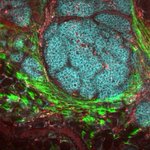
ALT This image of a breast cancer tumor and its microenvironment shows tumor cells in cyan, macrophages in red, collagen fibers in green.

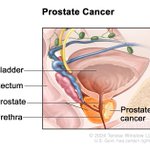
ALT Prostate cancer; drawing shows cancer in one side of the prostate. Also shown are the bladder, rectum, and urethra.\n\nProstate cancer forms in the tissues of the prostate (a gland in the male reproductive system that lies just below the bladder and in front of the rectum). Image Credit: Therese Winslow

ALT Three-dimensional structure of HIV infected (blue, green) and uninfected (brown, purple) T cells interacting. One cell (brown) has wrapped an extension around its uninfected neighbor (purple) to reach an infected cell (blue). Data from focused ion beam scanning electron microscopy (FIB-SEM).

ALT Photograph of a TMA slide and a highly magnified sample of PDX tumor.

ALT An illustration of an antibody target closing in on a rhabdomyosarcoma cell.