

Author, TRUSTSHIFT (upcoming), The Business Blockchain. Ethereum Maxirealist. Entrepreneur. Researcher. Natural wines. Nutritarian. https://teapawt.org/t.co/5zfc94ppeP
Toronto, Canada
Joined November 2008
- Tweets22.2K
- Following2.3K
- Followers37.5K
- Likes29.9K







Pinned Tweet
Ethereum generates about $5.7 trillion of value for the economy built on it.
The market prices ETH at $246 billion. That’s 4.3% of it.
Today I’m publishing the second edition of my annual Ethereum-as-infrastructure valuation report. Here’s the essence of it.
1/ Ethereum is a public good, so value it like one
Nobody can buy shares in TCP/IP, yet the Internet is the most valuable infrastructure ever built. Its protocols charge almost nothing. Their value shows up everywhere except in their own revenues.
Ethereum is in the same position. Valuing it by its fees, or comparing it to a company, misses most of what it does. Last year I argued it should be valued the way we value the Internet: through what it enables, not what it charges.
2/ Three buckets, like the Internet
The Internet’s value comes in three parts: the companies built on it, the economic activity it carries, and the surplus people get for free. Ethereum maps onto the same three:
a) Ecosystem value: the assets and companies built on Ethereum, at market prices. $127B.
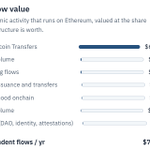
b) Flow value: the economic activity Ethereum settles, mainly stablecoins, plus trading, lending and tokenized assets. $70T a year of dependent flows, worth $3.0T.
c) Trust surplus: what users would pay for trust in the traditional system, minus what they pay on Ethereum. Custody, reconciliation, settlement delays, counterparty risk. Worth $2.6T.
Add a small credit for the EVM standard used by other chains, and Ethereum’s system value comes to about $5.7 trillion.
3/ Every rate is anchored to something real
I didn’t want numbers that look picked to land somewhere. So:
Ethereum is credited by using Visa’s take on the payments it carries, about 0.3%. Visa is the richest settlement network on earth, so that’s a ceiling, not an average.
The trust cost removed is 25 basis points, weighted toward wholesale settlement rather than expensive retail payments.
Annual values are capitalized at 7%, assuming Ethereum’s activity never grows from today. For a network that has grown every year, that’s deliberately conservative.
4/ ETH’s market cap is the benchmark, not part of the total
This is the biggest change from last year. Counting ETH inside the total would double count. So the model compares what Ethereum enables with what the market pays for ETH.
For every $1 the market pays for ETH, Ethereum generates about $23 of value for the ecosystem built on it.
5/ But ETH shouldn’t be worth all of it
Part of that value belongs to others: L2 tokens, DeFi protocols, shares in Robinhood, Circle and Coinbase, a stake in Tether. And public goods never capture everything they enable. That’s the whole point of them.
So the real question is: what share can ETH capture?
The Internet gives us an answer. The companies built on it are worth roughly 10–20% of the economic value it creates. Apply the midpoint, 15%, to Ethereum, and ETH would be worth about $7,000. That’s 3.5× today’s price.
Today the market credits ETH with less than 5%. Under half the low end of the Internet’s range.
6/ The number that’s hardest to argue with
Forget the capitalization multiple entirely. Each year, Ethereum enables about $389 billion of value. That’s 1.6× ETH’s entire market cap.
Ethereum enables more value every year than the market currently pays for ETH in total.
7/ What’s new: a live model you can challenge
This year the report isn’t static. Every figure comes from a live dashboard that refreshes hourly from public sources. You can inspect every input and formula, and use simulation mode to change the assumptions.
I wanted a model anyone could check and challenge. If you disagree with an assumption, change it and see what happens. valuation.ethmrc.com/
8/ What it isn’t
It’s not a price target, and it’s not a forecast. It’s a snapshot of today, measuring the gap between what Ethereum enables and what ETH is credited with. Either ETH’s capture of its own ecosystem rises toward Internet-like levels, or the market is pricing in that it never will.
That’s the debate this framework makes explicit.
The Internet reorganized information. Ethereum is reorganizing trust.
Full report: ethmrc.com/valuing-eth-2026/
PDF: ethmrc.com/valuing-eth-2026.…
Live model: valuation.ethmrc.com/
An expanded version will appear in my upcoming book, TRUSTSHIFT: Ethereum and the Reinvention of Trust. trustshiftbook.com/

ALT Ethereum Generates $5.7 Trillion of Value
So in the past few days, the US experienced 1/ an email outage, 2/ a router swap breakdown, 3/ a banking software halt.
What’s common? Central systems.
In the meantime, Ethereum kept humming, block after block.
J.P. Morgan's Kinexys and MIT's Digital Currency Initiative published a discussion paper on open blockchains for institutional finance. Ethereum comes on top against their criteria. No surprise.
Prediction: Bank networks will be “open, not public”: anyone meeting published criteria may validate, no one may be refused by discretion, and every one of them will settle to Ethereum.

ALT JP Morgan / Kinexys / MIT DCI Institutional Blockchain Requirements.
There were at least 17 people that could have discussed ETH as a Store of Value with common sense.
No, instead, @laurashin prefers to have someone else talk about it, as if they are experts.
teapawt.org/Unchained_pod/status/2…
17 on this thread:
teapawt.org/ethlabs_org/status/212…

Just popping this up, from 2 weeks ago, as it just happened. I hate it when I'm right in this case.
teapawt.org/wmougayar/status/21161…

Sadly, this is likely reality, following the $6.3B Binance hack, Ethereum (ETH) might face a volatile 30-to-90-day. With the Lazarus Group holding 420,000+ unfreezable ETH, analysts project a grinding downturn testing psychological floors between $1,800 and $2,000 before a macro recovery can begin.
A resulting thinned order book liquidity and 5x wider bid/ask spreads mean ETH will remain highly sensitive to localized spot-selling walls through November and December. While capital flight to on-chain DEXs offers a slight cushion, ETH might likely lag behind Bitcoin until the criminal dumping pressure exhausts itself in early 2027. #Ethereum #Crypto #Binance
More onchain Ethereum institutional adoption.
Invesco just made Ethereum the backbone of regulated stablecoin reserves.
Its Stablecoin Reserves Onchain Fund (IROXX), effective Nov 13, holds the Treasuries backing payment stablecoins, and its official shareholder register lives on Ethereum.
This is not a wrapper. It is infrastructure in play. $ETH
The best part of this development is that Invesco's own lawyers put the word "onchain", no hyphen- into an SEC filing as the plain-English explanation of what a Designated Blockchain record is. The term has moved from crypto vernacular into a registered fund's legal disclosure. And the prospectus calls Ethereum a "permissionless, public blockchain":
"Ownership and transfer of the Fund's shares will be authenticated and recorded as a token on a permissionless, public blockchain (a "Designated Blockchain") (i.e., "onchain")."
This places Ethereum inside the reserve architecture of regulated stablecoins, not merely around their secondary trading. It is a concrete example of public infrastructure combined with regulated identity and transfer-agent control.
Once adopted, the fund connects stablecoin issuance, Treasury collateral and Ethereum-native ownership records in one product.

ALT Ethereum Invesco
Note: @SuperstateInc maintains blockchain-integrated records under Invesco’s transfer-agent oversight.
Ethereum records plus an offchain register connecting wallets to verified identities constitute the official shareholder register.
Eligible investors can submit blockchain-based transaction instructions and peer-to-peer transfers between allowlisted wallets.
Excellent recap of ETH as SoV week. It’s been a fun 5 days educating the world.
Any questions?
They are all answered 👇
William Mougayar retweeted

LIVE: Inside The Ethereum Institutional Forum in London teapawt.org/i/broadcasts/2zkVWpzlJ…

Spoiler alert for tomorrow: Second Annual Ethereum-as-Infrastructure Valuation Report drops. 👀
Stay tuned.
It's going to be a good one. And a new interactive tool to go with it. PDF, and release Friday morning EST.
William Mougayar retweeted

We're delighted to share Making Treasury ETH Productive: a data-driven look at the state of ETH treasuries
By @Kairos_Res, in collaboration with @golemfoundation & @ethereuminsti

In light of the pouring of support for ETH as programmable Store of Value, someone brought-up this piece I wrote last April. Worth a re-read.
ETH is not another coin. It is a special snowflake of the SoV kind. Start understanding ETH as it should.
teapawt.org/wmougayar/status/20411…

Introducing Ethereum Imperative.
A punchy site that distills the case for Ethereum and ETH into the messages that matter, with links to the ecosystem leaders and data sources that back them up.
Fun thread to scroll and share.
ethereumimperative.com

