

Physician-Scientist | Interv. Cardiologist • Assoc Prof | LI: https://teapawt.org/t.co/8xMjc8R0jY | Research https://teapawt.org/t.co/wRmIc8n1WD | Phys Lab: https://teapawt.org/t.co/msCi42lcHi | Troponin Lab: https://teapawt.org/t.co/YyobUedHth
- Tweets6K
- Following2.1K
- Followers4.9K
- Likes13.7K





ALT Four panels show time-to-event curves for the primary end point and Its components. Panel A shows Kaplan–Meier estimates of the cumulative incidence of target-vessel failure (primary end point), defined as a composite of death from cardiac causes, target-vessel myocardial infarction, or ischemia-driven target-vessel revascularization, at 12 months. Panel B shows death from cardiac causes. Panel C shows target-vessel myocardial infarction. Panel D shows ischemia-driven target-vessel revascularization.

ALT This image is a forest plot from a clinical study comparing CCTA-guided PCI to IVUS-guided PCI across various subgroups, such as age, sex, hypertension, dyslipidemia, diabetes mellitus, and others. Each subgroup has corresponding events/total numbers for CCTA and IVUS. The right side presents risk differences with a horizontal line indicating a 95% confidence interval for each subgroup. A vertical dashed line marks the zero point for better outcome comparisons.


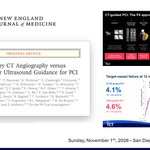
ALT A graph from the Original Article "Coronary CT Angiography versus Intravascular Ultrasound Guidance for PCI." The trial name, P4, is in parentheses after the title. The graph shows the cumulative incidence of target-vessel failure (primary end point), defined as a composite of death from cardiac causes, target-vessel myocardial infarction, or ischemia-driven target-vessel revascularization, at 12 months. The trial results are being presented at the Transcatheter Cardiovascular Therapeutics 2026 Conference. The logo of the New England Journal of Medicine is at the bottom.