

As a kid, I once sprayed a dude with a fire extinguisher🧯 | PhD on misinformation @arc_mpib @mpib_beriln | alumnus @UvA_Amsterdam @tcddublin 🤓 (he/him)
Berlin, Germany
Joined May 2012
- Tweets7.9K
- Following872
- Followers436
- Likes9K




Pinned Tweet
Who falls for online misinformation? A meta-analysis on demographic and psychological factors impacting misinformation susceptibility.
Preprint: osf.io/preprints/psyarxiv/7u…
My lovely coauthors: @AlanTump, Nina Ehmann, @lorenz_spreen, Ralph Hertwig, Anton Gollwitzer, @RalfKurvers 1/n

Mubashir retweeted

People in 26 countries prefer more control over their online environment.
Our conjoint study explores preferences for regulating online environments by examining binary choices between different regulation scenarios
osf.io/preprints/osf/haqu9
@fc_stock @kairuggeri
Mubashir retweeted

Microsoft's Computational Social Science group may have the opportunity to hire one researcher
Senior: 0-3 yrs post PhD
jobs.careers.microsoft.com/g…
Principal: 3+ yrs post PhD
jobs.careers.microsoft.com/g…
Please note: our ability to hire this season is not certain
Mubashir retweeted

Thrilled to share that the Handbook of Computational Social Science manuscript was finally submitted to the publisher in full! Huge thanks to all the authors and reviewers who made this possible.
Check out the Table of Contents!


Mubashir retweeted

🚨Our meta-analysis of the motives associated with conspiracy beliefs has been accepted at Psychological Bulletin!🚨“Reasons to believe: A systematic review and meta-analytic synthesis of the motives associated with conspiracy beliefs” osf.io/preprints/psyarxiv/rx…🧵👇1/16

ALT Abstract for our accepted pre-print of Reasons to believe: A systematic review and meta-analytic synthesis of the motives associated with conspiracy beliefs
Mubashir retweeted

🚨Job alert (in German)
We're seeking a student assistant for developmental studies on deliberate ignorance @arc_mpib @mpib_berlin !
Please see the link for details (deadline: January 17). We look forward to receiving your application!
mpib-berlin.mpg.de/1952948/s…
Mubashir retweeted

🚨 Call for Collaborators 🚨 Join our multi-country study on social preferences for political extremes funded by @TempletonWorld 🌍 We’re examining why people prefer extreme ingroups across multiple countries 🧠 Contribute to our project on political polarization! Details below👇

Mubashir retweeted

🌎 Fear of AI in 20 countries 🌏
Just published in American Psychologist:
Despite large variations of fear across countries and domains, we validated a unified psychological model.
Paper: doi.org/10.1037/amp0001454…
@APA showcase: tinyurl.com/4euzan7b
#ai #aiethics

✨New Preprint✨ tinyurl.com/AIFearPreprint
Fear of AI goes viral. Puzzle pieces are gathered about *why* in specific domains (e.g., doctor, judge, manager) and specific countries. Is there an overarching explanation across domains and countries? We tested a psychological model👇
Mubashir retweeted

As someone on the other side of this debate, it is interesting to see this defense of the claims that misinformation is both widespread and impactful. Actually, I don’t think there’s a lot of disagreement in some of the specifics. 1/
You’re unable to view this Post because this account owner limits who can view their Posts. Learn more
Mubashir retweeted

Want to challenge your biases and boost your logical reasoning? 🚀
Check out this fantastic website by my talented colleagues (@wimdeneys and @NinaFraniatte)! Dive into engaging videos that make logical reasoning accessible to everyone.
Available in English and French!

🧠Cogitum: Train your logical reasoning!
As part of our research in @lapsyde, @wimdeneys and I developed video-based training to boost sound reasoning 🎥 And we need your help to test it!
Try it anonymously (& share it!) in French or English here: cogitum-site.powerappsportal…
Mubashir retweeted

I would be grateful for the retweets. Open PhD position in my group to look at using cognitive computational Neuro approaches to understand motivation.

Funded PhD (UK students only). Interested in a PhD working in @MSNlab, co-supervised by @froemero1? Topic is flexible around themes of motivation and decision-making, using techniques such as computational modelling, brain imaging, or brain stimulation. tinyurl.com/543ucffd

Mubashir retweeted

New paper out in @ScienceMagazine! In 8 studies (multiple platforms, methods, time periods) we find: misinformation evokes more outrage than trustworthy news, when it does it's shared more + ppl are less likely to read before sharing. w/ @killianmcl1 @Klonick @mollycrockett 🧵👇

Mubashir retweeted

Dear colleagues, please circulate, I am looking to fill a PhD position in computational neuroscience - fully funded (3 years). Part of an international collab. (4 labs) to test and develop further computational models of episodic and spatial memory
cbs.mpg.de/psychology/neural…

Mubashir retweeted
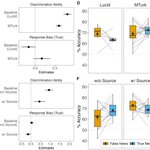
Study: Susceptibility to online misinformation: pnas.org/doi/epub/10.1073/pn…
"...older age, higher analytical thinking skills, and identifying as a Democrat are associated with higher discrimination ability."
"...political identity can shape what people perceive to be true, which can in turn shape their behavior."
"...a strong association between familiarity with a news headline and the likelihood that participants would believe it to be true, regardless of whether it was or not. Familiarity can easily be gamed online..."
by @RalfKurvers @nina_ehmann @lorenz_spreen et al. cc @VoiceOfFranky @STWorg @Sander_vdLinden @picardonhealth @MicrobiomDigest

Mubashir retweeted

(1/5) Very excited to announce the publication of Bayesian Models of Cognition: Reverse Engineering the Mind. More than a decade in the making, it's a big (600+ pages) beautiful book covering both the basics and recent work: mitpress.mit.edu/97802620494…

Very happy to share that our work is now published in PNAS (@PNASNews)! 🎉 It's a systematic look into how demographic and psychological factors are associated with misinformation susceptibility. @arc_mpib
Thread below and can be read in full here: pnas.org/doi/10.1073/pnas.24…


Who falls for online misinformation? A meta-analysis on demographic and psychological factors impacting misinformation susceptibility.
Preprint: osf.io/preprints/psyarxiv/7u…
My lovely coauthors: @AlanTump, Nina Ehmann, @lorenz_spreen, Ralph Hertwig, Anton Gollwitzer, @RalfKurvers 1/n
Mubashir retweeted

Out now in PNAS and led by the amazing @Abdulshir with a great team from @arc_mpib @mpib_berlin, our systematic meta-analysis of individual factors for misinformation susceptibility:
pnas.org/doi/10.1073/pnas.24…

Mubashir retweeted

🚨New preprint 🚨
**A computational model of reward learning and habits on social media**
🧵
We develop a computational reward learning model of real-world social media data, which infers the separate goal-directed and habitual cognitive processes driving posting...

Mubashir retweeted

1/7: 📢 New pre-print alert! @mrocklage, Mohsen Mosleh, @DG_Rand and I challenge the common belief that confidence is purely a driver of misinformation susceptibility. Our results show that confidence in specific judgments might actually improve truth discernment. A 🧵👇