

I run AIFLOW LABS. Daily Local AI brief: DGX Spark, open weights, desktop boxes. I also build robots. https://teapawt.org/t.co/bbTa7Fivjy
Phuket
Joined October 2023
- Tweets18.2K
- Following5.9K
- Followers4.5K
- Likes70.6K
Same Inkling prompt. 46 tok/s in Unsloth Studio, 4.6 in LM Studio.
@Zimo41650079726 ran UD-IQ3-XXS, drafter off, llama.cpp b12651 vs b12623.
I'd check the build in the app before I blame the model.
teapawt.org/AIFlow_ML/article/2125…
2
2
57


Who’s building a Thunderbolt 5 to ConnectX bridge for Mac Studio M5 Ultra + DGX Spark?
I want one cable between them, with proper macOS support.
I can bring local AI testers. Open to prototyping in Shenzhen and taking a working unit to Kickstarter.
3
3
183
115 ms per action chunk on a 5090. That's their number for 30 Hz control.
SANA-Robot is a 4.5B world-action model from NVIDIA labs and @yuyangzhao_. Same stack is 288 ms on Jetson Thor. On a real robot they stacked 83.6% of the Hanoi rings, vs 44.3% for π0.5. Vendor numbers.
I want that 115 ms timed on an arm in the lab before I trust the 30 Hz.
teapawt.org/AIFlow_ML/article/2125…
2
3
151
$ANT is in FAFO mode.
In a full reversal day they are still in the FTX 2.0 mode.
1
88

Official Ling-3.2-air recipe still wants four 141 GB-class GPUs for 256K. @Tech2Wild got 36.0 to 36.5 tok/s on one Spark with NVFP4, MTP on, after a 1K prompt. Their 228K try left 5.67 GiB free and a 6 GiB guard stopped it. I'd cap the window until a full prompt finishes.
1
1
133

Same Qwen3.8-27B, same 4-bit, one Spark. The MLX file starts a 128K answer 49 seconds sooner than EXL3.
@niklaslenz_ai measured both on TensorFold 1.3.4 + DFlash2. MLX 4-bit reads the prompt at 926 tok/s and waits 141.6 s; EXL3 waits 190.7 s. Sampled-code decode is 51.7 tok/s on MLX vs 50.7 on EXL3.
I'd pick the format by that long-prompt wait.
teapawt.org/AIFlow_ML/article/2125…

4
3
150

MLX 4-bit or EXL3 4.00bpw for Qwen3.8-27B on a DGX Spark? I ran both.
This is a file against file comparison. Both files hold the same model, Qwen3.8-27B, with 4 bits on both sides. One is an MLX checkpoint, the other an EXL3 pack.
I kept everything else equal. Both ran on Ash's TensorFold 1.3.4 with the same draft model and the same settings, each file on its own Spark.
Ash's recipe measures the 3.00bpw pack against MLX 4-bit. I wanted to add the pair with the same bit count.
The result in short: every quality gap sits inside the error margin, and writing speed has no clear winner. Reading differs. With MLX a 128K prompt starts 49 seconds sooner.
Ash's benchmark command, median of 15 runs, MLX 4-bit / EXL3 4.00bpw
Code, greedy: 68.0 / 79.1 tok/s
Chat, greedy: 52.0 / 47.0 tok/s
Code, sampled: 83.7 / 81.2 tok/s
Chat, sampled: 47.8 / 47.3 tok/s
His recipe lists the MLX checkpoint at 53.6, 50.0, 57.5 and 49.7 tok/s in these four cells.
Our standard speed test, sampled at 0.7, MLX 4-bit / EXL3 4.00bpw
Writing code: 51.7 / 50.7 tok/s
Writing prose: 45.4 / 41.4 tok/s
Without the draft model: 14.7 / 15.7 tok/s
8 requests at once: 122.5 / 108.1 tok/s
Reading the prompt, MLX 4-bit / EXL3 4.00bpw
2K tokens: 1,335 / 904 tok/s
32K: 1,216 / 839 tok/s
128K: 926 / 687 tok/s
Seconds until the first token
32K: 26.9 / 39.1
128K: 141.6 / 190.7
Quality, MLX 4-bit / EXL3 4.00bpw
MMLU-Pro, 400 questions: 58.25 / 59.25 %
GPQA, 198 questions: 44.9 / 42.9 %
IFEval, 200 prompts: 81.0 / 81.0 %
LiveCodeBench, 40 tasks: 42.5 / 50.0 %
Every quality gap sits inside the error margin. With 40 tasks, LiveCodeBench alone has a margin of about 15 points.
Writing speed has no clear winner. The EXL3 pack is ahead on greedy code, the MLX checkpoint on greedy chat, and sampled they are close.
The gap is in reading. The EXL3 pack reads at 68 % of the MLX speed at 2K and at 74 % at 128K.
That fits Ash's recipe. For the 3.00bpw pack it puts cold prefill at "about two thirds of the MLX checkpoint's bf16 prompts".
So at 4 bits on a Spark I'd take the MLX checkpoint for chat and for long prompts. The answers are as good and they start sooner.
For short code prompts at temperature 0 the EXL3 pack was the faster file here.
Setup: TensorFold 1.3.4, official release, DFlash2 drafts, one DGX Spark per file. Speed test and quality with a 135,168 token window, 8 streams, thinking off.
Files: TensorFold/Qwen3.8-27B-MLX-4bit, 14.95 GiB, and turboderp/Qwen3.8-27B-exl3 at 4.00bpw, 15.70 GiB
Method, Ash's benchmark: tensorfold benchmark, suite community-v2. It starts its own server, one request at a time, 256 tokens, sampled at temperature 1.0, 15 runs per cell.
Method, our test: median of 2 runs per prompt, 512 tokens, temperature 0.7, seed 42. Quality with a 4,096 token answer limit, 32,768 for LiveCodeBench.
TensorFold by Ash @ashxhart. EXL3 quant by turboderp @turboderp_. DFlash2 drafts by Inco AI @inco_ai. Model by Qwen @Alibaba_Qwen.
21
On one RTX 5090, Inkling 2 Mini waits 73.1 s after a 64K prompt. Qwen3.8-27B waits 24.7 s.
@niklaslenz_ai measured both as Unsloth UD-Q4_K_XL. I'd watch that wait on a 32 GB card.
teapawt.org/AIFlow_ML/article/2125…

3
3
122
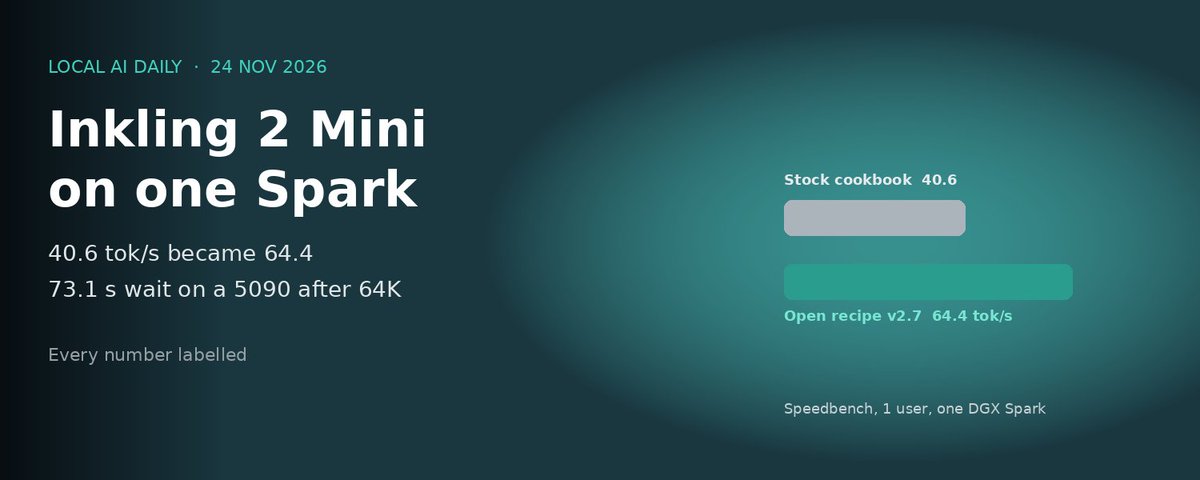
One Spark, same Inkling 2 Mini weights. 40.6 tok/s became 63.8.
@majewskizby's v2.7.1 SGLang + DSpark recipe, official NVFP4/MXFP8, GPU clock capped at 2200 MHz. Quality checks 30/30.
A 57% jump, and only the recipe changed.
I'll try this on ours next.
7
2
116
Source: github.com/knapcio/Inkling-2…

49
Now @JensenHuang remove the board immediately and add in there people that can actually run the business.
BREAKING: Nvidia reinstated Jensen Huang as CEO without consulting leadership, excluding interim CEO and CFO Colette Kress from the decision
1
93