Copernicus Marine (@CMEMS_EU) header
Copernicus Marine (@CMEMS_EU) profile picture

#CopernicusMarine Service provides products & services for #marine applications. Funded by #EU @CopernicusEU, Implemented by @MercatorOcean

Toulouse, France
Joined July 2015
Photo by Copernicus Marine (@CMEMS_EU)Photo by Copernicus Marine (@CMEMS_EU)Photo by Copernicus Marine (@CMEMS_EU)Photo by Copernicus Marine (@CMEMS_EU)Photo by Copernicus Marine (@CMEMS_EU)Photo by Copernicus Marine (@CMEMS_EU)Photo by Copernicus Marine (@CMEMS_EU)Photo by Copernicus Marine (@CMEMS_EU)Photo by Copernicus Marine (@CMEMS_EU)Photo by Copernicus Marine (@CMEMS_EU)
#CopernicusMarine are adding an extra 30 years of ocean state to our catalogue with the new physics reanalysis system: CIGAR. Until now, existing datasets for monitoring the physical state of the #Ocean via Copernicus Marine only reach back to 1993. The CIGAR system changes that. Soon, researchers and policy-makers will be able to reconstruct the past state of the ocean back to 1961, pulling together six decades of continuous #OceanData from pre-satellite monitoring through to modern systems such as the Argo floats. For users, this means: ⏰A longer baseline to measure long-term environmental changes ⏰Longer monitoring capabilities for polar and #Climate ⏰Backbone data for training AI models for climate and ocean modelling Find out more: marine.copernicus.eu/news/no…
1
2
9
310
Freely available data from #CopernicusMarine can support researchers and policy-makers in assessing the changing state of our ocean, from its physical state to its biogeochemical state. Our #GreenOcean data products enable users to: 🪸Assess #OceanAcidification in the global ocean 🟢Explore the distribution of plankton throughout surface waters ⌛Reconstruct past #Ocean state up to 45 years back 🌍Forecast potential pH, oxygen and nutrient levels across the globe This biogeochemical data, constructed via ocean modelling, satellite observations and in situ measurements, supports scientists analysing long-term trends for marine food webs and enables more informed decision-making around the creation of conservation tools such as #MarineProtectedAreas. Explore the data in a nutshell: marine.copernicus.eu/service…
3
263
#CopernicusMarine has added three new data resources to its roster, enabling policy-makers, researchers and civil society to better understand our changing #Ocean. From November, explore the CIGAR reanalysis system that reconstructs six decades of ocean state from 1961 to present day, dive into new carbon datasets on Particulate Organic Carbon and Dissolved Organic Carbon, and track changes in #OceanAcidification through global and regional time series of mean hydrogen ion concentrations. More detail in our latest article: marine.copernicus.eu/news/no…
1
5
305
Last week, #CopernicusMarine attended the World Conference on Marine Biodiversity @wcmb2026 to explore the importance of #Ocean monitoring and forecasting in supporting #Conservation of marine life. Throughout the week, we were reminded of the importance of collaborating with partners across Europe to build a stronger shared understanding of marine ecosystems, and how long-term ocean change threatens them. Having attended the Final Stakeholder Workshop on the #NECCTON project earlier in the week, where we explored how connecting NECCTON's data on marine ecosystems with Copernicus Marine's Blue and Green Ocean data can enhance policy-making around marine conservation in regional and global seas. @MercatorOcean @vliznews @EMODnet @CLS_Group
4
257
NECCTON and European Ocean Science are being featured in the final episode of #BBC #BluePlanet3, Future Seas! In this episode, NECCTON-associated scientific modelling outputs will showcase 70 years of ocean pollution as a data visualisation created by Johannes Bieser tracks the spread of #PFAS #ForeverChemicals through the ocean from 1950 to 2020. Making this invisible pollution visible, #NECCTON data can track the spread of contaminants across ocean basins and reveal the scale of environmental pressures. These advanced marine ecosystem modelling capabilities will soon be integrated into the #CopernicusMarine Service, supporting our evolution and improving our Green Ocean data capabilities. Tune into @bbcstudios's Blue Planet III to explore Future Seas. NECCTON and Copernicus Marine are implemented by @MercatorOcean. Image by Ocean Image Bank.
3
626
Missed our latest #OceanSessions training? Catch up via the recording to explore how to access and analyse Copernicus Marine data in Python. Our latest #Webinar supported 971 students, researchers and technical users in accessing, tailoring and exploring data available through the #CopernicusMarine Toolbox in #Python and Jupyter Notebook Featuring Earth Observation experts from NOVELTIS and @MercatorOcean, the session provided hands-on experiences for participants to explore data through #Arctic case studies. Recording: youtube.com/watch?v=lK_P-9uH…
2
2
271
Session begins this afternoon! Discover how to access and use ocean data from the @CMEMS_EU in a webinar dedicated to the Portuguese-speaking community! 🇵🇹 Register here: lnkd.in/eV9BbXS3 #oceanscience #environmentalmonitoring #blueeconomy #copernicusmarineservice
1
90
#SeaIce extent during the Arctic’s maximum in March has declined by 2.5% per decade since 1993, with summer extent having not returned to levels seen before 2007. The Arctic is vanishing, and so is Earth’s UV mirror. As the #Arctic loses its sea ice, the dark #Ocean waters underneath are revealed, absorbing 90% of the solar energy that reaches the Earth. This absorption is speeding up warming of the Arctic Ocean, accelerating global #ClimateChange and increasing sea ice melt, resulting in an ice-albedo feedback loop. The 10th #CopernicusMarine Ocean State Report revealed stark findings from the Arctic, reminding us of the region’s change from a cooling system to a heating system. Learn more in #OSR10: marine.copernicus.eu/access-…
6
1
17
639
The 7th #WorldConferenceOnMarineBiodiversity @wcmb2026 starts today, marking a milestone moment halfway through the #UNOceanDecade to assess progress towards protecting marine biodiversity. Ensuring effective decisions and strong conservation efforts requires strong data. #CopernicusMarine's Green Ocean data provides insights on chlorophyll, plankton, nekton, pH, oxygen and nutrients to support such work, while the #NECCTON project can provide modelling for marine food webs, fisheries, pollution and benthic habitats to strengthen informed decision-making. Experts from @MercatorOcean, implementers of Copernicus Marine, are joining the conference to explore how Green Ocean data, NECCTON and the EU Digital Twin Ocean (@edito_dto) can better support future biodiversity protections. Explore our Green Ocean data: marine.copernicus.eu/service…
8
22
709
The latest Ocean Temperature Bulletin sees October 2026 become the warmest October on record for the global ocean, hitting an average sea surface temperature of 21.01°C. The latest Bulletin, created by @MercatorOcean using #CopernicusMarine data, revealed new insights into the changing state of our ocean across #SSTs, #MarineHeatwaves and #ElNiño: 🌡️Above-average SSTs affected 75% of the global ocean 🌡️42% of the global ocean experienced marine heatwaves in October, with 10% experiencing heatwaves lasting the entire month 🌡️El Niño continued to strengthen in the tropical Pacific, with coastal areas of South America seeing temperatures up to 6°C above average Explore: mercator-ocean.eu/bulletin/o…
2
29
49
1,592
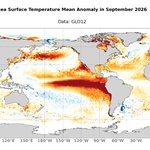
This year’s El Niño is set to become one of the strongest in modern history as it looks to strengthen further into 2027. The result of changing ocean temperatures in the #Pacific Ocean, #ElNiño brings warmer waters to the coast of the Americas, trapping colder water and nutrients in the deep and resulting in major changes to global climate. #CopernicusMarine’s sea surface temperature anomaly dataset allows us to track in real-time the changing state of our #Ocean. By harnessing this data on the MyOcean Light viewer, we can see the building of El Niño in the eastern Pacific. Explore: data.marine.copernicus.eu/vi…
2
41
4
147
6,427
#BluePlanet3 brings us two episodes with a focus on #OceanCurrents: "Open Ocean" and "Polar Waters" track currents moving nutrients and marine life through ocean basins to reveal how interconnected our waters truly are. Data available through #CopernicusMarine enables real-time tracking of currents across the globe, from the #GulfStream to the Antarctic Circumpolar Current. With a simple click on MyOcean Light, you can watch in real-time as currents move throughout the #Ocean, creating a mesmerising illusion. Simply click "Currents" on MyOcean Light and watch the world go by. Explore: data.marine.copernicus.eu/vi… 🎥 Movement of ocean currents around the Sargasso Sea and North Atlantic ocean basin, a focal area of Blue Planet III’s “Open Ocean” episode. Visualised using the “Sea water velocity” dataset on MyOcean Light.
5
18
805
How does #CopernicusMarine enable researchers and policy-makers to better understand our #Ocean? Through our #BlueOcean datasets, users can explore the changing physical state of the ocean, across: 🌊Salinity 🌊Ocean currents and velocity 🌊Waves 🌊Wind 🌊Sea surface temperature 🌊Sea levels Explore the data in a nutshell: marine.copernicus.eu/service…
3
6
473
Junte-se ao Serviço Marinho Copernicus e à ColabAtlantic num webinário especial destinado aos usuários de língua portuguesa do Serviço Marinho Copernicus! Neste webinário único, com a duração de duas horas, ajudaremos os participantes à acessar, explorar e visualizar os dados do Serviço Marinho Copernicus. Através de casos de utilização reais, de uma apresentação dos produtos, ferramentas disponíveis e uma breve formação prática, os participantes poderão explorar Copernicus Marinho para as suas necessidades específicas. Tanto os usuários atuais, como aqueles que pretendem começar a utilizar o serviço são bem-vindos à juntar-se a nós para explorarmos as possíveis utilizações dos dados para a investigação, o monitoramento ambiental e a economia azul. Observe que este webinário 𝘀𝗲𝗿𝗮 𝗿𝗲𝗮𝗹𝗶𝘇𝗮𝗱𝗼 𝗲𝗺 𝗽𝗼𝗿𝘁𝘂𝗴𝘂𝗲𝘀, sem tradução, e ocorrerá no dia 𝟭𝟵 𝗱𝗲 𝗻𝗼𝘃𝗲𝗺𝗯𝗿𝗼 𝗱𝗲 𝟮𝟬𝟮𝟲, 𝗮𝘀 𝟭𝟰𝗵𝟬𝟬 𝗪𝗘𝗧. events.teams.microsoft.com/e… #CopernicusMarine #Mare #ColabAtlantic #Webinário
2
247
Join #CopernicusMarine and ColabAtlantic in a special Portuguese webinar introducing users to the Copernicus Marine Service. Featuring real-world use cases, a presentation of available tools and hands-on training, participants will explore the uses of Copernicus Marine data for research, environmental monitoring and the #BlueEconomy. Please note this #Webinar will be 𝗵𝗲𝗹𝗱 𝗶𝗻 𝗣𝗼𝗿𝘁𝘂𝗴𝘂𝗲𝘀𝗲, with no translation, and will run on 𝟭𝟵𝘁𝗵 𝗡𝗼𝘃𝗲𝗺𝗯𝗲𝗿 𝟮𝟬𝟮𝟲 𝗮𝘁 𝟮𝗽𝗺 𝗪𝗘𝗧. Register today: events.teams.microsoft.com/e…
1
4
287
#CopernicusMarine data can turn #Ocean science into actionable insights for policy-makers, as two new studies show us. A recent paper in Water harnessed our data on sea surface temperatures to create a program that could forecast daily sea temperatures in the #MarmaraSea up to 60 days in advance. Another paper in JGR Oceans @theAGU harnessed chlorophyll-a, ocean mixing and sea surface height data to explore phytoplankton abundance in North Atlantic and North Pacific gyres, revealing a past overestimation of 1.4%. Read the papers: 🌡️ mdpi.com/2073-4441/18/21/267… 🟢 agupubs.onlinelibrary.wiley.… 📷Changing concentration of chlorophyll-a in the North Atlantic, Nov 2025 to Feb 2026, generated using MyOcean Pro.
5
12
519
🗾 EDITO is heading to Yokohama, Japan, for the DITTO International Summit 2026, taking place from 11 to 13 November! 🌊 More information: edito.eu/event/ditto-summit/ #DITTOSummit26 @CMEMS_EU @EMODnet @MercatorOcean @VLIZnews @SeascapeBelgium
1
113
Congratulations to "Seal of Approval" for winning the Copernicus Marine Hackathon 2026 with @UltrahackHQ and APelago. We are so pleased to announce the winner of the #Hackathon, "Seal of Approval", a forecasting system designed to support monk seal conservation in Madeira. The program combines #CopernicusMarine tide and wave data with real footage of coastal caves, supporting conservationists to determine the optimal times to safely visit caves during fieldwork. Congratulations also to our runners-up, "Sagara Silt Shadow", and "Team Atlantics" for their incredible solutions to key #Ocean challenges. Read the full news release: marine.copernicus.eu/winner-…
1
4
14
450
Antarctic sea ice saw below-average coverage during its maximum in September, the latest #OceanHealth Bulletin reveals. July to September saw major records broken in our #Ocean, across sea surface temperatures, #MarineHeatwaves and #SeaIce. The latest Ocean Health Bulletin breaks it down: 🧊Arctic sea ice extent reached its minimum in September at just 4.003 million km2 🌡️July, August and September 2026 were warmest on record, beating previous years’ records for these months 🌊#ElNiño drove coastal anomalies exceeding 6-degrees Celsius in the Equatorial Pacific by September 🌊Global marine heatwave extent hit a record each month, hitting 32% in September Explore: marine.copernicus.eu/bulleti…
1
3
265
UN Ocean Prediction State Report is out now! Featuring 27 peer-reviewed papers, and visualisations using #CopernicusMarine data, the report highlights the systems, individuals and tools behind #Ocean monitoring and forecasting. Co-coordinated by @OceanPrediction and @MercatorOcean, alongside other partners, the report's interactive summary reminds us of the importance of #OceanPrediction to enable informed decision-making and adaptation to a changing world. unoceanprediction.org/opsr/ Full report produced by OceanPrediction DCC in collaboration with OceanPredict/FORESEA, DITTO and OceanPractices. Summary produced with the Harpoon Story Engine co-developed by OceanPrediction DCC and Mercator Ocean International.
1
4
12
548