

Connecting Data, People & Ideas since 2016. Using relationships, meaning, context in Data to achieve great things #KnowledgeGraph #GraphDB #AI #SemTech
The World
Joined April 2016
- Tweets6.4K
- Following2.5K
- Followers7.1K
- Likes2.4K


Pinned Tweet
“If you are in the AI industry, you need to come here to see how the work we are doing is going to help you.”
These words from Tara Raafat, Head of Metadata Strategy at Bloomberg, capture something important about Connected Data London.
Tara has been part of this community since its early days. At #CDL26, she reminded us why the work of the connected data community matters well beyond its own boundaries.
As AI moves into the enterprise mainstream, the need for meaningful data, context, knowledge and trusted connections becomes increasingly important.
That's what this community has been working on for a decade.
Connected Data London celebrated its 10th anniversary in 2026, bringing together practitioners, researchers, technology leaders and innovators for two days of knowledge sharing, technical discussions and, perhaps most importantly, genuine community.
And the conversations went well beyond the sessions.
From Knowledge Graphs, Graph AI and Semantic Technology to the emerging role of graphs in enterprise AI, our speakers and participants brought decades of experience, fresh perspectives and practical insights to the table.
But don't just take our word for it.
Hear from Tara and other members of the community, including William Tunstall-Pedoe, Nicole Moldovan, Gurpinder S. Dhillon, Vinay Balasubramaniam, Jessica Talisman and George Anadiotis.
🎬 Watch the Connected Data London 2026 highlights:
youtube.com/watch?v=8V3UEo2j…
Missed a talk at #CDL26? Or missed the whole thing?
✅ Attended? Replay access is included in your ticket.
🎟 Couldn't make it? Get the All Access Remote Pass for permanent on-demand access to the recordings and materials from both days:
2026.connected-data.london/
Ten years of connecting data, people and ideas. And a lot more to explore together.
Thank you to everyone who made #CDL26 what it was, and to our speakers, sponsors and community partners for being part of the journey.
#KnowledgeGraphs #GraphAI #GraphRAG #AgenticAI #SemanticTechnology #EnterpriseAI #ConnectedData
Unifying Regulatory Compliance and Corporate Governance: A Graph-Based Approach to AI, Cybersecurity, and Policy Management
In today's complex business environment, organisations face a triple challenge: adhering to rapidly changing AI regulations, maintaining cybersecurity compliance, and aligning with internal corporate policies.
This talk introduces an innovative solution using graph databases to create a unified framework for managing these interconnected domains. We'll explore a comprehensive approach that extends beyond regulatory compliance to encompass corporate policy management, demonstrating how graph databases can transform complex texts into actionable, interconnected data structures.
Attendees will gain insights into:
- Techniques for converting regulations and policies into graph structures
- Leveraging graph queries to extract relevant compliance and policy information
- Visualising relationships between regulations, security controls, and corporate policies
- Identifying potential conflicts or overlaps between different requirements
- Through live demonstrations, this talk illustrates how a unified graph-based approach enables organisations to streamline compliance efforts, enhance policy management, and make informed decisions in the rapidly evolving landscape of AI and cybersecurity.
Join us to discover how graph databases are revolutionising the way organisations approach regulatory compliance and corporate governance, offering a powerful tool for navigating the complex interplay between external regulations and internal policies.
youtube.com/watch?v=pcnWEABo…
--
Matt Adams. Head of Security Enablement, Citi
Matt is the Head of Security Enablement at Citi, where he is responsible for enabling the secure adoption of disruptive technologies such as GenAI, DLT/Blockchain, and Quantum Cryptography.
--
Welcome to Connected Data London's #ThrowbackThursday
Every Thursday at 3pm GMT, we are releasing gems from our vault on #YouTube
Tune in and learn from leaders and innovators; subscribe to our channel and watch premieres as they are released!
#knowledgegraph #graphdatabase #graph #AI #datascience #analytics #semtech #ontology

2
145
Knowledge Graphs Can Change How Organizations Share Meaning. Building and Maintaining Them Is the Hard Part
The enterprise challenge is to make explicit the conceptual models already scattered across schemas, taxonomies, data dictionaries, reference tables, and spreadsheets that only one person trusts.
The goal: systems and people that stop arguing over what "customer", "product" or "contract" means.
LLM-driven chat, search and agents can now make semantic structure useful well beyond data teams. A good knowledge graph acts as semantic reference data, describing:
• What things are
• How they relate
• What they are called in different systems
• Which rules matter
The conversation can then move from "Where is the data?" to "What does the business mean by this?", "Which systems disagree?" and "What is the impact if we change this?"
The groundwork is decisive. Given a chaotic underlying model, an LLM will produce fluent chaos: confident, plausible and wrong.
The work that often goes unbudgeted:
• Reconciling competing definitions across teams
• Understanding data oddities that reflect business history
• Recording the reasons behind modeling choices on identity, state, time and synonyms
• Keeping mappings current as the business evolves
• Maintaining privacy, security and contractual guardrails
A unified model is a living agreement between humans.
For enterprises, the pragmatic route is rarely one model for everything. It is usually semantic agreement where it pays off most, plus explicit mapping elsewhere. For startups, early investment in a coherent domain model can create a compounding advantage.
Two questions to ask at the outset:
1. What pain is being removed right now?
2. Who will still care enough to maintain this in two years?
By Thilo Hermann
Knowledge Graphs: The Real Game Changer … but Hard to Build and Maintain sbee.link/vfucky4qjg
#EnterpriseArchitecture #SemanticTechnology #LLM #DataGovernance #DataManagement
--
Missed a talk at #CDL26? Or missed the whole thing?
All talk recordings are now available.
With so many ideas and speakers, nobody could catch them all live. We’ve got you covered.
✅ Were you there? Replays are already included in your ticket.
🎟 Couldn’t make it? Get a remote ticket for permanent on-demand access to every talk.
👉 sbee.link/6rdejcnbt4?utm_sou…
Recorded live at Connected Data London 2026 | 11–12 November | Leonardo Royal Hotel London Tower Bridge
#CDL26 #KnowledgeGraph #GraphRAG #Ontology #AI

Connected Data retweeted

Who is ready to work with ontologies?
Format aside, AI agents have a semantics problem, not a reasoning problem, Thilo Hermann argues. Autonomous agents need more than a prompt, a model, and a workflow engine to do useful work in an enterprise. They need a data foundation that lets the agent understand what something is, what it means, and how it should be exchanged.
Without that separation, agents quickly become impressive on the surface and unreliable underneath. That is exactly why the distinction between a canonical data model, an ontology, and a knowledge graph is not an academic detail. It is a practical requirement for any serious autonomous agent setup.
Ontology is the guardrail, not the prompt, Anthony Alcaraz chimes in. People keep collapsing three layers into one: Schema is how your data is stored. Columns, types, tables. Ontology is what your data means. Entities, relationships, constraints. A knowledge graph is the ontology instantiated: real entities and edges you can traverse.
John Beverley defines ontology engineering as the discipline concerned with constructing machine-interpretable artifacts designed to systematically disambiguate information, improve information quality, and facilitate information interoperability.
J Bittner explores what does an ontology actually do for a business. In plain English, a formal ontology makes a system’s assumptions (what counts as a customer, an approval, an obligation) explicit and machine-processable. Value shows up once it’s wired into actual work, not as a standalone artifact.
Jessica Talisman claims that while ontologies are hyped, most organizations are not ready to work with ontologies. Before the AI boom, ontology work was typically the job of one overstretched specialist. Now, the pressure runs the other way: flattening ontologies to fit existing pipelines, vector indexes or chunked corpora, which strips out the very dimensionality that makes them useful.
Generative AI can produce a plausible-looking class hierarchy in seconds. Verifying it takes as long as building it right the first time. Talisman’s throughline: description is the deliverable. Not the reasoner, not the graph store, not the axioms – the discipline of writing down what things actually are, in language both people and machines can use.
--
📩 Excerpt from The Year of the Graph Autumn 2026 newsletter
Read "# Meaning, Traversal, Reasoning, Action: The Graph Stack for Agentic AI" with more sections, references and attribution here 👇
yearofthegraph.xyz/newslette…
All things #KnowledgeGraph, #GraphDB, Graph #Analytics / #DataScience / #AI and #SemTech

🎥 The recordings from Connected Data London 2026 are now available on demand
This is the opportunity for the global community to watch the full programme, and for in-person attendees to catch every parallel Masterclass, Lightning Talk, and Presentation they missed.
Across two days of practitioner-led sessions, four core themes defined the conversation:
1. Grounding AI in Deterministic Reality
Moving past naive vector search and ungrounded models toward Neurosymbolic AI, GraphRAG, Model Context Protocol (MCP) servers, and verifiable reasoning.
2. The Semantic Renaissance & Data Engineering
Bridging the historic divide between data pipelines and formal meaning—from our opening 25 Years of the Semantic Web fireside chat to modern RDF standards and agent-oriented ontologies.
3. Scaling and Governing Enterprise Knowledge
Practical lessons on crossing the chasm from isolated pilots to governed semantic layers across finance, life sciences, manufacturing, and hyperscale cloud infrastructure.
4. Frontier Architectures & Honest Benchmarks
Unvarnished looks at local agent memory, physical robotics assembly graphs, just-in-time entity resolution, legal-grade provenance, and empirical RDF framework benchmarks.
🔓 Why watch on demand?
• Catch every parallel track: Gain full access to all 4 Masterclass stages, 15 Rapid Insights lightning talks, the Plenary Keynotes, and the Nodes, Edges, and Educational tracks.
• Learn at your own pace: Your All-Access Replay Pass grants lifetime access to all session recordings, alongside shared Masterclass materials so you can revisit complex architectures and implement them with your team.
• Built for depth: Pause, review technical workflows, and share specific briefings across your engineering and data leadership teams.
Already attended Connected Data London 2026? Sign in via the event portal to access your replay library.
👉 Missed it in London? Claim your All-Access Replay Pass here:
2026.connected-data.london/
🤖 Made with AI


What is an Ontology? South Park has a working answer 🎬
Marvin is Randy's parent. Randy is Stan's parent. No fact anywhere says Marvin is Stan's grandparent, yet a reasoner reaches that conclusion by applying one rule to two statements.
That is an ontology at work: shared definitions and rules, written clearly enough for a computer to use.
A primer built on the Marsh family and South Park Elementary walks through the anatomy:
Triples: Stan → attends → South Park Elementary. Subject, predicate, object. Eight of them cover family, friendship, school, age and grade.
Identifiers: South Park has two boys named Kyle, a friend and a cousin from Connecticut. A string cannot separate them. An IRI can.
Classes and properties: Person is a class, has grade level is a property. Stan moves from fourth grade to fifth and remains the same Stan.
Rules: inverse, symmetric, transitive and property chains, plus RDFS domains and ranges. A rule can follow the data faithfully and still return an answer nobody wanted.
Validation: SHACL rejects "grade level banana." Grade 5 passes the same check and can still be wrong. The computer has checked the record, not watched the episode.
Provenance: every conclusion traces back to the facts and the rule that produced it.
Three review questions close it: is the model consistent, coherent, valid?
The primer traces to a talk. At Connected Data London 2026, Joe Reis presented "Respect My Ontology: Why Data Engineering and Knowledge Graphs are Doing a W.T.F.", also staged through South Park.
Two camps work on how things relate to one another, in different languages. The data camp is professional wrestling, flashy. The knowledge camp is traditional wrestling, foundational technique.
Labels such as goth and emo, and the LPG vs RDF debate, show how tribes form around names. The Underpants Gnomes cover the AI phase: add context, ?, profit, with a semantic swamp as the risk.
The call to action: end the infighting and bring outsiders in. Many data engineers rebuild what RDF and schema.org already offer because nobody introduced them. The Q&A put the cause down to sales and marketing, and proposed baseline material such as "ontologies for executives."
Jessica Talisman, who attended alongside Joe Reis, took the same cartoon and made it the modeling material. An interactive South Park ontology webapp lets readers change a grade or an identifier and watch the graph respond.
Read the primer. Then watch the talk for the wrestling, the gnomes and the Q&A.
By Jessica Talisman & Joe Reis
What is an Ontology? A basic ontology explainer as told through South Park sbee.link/c4wrmbjfne
South Park facts form a knowledge graph sbee.link/mpugwjq9ac
Respect My Ontology: Why Data Engineering and Knowledge Graphs are Doing a "W.T.F." sbee.link/k79dnr3pjq
#SemanticWeb #RDF #SHACL #OWL #DataEngineering
--
Missed a talk at #CDL26? Or missed the whole thing?
All talk recordings are now available
With so many ideas and speakers, nobody could catch them all live. We’ve got you covered.
✅ Were you there? Replays are already included in your ticket.
🎟 Couldn’t make it? Get a remote ticket for permanent on-demand access to every talk.
👉 sbee.link/wkdbv3fjpc
Recorded live at Connected Data London 2026 | 11–12 November | Leonardo Royal Hotel London Tower Bridge
#CDL26 #KnowledgeGraph #GraphRAG #Ontology #AI

Connected Data retweeted
Knowledge Graphs as AI Memory: When Vector Search Is Not Enough
Vector search finds text that resembles the query. Some enterprise questions need the path between things instead.
"Which of our suppliers are exposed to the same tier-2 component shortage as our primary manufacturing partner?" The answer is spread across entities and the connections between them, not held in any single chunk.
This article frames the graph as the structural complement to vector retrieval, and walks through the architecture. 🕸️
Four GraphRAG patterns at production maturity
- Local search: seed entities, N-hop traversal, subgraph passed to the LLM
- Global search: Leiden communities with multi-level summaries (LazyGraphRAG defers summarisation to query time)
- DRIFT: global context first, then targeted local traversal
- Hybrid routing: a classifier sends each query to vector, graph or community retrieval
Five stages to build the graph
- Schema design before any extraction, with explicit relationship semantics (SUPPLIES_COMPONENT_TO rather than RELATED_TO)
- Schema-constrained LLM extraction, validated before ingestion
- Entity resolution, the stage most often underestimated: exact match, embeddings, LLM disambiguation, human review for borderline merges
- Idempotent ingestion with MERGE instead of CREATE
- A GraphRAG retrieval layer
Figures cited
- Multi-hop accuracy from 16.7% to 56.2% in Microsoft's GraphRAG research
- 80% accuracy versus 51% for vector-only RAG
- 3 to 5 times more LLM calls at extraction
Operational reality
Schema drift, stale community summaries, traversal latency, and resolution errors that compound through every downstream query. In regulated settings, the returned graph path doubles as an auditable explanation.
The takeaway is routing: vector search finds similar content, graph traversal finds connected entities, and a query router decides which one each question needs.
By Navaneethan L.
medium.com/@navaneethanjuly1…
#GraphRAG #AIMemory #RAG #EntityResolution #Neo4j
--
📩 The Year of the Graph Autumn 2026 newsletter issue is out!
Meaning, Traversal, Reasoning, Action: The Graph Stack for Agentic AI. 👇
yearofthegraph.xyz/newslette…
All things #KnowledgeGraph, #GraphDB, Graph #Analytics / #DataScience / #AI and #SemTech.
Subscribe and follow to be in the know. Reach out if you'd like to be featured

Can we make AI more trustworthy without sacrificing its scale and capabilities?
In this short interview, William Tunstall-Pedoe, Founder of UnlikelyAI and creator of the technology behind Amazon Alexa, explains why the future of trustworthy AI depends on combining Large Language Models (LLMs) with symbolic AI, knowledge graphs, and semantic technologies.
His message is clear: LLMs bring scale and help process complex data, while symbolic methods and semantic representations provide the accuracy, explainability, and auditability needed to build AI systems we can truly trust.
William also highlights a major challenge facing organizations today: failing to adopt semantic technologies is holding them back from unlocking the full value of their data.
Recorded at Connected Data London 2026, following his keynote:
🎤 Breaking the Trust Ceiling: From Evi and Alexa to Neurosymbolic AI
Learn more about the keynote:
2026.connected-data.london/t…
About William Tunstall-Pedoe:
William is a British entrepreneur and AI expert, Founder of UnlikelyAI and previously founder of Evi, whose technology became the foundation of Amazon Alexa.
#TrustworthyAI #NeurosymbolicAI #KnowledgeGraphs #SemanticTechnology #ArtificialIntelligence #LLM #ConnectedDataLondon #UnlikelyAI #Alexa #ai
--
Welcome to Connected Data London's #TeaserTuesday
Every Tuesday, we share teasers from #CDL26 on our channels
Connected Data London 2025 brought together leaders and innovators. Were you there?
🎥 Watch the sessions: 2026.connected-data.london/
📩 Join the community: connected-data.london
Tune in and learn from leaders and innovators; subscribe and watch premieres as they are released!
Join community legends and new voices in #CDL25 for all things #KnowledgeGraph #Graph #analytics #datascience #AI #graphDB #SemTech #Ontology
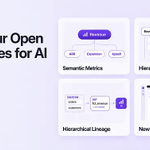
The Semantic Layer Platforms Landscape, Q4 2026: where meaning gets defined for AI agents
Forrester maps a market moving from dashboards to agents. A Forrester Wave follows in Q1 2027.
Storage and compute are the shelf. The semantic layer is the catalogue card
It fixes what "revenue" means, so a BI assistant, a copilot and a domain agent read the same number.
What an agent needs beyond it
• Semantics: what the metric means
• Lineage: where the number came from
• Quality signals: whether to trust it today
• Ownership and policies: what it may do for the person asking
Forrester's proposed name for the whole is a context layer, the next step after semantic layers and knowledge graphs. It joins business semantics and governance with ontological modeling and live runtime context: events, decisions, actions, outcomes.
Four shifts
1. Governed metrics and access controls reach agents through MCP, replacing unguided text-to-SQL
2. The semantic layer becomes one part of a broader context layer
3. Platform-native semantics (Snowflake, Databricks, LookML, Power BI) sit beside standalone tools (Cube, dbt Semantic Layer/MetricFlow, AtScale, Actian)
4. Portable definitions advance through Open Semantic Interchange and Apache Ossie
The map moves too. In 7WData's read of practitioner articles (July to October 2026), the field set against Snowflake now sits a floor above the warehouse: governance, catalogs, semantic layers, BI. Several of those names are also partners.
Open questions
• Vocabulary: semantics, ontology, semantic layer, knowledge graph and context layer are used interchangeably. Forrester's definition is an attempt to separate them
• Architecture: the market does not yet map to one pattern. Vendors reach similar use cases from different heritages and assumptions
• Coopetition: portable definitions are written by companies that also compete. Salesforce, Snowflake and dbt Labs co-founded Open Semantic Interchange, and Salesforce is also named a rival semantic layer
• Consumption: Forrester expects five patterns to coexist, from visual analytics to agent-based subscriptions, all needing one layer beneath: enterprise infrastructure, not an analytics feature
By Boris Evelson, Indranil Bandyopadhyay, Sriharsha Chintalapani, Karthik Pasupathy
The Semantic Layer Platforms Landscape, Q4 2026 sbee.link/6rf87493vb
Semantic layer platforms in 2026: How to evaluate one for AI agents sbee.link/hty8uc6xag
Is the Semantic Layer Dead? Where Business Meaning Lives Now sbee.link/96a3qpdcyw
Snowflake’s real fight is not on its competitor list sbee.link/g7eqv4hjyf
#SemanticLayer #ContextLayer #AgenticAI #DataGovernance #MCP
--
Missed a talk at #CDL26? Or missed the whole thing?
All talk recordings are being processed and will be available in the next few days.
With so many ideas and speakers, nobody could catch them all live. We’ve got you covered.
✅ Were you there? Replays are already included in your ticket.
🎟 Couldn’t make it? Get a remote ticket for permanent on-demand access to every talk.
👉 sbee.link/vhtre4umqn
Recorded live at Connected Data London 2026 | 11–12 November | Leonardo Royal Hotel London Tower Bridge
#CDL26 #KnowledgeGraph #GraphRAG #Ontology #AI

Connected Data retweeted
No Dev? No Problem! Let agents build your graph visualization!
Want to build interactive network diagrams without manually writing code?
The yFiles AI tools help coding agents transform natural language prompts into high-quality graph visualizations.
Connect your agent to the tools to generate clear, explorable visualizations for knowledge graphs, workflows, and dependencies in seconds.
👉 Explore yFiles today go.linkeddataorchestration.c…
--
#AI #Visualization #KnowledgeGraph #ApplicationDevelopment #LowCode #NoCode
yFiles - helping bring Year of the Graph to life 👇

Can an AI model use a billion-fact knowledge graph without a search step in front of it? 🔎
Most AI systems answer questions about your data with retrieval-augmented generation (RAG): a search step finds relevant facts and pastes them into the prompt.
AtlasKV, a new ICLR 2026 paper from HKUST and Huawei Theory Lab, loads the knowledge graph into the model itself. The model finds the facts it needs while it reads the question.
The memory result is real: a billion facts in under 20GB of GPU memory.
But accuracy was only measured up to 10,000 facts.
"No search step" means the lookup moved inside the model.
Ready for prime time? Not yet. Research code, one 8B-parameter model, no public production use found.
A plausible first role: fuzzy recall in front of a governed knowledge graph, not a RAG replacement.
- How it works
Each knowledge graph triple becomes a lookup entry: a question-like key and an answer-like value. Entries are grouped in three levels of clusters. As the model reads a question, its attention layers (which decide what matters in the input) score top clusters, then narrower groups, then single facts. Only the winners move to the GPU (pruning). Per the authors, new facts can be added without retraining.
- What the numbers measure
At 10,000 facts, the right fact was the model's top pick 16% to 40% of the time with pruning on, and 27% to 62% with it off. Pruning also slowed answers from 2.1 to 6.2 seconds. "Accuracy" means where attention lands in one layer, not a verified answer. Compared against pasting everything into the prompt and Microsoft's earlier KBLaM method, not against a tuned RAG pipeline.
- The knowledge graph angle
The graph is flattened on entry. Every triple is an independent fact, which the authors say blocks multi-hop reasoning. Clusters group facts by text similarity, not by ontology or graph structure.
Questions the paper leaves open
• Correcting or retracting a fact that sits inside a cluster
• Per-user permissions
• Which fact an answer came from: selection is layer by layer, and the paper's own example came back reworded
• Joins, paths and aggregations
• Memory beyond the GPU: roughly 1.5TB for a billion facts (384 dimensions, 16-bit), our estimate
Would you keep facts in the graph, or in the model?
By Haoyu Huang, Hong Ting Tsang, Jiaxin Bai, Xi Peng, Gong Zhang and Yangqiu Song. Link in comments
#RAG #LLM #EnterpriseAI #AIResearch #Provenance
--
Missed a talk at #CDL26? Or missed the whole thing?
All talk recordings are being processed and will be available in the next few days.
With so many ideas and speakers, nobody could catch them all live. We’ve got you covered.
✅ Were you there? Replays are already included in your ticket.
🎟 Couldn’t make it? Get a remote ticket for permanent on-demand access to every talk.
👉 2026.connected-data.london?u…
Recorded live at Connected Data London 2026 | 11–12 November | Leonardo Royal Hotel London Tower Bridge
#CDL26 #KnowledgeGraph #GraphRAG #Ontology #AI
Connected Data retweeted
Backpropagation for the knowledge graph: EvoRAG lets feedback on answers reshape the triplets behind them.
Most KG-RAG pipelines build the graph once, offline, without knowing which questions it will later serve.
In an error analysis of a two-hop baseline on RGB and MultiHop, three failure modes stand out:
- Irrelevant facts: 17.9% of errors
- Long reasoning paths missed: 20.7%
- Outdated information: 14.1%
Together they account for over half of all errors.
EvoRAG treats this as a data management problem and closes the loop between feedback, LLM and graph. 🔁
How it works:
- Feedback arrives at the response level: an LLM judge, human ratings, or F1 against ground truth
- An LLM scores each retrieved reasoning path from -1 to 1. Fidelity and Conflict gates block updates when the evidence is spurious or contradictory
- Path utility is propagated by gradient to individual triplets, each carrying a learnable contribution score
- Retrieval blends semantic relevance with that score
- Relation fusion adds shortcut edges across high-contribution multi-hop paths. Relation suppression softly deprioritizes persistent low performers without deleting them
Reported results:
- +7.34% average accuracy over KG-RAG baselines across RGB, MultiHop and HotpotQA
- Prompts about 4.6x shorter, at roughly 1.12x the latency of KRAG
- Accuracy stabilizes after about 6 iterations, with around 83% of problematic triplets suppressed on RGB
- LLM, human and F1 feedback land within 0.75% of each other on average
- With 10% and 20% erroneous feedback, accuracy falls by only 1.15% and 2.43%
- At 5,000 queries over about 1M triplets: +8.25%
Scope: relations evolve over a static base graph. Dynamic graphs with verified fact updates are listed as future work.
By Enze Yi and co-authors
arxiv.org/abs/2604.15676
#KGRAG #RAG #LLM #Backpropagation #Reasoning
--
📩 The Year of the Graph Autumn 2026 newsletter issue is out!
Meaning, Traversal, Reasoning, Action: The Graph Stack for Agentic AI. 👇
yearofthegraph.xyz/newslette…
All things #KnowledgeGraph, #GraphDB, Graph #Analytics / #DataScience / #AI and #SemTech.
Subscribe and follow to be in the know. Reach out if you'd like to be featured

From spreadsheet to ontology: the architecture review that starts in Excel
Every architecture review opens the same way. Someone draws a context diagram. Everyone squints at it.
Which connection is encrypted? Does that flow carry customer data? What happens when the queue backs up? The diagram shows the shape of a system. The facts live in heads, wikis and spreadsheets.
First, the tool underneath.
Relationship Visualizer is a free, open source (MIT) Excel workbook. Enter rows such as “A is related to B” and Graphviz diagrams draw as the data changes. The same rows export as a typed JSON knowledge graph, so an AI reads the structure itself instead of interpreting a picture of it.
Now the newest layer: the Context Diagram Toolkit.
Describe a system in one workbook: actors, applications, data stores, the connections between them, and facts about each, from data classification and PII to authentication and lifecycle. Two outputs follow:
A context diagram with connections colored by governance status. Green approved, amber conditional or deprecated, red prohibited. Dashed means a better alternative exists.
An RV-KGF knowledge graph in JSON holding every entity, relationship and fact.
Add the included review prompt and an AI returns a component inventory, ratings across security, scalability, resilience and more, a risk register and proposed mitigations.
The workbook quietly holds the layers of a formal knowledge graph project:
Ontology: the styles worksheet, 100+ connection types from REST to SFTP to Kafka
Semantic model: the sql worksheet, deciding which rows become entities, relationships and typed facts
Knowledge graph: the self-describing JSON export
Reasoning layer: the review prompt, applying rules such as flagging any connection that may be unencrypted, crosses a trust boundary and carries PII
It does not replace an enterprise architecture platform. It serves the earlier moments: design discussions, solution reviews, “can you draw me what this looks like?”
Free and MIT licensed. Requires Relationship Visualizer 11.1 or later, on Windows. 🔎
By Jeffrey J. Long sbee.link/ugrh8wmqpf
#SemanticModel #Graphviz #EnterpriseArchitecture #OpenSource #ContextDiagram
--
Missed a talk at #CDL26? Or missed the whole thing?
All talk recordings are being processed and will be available in the next few days.
With so many ideas and speakers, nobody could catch them all live. We’ve got you covered.
✅ Were you there? Replays are already included in your ticket.
🎟 Couldn’t make it? Get a remote ticket for permanent on-demand access to every talk.
👉 sbee.link/tp8fdewguy?utm_sou…
Recorded live at Connected Data London 2026 | 11–12 November | Leonardo Royal Hotel London Tower Bridge
#CDL26 #KnowledgeGraph #GraphRAG #Ontology #AI

Connected Data retweeted
Procedural Graphs: a playbook your agent can follow and your pipeline can improve
Most agents choose each next action by reading a growing history and improvising. Rules, step order and conditions are never written down. On long tasks that shows up as drift, tools called out of order and failed actions repeated.
Procedural Graphs, from a Google paper (arXiv 2609.09153), give that missing playbook a home: a graph outside the model weights that can be inspected, versioned and edited. Think of a knowledge graph for actions instead of facts.
What it is
• Nodes: tool calls, reasoning steps or task states
• Edges: LEADS_TO, TRIGGERS, PROVIDES_INPUT_FOR, CONVERGES_TO
• Each edge carries three text fields: condition (when it applies), guidance (how to act), pitfalls (what to avoid)
Example edge: cash_flow_forecast LEADS_TO fund_raising_request
Condition: runway falls below the safety buffer
Guidance: submit early to cover delivery delay
Pitfall: no second request while one is pending
How it runs: guidance, not control 🧭
1. Match the latest action to a node
2. Pull its 2-hop neighborhood
3. A guidance model turns that subgraph, the task and recent steps into short advice for the solver's prompt
The solver still chooses its actions. Graphs in the benchmarks stayed compact: 7 to 17 nodes in all but one.
How it improves
Offline, a refiner compares failed and successful runs and proposes edits: add or delete nodes and edges, rewrite attributes. An edit is committed only after structural checks and a held-out validation score that holds or improves. Rejected edits are remembered so they are not proposed again.
What builders can take from it
• Move long prompt procedures into structured transitions with conditions
• Soft guidance beat hard state machines and raw graph injection in the ablations
• Give the agent its neighborhood, not the full rulebook
• Treat an expert-written playbook as a hypothesis: a flawed one dropped MultiChallenge success from 87.50% to 58.93%, and gated evolution brought it to 92.86%
Where it fits: tool-heavy, ordering-sensitive, long-horizon work. Results were first or joint first in 21 of 24 settings across 4 models, with small margins on simple lookups like HotpotQA. The cost: total tokens rose 33.4% to 55.4% over no-graph baselines.
By AJ Awan (Flowtivity), on the paper by Yuxing Lu, Yicheng Chen, Shanchan Wu and Sercan Ö. Arık
Google's Procedural Graphs, Explained Simply: The Self-Evolving Playbook for AI Agents flowtivity.ai/blog/procedura…
Procedural Graphs: Self-Evolving Execution Structures for LLM Agents arxiv.org/abs/2609.09153
#AIAgents #LLMAgents #AgenticAI #AgentMemory #ProceduralKnowledge
--
📩 The Year of the Graph Autumn 2026 newsletter issue is out!
Meaning, Traversal, Reasoning, Action: The Graph Stack for Agentic AI. 👇
yearofthegraph.xyz/newslette…
All things #KnowledgeGraph, #GraphDB, Graph #Analytics / #DataScience / #AI and #SemTech.
Subscribe and follow to be in the know. Reach out if you'd like to be featured

Shapes Constraint Language Masterclass
The Shape Constraint Language (SHACL) is a W3C standardization for validating our semantic knowledge graphs by defining a set of constraints. By constraining RDF using SHACL we gain the possibility of exactly this—validating semantic knowledge graphs under a closed world assumption!
This masterclass introduces you to the SHACL Core constraints, demonstrate how to constrain your data and what happens if the data conforms false (or true for that matter!).
Key topics of this tutorial:
- Terminology and concepts of semantic knowledge graphs
- Comparing SHACL and the Web Ontology Language (OWL)
- Introduction to SHACL
- How we can use SHACL as a modelling language, and not only as a validation language.
With hands-on live coding:
- Building shapes for ABoxes
- Validation and validation errors
You would need some experience in RDF before attending this tutorial, but no prior experience with SHACL is needed. We will use a web based SHACL engine that can be accessed through any browser. No installation required. However, a brief demonstration of RDF4J's SHACL engine will also be given through a Java application, that will be accessible for anyone through GitHub.
After attending this tutorial you should expect to have gained knowledge about how to constraint your RDF data using SHACL, perform validation, and be able to interpret the validation result.
Key Topics
- Shapes Constraint Language
- Introduction
- RDF validation
- Hands-on live coding
Target Audience
- Information architects
- Knowledge Graph practitioners
Goals
Get a glimpse of the SHACL validation capabilities
Session outline:
sbee.link/nry6apbkqc
Format
The Masterclass is built up as a traditional lecture including real-life use cases and live coding
Level
Beginner
Prerequisite Knowledge
Some understanding and knowledge of RDF
sbee.link/bu4nrcaxhe
--
Veronika Heimsbakk. Knowledge Graph Lead, Capgemini
Veronika, Knowledge Graph Lead at Capgemini, is a dedicated and enthusiastic outreach of the wonders of semantic knowledge graphs. Recently awarded among Norway’s Top 50 Women in Tech. Her main niche within the space is everything SHACL
--
Welcome to Connected Data London's #ThrowbackThursday
Every Thursday at 3pm GMT, we are releasing gems from our vault on #YouTube
Tune in and learn from leaders and innovators; subscribe to our channel and watch premieres as they are released!
#knowledgegraph #graphdatabase #graph #AI #datascience #analytics #semtech #ontology

"Which definition of revenue are we talking about?"
As AI moves into everyday work, that question keeps coming up. An ontology is how the answer gets written down in a form agents can read: which business concepts matter, how they relate, which rules apply, and which data implements them.
One more signal added to the long list showing how ontology adoption is growing:
One year ago, Steve Wooledge, Collate CMO, couldn't tell what an ontology is. Today, Collate is announcing Ontology Studio as part of the Collate 2.1 release.
📈 Gartner (press release, May 11, 2026) predicts that by 2027, organizations that prioritize semantics in AI-ready data will raise agentic AI accuracy by up to 80% and cut costs by up to 60%.
🏠 Scout24, the company behind ImmoScout24, runs internal AI agents on a shared data foundation that links business knowledge to data. Angelita Frozza Sanches, Head of Data, describes agents as only as useful as the context behind their answers, with confidence scores and expert feedback driving continuous improvement.
The announcement, Ontology Studio in Collate 2.1, also puts weight on portability.
Jessica Talisman, Semantic Engineer and author of Ontology Pipeline, frames the test simply: "An ontology you can't take with you belongs to your vendor." Can it be inspected, validated and exported in open standards?
🏢 Several Fortune 500 companies contacted the Collate team directly after a webinar with Jessica Talisman on ontologies, context and why they matter.
Collate is the platform built on OpenMetadata: an open-source metadata and context platform for data discovery, lineage, governance and AI agents, built schema-first on JSON Schema and RDF/OWL. OpenMetadata is Apache 2.0 licensed, and it is primarily driven and maintained by Collate.
Metadata, meaning, and memory belong in one context platform. Metadata tells an agent what data exists. Meaning tells it what the data represents. Memory tells it what your organization has learned. If they are spread across separate tools, agents get partial views that disagree.
OpenMetadata keeps all three on one graph, and 2.1 gives AI agents a deeper understanding of business meaning. Collate 2.1 release is synced with OpenMetadata 2.1 release.
Ontology Studio is built on OWL and SKOS, imports and exports OWL, Turtle, RDF/XML and JSON-LD, and ships starter packs from standards such as FIBO, HL7 FHIR, GS1, EPCIS, ISA-95 and HR Open.
Whether or not you work with Collate or OpenMetadata, the point stands: business meaning written down in open standards improves what agents can do, and stays portable.
Collate Launches Ontology Studio for AI Agents getcollate.io/blog/announcin…
Announcing OpenMetadata 2.1: Your Business Definitions in the Context Graph blog.open-metadata.org/annou…
#OpenMetadata #OWL #SKOS #AIAgents #DataGovernance
--
Missed a talk at #CDL26? Or missed the whole thing?
All talk recordings will be available in the next few days.
With this many ideas and speakers, nobody could catch them all live
✅ Were you there? Replays included in your ticket
🎟 Couldn’t make it? Get a remote ticket for permanent on-demand access
2026.connected-data.london?u…

Connected Data retweeted
KGCL: Knowledge Graph Change Language
Agents operate against the ontology as a semantic contract. KGCL gives changes to that contract a standard form.
In an agent-first data architecture, the ontology is also a structural guardrail. It keeps LLM-generated knowledge graphs from drifting into unstructured, over-connected networks that are hard to maintain.
Knowledge keeps moving, so the contract has to move with it. Terms are added, merged and deprecated. Definitions and synonyms get refined. A frozen ontology leaves agents with dead ends. Ungoverned, LLM-driven schema edits can break downstream consumers, workflows and data contracts.
The Knowledge Graph Change Language (KGCL) treats change as a first-class object: diff and patch for ontologies and knowledge graphs, expressed at the level curators think in. In the 2023 community survey behind the paper, 82% rated staying informed about ontology changes very or extremely important, and 8% were satisfied with how changes are viewed today.
Three parts:
• A taxonomy of node and edge changes: rename, add synonym, obsolete with replacement, move a class, change a predicate
• A controlled natural language with a Lark grammar: obsolete GO:9999999 with replacement GO:0005634
• A LinkML data model, so one change serializes to CNL, YAML, JSON or RDF
Where builders can start:
• kgcl-schema on PyPI: schema, Python model and CNL parser
• Ontology Access Kit: diff two ontologies into KGCL, or apply KGCL to one
• KGCL-Java with a ROBOT plugin: robot apply inside an existing pipeline
• Ontobot: a GitHub Action that reads KGCL from an issue and opens a pull request. In the Mondo example, a curator approves before merge
Alongside SHACL:
• KGCL publishes a SHACL representation, so a change request can be checked for structural conformance before it enters the pipeline
• A class change, deprecation or restructured relationship can trigger review of SHACL shapes, ingestion rules and validation pipelines, so enforcement evolves with the semantic model
From the paper (Hegde et al., Database, 2025):
• A draft provisional mode stores proposed changes inside the ontology until they are approved or rejected
• Planned: LLM-generated KGCL from free-text requests
• Not yet covered: instance-level changes, concept merge and split
• Tool support varies by change type
KGCL: Knowledge Graph Change Language incatools.github.io/kgcl/
A change language for ontologies and knowledge graphs academic.oup.com/database/ar…
#AgenticAI #KGCL #SHACL #DataGovernance #SemanticLayer
--
📩 The Year of the Graph Autumn 2026 newsletter issue is out!
Meaning, Traversal, Reasoning, Action: The Graph Stack for Agentic AI. 👇
yearofthegraph.xyz/newslette…
All things #KnowledgeGraph, #GraphDB, Graph #Analytics / #DataScience / #AI and #SemTech.
Subscribe and follow to be in the know. Reach out if you'd like to be featured

Connected Data London post-event goodies: Photo Gallery
CDL26 has been a blast, and apparently what's on everyone's minds (and in our inboxes) right now some variation of the following:
- Do you have an official gallery?
- Can we get access to the speaker slides?
- When will the recordings be available?
- What's your next event going to be?
The answers are yes, yes, any day now, and you'll hear about that one soon!
Our AV crew has been roaming the event and is still working on getting all the material processed.
In the meanwhile, here's a first taste: the official CDL26 Photo Gallery
Look back on your Connected Data London 2026 event experience and get ready for next year! View our tenth anniversary highlights to see how our community collaborated, inspired and rejoiced - our gallery gives you a glimpse of what to expect in 2027.
2026.connected-data.london/g…
Stay tuned for slides, videos, and more news!


1
172
Ontologies for AI in practice: Do LLMs need ontologies, or are text definitions good enough?
A three-part experiment on a small, deliberately ambiguous genealogy dataset (fictional people) tested what changes when an LLM is given progressively more semantics.
The task: count a person’s ancestors. The evidence is anecdotal by design, but practical.
🔎 Part I: adding semantics step by step
Data alone: many errors, and a correct count only by chance
Cleaner dates: no change
Plain-text definitions: a substantial improvement
RDF knowledge graph: the same answer, but it exposed hidden assumptions, including an imprecise question (“how many ancestors in this dataset?”)
Curated graph: more precise and consistent answers
Ontology: the correct count
🧪 Part II: model size and stability
Small local models (4B to 8B) could not use added semantics
Impact started to appear at 32B parameters
Text definitions produced high variability across runs
Knowledge graphs with ontologies matched or beat definitions and were more consistent
Removing the text definitions from context improved graph-based results
🧩 Part III: how to provide semantics
OWL axioms only, OWL with definitions, OWL with operational directives, Apache Ossie (OSI) and Google’s OKF were compared.
Takeaways:
- Axioms alone were not enough, and the natural-language definitions inside ontologies did most of the work
- With a capable model, the format mattered little. Opus reached perfect results across representations, while DeepSeek-R1:32B used none of them
- Ontology plus knowledge graph was the most effective and consistent option
- Among approaches that annotate data directly, OKF ranked highest
Definitions alone are not enough. Results were strongest when context-specific meaning is connected to the data elements themselves, as in a knowledge graph.
By Andrea Splendiani
Ontologies for AI in practice / part I sbee.link/gkx3nd6rec
Ontologies for AI in practice / part II sbee.link/erhmudfwc6
Ontologies for AI in practice / part III sbee.link/3d7xhwbnm4
#LLM #FAIRData #OWL #SemanticLayer #DataGovernance
--
Missed a talk at #CDL26? Or missed the whole thing?
All talk recordings will be available in the next few days.
With this many ideas and speakers, nobody could catch them all live
✅ Were you there? Replays included in your ticket
🎟 Couldn’t make it? Get a remote ticket for permanent on-demand access
sbee.link/pqwxhda3n4

Connected Data retweeted
LLM wiki and knowledge graph formats and recipes
Agent builders are converging on the same discovery: the simplest way to give an agent durable memory is a markdown LLM wiki. Enterprises are converging on semantic layers, context graphs and ontologies to ground their agents. Tony Seale put these together.
You can combine a markdown wiki with a formal knowledge graph and ontology, Seale argues. It is an extremely powerful pattern, now published as an open standard for the community to evolve. It’s called Vault-LD. The idea is simple: markdown plus YAML-LD frontmatter.
The W3C recently published version 1.0 of the YAML-LD specification. YAML-LD is a set of conventions which specify how to serialize (RDF) Linked Data as YAML based on JSON-LD syntax, semantics, and APIs.
JSON-LD is a lightweight, machine-readable format used to store and transport linked data on the web. JSON-LD uses Schema.org vocabularies to explicitly define what web page elements mean (like products, prices, or authors).
JSON-LD owns meaning; it’s the format behind the EU Digital Identity Wallet, Microsoft’s Digital Twins Definition Language, and how AI-ready datasets describe themselves on Hugging Face and Kaggle.
JSON Schema owns structure; it’s the validation logic behind most modern API specs, MCP tool definitions, and IoT data models. Juan Cruz Viotti addressed JSON Schema and JSON-LD interoperability.
Google’s Open Knowledge Format (OKF) formalizes the LLM-wiki pattern. OKF v0.2 adds support for trust signals, to answer questions like “what was this made from?” or “Is it still true?”.
Neo4j created ki, an open source project to sync a Neo4j graph deterministically from a folder of markdown, and added unofficial support for OKF.
--
📩 Excerpt from The Year of the Graph Autumn 2026 newsletter
Read "# Meaning, Traversal, Reasoning, Action: The Graph Stack for Agentic AI" with more sections, references and attribution here 👇
yearofthegraph.xyz/newslette…
All things #KnowledgeGraph, #GraphDB, Graph #Analytics / #DataScience / #AI and #SemTech.
