

Your gateway to India's official data. As a comprehensive data portal, we offer a vast collection of datasets. A product of @factlyindia
India
Joined September 2022
- Tweets623
- Following7
- Followers522
- Likes21






A doctor’s availability can depend on where you live. For many people in rural India, access to specialist care remains a question of geography as much as healthcare policy.
The Supreme Court has flagged a “policy deficit” in building national consensus on compulsory rural service for medical graduates. It is considering whether to lay down constitutional principles for a framework that states could develop, in consultation with medical authorities. The question goes beyond service bonds: it is about how India ensures access to healthcare in underserved areas.
But where are the gaps, and which states face the greatest shortages of doctors and specialists? Explore state-wise health infrastructure data spanning 2005, 2015 and 2020–2023, alongside government allopathic doctor counts for 2016–2023: dataful.in/datasets/20972/

India’s millions of small, unincorporated businesses are a vast part of the economy, but how well do we understand where they are growing and what sustains them?
The 2025 Annual Survey of Unincorporated Sector Enterprises estimated 7.92 crore establishments, up nearly 8% from the previous round. Now, the next survey is set to expand its questions, including for the first time, the constraints faced by women entrepreneurs, and shift to a financial-year cycle from 2027–28.
The district-level data offers a way to look beyond the national totals. Where are these businesses concentrated, and how do employment, productivity and digital adoption vary across India?
Explore the ASUSE 2025 district data: dataful.in/datasets/24386/
Rajasthan has declared 80 tehsils across 14 districts drought-hit after deficient rainfall, reduced water availability and damage to kharif crops. But the story extends beyond rainfall. It is also about how much water reservoirs retain, what farmers can sow, and whether El Niño years offer clues to the risks ahead.
India’s 2026 monsoon ended 13% below normal, while southern reservoirs held 43% less water than their 10-year average. Our latest story examines these rainfall deficits, historical El Niño years and the growing pressure on water reserves.
Read more: insights.dataful.in/articles…

US Secretary of State Marco Rubio’s visit to Jamnagar puts India’s refining capacity in the spotlight. What sets this refinery apart from the others spread across the country?
Reliance’s Jamnagar complex has a Nelson Complexity Index (NCI) of 21.1, compared with 11.8 for the highest-scoring PSU refinery. Its high complexity allows it to process a wider range of crude oils, including heavier grades, and produce higher-value petroleum products.
Explore the Nelson Complexity Index (NCI) scores for PSU refineries here: cht.gov.in/refinery-complexi…
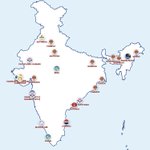
The attached map shows refinery locations across India. (Source: Centre for High Technology, Ministry of Petroleum & Natural Gas)

What gets counted as work shapes how we understand the labour market.
From January 2027, MoSPI proposes changes to the Periodic Labour Force Survey (PLFS), including a separate sampling stratum for digital platform workers and new questions on unpaid household work, caregiving, volunteering and unpaid trainee work. The aim is to capture forms of work that conventional employment measures can miss.
There is already data to build on: e-Shram registrations since 2021, earlier occupation estimates and Labour Ministry data obtained through RTI help map platform gig workers across states and occupations. Explore the data, and the gaps a changing survey is trying to address: dataful.in/datasets/21369/
Proposed changes: mospi.gov.in/uploads/latestR…

A strike by power employees in Haryana left Gurugram, Faridabad and Nuh without electricity this week, and in some homes without water. The department received more than 3,000 outage complaints within 12 hours of the strike beginning.
The employees are protesting a decision by the state’s electricity regulator to grant a private company a parallel distribution licence covering Gurugram and Nuh. They fear it could eventually affect jobs and the availability and affordability of power for farmers and other consumers. The state government says it opposes the licence and has appealed to the Appellate Tribunal for Electricity.
The dispute comes as the national picture for distribution companies has changed. In January, the Power Ministry said India’s discoms and power departments had together recorded a profit after tax of ₹2,701 crore in 2024-25, after a loss of ₹27022 crore the previous year.
The financial turnaround and the strike are separate developments. But they raise the same que

The combined headcount of six major Indian IT services companies fell by about 24,400 over the past twelve months, to roughly 797,700, according Economic Times. The report notes that some firms, including TCS and HCLTech, have recently added staff in modest numbers. Graduates, meanwhile, are navigating entry-level work that AI is rewriting. The shift comes as AI changes entry-level work and new graduates struggle to find openings.
For context, worker data by industry, region and gender from 1977-78 to 2025, along with EPFO payroll figures since 2017-18, is available here: dataful.in/datasets/20452/
The WMO warned on 21 October that the current El Niño could be unprecedented in strength, with Pacific sea surface temperatures potentially reaching 3.8°C above average between November and January.
For India, the effects have already been felt. The India Meteorological Department forecast a below-normal monsoon in April, at 92% of the long-period average, and revised it to 90% in May. The season ended about 12.6% below average. The department expects below-normal rainfall in October as well, with the El Niño still strengthening.
In Parliament in August, the government said El Niño conditions were likely to persist until February 2027. If you want to see how past El Niño years actually played out, the year, month and region-wise monsoon rainfall data since 1901 is here: dataful.in/datasets/18473/

The regional connectivity scheme UDAN was launched on October 21, 2016. Its first flight, from Shimla to Delhi, took off on April 27, 2017. In ten years, 1.72 crore passengers have flown on regional routes under it. India’s domestic airlines carried about 16.8 crore passengers in FY26 alone. So the scheme’s decade is roughly a tenth of one year’s domestic flying.
Headcount is therefore the wrong test of UDAN. The better test is where flights go, and whether they keep going: which regional airports grew, which stayed small, and how the big-city share moved. City-wise airport traffic for 2015 to 2026, and airline-wise domestic operating stats since 1997-98, can help answer that: dataful.in/datasets/15044/

US Secretary of State Marco Rubio said 99 percent of the work on the India-US trade deal is done and that an agreement is weeks away and asked India to scale up purchase of US tech and energy. In FY26, India sold about $87.3 billion of goods to the US and bought about $53.4 billion as per Commerce Ministry data. A year earlier, imports from the US were $45.6 billion. The surplus narrowed to $33.8 billion from $40.88 billion the year before.
Much of that rise in imports came while the two governments were still negotiating. Whether the deal widens or reverses that depends on terms we haven’t seen.
Track what India actually buys and sells, fiscal-year country-wise imports, exports and trade balance from 2006-07 to 2025-26 here:
dataful.in/datasets/2154/

The latest rabi MSP announcement has reopened a familiar debate: how much do the prices set by the government reflect farmers’ actual costs?
The Cabinet approved higher MSPs for the 2027-28 marketing season, but the Samyukt Kisan Morcha rejected the increase, arguing that prices should reflect the full cost of cultivation plus a 50% margin. Wheat’s MSP rose by just ₹25 per quintal, while safflower saw the largest increase, at ₹675.
These debates are easier to place in context when we look beyond a single year’s hike. Dataful has all-India crop-year MSP data for paddy, wheat and millets from 1975-76 to 2026-27, making it possible to trace how support prices have changed over five decades.
Explore the long-term trend: dataful.in/datasets/17830/

The Supreme Court has directed that tickets bought at railway counters must include travel insurance from 27 October 2026, extending coverage to offline bookings.
Indian Railways reported a 58% reduction in signalling failures over 11 years, alongside a decline in consequential train accidents, according to the Ministry of Railways. Yet passenger safety also involves what happens after an accident.
To understand the longer-term picture, Dataful brings together historical data on compensation paid to railway accident victims from 2012-13 to 2023-24 and consequential train accidents dating back to 1960-61. These records help trace both the human and financial costs of rail accidents over time.
Explore the data: dataful.in/datasets/1188/

The IDBI Bank deal marks a significant moment in India’s disinvestment journey. On 14 October, the Cabinet approved the sale of a combined 60.72% stake held by the Centre and LIC to a Fairfax-backed buyer for ₹52,878 crore. The transaction, subject to regulatory approvals, is expected to take the government past its FY2026-27 disinvestment target.
Earlier this year, the government also approved the strategic sale of IMPCL, a public sector medicines company under the Ministry of AYUSH.
How do these deals fit into India’s longer disinvestment history? Dataful brings together year-wise targets and achievements from 1991-92 to 2025-26, allowing comparisons across more than three decades.
Explore the data: dataful.in/datasets/15654/

A fire scare linked to a power bank aboard an IndiGo flight bound for Chennai has renewed attention on onboard battery safety. While individual incidents raise immediate concerns, understanding aviation safety also requires looking at patterns over time.
For that broader picture, Dataful brings together operator-wise data on aircraft accidents and serious incidents in India from 2011 to 2024, making it possible to compare trends across operators and years.
Explore the dataset: dataful.in/datasets/19976/

Retail inflation in India reached 5.54% in September 2025, a nine-month high, with rising food prices contributing to the increase.
But inflation figures also need context. Changes in the CPI base year can affect how price movements are measured and interpreted.
RBI’s monthly CPI growth series, spanning 1996-97 to 2026-27, offers a longer view of India’s inflation trajectory.
Explore the data: dataful.in/datasets/17645/

A protest is more than a public gathering. It is also a test of how a city or state accommodates dissent.
As protests become a larger part of India’s public conversation, questions around where people can demonstrate and how public-order incidents are recorded come into focus.
NCRB’s Crime in India data tracks different types of riots across states from 2014 to 2024, offering a way to examine patterns in recorded public-order offences.
Explore the dataset: dataful.in/datasets/453/

Only 48% of life insurance policies are renewed beyond five years, according to The Times of India.
Persistency is one measure of whether policyholders continue their insurance over time. Dataful brings together insurer-wise persistency data from 2009-10 to 2024-25, alongside data on lapsed and forfeited policies, life insurance premiums, and individual death claims and their settlement ratios.
Explore the insurer-wise data: dataful.in/datasets/21052/

India’s water stress goes beyond a weak monsoon. El Niño can disrupt rainfall patterns, while years of groundwater extraction put pressure on reserves that replenish slowly. The result is a water balance that can look very different from one state to another. In 2025, India extracted 247.22 billion cubic metres of groundwater, equivalent to 60.63% of its annual extractable resource.
To understand the bigger picture, groundwater recharge and extraction need to be read alongside reservoir storage. Dataful brings together state-wise groundwater assessments across multiple years and weekly reservoir storage data from 2019 to 2026.
Explore the data: dataful.in/datasets/1264/

Cancer treatment in India is already expensive enough without the markup on the medicines. Before a family can think about recovery, there is usually a quieter calculation: what the medicines will cost, and for how long. Every month of treatment adds to it.
The Centre has now capped trade margins on non-scheduled cancer drugs at 30%, and patients are expected to save Rs 2,500 crore a year because of it. Prices may fall too, though how much will only show up in what patients actually pay.
That’s a lot of money staying in families who need it for everything else. The actual outcome will, however, show up in what patients pay.
For the wider picture, state-wise cancer incidence and mortality for 2013 to 2024 is here: dataful.in/datasets/20203/
