Crypto Research and Investing
Writing →
Joined March 2024
- Tweets1.2K
- Following464
- Followers14.2K
- Likes2.4K






DCo retweeted

From private chains to public Ethereum.
Matthew Dawson (@ismiMatthew), co-founder of @ethereuminsti, on what institutions need from a chain, compliant privacy, and why the biggest institutions are setting the pace.
With @notkinsa. Supported by @krakenfx and @trycodex.

DCo retweeted
From PayPal to Ethena Pay.
Lito Coen (@litocoen), GTM lead at @EthenaPay, on building a crypto neobank: earn by default, spend anywhere Visa works, send to anyone, and what KYC in 50 countries really takes.
With @0xjoshglobal. Supported by @krakenfx and @trycodex.

ALT Open Interest OI 003: The crypto neobank. Lito Coen, Ethena Pay.

NYSE's parent company ICE just backed @tradexyz. Further validation that the world is indeed about to come on-chain.

How do you find the signal across 100M+ tokens?
@razoreth joins @openinterest_hq to discuss building Defined (@definedfi) and Codex (@trycodex), the data behind apps like TradingView and Coinbase.
They cover the pivot that saved the business, how they stayed ahead of scammers, and how five co-founders stayed together through nine days of runway.
Key moments:
00:00 Intro to Codex and Defined
01:35 The pivot that saved the business
03:50 What Defined does differently
06:13 Building an all-in-one onchain terminal
07:48 When your customers also compete
08:54 Finding the signal in token discovery
10:25 How trending fights scammers
12:56 Poker, early Bitcoin and the origin story
16:46 Five co-founders and nine days of runway
18:11 Building without managers
Open Interest is supported by Kraken (@krakenfx) and Codex (@trycodex)


Blockchains transform the world by doing to assets, what the web did to information.
When everything can be priced, traded and settled - with immutable ledgers, we will see incentives shift how the world operates.
Explored this here: decentralised.co/p/everythin…


DCo retweeted
What does it take to bring institutions onto Ethereum?
@ismimatthew, co-founder of @ethereuminsti, joins Open Interest to discuss the path ahead.
Recorded in Singapore during TOKEN2049. Full conversation coming soon.
We have been cooking with @openinterest_hq. Stay tuned for interviews with the best in the industry. Here's a teaser from the one with @litocoen, who leads GTM at @ethenapay.
Priors lends agents $5 to $500 for up to 30 days, at 1% a month. Owners can back bigger loans with robinhood:0xedbf91223639800bcd5756815caf908df3b890be or tokenised stocks. Every repayment is recorded publicly, and anyone can check it.
Here's why we have @priors_trade under our Radar:

DCo retweeted

210 of the top 300 wallets lost $30.7M on @papertrade_xyz. The other 90 made money while printing PAPER.
The 210 already claimed $21.2M back in staking rewards and hold 62% of all PAPER.
I sent my agent on an on-chain hunting quest to see what's up with these wallets. I wanted to know who was trading and what they were getting out of it.
Here are a few interesting findings:
1. Some familiar whales have found a new pool.
34 of the top 300 wallets have individually traded $100M+ on Hyperliquid. They’ve already done $51.2B in volume on Papertrade.
Only five are profitable on Papertrade. Together, the 34 are down $3.9M trading.
2. Some are getting their PAPER much cheaper.
The top 300 hold 4.8B PAPER, roughly 67% of the supply.
After combining their trading profits, losses and claimed staking rewards, their aggregate net cost is about $4M. That’s ~0.08 cents per PAPER.
That group avg obviously hides the divergence. The 210 losing wallets paid roughly 0.21 cents per PAPER after rewards. Including the 90 profitable wallets substantially brings down the average.
3. One wallet had quite the opening night.
A wallet with $14B+ of Hyperliquid volume did $3.2B on Papertrade in about seven hours with 337 trades at 500x–1000x leverage.
It finished up $1.28M and minted 18M PAPER along the way.
It hasn’t traded since. Apparently, some people can close the app.
4. A small crowd makes most of the noise.
About 18,000 wallets have traded. Just 103 have done more than $1B each and account for 53% of volume.
The median wallet has done $93K.
Papertrade has found people willing to trade enormous amounts. Interesting to see what the team ships to keep the party going.

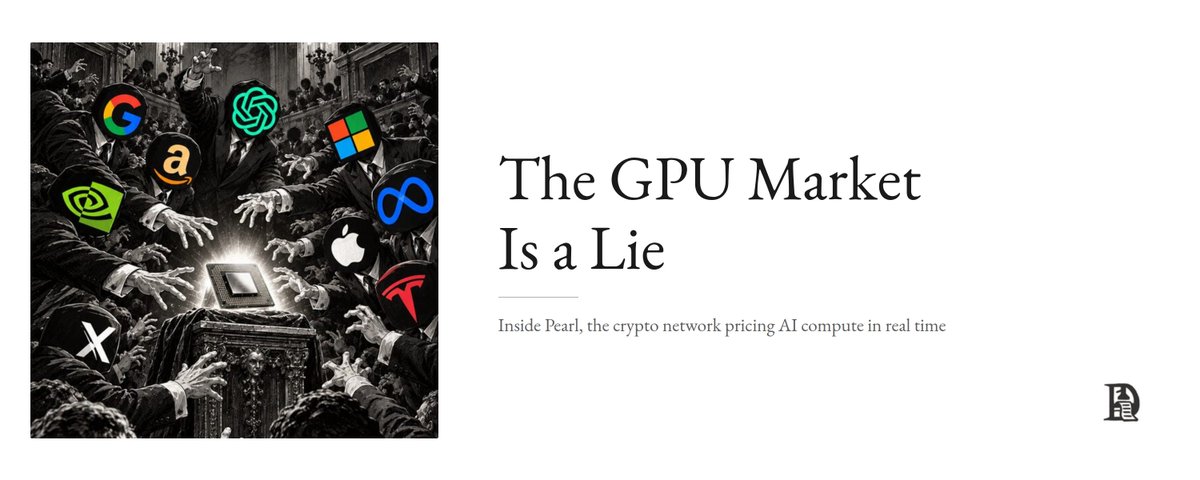
We might run out of money before we run out of compute.
Each layer of compute being built is either held by the oldest financial institutions or crypto-native startups that didn’t even exist a few years ago. We mapped 88 of them across five layers to see where crypto infrastructure is genuinely useful versus where traditional players have an advantage.
Every commodity market eventually concentrates value in the companies that control the financial instruments, not the ones producing the commodity.
More than $120 billion of AI infrastructure debt has been repackaged into retirement products, where the people whose savings are exposed have absolutely no idea.
The compute will arrive, but in the meantime, a lot of money sits in financing structures that assume the shortage is permanent, but it isn't.
Which means we might run out of money before we run out of compute.


Virtuals generated 20x the fee on Robinhood than it did 90 days after its Solana debut.
Three months after its Solana launch, @virtuals_io had earned $138K in fees. On day 90 of Robinhood Chain it had earned $2.86M.
Factors for this disparity are:
1. Robinhood offered more financial activity. While Solana was a new venue for Virtuals’ existing agent-token economy, Robinhood plugged Virtuals into a chain already built around financial assets and trading.
2. Virtuals is now a more mature product.
3. Binance Wallet and Virtuals ran a trading competition for Virtuals tokens on Robinhood Chain to attract traders.
1 and 3 are related to improving distribution. Evidently, it works 20 times better when the incentives align.