

cross asset alpha, before it becomes memetic. join our research alpha discord, via website ⬇️.
The Next Meta
Joined November 2024
- Tweets4.8K
- Following1.5K
- Followers11.5K
- Likes17.7K





$NVDA's reported $500M-plus Inception talks price a model-architecture option, not a balance-sheet bet.
The Information says NVIDIA is nearing a deal above $500M before potential employee earnouts. Inception raised a $50M seed round in 2025, putting the reported floor at more than 10x disclosed funding.
At $500M, the check equals 0.50% of NVIDIA's $100.8B in cash equivalents and marketable securities and 1.14% of last quarter's $43.8B of FCF. $NVDA was $145, -0.9% after hours; the acquisition math is immaterial to the base financial model.
The operating payoff is Inception's diffusion architecture. The company says Mercury delivers sub-300 millisecond time to first token, 5-7x higher throughput and up to 70% lower cost per task. Those gains need to show up in broader inference use on NVIDIA's platform; otherwise a $500M-plus transaction remains too small to change earnings.
Sources: The Information; Inception; NVIDIA fiscal Q3 disclosures.

1
798
$NVDA / $AMD: 879,868 China chip approvals, zero shipments in the disclosed records
The House Foreign Affairs Committee released 21 BIS approvals covering 579,868 NVIDIA H200s and 300,000 $AMD MI325X chips. The approved total was 25.5% of 3.44 million requested, and every approved entry was marked not shipped as of May 11.
At the Reuters-reported $27,000 China price, NVIDIA's pool represented $15.7B of gross product value. NVIDIA now says it is no longer shipping H200, and its $130B fiscal-Q4 guide assumes $0 of China Data Center compute revenue.
$AMD's 300,000-unit pool is the earnings sensitivity. Every $10,000 of MI325X ASP would equal $3B of revenue; the 25% U.S. inspection tariff in $AMD's 10-Q would equal $750M at that customs value before pricing offsets.
NVIDIA closed at $146, down 3.3%. $AMD closed at $489, down 7.7%, and traded at $479 after hours. Shipment status, not the approval count, determines the model.
1
804
$AMD's rebuttal recovered only 31% of the stock's $98B prior-close-to-low equity-value loss.
$AMD said Hunterbrook misrepresented the company's business practices and relationships and reiterated that it complies with U.S. export-control laws. Shares closed at $489 after falling to $471, a $31B recovery.
At 3:50 p.m. CST, $AMD was $476, -2.7% after hours, giving back $21B, or 70%, of that bounce.
The statement lowers the odds of an immediate estimate cut, but it did not explain how IEIT obtained post-blacklist firmware or whether a license covered it. Until $AMD documents that path, the stock is pricing compliance and governance risk rather than a confirmed revenue loss.
Source: Reuters, company filings, Google Finance

634
AI Afternoon Market Summary
Anthropic held a 16.0% premium to its $83 IPO price, but the rest of the morning AI bid failed into the close. $QQQ reversed from +1.75% pre-market to -2.05%, $SOXX swung from +2.72% to -2.32%, and CoreWeave gave back 9.70 points. Intel was the clean company-specific exception.
$ANT $96, +16.0%
The stock remained above the offer but finished 13.6% below its $111.50 first trade. The debut validated demand for Anthropic shares without resetting supplier revenue or infrastructure valuations.
$INTC $56, +1.7%
Intel outperformed $SOXX by 3.98 points after announcing its first external 18A-P customer. Customer identity and wafer volume still determine the FY27 foundry revenue contribution, but the positive tape held while semis sold off.
$CRWV $45, -5.0%
CoreWeave reversed from +4.66% pre-market to -5.04%. Anthropic's IPO premium did not remove the financing discount on capital-intensive AI infrastructure.
$SNDK $763, -1.7%
Sandisk outperformed $SOXX by 0.58 point, preserving modest storage relative strength. $ARM fell 3.0% and did not clear the relative-strength gate.
Sources: AP, company comments and live regular-session quotes at 3:01pm CT.
2
1
715
Anthropic's IPO validated demand for one scarce new AI equity, not a sector multiple reset.
$ANT $95, +14.2% versus the $83 IPO price, but 15.0% below the $111.50 first trade. The reversal erased $303B of implied equity value from the opening print.
$SOXX $139, -1.9% after +2.7% pre-market; $QQQ $649, -1.6%; $CRWV $46, -4.0% after +4.7% pre-market. The IPO premium has not translated into supplier earnings support.
We would not lift AI supplier revenue or multiples off the debut. $ANT holding above $83 while $SOXX and $CRWV recover their opening levels would change that read.
647
$AMD $491, -7.4%: a short report erased $64B of equity value.
The stock trails $SOXX by 8.0 points after Hunterbrook disclosed a short and alleged that blacklisted server maker IEIT kept receiving newer $AMD firmware. Hunterbrook could not determine how IEIT obtained it or whether licenses existed.
$AMD's 2025 filing shows $4.284B billed to Singapore and $7.751B to China and Hong Kong. The BIS rule effective today adds license requirements for covered advanced-computing shipments to Singapore and four other countries.
If 10%-25% of the Singapore-billed base were delayed or denied, the revenue hit would be $428M-$1.071B and gross profit $231M-$578M at $AMD's latest 54% GAAP margin. Billing location is not end-use exposure, so the range is a sensitivity rather than a forecast.
The tape is charging $AMD for enforcement and credibility risk well beyond the mechanical P&L range. Documentation of a valid firmware path would close much of the gap; confirmation of unlicensed support would turn the selloff into an estimate event.
1
777
Anthropic registered 120.38M employee and adviser shares for resale before $ANT's first Nasdaq print.
At the $83 offer price, the potential secondary pool is worth $9.99B.
The registered count equals 12.3% of the 980M-share IPO. It is 0.9% of the 13.22 billion-share pro forma Class A/Class N base, but large enough to influence the opening float.
No planned transactions are disclosed. The 120.38M shares become a tape issue only when holders sell; first-session volume will separate available supply from actual pressure.
$GOOGL and $NVDA each bought $10B at $83 in the concurrent placement. Every 10% move in $ANT changes each position's gross mark by $1B before accounting treatment.
875
AI Morning Event Summary: Anthropic lifts AI beta; NVIDIA trails semis
$SPY $737, +1.0%; $QQQ $671, +1.8%; $SOXX $146, +2.7% pre-market.
Initial claims were 203K versus 198K consensus, continuing claims rose 70K to 1.763M, and the Philly Fed fell to 6.3 versus 20.6 consensus while prices paid rose to 58.2 from 43.2. The tape is looking through the mixed growth/inflation signal.
Anthropic prepares to trade after pricing 980 million shares at $83 for $81.3B of gross IPO proceeds.
$SNDK $810, +4.3% / $MU $735, +4.2%: memory is leading the semiconductor rebound. The pair leads $SOXX by 1.62 and 1.44 points, respectively. Lynx Equity kept Micron as its top chip pick with a $1,325 PT and Sandisk at $2,450, citing unchanged DRAM/NAND demand despite slower data-center permitting.
$INTC $57, +3.9%: Lip-Bu Tan stated that Intel signed its first external 18A-P customer. A signed program lowers execution risk versus the prior pipeline; wafer volume determines the foundry revenue contribution.
$ARM $189, +3.6%: Arm leads $SOXX by 0.92 point without a fresh company catalyst. AI CPU and agentic-compute beta is participating, but the premium forward valuation still needs royalty and server-share revisions to follow the tape.
$NVDA $153, +1.1%: NVIDIA trails $SOXX by 1.59 points. FT and Reuters report tighter China manufacturing controls, while The Information reports Moonshot AI cancelled a $150M Indonesian Blackwell-access contract after the new U.S. rules. The broad AI rebound is not restoring NVIDIA's sector leadership.
$GOOGL $294, +4.0% / $CRWV $50, +4.7%: Google released Gemini 4 Neon at $3 per 1M input tokens and $15 per 1M output tokens. CoreWeave's 4.7% gain puts the financing-sensitive neocloud trade ahead of the large-cap AI bid.
Wall St
$MU: Lynx Equity maintained a $1,325 PT and called Micron its top chip pick; the note argues permitting delays have not changed the multi-year memory demand outlook.
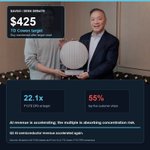
Anthropic: Needham initiated Buy with a $150 PT, 81% above the $83 IPO price, using 18x estimated FY27 revenue and assuming 150%+ FY27 growth with 35%+ operating margins.
Three tech headlines
- Intel signed its first external 18A-P customer after the node entered risk production in June. External foundry revenue still depends on customer identity, wafer starts and volume timing.
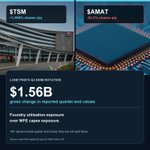
- FT and Reuters report TSMC and Samsung suspended some China chip shipments while seeking U.S. licenses. The near-term risk is foundry utilization and China AI-chip revenue for $TSM, $NVDA and $AMD.
- Google launched Gemini 4 Neon across the API, Gemini and Antigravity. Its $3 input and $15 output pricing per 1M tokens sits below Google's larger Carbon model and adds price/performance pressure across paid AI APIs.
What to watch
- Anthropic is expected to open near 10:00 a.m. ET. The first-hour spread versus the $83 IPO price is today's cleanest AI-risk signal.
- $SOXX needs to keep its 0.97-point lead over $QQQ; $NVDA needs to close its 1.59-point sector deficit.
- The 10-year TIPS auction is at 1:00 p.m. ET, and Fed Governor Barr speaks on AI at 2:15 p.m. ET.
- Intel's 18A-P customer identity and the scope of the new China license requirements determine whether today's foundry moves carry into revenue estimates.
1
888
$SOXX $148, +4.0%, leads the Nasdaq 100 by 2.0 points after the open.
Intel +7.5%, CoreWeave +8.6% and the Sandisk/Micron/Intel/Arm basket +5.3% keep foundry, memory and neocloud in front.
NVIDIA erased its 1.6-point pre-market deficit and trails the ETF by 0.2 point.
165
NVIDIA's $500B financing gap
The Wall Street Journal reports that the third-party chip-financing platforms announced with Apollo, BlackRock, Blackstone, Brookfield, Goldman Sachs and KKR have deployed $0. A first transaction is not expected before 2027.
The external credit bridge is not operating yet. NVIDIA discloses $118B of maximum gross guarantee exposure, including $105B tied to OpenAI's Ohio campus. The guarantee ceiling equals 23.6% of the external target, although it phases in as projects enter service rather than representing a current cash liability.
The $130B fiscal-Q4 revenue guide has no disclosed reliance on these platforms. We give the $500B target no funded-demand credit until a transaction closes.
$NVDA $153, +1.5% pre-market, trails $SOXX $146, +3.2% by 1.8 points. A 2027 deal with disclosed support terms would begin transferring customer credit risk away from NVIDIA; additional guarantees would move it back.
666
$PANW $368, +8.4% after hours: the move adds $23.4B of equity value, 5.2x the $4.5B price paid for Applied Compute.
Q1 revenue was $3.445B, $135M above the top of guide. NGS ARR was $9.73B, $170M above the top. The FY27 revenue midpoint rose $395M to $14.545B.
Applied Compute has $100M of annualized revenue, putting the purchase price at 45x its current run rate. Palo Alto targets $1B of incremental NGS ARR by FY29, a 10x scale-up, supported by less than $3B of data-center capex from FY27 through FY30.
At the filed $337.16 reference price, the $4.5B consideration mechanically creates 13.35M shares, or 1.63% dilution before adjustments. Palo Alto also expects up to 100bp of FY27 and 200bp of FY28 operating-margin pressure, with margins returning to 29%-30% in FY29.
We think the tape is underwriting the $1B ARR target, not merely the $395M guide raise. The rerating holds if ARR scales while capex stays below $3B and operating margin returns to 29%-30% in FY29.
704
Reuters reports Anthropic priced its IPO at $83, 6.4% above the marketed high end. The company's filed $793M-per-$1 sensitivity implies $91.7B of net proceeds, up 8.4% from the $74 midpoint estimate.
That covers 130% of the $70.7B due over the next 12 months. The $26B strategic placement falls to 28.3% of proceeds from 30.7% at the midpoint, strengthening the outside-capital signal for the AI infrastructure stack.
The deal still covers only 10.2% of Anthropic's $900.9B aggregate commitments. Pricing reduces near-term counterparty risk for $AMZN, $GOOGL and $NVDA; it does not change cloud or chip revenue schedules. Thursday's first trade needs to hold the $78 marketed high end.
1
764
$AMD: OpenAI is now helping design the silicon it agreed to buy.
OpenAI says model-written RTL improved power, performance and area by up to 14% on heavily optimized flagship GPU IP in less than five months. $AMD already included some changes in a design sent to manufacturing and saved others for future versions.
OpenAI's 6GW agreement already sets the revenue opportunity, starting with 1GW of MI450 in 2H26. Production-bound co-design improves execution and retention across multiple generations. The unnamed GPU generation and undisclosed PPA mix keep the 14% out of current unit economics.
$AMD closed at $530, +5.3%, 8.2 points ahead of $NVDA, before the OpenAI publication and traded at $525, -1.0% after-hours. Silicon-level validation tied to a named Instinct generation would put the engineering gain into performance, power or die-cost assumptions.
654
Yeah it’s just gg for nvda at this point. $amd

Working with @AMD, our models identified up to 14% PPA improvement on flagship GPU IP in less than five months—building on designs AMD’s engineers had already spent years optimizing.
The same approach helped improve Jalapeño, our first custom inference chip, with gains verified on real silicon.
New evaluations also show our models getting better at certain chip design tasks.
We’re sharing these results and how we’re working with @Synopsys to bring our model capabilities and their trusted EDA design and validation tools to more chip designers.
openai.com/index/advancing-c…


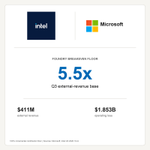
$INTC's Microsoft EMIB win is commercial proof. It is not yet a Foundry breakeven bridge.
Intel Foundry produced $411M of external revenue in fiscal Q3 and lost $1.853B. Even if every incremental external-revenue dollar became operating profit, quarterly external revenue would need to reach $2.264B, 5.5x the Q3 base, to cover the loss.
At a 40%-50% incremental contribution margin, the hurdle rises to $4.1B-$5.0B, or 10.0x-12.3x the current base. Microsoft can validate EMIB; production volume and lower process-ramp costs must close the gap.
Sources: Microsoft; Intel fiscal-Q3 10-Q.

687
$INTC $55, -0.9%, closed 1.2 points behind $SOXX $142, +0.3%, after Microsoft became the first announced user of Intel Foundry EMIB packaging for Azure first-party silicon and confirmed multi-year Xeon capacity.
Commercial validation is ahead of earnings visibility. External customers generated $411M, or 6.1%, of Intel Foundry's $6.697B fiscal-Q3 revenue, while the segment lost $1.853B.
Microsoft also cited up to 2.3x better performance and memory flexibility for selected Azure M-series workloads and 2.5x faster SQL backups. Those gains support Intel's data-center demand, but Microsoft volume and production timing must show that EMIB can expand external revenue and narrow the Foundry loss.
690
AI Afternoon Market Summary
The broad tech tape held into the final hour, but semiconductor leadership fractured further. $QQQ $658, +0.2%, and $TLT $80, +0.8%, while $SOXX $141, -0.5%. The 6.7-point gap between $AMD and $NVDA says the close is rewarding competitive silicon exposure while discounting NVIDIA leadership risk and the highest-beta AI demand names.
$AMD $522, +3.7%
$AMD is 6.7 points ahead of $NVDA and sits within 0.4% of its session high. One session does not prove accelerator share gains, but the relative move is too large to call a broad semiconductor selloff.
$NVDA $151, -3.0%
NVIDIA's $115.8B fiscal-Q3 revenue and $130B fiscal-Q4 guide still raised the earnings base. The stock is instead carrying the leadership discount: it is 6.1% below its session high while $AMD is near its high.
$CRWV $48, -4.7%
CoreWeave trails $QQQ by 4.9 points. Firm Treasuries and a positive $QQQ leave externally financed AI compute, not duration, as the cleaner source of the discount.
$SNDK $768, -3.7%
Sandisk trails $SOXX by 3.2 points. Storage did not join the $AMD rebound, so the morning demand read-through faded into the close.
736
FOMC minutes put AI in both the inflation and financial-stability discussion, but the first post-release tape did not add a broad duration selloff.
Almost all participants expected further rate increases. Two said a move above 25bp could warrant consideration in December if inflation data were unfavorable. Almost all also discussed an AI-return shock, while most flagged fast-growing, opaque AI financing structures.
At 1:18 p.m. CST, $TLT was up 0.9% near its high and $QQQ was up 0.3%. $SOXX at $141 still trailed $QQQ by 1.0 point, with $NVDA at $151 down 2.6% and $CRWV at $47 down 5.0%.
The rates message looks priced. The remaining discount is concentrated in AI hardware leadership and externally financed compute. That read breaks if $SOXX closes the $QQQ gap and $CRWV stops leading the downside.
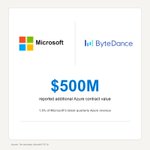
$MSFT's reported $500M ByteDance Azure expansion is financially modest and strategically awkward.
The value equals 1.5% of Microsoft's $33.2B fiscal-Q1 Azure revenue. At the 66% Microsoft Cloud gross-margin proxy, it would produce $330M of gross profit over the contract life before OpenAI model costs.
The Information says ByteDance would primarily access OpenAI models through Azure, while OpenAI has objected over alleged model distillation. The contract is too small and its timing too unclear to change our Microsoft base case.
Contract controls and U.S. policy carry more downside than the earnings contribution. A signed deal with enforceable usage rules preserves the revenue; tighter access restrictions could eliminate it.
Sources: The Information; Microsoft FY27 Q1.

679
AI Tape Volatility Check: the first-hour semi recovery failed
$SOXX $140, -1.1%, erased its 9:18am gain and fell 3.61% from HOD to LOD; it is 0.37% off the low. $SPY $728 is -0.6% and $QQQ $655 is -0.3%.
The renewed fade follows NVIDIA's post-earnings rebound ahead of its 11am company meeting, with leadership risk and the highest-beta demand read-throughs back under pressure.
$NVDA $152, -2.4%, fell 5.37% from the open to LOD and is 0.04% off the low. $SNDK $762, -4.4%, fell 7.21% from the open to LOD and has reclaimed 0.74%.
$CRWV $47, -5.8%, fell 10.09% from the open to LOD and has reclaimed 1.00%. $MRVL $144, -3.1%, has a 6.41% HOD-to-LOD drawdown and is 0.86% off the low.
The equal-weight $NVDA/$AMD/$MU/$SNDK/$INTC/$ARM basket is down 1.73%, 1.48 points behind $QQQ. NVIDIA's meeting and the 1pm FOMC minutes are the next reversal tests.
739