

Visual Information Layer of Technology | Janitor @paboxoxyz | All Posts NFA + DYOR
Singapore
Joined January 2022
- Tweets50.8K
- Following7.3K
- Followers47.6K
- Likes39.2K






Pinned Tweet
Why did we build @paboxoxyz from scratch?
Because tokenized stocks run on two different clocks.
The blockchain never stops. Stock markets and their price feeds do closing daily, and pausing on weekends and holidays.
That becomes critical when you use a stock token as collateral: a price from before the close doesn’t tell you what you could sell it for right now.
Most DeFi lending was designed for assets that trade 24/7. Tokenized stocks need lending rules that account for these market breaks.
So we built market hours into Paboxo:
- New borrowing and liquidations pause when the relevant stock market is closed.
- Collateral withdrawals against outstanding debt pause too.
- You can still repay or add collateral.
- Price-dependent actions require fresh oracle data.
We want people to borrow against their stocks without having to sell them. That starts with respecting how the underlying market actually works.
Paboxo v0 is now live on Robinhood Chain Mainnet.
This is our first step.


Paboxo is live: app.paboxo.xyz
Deposit USDG. Earn lending yield. Borrow against Stock Tokens.
Now open for deposits on Robinhood Chain.

Eli5DeFi retweeted
What if trading fees didn’t just get spent, but kept looping back to rebuild a token’s liquidity?
Samson digs into that dynamic via @Moshdottrade.
The setup: backers bankroll the launch, funds remain parked in agent vaults, and agents operate inside the contract’s guardrails, buying dips, selling into demand, keeping liquidity active.
$AUR / @aurumonmosh adds a twist: its backer routes the fees it earns right back into those vaults. Per the article, that feedback loop expanded their $GLD reserves to 17× the initial raise.
Mosh V1’s suggested “holder cut” could mechanize part of the same flywheel.
Fees would stream to holders based on balance and time held. If agent vaults qualify as holders, their allocation becomes a built-in refill for market-making firepower.
$BUN / @BundleCatAI shows the blueprint, though its current bundle would likely require dedicated fee routing rather than simply flipping on V1’s parameter.
Which raises a compelling angle for @paboxoxyz:
A future Mosh V1 launch could combine lending utility with pre-funded liquidity and tunable fee sharing. We’re also exploring compelling ways to utilize agents’ fees, potentially creating a new blueprint for DeFi protocols.
Still, the core variable doesn’t change: demand.
Agents can steward liquidity, but durable fee flow only comes from real users who keep trading and using the product.
We are bullish, and I think you should as well.
NFA. DYOR.


$AUR's backer sent every fee back to the swarm. A month later its vaults hold 17× the raise, and the bid under the token is still growing.
What that taught us, and how Mosh V1 turns it into a setting anyone can choose.

What if trading fees didn’t just get spent, but kept looping back to rebuild a token’s liquidity?
Samson digs into that dynamic via @Moshdottrade.
The setup: backers bankroll the launch, funds remain parked in agent vaults, and agents operate inside the contract’s guardrails, buying dips, selling into demand, keeping liquidity active.
$AUR / @aurumonmosh adds a twist: its backer routes the fees it earns right back into those vaults. Per the article, that feedback loop expanded their $GLD reserves to 17× the initial raise.
Mosh V1’s suggested “holder cut” could mechanize part of the same flywheel.
Fees would stream to holders based on balance and time held. If agent vaults qualify as holders, their allocation becomes a built-in refill for market-making firepower.
$BUN / @BundleCatAI shows the blueprint, though its current bundle would likely require dedicated fee routing rather than simply flipping on V1’s parameter.
Which raises a compelling angle for @paboxoxyz:
A future Mosh V1 launch could combine lending utility with pre-funded liquidity and tunable fee sharing. We’re also exploring compelling ways to utilize agents’ fees, potentially creating a new blueprint for DeFi protocols.
Still, the core variable doesn’t change: demand.
Agents can steward liquidity, but durable fee flow only comes from real users who keep trading and using the product.
We are bullish, and I think you should as well.
NFA. DYOR.
$AUR's backer sent every fee back to the swarm. A month later its vaults hold 17× the raise, and the bid under the token is still growing.
What that taught us, and how Mosh V1 turns it into a setting anyone can choose.

What the actual f-?

🇺🇸 🚨 USA: OPENROUTER.AI USER DATABASE AND API KEYS ALLEGEDLY FOR SALE
A threat actor on an underground forum claims to be selling a database associated with openrouter[.]ai, including user records and API keys.
The actor claims:
* 251,996 user rows (about 250,000 unique users)
* 207,847 API keys (described as sk-or-v1 format; active / revoked / expired mix)
Alleged user fields include emails, usernames, password material (hashed and some plaintext claimed), names, signup dates, credits, plan and country. Alleged API-key fields include user linkage, key values, creation/last-used timestamps, spend and rate limits.
The claim has not been independently verified.
⚠️ Analyst Note:
If authentic, exposed API keys would enable unauthorized LLM spend and account takeover, and user emails/credentials would fuel phishing and credential stuffing. Key values and sample rows are redacted from our images and are not reproduced here. Unverified threat-actor claim, NOT confirmation of an OpenRouter compromise.
Source: this is for subscribers only. Subscribe: xitter.cf/DailyDarkWeb/creator-s…
#DDW #DarkWeb #USA #OpenRouter #APIKeys #DataBreach #ThreatIntelligence

Eli5DeFi retweeted

Checkmark is ready!
A quick reminder: you can also use your SPCX Stock Tokens as collateral on Paboxo, built on @RobinhoodCrypto's chain.
Try it here: app.paboxo.xyz


➥ Project Spotlight - Week 43/2026
Here are 9 handpicked projects you'll want to explore.
➢ @weftfinance
➢ @AscendLaunch
➢ @signo_fi
➢ @ChopLogsApp
➢ @IntelTrade
➢ @ImperialPerps
➢ @districtxyz
➢ @suno_finance
➢ @Torchpaddotfun
Below you will find brief summaries for each.
Let's dive in!
…
— 📌 | Weft
AI trading agent that turns a thesis into a rules-based strategy. It monitors conditions (price, funding, on-chain flows, sentiment) and executes across @HyperliquidX perps, equities, prediction markets, and Solana spot. Also supports token launches with automatic fee handling, buybacks, and burns.
…
— 📌 | Ascend
Launchpad for the next generation of projects on @Enter_Elysium. No native token yet, revenue supports $HYPE, builders, and ecosystem growth. Offers incubator funding (up to $250k), strategic partnerships, and post-launch support.
…
— 📌 | Signo
AI agents that watch your DeFi positions 24/7. They alert on Telegram, prepare the next transaction for you to review and sign, and can execute within on-chain limits you set (and can revoke). Never holds keys. Free to start; works with any AI assistant via MCP.
…
— 📌 | Chop
Volatility farming protocol on Robinhood Chain. Wrap any token into a “log,” pair it, and stake to earn fees from wraps, unwraps, and trades that arise when markets chop. Fees fund $CHOP burns and farmer rewards. Includes agent-native tools via Bankr.
…
— 📌 | Intel Trade
Real-time intelligence layer for Hyperliquid. Turns on-chain data, trader/entity tracking, and market-moving events into actionable insights so traders can act on “All Finance” transparency. Opening broader access after a gated phase.
…
— 📌 | Imperial
Unified Solana perps terminal / router. One interface and collateral pool that routes to multiple venues (Phoenix, FlashTrade, Jupiter, GMTrade, etc.). Features points, gacha packs that open funded positions, and low fees. Merged its prop AMM (Armada) into the main product.
…
— 📌 | District
Launchpad for builders on Solana and Base, backed by a16z, Initialized, and Alliance. Fair launches, automatic treasury splits, high builder rewards, and a community flywheel. Also runs multi-agent systems that operate projects autonomously (e.g. Attention Mine).
…
— 📌 | Suno
Onchain solar infrastructure protocol. Investors finance plants via pWatt; operating projects back uWatt (a ~$1-targeted unit) whose staking yields come from electricity revenue. Pools mid-scale solar that traditional finance often overlooks. ~$5M AUM reported.
…
— 📌 | Torch
Trade and token launchpad on @RobinhoodCrypto Chain. Launch tokens with presets, trade from a non-custodial wallet (Turnkey), earn creator/holder rewards, and trigger automatic $TORCH burns on every trade. Includes terminal, Telegram bot, alpha feed, and Uniswap v4 pools.

Check out our complete portfolio here:
eli5defi.xyz/

➥ Project Spotlight - Week 43/2026
Here are 9 handpicked projects you'll want to explore.
➢ @weftfinance
➢ @AscendLaunch
➢ @signo_fi
➢ @ChopLogsApp
➢ @IntelTrade
➢ @ImperialPerps
➢ @districtxyz
➢ @suno_finance
➢ @Torchpaddotfun
Below you will find brief summaries for each.
Let's dive in!
…
— 📌 | Weft
AI trading agent that turns a thesis into a rules-based strategy. It monitors conditions (price, funding, on-chain flows, sentiment) and executes across @HyperliquidX perps, equities, prediction markets, and Solana spot. Also supports token launches with automatic fee handling, buybacks, and burns.
…
— 📌 | Ascend
Launchpad for the next generation of projects on @Enter_Elysium. No native token yet, revenue supports $HYPE, builders, and ecosystem growth. Offers incubator funding (up to $250k), strategic partnerships, and post-launch support.
…
— 📌 | Signo
AI agents that watch your DeFi positions 24/7. They alert on Telegram, prepare the next transaction for you to review and sign, and can execute within on-chain limits you set (and can revoke). Never holds keys. Free to start; works with any AI assistant via MCP.
…
— 📌 | Chop
Volatility farming protocol on Robinhood Chain. Wrap any token into a “log,” pair it, and stake to earn fees from wraps, unwraps, and trades that arise when markets chop. Fees fund $CHOP burns and farmer rewards. Includes agent-native tools via Bankr.
…
— 📌 | Intel Trade
Real-time intelligence layer for Hyperliquid. Turns on-chain data, trader/entity tracking, and market-moving events into actionable insights so traders can act on “All Finance” transparency. Opening broader access after a gated phase.
…
— 📌 | Imperial
Unified Solana perps terminal / router. One interface and collateral pool that routes to multiple venues (Phoenix, FlashTrade, Jupiter, GMTrade, etc.). Features points, gacha packs that open funded positions, and low fees. Merged its prop AMM (Armada) into the main product.
…
— 📌 | District
Launchpad for builders on Solana and Base, backed by a16z, Initialized, and Alliance. Fair launches, automatic treasury splits, high builder rewards, and a community flywheel. Also runs multi-agent systems that operate projects autonomously (e.g. Attention Mine).
…
— 📌 | Suno
Onchain solar infrastructure protocol. Investors finance plants via pWatt; operating projects back uWatt (a ~$1-targeted unit) whose staking yields come from electricity revenue. Pools mid-scale solar that traditional finance often overlooks. ~$5M AUM reported.
…
— 📌 | Torch
Trade and token launchpad on @RobinhoodCrypto Chain. Launch tokens with presets, trade from a non-custodial wallet (Turnkey), earn creator/holder rewards, and trigger automatic $TORCH burns on every trade. Includes terminal, Telegram bot, alpha feed, and Uniswap v4 pools.


Seeing a lot of folks claiming @ponsdotfamily revenue got nuked to ~$30k/day, genuinely curious, what charts are you all looking at?
- Pons internal analytics: ~ $55k
- @stateofblocks dashboard by @that1618guy: ~ $42k (est. $112k)
- @DefiLlama: $54,571
Off the peak?
Sure, but I’ve said it a bunch: PONS basically tracks RHC activity. Even so, it’s holding up way better than most projects, and the bulk of revenue (~80%) is used to buy back and burn $PONS.
Also, let’s not forget that RH’s earnings call will be on October 27.
Feels like the bottom’s already been printed.


An idle Mac is unused AI capacity. Faster software can make that same Mac more productive.
@eigencloud is connecting both ideas through @DarkbloomAI and @YukonResearch.
And @FourPillarsFP’s latest research explains how they fit together ↓
➠ Darkbloom turns spare Macs into an inference network.
Mac owners install the provider app, choose a model, and set when their machine is available. Developers pay to run inference (generating responses from an AI model).
A coordinator checks which machines have the right model, enough memory, and available capacity before assigning requests. Owners earn from the work their hardware serves.
The cost advantage starts with hardware people already own. Darkbloom can expand supply without buying every machine itself.
In the report’s GPT-OSS 20B example, direct pricing is $0.07 per million output tokens vs. $0.14 for its API comparator.
-
➠ Yukon focuses on getting more out of those machines.
Researchers and AI agents tackle optimization challenges in parallel. They submit code changes, which are tested for correctness and performance.
Verified improvements are shared, so the next team can build on what works instead of repeating the same experiments.
There’s already a concrete example: the initial MLX Fast challenge reported a 2.6× speedup for Poolside’s Laguna XS 2.1 model.
-
➠ The connection is straightforward:
More idle Macs join → researchers optimize the software → verified improvements help compatible Macs serve more requests.
The opportunity: more useful AI compute from existing hardware, with developer spending becoming income for Mac owners.
Curious to see, over time, how consistently those benchmark gains translate into lower costs and reliable service under real traffic.
NFA. DYOR.


Pay someone from a public crypto wallet, and they may learn far more than how much you paid.
That address can become a starting point for tracing your holdings, transfers and trading activity.
@NullMaskio built by $ZEC contributors, offers a private balance through the wallet you already use.
The flow is straightforward:
- Register your account
- Deposit into a shared pool
- Then transfer, swap or withdraw privately.
Deposits are screened before you can spend them. You sign each action, NullMask generates the proof, and a relayer sends the transaction. Contracts verify it’s valid without revealing private details.
The relayer replaces your wallet as the public transaction sender. What else stays hidden depends on the action:
• Private transfers:
Sender, recipient and amount are hidden between NullMask accounts.
• Swaps:
Assets and amounts remain public, while the user is hidden.
• Withdrawals:
Recipient, asset, amount and timing are public. Sending to someone without a NullMask account becomes a withdrawal.
Public deposits and withdrawals can still be matched using timing and amounts. NullMask’s Withdrawal Waves schedule exits every 15 minutes and allow splitting across up to five parts. This can complicate matching, but effectiveness depends on other users’ activity and your behavior.
Its bridge sends from your regular wallet through @NEARProtocol Intents.
The crucial trade-off: NullMask’s operator can read your private balance and history, however its account keys cannot spend.
Users pay for this service through:
• 0.5% deposit and 0.5% withdrawal fees.
• Network/service charges, including on transfers and swaps.
• DEX pool fees when swapping.
$MASK is the protocol’s native token and the main mechanism for capturing value.
The real upside is delivering privacy as a simple add-on inside the wallets people already use. The big question is whether users will keep paying for that convenience? I think yes.

Eli5DeFi retweeted

“Let me fund your bundle pls”
-everyone on chain
The future of on chain launches will be on mosh.trade, funded by robinhood:0x07ebb29a38fbcb41563817e5e19f2cec619c90d2

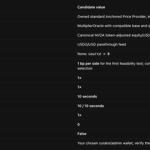
Well, I think Metric is very interesting, some pro tips, send your LLMs or Agents with Metric's docs and fine-tune your LPs creation (check images below for example on $NVDA).
app.metric.xyz/r/eli5defi


A DEX pool can earn fees while selling its assets too cheaply.
@metricxyz’s Active Pools aim to reduce that problem by updating prices as new market information arrives.
The key idea: separate pricing from liquidity.
Each pool uses a Price Provider, a smart contract that supplies:
• Bid: what the pool pays to buy an asset.
• Ask: what it charges to sell.
• Reference: the baseline around which liquidity is arranged.
A provider sets a reference price using oracle feeds, onchain data, or a market maker model.
LPs deposit into bins (percent ranges around that reference). The pool price is: Reference price × (1 + deviation)
Deviation reflects how trades moved the pool: buys push up, sells push down. Big trades can cross multiple bins and get worse prices.
Example: $100 with +1% deviation = $101. If the reference moves to $110 with no trades, price becomes $111.10.
This makes Bins shift with the reference; tokens don’t rebalance.
That’s the main difference from ordinary Uniswap v3 positions, whose price boundaries stay fixed. Metric reduces the need to reposition liquidity as the reference moves.
Curators run the pools. They choose pricing logic, configure fees and safeguards, and maintain updates. Public pools accept outside liquidity; private pools can restrict deposits to the operator’s capital.
The broader idea isn’t entirely new. DODO already adjusts quotes around inventory, and Uniswap v4 hooks allow custom pricing. Metric combines customizable pricing, moving liquidity ranges and shared market-making infrastructure.
That could suit assets with established external prices, including tokenized stocks, gold and major crypto assets.
Here’s how the money works:
• Traders pay spreads and any configured fees inside the quote, plus network gas.
• Spread and bin-fee income is shared among LPs, curators and Metric.
• LP earnings stay in their bins and compound.
• Curator and protocol fee shares can change without a timelock.
So “zero fees” doesn’t mean trading has no cost.
Protection also matters:
• Anchored pricing constrains quotes using an independent feed.
• Freshness checks can reject trades using stale data.
• StopLoss can reject swaps that breach configured drawdown checks.
• Participating Ethereum and BNB Chain builders commit to placing updates before trades.
Still, LPs remain exposed to inventory drawdowns, oracle outages, and curator-side risk.
Metric’s edge is that it keeps liquidity tracking a moving reference price, cutting down the need for constant hands-on range tweaking.
What will make or break Metric is whether it can deliver truly competitive execution and strong net LP outcomes once fees and inventory bleed are accounted for.
NFA. DYOR.
