

Founder @ Vision Capital Fund. Investor, author, angel. Invest in companies that reflect our best vision for our future. Musings on investing, business & life.
Singapore 🇸🇬 | Global 🌏
Joined October 2017
- Tweets26.1K
- Following1.8K
- Followers28.8K
- Likes42.9K




Pinned Tweet
I am thrilled to announce the launch of Vision Capital Fund, which has been in the making for over seven years.
We are focused on growing wealth for generations by delivering outstanding long-term investment returns from investing in exceptional companies that best reflect our vision for our future.
Website: visioncapitalfund.co/
Press Release: tinyurl.com/VCFpressrelease
Day One Investor Letter: tinyurl.com/VCFDayOne


Microsoft $MSFT 1Q27 Earnings
- Rev $92.3b +19% ↗️🟢
- GP $62.6b +17% ↗️🟢 margin 67.8% -125 bps ↘️🔴
- EBIT $45.9b +21% ↗️🟢 margin 49.8% +88 bps ✅
- NG* Net Inc $36.4b +18% ↗️🟢 margin 39.5% -23 bps ↘️🔴
- Net Inc $36.6b +32% ↗️🟢 margin 39.7% +397 bps ✅
- OCF $58b +29% ↗️🟢 margin 62.9% +484 bps ✅
- FCF $18.6b -27% ↘️🔴 margin 20.2% -1285 bps ↘️🔴
*Adjusting for investments in OpenAI
Product
- Rev $14.6b -8% ↘️🔴
- GP $12.2b -6.5% ↘️🔴 margin 83.1% +146 bps ✅
Service
- Rev $77.6b +26% ↗️🟢
- GP $50.4b +24.0% ↗️🟢 margin 64.9% -89 bps ✅
Agents and Infra (faster growing, more profitable)
- Rev $76.8b +25% ↗️🟢
- GP $52.9b +20.3% ↗️🟢 margin 68.9% -240 bps ↘️🔴
- EBIT $40.6b +24.0% ↗️🟢 margin 52.8% -24 bps ↘️🔴
Devices and Consumer (slower growing, less profitable)
- Rev $15.5b -3% ↘️🔴
- GP $9.7b -0.1% ↘️🔴 margin 62.3% +196 bps ↘️🔴
- EBIT $5.4b +2.2% ➡️🟠 margin 34.6% +183 bps ↘️🔴
Revenue by Product Type
- Azure $33.2b +48% ↗️🟢
- Microsoft 365 Cloud $27.8b +17% ↗️🟢
- M365 Commercial Cloud +18% ↗️🟢
- M365 Consumer Cloud +16% ↗️🟢
- Productivity and server licensing $8.4b -3% ↘️🔴
- Search and advertising $6.6b +10% ↗️🟡
- XBOX $5.4b -2% ↘️🔴
- Industry solutions $5.3b +9% ↗️🟡
- Windows OEM and devices $3.6b -22% ↘️🔴
- Frontier and support services $2.1b +4% ↗️🟡
- Microsoft Cloud Rev $63.9b +31% ↗️🟢
- Microsoft Cloud GPM 66% -200bps ↘️🔴
Biz Metrics
- Commercial Bookings -12% ↘️🔴
- Commercial RPO $677b +73% ↗️🟢 (flat QoQ)
2Q27 Mgmt Guide
- Agents and Infra Rev $80.7b +25% ↗️🟢
- Devices and Consumer Rev $16.4b -2% ↘️🔴
- Rev $97.1b +19% ↗️🟢
- GP $64.2b +16% ↗️🟢 margin 66.1% -192 bps ↘️🔴
- EBIT $45.6b +19% ↗️🟢 margin 47.0% -13 bps ↘️🔴
1 | While revenue from agents and infrastructure grew 25%, commercial bookings decreased 12%, commercial RPO saw a small sequential decline.
Revenue from Agents and Infra was $76.8 billion and grew 25%, reflecting strength across the connected layers of our platform. Commercial bookings decreased 12% and 11% in constant currency, driven by the impact from large Azure commitments in the prior year, partially offset by healthy growth in our commercial sales motions, including a large Azure commitment this quarter. Commercial remaining performance obligation grew 73% to $677 billion, with a smaller sequential decline relative to historical seasonality due to the large Azure commitment this quarter.
2 | Cloud revenue grew 30%, with Azure growing even faster at 48%, driven by Foundry, which tripled YoY, and efficiency gains. Azure growth was broad-based.
Now to Microsoft Cloud. Revenue was $63.9 billion and growth accelerated to 30% and 31% in constant currency with sequential dollars added nearly doubling year-over-year, reflecting strong demand across Azure and M365 Commercial Cloud. Azure revenue was ahead of expectations and increased 48%, even with the 3P capacity delays noted earlier, driven by Foundry and improved CPU monetization. Foundry revenue more than tripled year-over-year with upside driven by efficiency gains across our GPU fleet that allowed us to allocate additional capacity to customers as well as higher revenue per token that we benefited from in the quarter. Across our CPU fleet, engineering work enabled us to identify and monetize underutilized capacity this quarter, helping us serve more of the growing demand with our existing capacity. All up, Azure growth was broad-based across both enterprises and small and medium business segments and spanning both core cloud services and AI infrastructure.
3 | Devices and consumer segments had much slower growth, dragged by Xbox, and Windows OEM. Struggles in Q2 should continue.
Now to Devices and Consumer. Revenue was $15.5 billion and declined 3%. Search and advertising revenue ex-TAC increased 12% and was ahead of expectations, driven by higher volume and rate across LinkedIn, Edge and Bing. Xbox revenue decreased 2% and Xbox content and services revenue decreased 2% and 1% in constant currency, driven by declines in third-party content and Xbox Game Pass, partially offset by growth in first-party content. And Windows OEM and devices revenue decreased 22%. Windows OEM revenue was below expectations and decreased 27% and 28% in constant currency, driven by the Windows 10 end of support demand in the prior year, inventory drawdowns by OEM and channel partners and weaker PC market demand. Inventory levels remain elevated.
Hardware revenue in Q2 should decline YoY Windows OEM and devices revenue should decline in the mid-30s. Growth will continue to be impacted by elevated inventory levels, PC market demand and a prior year comparable that benefited from Windows 10 end of support. As in prior quarters, the range of potential outcomes remains wider than normal. We expect these trends to continue through the rest of the fiscal year.
4 | Expecting 2Q27 revenue to grow by 19%, driven by faster revenue growth from agents' infrastructure of 25%, whereas consumer and devices declined by 2%.
Starting with segment guidance. We expect revenue from Agents and Infra of USD 80.1 billion to USD 80.7 billion or growth of 24% to 25%. In commercial bookings, we expect healthy growth in our commercial sales motions, the results will be impacted by the significant Azure commitments signed in the prior year. Timing related to significant Azure commitments like these will result in material volatility in bookings, making quarterly growth rates less indicative of underlying sales execution. In Azure, we expect revenue growth of 49% to 50% in constant currency with continued efficiency gains across our CPU and GPU fleet, helping to offset some 3P GPU-as-a-Service contracts that have been delayed to H2.
5 | M365 commercial cloud to grow revenues faster at 19%, whereas consumer cloud will be in the low teens. Industrial solutions cloud to be in the mid to high single digits, and frontier and support services to grow in the low to mid single digits.
In M365 Commercial Cloud, we expect growth of ~19% in constant currency with FX expected to reduce reported growth by less than 1 point…M365 Consumer Cloud revenue should grow in the low teens, down sequentially as we lap the price impact noted earlier…In Industry Solutions Cloud, we expect revenue growth to be in the mid-to-high single digits with continued impact from the bookings trends noted earlier. And in Frontier and Support Services, we expect revenue to grow in the low to mid-single digits.
6 | The top three things that Microsoft is focused on: Designing AI to empower people, ensuring enterprises have sovereignty over their own learning, building trust with controls that ensure agent safety and security.
We are focused on 3 things: designing AI to empower people, ensuring every organization has sovereignty over its own learning and building trust with controls that ensure agent safety and security.
7 | Copilot was unified, bringing together Chat, Cowork, Autopilot, and Code, wanting to make Copilot the new OS for work.
We announced our biggest update to Copilot to date this quarter, bringing together Chat, Cowork, Autopilot and Code into one unified experience. It's one product experience across commercial and consumer and comes with all of Office built in. We think of Copilot as the new OS for work.
8 | More customers, more users, using Copilot with activity and satisfaction growing rapidly
Customers are increasingly turning to Copilot to get real work done. Automated tasks have nearly doubled since July. Daily users are up nearly 50% QoQ and over 5x YoY. User satisfaction improved nearly 20% QoQ to another all-time high. And 90% of Copilot queries use Auto mode, which dynamically routes tasks across models optimizing for quality, speed and cost. These improvements are translating into larger purchases. The number of customers with more than 50,000 Copilot seats increased over 8x YoY…For example, we increased the throughput for Copilot workloads by over 50% QoQ.
9 | Seeing strong consumption from Agentic features on GitHub
Credit consumption from Agentic features on GitHub has more than doubled since usage-based billing went into effect. And we're also helping developers secure their code and turn AI-generated code into high-quality software. GitHub Advanced Security revenue increased over 50% YoY as customers use its AI capabilities to scan entire repos and fix vulnerabilities in real time.
10 | Microsoft making progress with their own first-party AI models, focused on advancing the cost-to-outcome frontier
We also continue to make rapid progress with our first-party models. Our goal is to advance the cost-to-outcome frontier, which means delivering capabilities comparable to leading models within 3 to 6 months of their release at a fraction of the training cost, thereby allowing us to transfer those cost benefits to customers. And you see this in our products today.
11 | Nvidia GB300s make up the majority of GPU deployments.
Underlying everything I've talked about so far is our infrastructure. We are building against a growing book of business with a fungible fleet that allows us to dynamically allocate capacity to the highest value opportunities across compute, data, Foundry and Copilot. Accelerating demand led to us adding 24 new data centers across 5 continents this quarter. And we are bringing capacity online faster, reducing dock-to-live times by about 20% quarter-over-quarter for new GB300s in our biggest regions, which make up the majority of the GPU deployments.
12 | Microsoft continues to scale their AI fleet with Nvidia and AMD GPUs alongside their own chips of Maia custom ASICs and Copilot CPUs.
We continue to scale our fleet with the latest innovations from NVIDIA and AMD alongside our own Maia systems. We have docked our first NVIDIA Vera Rubin GPUs and are very excited about it. Maia 200 is already delivering up to 1.7x more tokens per watt across the AI experiences in Teams and Copilot, and Maia 300 will drive further gains, delivering 40% more tokens per watt compared to the leading GPU-based systems. Our growth extends beyond GPUs. We continue to see strong adoption of our cloud-native Cobalt CPUs, improving price performance for general-purpose cloud workloads.
13 | Microsoft is making some changes to the sales motions with Frontier Company building on the Forward Deployed Engineering (FDE) model.
And I think I would say it's also why we've made the investment into the frontier company here, coupled with changes in our sales motion, which I talked a little bit about. We need both of those things to make sure customers are -- because what I think Satya is saying, we want them to utilize both the Copilot license to its fullest and understand when the consumption meter is delivering value to them. The investment in the FDE organization or the Frontier Co., as well as new motions within our modern work and Microsoft 365 sales teams are both meant to do that.
14 | Microsoft owns 24% of OpenAI, OpenAI at $10b, accounts for 11% of revenues, and Microsoft has made $12b of the $13b funding commitments.
We have a long-term strategic partnership with OpenAI which was originally established in 2019. We have an investment accounted for under the equity method that represents an approximate 24% interest on an as-converted basis. For the three months ended September 30, 2026, we recorded revenue from commercial arrangements with OpenAI, inclusive of revenue-sharing payments, of $10.0 billion. Accounts receivable from OpenAI as of September 30, 2026 and June 30, 2026 was $7.2 billion and $6.0 billion, respectively. We have made total funding commitments of $13.0 billion related to our investment, of which $12.0 billion has been funded as of September 30, 2026…
15 | Microsoft still has demand that far exceeds supply. Token pricing will continue to create variability.
That's a great thing because we're -- as I said in the call, we still have demand that exceeds supply. So where we can have our engineering teams deliver those efficiencies, we do really try to put it into Foundry when we can because it's so important, as Satya talked about, into how customers broadly are building what I would call against the new stack. Secondly, and you mentioned it, token pricing will create a little bit of variability. We had higher token pricing than we expected in the quarter. Listen, high-quality models that we're able to take advantage of and see good margins on do benefit us in the quarter, and that did happen in Q1. We need to find some more, which we're counting on, enable to get to that guidance that I gave because I have faith in the team's work in Q1 continuing into Q2. B
16 | Microsoft managed to create additional capacity within their existing fleet from the efficiency gains, and expect that to continue into Q2.
And I think also in that number in Q1 was the efficiencies I talked about applied not just to our GPU fleet. But I think people sort of underestimated when the example Satya gave for Adam's question that the GPU, CPU storage memory workload. I mean it takes all of the pieces. And so our ability to also create additional capacity within our existing fleet gave us some room to be able to convert that actually pretty quickly as well in Q1. So in Q2, we've got those efficiency gains, which is great, and those will continue into Q2.
17 | Capex was $45.2 billion in 1Q27 as third-party capacity deliveries were delayed. 3/4 of capex was for short-lived assets, primarily CPUs and GPUs, whereas the remaining ¼ was for long-lived assets.
Capital expenditures were $45.2 billion as some third-party capacity deliveries we expected in Q1 were delayed. Roughly 3/4 of our CapEx was for short-lived assets, primarily CPUs and GPUs, including higher memory and storage costs as we continue to invest in the infrastructure required for our customers to build and scale AI applications. The remaining spend was for long-lived assets.
18 | Microsoft still expects to continue to be free cash flow positive in FY27.
And as we continue to improve the efficiencies of our infrastructure, each dollar of CapEx has the potential to support more revenue and higher returns over time. Given our strong business performance, we expect to continue to remain free cash flow positive in FY '27. To complement cash generated by the business and preserve financial flexibility, we will access additional sources of funding when we believe it is attractive to do so.
19 | Microsoft is seeing some of the shiny new things in AI waning. Enterprises are asking if they can build the system, own the weights, manage their costs, and have reliability and security. The enterprise breadth motion starting, and Microsoft is well positioned.
And in fact, maybe in some of the shiny object stuff is waning, right, which is not about the next big thing. They're really more about, wow, can I build the system? Can I own the weight? Can I manage my costs? Can I have reliability? What about security?
And so in that sense, the enterprise breadth motion is starting. But like everything else, the enterprise stuff is not like a quarter-over-quarter. It's a decade-long thing, and that's what I've been waiting for as opposed to like 4 customers who buy a lot of capacity from you and you can show a few quarters of growth. And that's not a business as far as I'm concerned. So I want the breadth.
We are well positioned on the breadth. And we have large customers who want to buy from us, and we're open for business with it. And as long as the pricing is right, we may sell them some. If not, we will be patient about building the breadth of business.
➡️ Final Takeaways: Microsoft $MSFT
Long-term compounder with combination of growth, profitability and durability at scale with multiple growth drivers supported by long-term tailwinds in agent and infrastructure with faster growth and higher profitability offsetting the weaker growth and lower profitability in consumer and device. Azure and Cloud continues to benefit from the enterprise software distribution, moving away from being overly reliant on OpenAI, towards a highly open model architecture instead, commoditising the model layer and aggregating distribution instead. Microsoft notably has a more cautious, less aggressive stance versus Amazon AWS and Google GCP.


Amazon $AMZN 3Q26 Earnings
- Rev $201.9b +12% ↗️🟡
- GP $107.4b +17% ↗️🟢 margin 53.2% +238 bps ✅
- EBIT $28.1b +61% ↗️🟢 margin 13.9% +423 bps ✅
- Net Inc $20.7b -2% ↘️🔴 margin 10.2% -152 bps ↘️🔴
- OCF $42.4b +19% ↗️🟢 margin 21.0% +129 bps ✅
- FCF $-34.8b -- ⤴️🟢 margin -17.3% -1749 bps ↘️🔴
Revenue by Segment
- Product sales $75.3b +2% ➡️🟠
- Service sales $126.6b +19% ↗️🟢
- Online Stores $68.5b +2% ➡️🟠
- Physical Stores $5.7b +2% ➡️🟠
- Third-Party Seller Services $46.5b +9% ↗️🟡
- Advertising $19.6b +11% ↗️🟡
- Subscription $14b +11% ↗️🟡
- AWS $46b +39% ↗️🟢
- Other $1.6b +16% ↗️🟢
- WW Paid Units +12% ↗️🟡
- WW Shipping Costs +11% ↗️🟡
North America
- Rev $112.9b +6% ↗️🟡
- EBIT $8.7b +82.1% ⤴️🟢 margin 7.7% +322 bps ✅
International
- Rev $43.1b +5% ↗️🟡
- EBIT $1.6b +31.8% ↗️🟢 margin 3.7% +73 bps ✅
AWS
- Backlog $578b +189% YoY +17% QoQ 📶🟢
- ARR Rev $184b +39% ↗️🟢
- Rev $46b +39% ↗️🟢
- EBIT $17.8b +55.4% ↗️🟢 margin 38.7% +401 bps ✅
Mgmt Guide
- 4Q26 Net Sales $246b +16% ↗️🟢
- 4Q26 Ad Rev +18% (high-teens) ↗️🟢
- 4Q26 EBIT $33.6b +34% ↗️🟢
- FY26 capex $220b unchanged
1 | “Lower” e-commerce sales due to “tough comps” with Prime Day occurring in Q2 this year instead of Q3. Q2 had “higher” and Q3 had “lower” growth.
As a reminder, Prime Day timing shifted this year, with the event occurring in Q2 for most large countries. In 2025, Prime Day occurred entirely in Q3. Excluding this shift, third quarter year-over-year growth would have been approximately 400 basis points higher.
2 | Net income “declined” due to tough comps as there was $9.5bn of pre-tax gains from Anthropic in 3Q25.
Net income decreased to $20.7 billion in the third quarter, or $1.89 per diluted share, compared with $21.2 billion, or $1.95 per diluted share, in third quarter 2025. This decrease is driven primarily by pre-tax gains of $9.5 billion in third quarter 2025 included in non-operating income (expense) from our investments in Anthropic.
3 | Q3 remains strong for Amazon, where AWS is just exploding.
Q3 was another strong quarter for Amazon. In AWS, our plan is working. Despite lapping a comparable YoY period where we added a lot of capacity, AWS grew 39.3% YoY accelerating for the sixth straight quarter, our fastest growth in nearly 5 years. Backlog is $578 billion, growing triple digits YoY and well diversified.
4 | AWS is installing accelerators as fast as they can, and customers are just gobbling it up. Operating margins remain strong on the core side and rapidly improving on the AI side.
We're installing an AI accelerator about every 14 seconds and almost as fast as we install capacity, customers are gobbling it up. Our core compute and storage revenue grew at their fastest rates in several years. Our operating margins have long been strong on our core offering, but rapidly improving on the AI side, too, well ahead of where they were on core at a similar time of evolution.
5 | While Amazon is not guiding for AWS EBIT margins, the improving profitability is a result of disciplined efficiency gains, capacity optimization, and operating leverage.
let me start with the operating margin outlook for AWS. So we're not guiding out beyond -- we're not guiding at all on our margin for AWS. But I can tell you -- give you my color on it. So very -- it seems very strong op margin, 38.7% this quarter. And I would add that the profitability you've been seeing recently is really not a random output, it's a result of a lot of disciplined efficiency gains, capacity optimization, closely managing our fixed cost.
6 | Even with higher memory costs and depreciation, AWS continues to accelerate their capex payback and has conviction that it will yield more revenue and free cash flows with strong ROICs.
Even with heightened component costs like memory and significant depreciation from the CapEx we're investing. We continue to accelerate our CapEx payback and have even more conviction than we already had that the investment we're making in AWS will yield a much larger revenue and free cash flow generating business than we would have imagined a couple of years ago with strong return on invested capital.
7 | AWS has a compelling flywheel, much better than that of the neoclouds, which are just primarily hosting GPUs and renting short-term data center capacity.
We have a compelling flywheel spinning in AWS. Borrowing from Jim Collins' flywheel definition Good to Great, where if you do A, you almost can't help but do B and if you do B, you almost can't help but do C and so on. In AWS, having the leading functionality, security and operational performance can't help but drive customers to run their apps and store their data in AWS, which can't help but drive AWS AI demand because customers prefer their production inference to be near the rest of their data and apps, which can't help but drive core AWS demand because AI uses core for work like reinforcement learning, posttraining and tool usage, which can't help but drive reinvestment back into our broader AWS functionality. This is a different model than primarily hosting GPUs or renting short-term data center capacity. This is a long-term platform strategy that broadly helps customers invent and evolve their customer experiences, operate stably and build a reliable partnership they can grow for many years.
8 | 85% of global IT spend remains on-premises, and AWS is still riding a 10- to 20-year secular tailwind of which IT spend will shift to the cloud.
It's important to remember that the vast majority of global IT spend, about 85% is still on-premises, and we're in a 10- to 20-year cycle where that equation will flip to the cloud. Conventional wisdom has been that linchpin workloads like mainframes or storage array networks would never move to the cloud. But these workloads are moving as AWS has built unique cloud substitutes and AI-driven migration capabilities to make this transition much easier. And enterprises get the benefits of less CapEx, lower operating costs, faster innovation, better developer productivity and data accessibility to more easily leverage AI. Our core business has attractive margins because we've learned to run it very efficiently over the last 20 years.
9 | The acquisition of DuckLabs will allow DuckDB to become the universal SQL dialect of AWS storage and analytics, allowing customers to have zero migration or portability cost between query engines.
With our acquisition of DuckLabs, DuckDB will become the universal SQL dialect of AWS storage and analytics, simplifying data processing with a modern analytics engine that is fast, simple to use and ubiquitous and where customers will be able to write SQL queries once and then execute using any AWS analytics service. For the first time in analytics, customers will have 0 migration or portability costs between query engines. This is a big deal. And you can imagine how it will also help agents do efficient querying as well.
10 | Bedrock is experiencing explosive growth, with spending 7x and token volume 17x YoY.
On the AI side, we continue to expand the capabilities of our inference service, Amazon Bedrock, and it's leading to remarkable growth with Fortune 500 companies spending nearly 7x more on Bedrock year-over-year and total Bedrock token volume growing nearly 17x year-over-year. Bedrock is the fastest growing multibillion-dollar service in AWS' history. We recently added OpenAI models to Bedrock and usage is growing quickly. We also just added Bedrock managed versions of Kimi, GLM and SpaceX models.
11 | Customers keep choosing Bedrock because their data remains secure and private. Inputs and outputs are never shared with model providers or used to train their models.
You can't have a conversation about AI today without talking about security. It's another reason customers keep choosing Bedrock. We've designed Bedrock so customers' data remains secure and private. Inputs and outputs are never shared with model providers or used to train based models. When customers tune a foundation model, we create a private copy specifically for their use, and data is fully encrypted both in transit and at rest.
12 | AWS Continuum, which is used to discover, prioritize, validate, and remediate code vulnerabilities, and machine speed are already being used by numerous customers with interests unlike anything before.
As frontier models get more powerful, they're surfacing software vulnerabilities previously not found and at unprecedented rates. We built AWS Continuum to discover, prioritize, validate and remediate code vulnerabilities and machine speed. It's already being used by customers like Capital One, IBM, Infor, Luminate and Robinhood. In Q3, we announced that we'll integrate it into the tools where code's being written, Anthropic's Claude Code, OpenAI's Codex, and AWS's Kiro. The interest from customers exceeds anything we've ever seen for a new security service.
13 | Customers continue to use numerous AWS agent products, from Agent Core (purpose-built agents), Agent Connect (contact center agents), to Amazon Quick (AI work companion).
Agents continue to be deployed at accelerating rates, many of which are being built on Bedrock AgentCore's building blocks. Tens of thousands of customers currently use AgentCore, deploying 2x more agents with it in Q3 than the prior 3 quarters combined. In addition to building their own purpose-built agents, most companies will also use turnkey agentic services, and we offer several that customers love Kiro for coding, Amazon Connect for contact center agents and Amazon Transform for migration. They're all iterating quickly and picking up customer momentum. As is Amazon Quick, our intelligent AI work companion, which is growing very rapidly as large enterprises like Mondelez, EchoStar, 3M, Southwest Airlines and DXC are choosing Quick because it's purpose-built for work with no compromises on customer data.
14 | Amazon chip business grew triple digits. Revenue commitments for Graviton CPU and Trainium ASICs increase by more than 20x. Customers are saving more from using Amazon's silicon.
Finally, our chips business continues to grow triple-digit percentages YoY and revenue commitments for Graviton and Trainium have each increased more than 20x YoY. AI continues to be a tailwind for Graviton because posttraining reinforcement learning and agent tool use is mostly done on CPUs versus AI accelerators, and Graviton is the strongest CPU chip, offering up to 30% to 40% better price performance than alternatives. Customers using our custom silicon saved more than $2 billion in Q3 alone
15 | Despite the new generation of chips, demand for prior generations remains very strong, and continues to sell at a premium. Trainium now available outside of AWS.
As we launch new generations of chips, demand for prior generations remained strong. After our launch of Graviton5, backlog for prior generation Graviton instances still more than doubled QoQ. And short-term capacity for prior generation Trainium instances sell at a premium compared to the first half of the year. With Trainium demand so strong, customers continue encouraging us to make it available outside of AWS. We intend to do so late in 2027. Overall demand for AWS capacity remains exceptionally strong.
16 | AWS’s investments in custom chips and networking is building a cost-efficient infrastructure. Expect AWS margins to fluctuate QoQ.
Our investments in custom chips and custom networking along with software and process improvements are helping us optimize capacity and build a more cost-efficient infrastructure. As we've long said, we expect AWS operating margins to fluctuate driven in part by the level of investment we're making at any point in time.
17 | Amazon’s own chips with Trainium and Graviton CPUs are highly price performant than GPUs and other x86 CPUs, and that is attracting other customers.
Trainium, with a meaningful advantage it has in price performance versus other alternatives is very compelling to people. And then as more and more people are using AI in a very broad way, it drives a lot of the core in capabilities like reinforcement learning and posttraining and tool calling and we have the leading CPU chip in Graviton, which is about 30% to 40% more price performant than the other x86 providers. So it's -- those things are really driving very significant growth.
18 | Amazon is focusing on their own silicon like Trainium, to lower the inference costs.
Some of it is the cost of inference. I think if we all want enterprises to be able to use inference the way we all believe they will, we have to keep working on taking the cost of inference down. That is a huge mission for AWS. It's one of the significant reasons why we're building our own custom silicon in Trainium is that we just really believe it's incredibly important for customers to be able to use inference in a much more cost-effective way. That has come down a lot, the cost of inference over the last couple of years, and I think it will come down meaningfully more.
19 | Inference accounts for well over half of AWS AI revenue and continues to grow. 2026 cash capex remains unchanged at $220bn, the majority of which is for AWS. Expect this to grow significantly in 2027. AWS has a clear line of sight to attractive financial returns.
Enterprises are still very early in using inference at scale, and yet inference already accounts for well over half of AWS' AI revenue and growing. And we have a lot of training revenue as well. We still expect 2026 cash CapEx of approximately $220 billion, the majority for AWS and expect to spend meaningfully more in 2027. And with a clear line of sight to attractive financial returns, as I laid out on our last call. AWS is a $184 billion annualized revenue run rate business, and yet the opportunity remains extraordinary.
20 | AWS can grow >40% in 2027 and 2028 and reach $1T revenue in the next 5-10 years (implied ~18-40% CAGR). AWS will be another trillion-dollar revenue business alongside the Amazon e-commerce business.
With our continued pace of innovation, new core and AI functionality, enterprises wanting to run their core and AI workloads in AWS and the amount of capacity that we're adding each year, we believe that AWS can grow north of 40% in each of 2027 and in 2028, and be a $1 trillion revenue business in the next 5 to 10 years. We're in the very early days of this inflection, our strategy is working, and I expect it will for the foreseeable future. In stores, I think some folks are sleeping a bit on how much progress that business has made and what it's become in the last few years. I'm not aware of another retail business approaching Amazon's revenue size, hundreds of billions of dollars, with double-digit operating margins inclusive of ads that's growing at this pace.
21 | Amazon is on path to more than 2 businesses with >$1T of annual revenues. But the growth path of AWS will vary across quarters but be directionally much higher.
What we're building at Amazon is unlike anything that's ever been seen before. There has never been a business with $1 trillion of annual revenue. Amazon is on a path to have 2 of them in AWS and stores. It's rare, and we're energized by what's ahead…There has never been a trillion dollar revenue business, and we may have two of them in the next 5-10 years.
The amount of capacity we add each quarter will vary, but we're -- I mean, at this scale, to be projecting growing over 40% year-over-year in each of 2027 and 2028 is pretty significant and the fact that we believe that this can be a $1 trillion revenue business in 5 to 10 years, it's an extraordinary, unusual opportunity that we're very excited to be pursuing.
22 | AWS’s capacity is reserved well in advance by customers, and they have good visibility into the next few years into 2027, 2028, and 2029, which is why they have confidence in AWS hitting $1T in revenues in the next 5-10 years.
On the AWS side, if you just look at the growth rates, Brian, look at the growth rates on the run rate and then look at what we're projecting in '27 and '28. And as I've said a few times, we will always -- despite how much capacity we're providing, we -- the big chunks of capacity that people take, the hundreds of megawatts or sometimes up to 1 gigawatt of capacity, those big chunks are reserved well in advance because you can't leave 1 gigawatt of capacity hanging around. And so we have very good visibility into '27 and '28 and some of '29, too, with respect to what customers want in those really big chunks of capacity. We will always leave a fair bit of capacity available for on-demand on EC2 or in Bedrock, and we're working closely with our customers and they'll have plenty of capacity to be able to use in AWS. But we have very good visibility into the next few years on what AWS looks like, those types of growth rates when you do the math on the revenue and the revenue run rate we have get you pretty quickly to escalating numbers.
23 | AWS just open-sourced TorchNeuron so that developers can run existing PyTorch code without rewriting it.
we just open-sourced TorchNeuron so developers can run existing PyTorch code, which most already use on Trainium without rewriting a thing.
24 | Think that AI models will not be a winner take most in token volumes. It will become increasingly commoditized where 6-8 models will be largely as good as other or 95%+ of the workloads.
People always assume that whatever is in the lead early on is going to be the only thing or things that people use, and it's never the case. It's not true in database. It hasn't been true in analytics. And so -- and it's not going to be true with models either. In -- I'll say in the next 2 to 3 years, I think they're going to be 6 to 8 models that are about as good as each other or at least good enough for 95-plus percent of the workloads. And some will be better at reasoning and some will be better at coding and some will be better at visual pieces and some will be lower latency and some will be lower cost. And most customers are going to use multiple models, and many will use multiple models in the same generative AI application.
25 | Customers want different models, and that's why Amazon chose to have both closed and open models.
And so what customers really want to do, and we see this validated over and over again when we talk to customers is they want a service that has really broad selection of those frontier models and that has very good price performance and it has very strong security and access control. And they want that service so that they can kind of decide what combination of models they want to use and to swap them back and forth as they leapfrog each other as different constraints of their applications require them. And that's what we see with Bedrock.
People are very excited about it. We have both closed models and models like Anthropic and OpenAI's models. We have open models with Kimi and GLM and others. I think the Western world is very hungry for additional open models that are Western open models. And so I believe that will happen over time as well.
26 | Amazon has to continuously think about whether to use that compute internally for the long-term or sell it externally for higher near-term revenues.
There's only so many chips that provider can provide each year. Everybody gets an allocation. And you have to decide with that allocation how much of it you want to sell externally and how much of it you want to use in your cloud. And there's a trade-off. If you sell externally, you're able to realize more revenue in the short term because you get to recognize the revenue as soon as it leaves your inventory. And on the flip side, if you decide to use it inside your cloud in the form of EC2 instances or Bedrock, you actually will end up driving more absolute revenue and free cash flow from those chips because you get to use them over 5 to 6 years and drive revenue for a longer period of time. So it is -- you have to really think through what you want to do.
27 | Amazon expects a significant business selling their own chips externally (like Google)n from late 2027 onwards.
To date, I would say that we've taken a different approach in how we've used our chips than the other provider who has the same type of balancing act going on. And as I mentioned earlier, we believe we're going to have a very significant business selling chips externally, and we're going to start in late 2027. And we will be thinking through that balance, I think, probably every year. But they'll both be very significant. Our ability to create price performance, scalable chips is going to be a very significant strategic advantage for us at scale, both in our own cost structure as well as building a separate business and selling external chips and selling external chips really is a very different business than your cloud infrastructure business.
28 | Amazon continues to grow meaningfully faster than any retail competitor, increasing their market share.
Year-to-date, units have grown nearly 15% YoY, and that's on an enormous base having sold more than 30 billion items last year. In absolute dollar terms, we've added more than $90 billion in gross sales in the trailing 12 months. And we're growing meaningfully faster than other retail competitors, adding about double the gross sales per quarter than our next largest competitor in the U.S. and consistently taking retail market segment share.
29 | Rapidly improving ecommerce profitability by almost 1000bps has enabled Amazon to reinvest it to make the customer experience even better.
Over the past few years, our North America and international segments have each expanded operating margins by nearly 10 percentage points, which enables us to reinvest in making the customer experience even better. Remember, it's still early. The significant majority of retail, nearly 80% currently occurs in physical stores. That will eventually flip to e-commerce over time. We're helping enable this shift by rapidly building out our efficient and speedy fulfillment network, providing delightful customer experiences while driving significant free cash flow and return on invested capital.
30 | Amazon continues to focus on fast delivery and lowering their cost to serve.
Each of our priorities from faster delivery, to cost to serve, to groceries and pharmacy, to AI shopping are force multipliers, and we're firing on all cylinders. Our delivery speeds keep getting faster as we invest in our same-day network as well as our Amazon Now and Amazon Prime Air ultrafast services. We had our fastest Q3 ever globally, and we delivered more than 1.5 billion items to Prime customers same-day or overnight in Q3. We're energized by the customer response to our rapid rollout of Amazon Now around the world, is now available in over 450 towns and cities, and the number of items ordered through Amazon Now is up 10x year-over-year. We're on track to reduce cost to serve per unit for the fourth consecutive year, which enables us to continue meeting or beating competitors' prices and cost effectively deliver a broad selection of fresh groceries and everyday essentials.


31 | Increasing speed is fueling Amazon's grocery business, growing 3x faster. Customers that buy perishables with same-day delivery buy 7x more. Active grocery customers buy 4x more non-grocery categories.
Increasing speed is fueling our grocery business, including perishables and everyday essentials and gross sales grew to nearly $250 billion in the trailing 12 months. In Q3, fresh groceries and everyday essentials grew about 3x faster than the rest of our store, representing about half of all units sold. Customers who shop perishables with same-day delivery buy nearly 7x more everyday essential units than those who don't. And active grocery customers shop nearly 4x more nongrocery categories like home and apparel and spend over 2x more on those categories compared to nongrocery customers.
32 | Fast, same-day 3-out delivery is also powering the rapid growth of Amazon Pharmacy.
Amazon Pharmacy is also growing fast. The number of customers using it is up over 60% year-over-year with growth accelerating each quarter through 2026, and repeat customers grew more than 50% YoY. J.D. Power recently ranked Amazon Pharmacy, the top mail-order pharmacy for the third year in a row, and we keep making it even better, now offering 3-hour prescription delivery in more than 350 cities. Over 400 million customers have used Alexa For shopping, our agentic shopping assistant, in the last 12 months with customer interactions up 570% YoY.
33 | Shipping costs grew at a slower pace than unit growth. Robotics and AI are delivering productivity gains and improvement in employee safety.
Shipping costs increased 11% YoY versus a 12% increase in units. Excluding fuel and linehaul inflation, shipping costs grew 8% or ~400bps slower than unit growth. Robotics and AI are delivering measurable gains through productivity and employee safety, which we'll expect to compound in the future. In 2026, we doubled our fleet of robotic arms like Cardinal and Sparrow. We're also developing robotics foundation models that enable faster programming and teach robots increasingly complex physical tasks with the goal of delivering useful robotics at scale.
34 | Amazon is highly bullish on robotics to improve productivity, safety, cost structure and time to delivery.
I
think we will -- we're investing in all sorts of additional robotics of all different form factors. I think we have the opportunity to also assist on some of the delivering of the last 100 yards to customer stores. We have a lot coming. And so for us, the way we measure robotics are, does it lead to comparable or better productivity, safety, cost structure and time to delivery. And when we like that combination of economics, we will deploy it at scale in our fulfillment network.
And if I look at the new designs that we have coming in our fulfillment network, they -- including our expansion of same-day facilities, they are very heavy on robotics. So we think it had a big impact, and we think it's small compared to what it's going to be in the next 5 years.
35 | Amazon will likely prefer to work with external agents and partners that it can watch, not visitors that it cannot see. It believes that Alexa for shopping is going to be the primary shopping agent that customers use to shop Amazon. It does not want to give up that consumer surface to the other AI agents and chatbots.
U.S. customers using Alexa for Shopping are spending 50% more per order than those who don't. It researches products, compares options, checks a full year of price history, gets personalized gift recommendations, and tracks deals and price drops on customers' behalf. Though we anticipate working with horizontal agents, we believe Alexa for Shopping is going to be the primary shopping agent customers use to shop Amazon. Having a shopping assistant constantly by your side as you browse, get inspired, have questions on product detail pages and that you can simply ask to buy something based on your prior purchases that already has your history, your shipping address and payment info is uniquely helpful and convenient for customers.
36 | Agentic shopping from external horizontal agents is still not meaningfully negatively impacting Amazon ads. There are only a few customers, and the experience remains neither great nor convenient versus going to an ecommerce platform.
A natural question is whether agentic shopping from external horizontal agents is meaningfully impacting Amazon Ads. And the answer is no. Few customers are doing much shopping this way yet, as the experience is still not great nor more convenient than coming to a retailer directly to research or one-click order there. Q3 was chock-full of innovation from our ads team that we expect to have impact in the coming months. Headlined by Amazon Ads Agent, which brings together our full advertising offering under a single AI-first platform, backed by trillions of shopping, browsing and streaming signals, it supports advertisers at every step with insights, answers and the ability to optimize and act on their behalf. We also launched full funnel campaigns in Amazon Ads Agent, bringing sponsored ads, display, video and streaming TV into a single campaign.
37 | While Amazon ads seem to be growing slightly slower at +12% in Q3, it was largely due to timing anomalies. Prime Day was Q2, not Q3, and this had a 850bps impact.
Moving to Amazon Ads. We generated $19.6 billion of revenue in Q3, up 12% year-over-year. Though there were some timing anomalies in this past quarter, we continue to be pleased with the overall momentum across our ad offerings. I'll mention 3 items impacting the growth rates. First, we shifted Prime Day into Q2 for most countries, moving significant sales and ad revenue that were in Q3 '25 into Q2 '26, a tailwind to our Q2 2026 rate and a headwind to Q3 2026. For advertising, that was 850 basis points sequential impact to Q3 YoY growth.
38 | In addition, the timing of NBA on Prime is also another source of noise in the advertising revenue growth. This should lap in Q3, and expect advertising revenue growth to return to high teens in Q4.
Second, Q2 '26 included the first season of NBA on Prime, which last year's Q2 didn't have, while Q3 does not include any NBA, it starts in Q4. And third, in Q3 2025, we changed our search engine marketing programs to drive more traffic to search pages on Amazon. It's a better experience for customers, and we also monetize that traffic at a higher rate and helped accelerate advertising revenue growth starting a year ago, and we started lapping that in Q3. We expect year-over-year growth will return to the high teens in Q4.
39 | Amazon launched full funnel campaigns in Amazon Ads Agent, allowing advertisers to provide initial inputs and it plans, executes and continually optimizes the rest.
We also launched full funnel campaigns in Amazon Ads Agent, bringing sponsored ads, display, video and streaming TV into a single campaign. Advertisers provide initial inputs, including budget and duration and Amazon's AI plans, executes and continually optimizes the rest. We're continuing to see momentum in several other areas.
40 | Amazon LEO expect to begin initial service this year, continue to expense the majority of LEO-related costs in Q4 but expect to start capitalizing them in 1Q27 onwards of production and launch costs.
Amazon Leo's commercial service is on track to begin initial service this year, and we expect to begin capitalizing certain costs in Q1 of next year, including production and launch costs. This is later than I've been predicting in earlier earnings calls. As a result, we will continue to expense the majority of Leo-related costs in Q4.
41 | Amazon sees this as a once-in-a-lifetime opportunity to invest huge capex to continue being the leader.
If you think about AWS, at finding ways to extend useful lives and to make the breakeven sooner, and we're making good progress there, too. On the CapEx involved to grow the way we're talking about, it's meaningful. And I think that this -- the way we think about it, Doug, is that this is a once-in-a-lifetime opportunity. I think what we're seeing with AI, it's the biggest transformation in our lifetime. And if the idea of being able to grow 39% with $184 billion annual run rate and to grow 40% a year on top of that in each of the next 2 years and ultimately end up as $1 trillion-plus business, we're going to invest to continue being the leader.
42 | Sees this AI infrastructure investment that will forever change the path of Amazon.
We are the leader today in the, I'll call it, the infrastructure and AI space. And would it be more convenient if this type of acceleration and opportunity happened over 25 years and you could spread the CapEx over 25 years? Yes, it might be more convenient, but that's not the world that we live in, and that's not the opportunity. And we can fund this plan. And I think it will forever change the size of Amazon.It will ever -- forever change our revenue. It will forever change our free cash flow. And we're going to invest and we're going to pursue it to continue to be the significant leader like we are today.
43 | Most of Bedrock today is being run on top of Trainium, because it keeps prices as low as possible yet bringing good margins.
Yes. Well, you're right that the majority and most of Bedrock today is being run on top of Trainium. And we do that in meaningful part because we really like the price performance that we're getting, and it allows us to keep -- to both keep prices as low as possible for customers as well as our ability -- we like the margins associated with it.
44 | Neoclouds are 3500bps worse in EBIT margins if their business model is based on long leases, which means when demand and prices collapse, they will be the most fragile and would be much more negatively impacted.
If you think about margins in the cloud space and you're looking at different players and what their cost structure looks like, there are a few things to pay attention to. The first is for their data centers, how many of them are they actually buying or long leasing versus doing colo or neoclouds. I mean neoclouds are about 3,500bps worse in operating margin than if you long lease them.
45 | In addition, Neoclouds do not have their own hardware and thus are running at a higher comparative cost structure, whereas AWS is running on a significantly lower cost structure.
So -- and then you look at what is the hardware on top of which they're running. And the -- if you're using the hardware that everybody else is using, you'll have a comparable cost structure to what everybody is doing. And if you have the ability to use hardware that's different, you'll have an advantage. And so I think when you look at what we're doing, most of our capacity is either owned or long leased which is -- enjoys better operating margins than what you'll find when people are mostly doing colo or neo or a big chunk doing colo or neo.
And the fact that we're running on top of our own chip that's providing both advantaged price performance and it's more cost effective for ourselves because we own it, I think, gives us some structural cost advantages that I think are going to be very helpful to customers as we pass them back to customers and helpful to the overall economics of AWS.
➡️ Final Takeaways on Amazon $AMZN:
Amazon continues to work on their continuous powerful flywheel to lower the cost to serve their customers, their logistics and ecommerce infrastructure is unparalleled, and expect US and International EBIT margins to keep improving in a non-linear manner supported by advertising. The same attitude is also being deployed in AWS working with the top dog, and using their own ASICs chips like Trainium ASICs and Graviton CPUs to take compute costs and speed down lower. As CAPEX ramps with another type of reinvestment cycle for AWS, expect FCF to keep trend lower in the short-term, before recovering even stronger after when capex growth renormalizes. AWS has shown tremendous strength with continued growth reacceleration for the 6th quarter. Excited to see AWS become a $1T business in the years ahead.


Mastercard $MA 3Q26 Earnings
- Rev $9.8b +14% ↗️🟡
- NG EBIT $5.9b +15% ↗️🟢 margin 60.5% +73 bps ✅
- EBIT $5.9b +16% ↗️🟢 margin 59.8% +94 bps ✅
- NG Net Inc $4.7b +17% ↗️🟢 margin 47.4% +140 bps ✅
- Net Inc $4.6b +18% ↗️🟢 margin 47.2% +154 bps ✅
- OCF $5.1b -10% ↘️🔴 margin 51.9% -1396 bps ↘️🔴
- FCF $4.8b -10% ↘️🔴 margin 48.5% -1313 bps ↘️🔴
GDV by Type and Geography
- GDV $3T +7% ↗️🟡
- GDV (Credit) $1.6T +7% ↗️🟡
- GDV (Debit/Prepaid) $1.4T +7% ↗️🟡
- GDV (US) $867b +6% ↗️🟡
- GDV (US - Credit) $400b +1% ➡️🟠
- GDV (US - Debit/Prepaid) $467b +10% ↗️🟡
- GDV (ROW) $2.1T +8% ↗️🟡
- GDV (ROW - Credit) $1.2T +9% ↗️🟡
- GDV (ROW - Debit/Prepaid) $848b +6% ↗️🟡
Biz Metrics
- Switched Txn $49.3m +9% ↗️🟡
- Total Cards 3.8b +5% ↗️🟡
- MA Cards 3.5b +7% ↗️🟡
- Maestro Cards 269m -17% ↘️🔴
- Pymt Network Rev $5.7b +11% ↗️🟡
- VAS Rev $4.1b +19% ↗️🟢
Assessments by Type
- Domestic 3.2b +14% ↗️🟡
- Cross-Border$3.8b +16% ↗️🟢
- Txn Processing 4.8b +14% ↗️🟡
- Other 285m +12% ↗️🟡
Switched Volume
- US +9% ↗️🟡
- WW ex-US +7% ↗️🟡
- Txn +9% ↗️🟡
- XB +11% ↗️🟡
- XB (Intra-Europe) +10% ↗️🟡
- XB (Other) +12% ↗️🟡
- ХВ CNP ex travel +15% ↗️🟢
- XB Travel (CP + CNP travel) +8% ↗️🟡
1 | Strong quarter despite economic and geopolitical uncertainty.
Three quarters into the year, our performance continues to demonstrate the strength and consistency of our business. Net revenue growth was up 14%, and net income up 18% in the third quarter on a year-over-year non-GAAP currency-neutral basis. While there continues to be economic and geopolitical uncertainty, consumers continue to spend, businesses continue to invest and commerce continues to expand. The economy, our overall business and our network have a resilient backdrop.
2 | VAS continues to grow faster than payment network revenues.
Payment network net revenue increased 11%, primarily driven by domestic and cross-border transaction volume growth as well as pricing. It also includes growth in rebates and incentives. Value-added services and solutions net revenue increased 19%. This includes a minimal impact from acquisitions and dispositions and now reflects the contributions from BVNK.
3 | Switch volume and transaction matrix remain strong. Intra-Europe was down sequentially due to new EU customs fees.
Starting with Q3, switched volume and transaction metrics are generally in line with Q2 and remained strong. Of note, the sequential increase in the U.S. switched volume was primarily due to recent commercial wins.
Looking at cross-border. First, lower-yielding intra-Europe volumes were down sequentially from Q2 to Q3, driven by the impacts related to a new customs fee in the EU, timing of large retail promotional events and lower crypto purchases in the quarter compared to last year.
4 | Mastercard now has over 200 million accepted locations and 300 million more digital access points globally.
At its core, our network helps people and businesses transact and participate in the economy, and our advantage here is clear: a diversified business, a trusted global network and the ability to help our customers grow. We're building on that advantage by expanding the reach and utility of our network. We now have more than 200 million acceptance locations and 300 million more digital access points around the world. That is unmatched.
5 | Affluent spend is growing twice as fast as overall credit.
This year, we have already won 100 new affluent credit and debit programs and launched more than 25 World Legend programs. Mastercard affluent portfolios have higher engagement and higher cross-border spend. In fact, our affluent spend is growing 2x faster than overall credit. This quarter, UBS launched a super-premium invitation-only Mastercard credit product in Switzerland's highly competitive affluent market. It includes our concierge service and frequent traveler benefits.
6 | Partnering with MrBeast on the marketing front for Mastercard.
That focus on meeting new people where they are led to our new partnership and co-brand program with Beast Industries. This program spans consumer and small business creator cards. With more than 1 billion followers across social media, MrBeast is one of the most influential creators in the world. But that work is not just about clicks. It's capturing the cultural power of digital communities and driving economic and social opportunity. Together, we will connect creators and their communities in new ways, bringing Mastercard scale and capabilities to the next generation as their financial lives evolve.
7 | Signed numerous partnerships this quarter.
In the Nordics, we renewed our partnerships with Handelsbanken and Swedbank, following a previously signed exclusive agreement with SEB…At the same time, we renewed DSGV and DZ Bank, 2 of Germany's largest banking organizations.
This includes new programs with China's top 15 issuers. This quarter, we added to that with the new World Hilton co-brand with Bank of Communications and a consumer debit deal with Bank of China, who alone serves hundreds of millions of retail customers.
In the United States, we secured a major win with Pinnacle Financial Partners. The newly combined bank's entire issuing portfolio will move onto our network starting in 2027.
This quarter, we signed an important small business deal with HDFC Bank. It's India's largest private sector bank with nearly 10,000 branches, over 100 million customers. This deal includes value-add services and solutions and is expected to add 3 million cards to the Mastercard network.
8 | Consumers are starting to use agents to discover and purchase products. That trend should continue to build. While growth is rapid off a small base, it is still early days and it is still insignificant for now.
Consumers are already beginning to use agents to discover and purchase products. We expect that trend to build as holiday shopping ramps up and to continue well beyond the season. It is still early days, and the numbers are not yet significant in the grand scheme. But as the AI agentic assistants have emerged, agentic transactions are ramping up at impressive weekly growth rates. We're now seeing the early stages of consumer adoption. For this type of agentic commerce to function at scale, we need 4 things: trust in the payment, the agent, the ecosystem and ubiquitous reach. Mastercard has built capabilities for each of these 4.
9 | Tokenization is embedded in Agent Pay.
For trust in the payment, tokenization is embedded in Agent Pay and backed by the franchise rules everyone expects today. For trust in the agent, Agent Pay ensures agents are verified and authorized by the buyer, that the merchant and issuer are aware. For trust in the ecosystem, we bring transparency and continuity through the payment flow. Verifiable Intent captures the buyer intent, and our recently launched Agentic Trust Intelligence solution helps banks and merchants evaluate transactions initiated by any AI agent. And that allows these transactions to occur wherever Mastercard is accepted.
10 | Shopify’s Shop Pay and OpenAI is partnering with Mastercard Agent Pay..
At the same time, we are helping merchants ready themselves and be more discoverable to agents with our new Agent Connect solution. Many partners are putting all of this into practice. For example, Shopify, through Shop Pay, is using Agent Pay and our network tokens to make agentic payments more secure and seamless by preserving the integrity of the consumer's credential end-to-end. Shop Pay is already available on multiple agentic platforms with more to follow. And with OpenAI this quarter, we signed a broad strategic partnership that includes the use of Agent Pay and goes well beyond.
11 | Mastercard is becoming the payment rails for stablecoins.
Through BVNK, we are expanding the infrastructure that connects stablecoins with traditional payment and money movement experiences. Financial institutions and fintechs today struggle to offer both fiat and stablecoin accounts, creating the risk of customer deposits moving to competing stablecoin accounts.
Our first combined Mastercard BVNK product is the Mastercard Global Money Platform, enables financial institutions and fintechs to offer accounts where customers can hold, convert, send and receive across fiat currencies and stablecoins. Mastercard Move is also integrated, bringing its 17 billion endpoints to the platform. This enables businesses to pay out stablecoin balances directly into recipients' local bank accounts. Nuvei and Marqeta will be among the first customers to integrate the platform, with more partners to be announced soon. And all of this is complementary to our existing stablecoin offerings such as crypto co-brands and stablecoin settlement.
12 | Expecting high-end of low double-digit revenue growth for 4Q26 and FY26.
As it relates to our expectations for the fourth quarter of 2026, YoY net revenue growth is expected to be at the high end of low double digits range on a currency-neutral basis, excluding inorganic activity…From an operating expense standpoint, we expect Q4 growth to be at the high end of low double digits range versus a year ago, again, on a currency-neutral basis, excluding inorganic activity.
For the full year 2026, we expect net revenue growth to remain at the high end of low double digits range on a currency-neutral basis, excluding inorganic activity. We also expect full year operating expenses growth to remain in line with previous expectations at a low double digits range versus a year ago on a currency-neutral basis, excluding inorganic activity.
13 | There is currently a lot of patchwork payment solutions for agentic commerce.
So there's a lot of patchwork going on right now, and I wouldn't call that solutions. It's kind of patching towards what is the golden goal here, and the golden goal I just listed is, you have a protected transaction that works in the same way as consumers are used to and merchants are used to. So one of the things that need to happen before this to really take off is consumers need to feel comfortable. So use of Agent Pay and having registered agent is a key thing. And the other thing is merchants need to be actually discoverable because then the other side of the transaction isn't really working.
14 | Mastercard is not supporting VCN as a solution in between.
What we're not supporting is VCN as a solution in between. That is not the consumer scenario that actually you asked. You said, "If you put your card somewhere into an agent as an agent-first solution or whatever it is," consumers do what they do, and it's their choice, and we try to give them many choices to choose Mastercard.
A VCN is a processor decision that is a bridge to get ready for a fully tokenized transaction all the way through for a period of time. We are cognizant that this ecosystem needs to get there, no question about it, but that's not a long-term solution that we will support.
15 | Mastercard believes that fully tokenized all the way through Agent Pay is the way to tackle digital/agentic commerce, and wants to be the new payment rules for that.
It is in everybody's best interest to use Agent Pay and equivalent. We are not supporting solutions that take a onetime VCNs out there as fronting a transaction. That fundamentally breaks a transaction that is important from a consumer perspective. They made a choice. It's important from a rewards perspective, from a control perspective, and so forth.
So I think we're at this turning point where everybody is pushing in the same direction. We are very clear that fully tokenized all the way through agentic pay or an equivalent is the way to go. If we get this all right, it will truly be the next evolution of digital commerce.
16 | Don't think agentic commerce is going to be the only mode of commerce. Commerce will be multimodal, and Mastercard has to be versatile to maybe be able to support different modes, whether it's in person, online, or agentic.
There's room for new services in cyber, in a new world of agentic or the evolution towards that. And by the way, I don't think agentic is going to be the only mode of commerce. It is going to be multimodal. So therefore, we have to be versatile and cut across all these different modes, whether it's in-person transactions, online and agentic down the road. They can all coexist. And that speaks to the versatility of the network, and our services can apply across the board
17 | Mastercard's flywheel is to get volume, deliver services on the volume, and the services, in turn, become the differentiation that drives even more volume.
we use rebates and incentives to drive volume and transaction onto the network. I'm just going to reiterate my flywheel point. You get the volume, then we deliver services on the volume, and then the services in turn become the differentiation that will drive even more volume. So we'll continue to do that. And we have been winning -- we have been winning deals and -- with new customers and expanding our customers in terms of our deal base.
18 | Mastercard continues to be very disciplined in terms of what, how, and what deals they want to win, and what deals they will walk away from.
And -- but we've been very disciplined. We've been very disciplined and -- in terms of how -- what deals we want to win, what deals we want to walk away. We're not just going to win every deal, and we're not going to do that. We don't want to do that.
We're going to win deals that gives us a higher growth momentum that's accretive to the growth trajectory. We're going to win deals that are additive to the cross-border flows, and we're going to win deals that will allow us to deliver services as well. So the punchline is we'll use R&I as a tool to drive the growth momentum and the growth algorithm.
➡️ Final Thoughts on Mastercard $MA:
Long-term stable compounder of steady growth (>12%+) with VAS driving faster growth than payment network, and growing profitability strong operating leverage via slower expense growth, resulting in even faster earnings growth (~15%+), the toll-booth supporting the long-term secular tailwind of the war on cash, and winning across more verticals and rails supported by strategic accretive acquisitions. VAS remains very strong. Strong push into stablecoins and agentic commerce, wanting to be the new tollbooth of that.


ServiceNow $NOW 3Q26 Earnings
- Rev $4.1b +21% ↗️🟢
- NG GP $3.2b +15% ↗️🟢 margin 77.3% -357 bps ↘️🔴
- GP $2.9b +10% ↗️🟡 margin 70.5% -678 bps ↘️🔴
- NG EBIT $1338m +17% ↗️🟢 margin 32.6% -87 bps ↘️🔴
- EBIT $385m -33% ↘️🔴 margin 9.4% -741 bps ↘️🔴
- NG Net Inc $1.0b +5% ↗️🟡 margin 25.3% -381 bps ↘️🔴
- Net Inc $277m -45% ↘️🔴 margin 6.7% -799 bps ↘️🔴
- OCF $839m +3% ↗️🟡 margin 20.4% -343 bps ↘️🔴
- FCF $748m +29% ↗️🟢 margin 18.2% +125 bps ✅
Biz Metrics
- Sub Rev $4.0b +21% ↗️🟢
- RPO $29.7b +22% ↗️🟢
- cRPO $13.7b +21% ↗️🟢
- ncRPO $16.1b +23% ↗️🟢
- Cust with $5m+ ACV 680 +23% ↗️🟢
- Avg ACV of Customers with $5M+ ACV $15.4m +5% ↗️🟡
- 98% renewal rate ➡️🟢
- Net New ACV: 48% technology, 34% CRM, 18% creator
- Revenues: UCAN 63%. EMEA 25%. APAC 12%
Mgmt Guide 4Q26
- Sub Rev $4.255b +23% ↗️🟢
- cRPO +18.5% ↗️🟢
- NG EBIT Margin 32.0% ↗️🟢
Mgmt Guide FY26
- AI net new ACV $1.7b
- Sub Rev $15.785b +22.5% ↗️🟢 (raised smalls ✅)
- FCF margin 36% (+100bps from 35%) ↗️🟢
1 | Delivered another strong quarter, exceeding the high end of guidance across every top-line and profitability metric
We delivered another strong quarter, exceeding the high end of our guidance across every top line and profitability metric. Q3's results reinforce that ServiceNow is becoming even more strategic as enterprises move from experimenting with AI to deploying it at scale. Customers want the productivity and growth that come with super intelligence, but they also need the visibility and security to do so with confidence. With the ServiceNow AI platform at the operational core of the world's largest enterprises, we are perfectly positioned to help customers put AI to work across their business, govern every agent in action and translate intelligence into secure, measurable outcomes.
2 | Growth in subscription revenues will be slightly depressed as they are recorded in professional services initially before being recorded in subscription revenues later on.
With respect to why we didn't raise by the entire beat, there's a couple of things…. From an accounting perspective only, the value of those deployments are carved out as subscription revenue, and they're included in professional services rather than subscription revenue. Notably, upon renewal of those contracts, the value of those services return to subscription revenue. So it provides a structural acceleration to growth. And it's not huge, about 25 bps in Q3 and expecting it to have approximately 50 bps in Q4, which is the only reason why we didn't pass through the full beat in Q3 into the rest of the year. So subscription revenue, feel really, really strong about that.
3 | Control Tower Alliance and new AI Passport solution announced.
ServiceNow announced the Control Tower Alliance, a new ecosystem of leading companies in AI, cloud infrastructure, security, and governance, which will work with ServiceNow to help customers adopt trusted enterprise AI safely at scale. Founding members of the new program include Anthropic, Amazon Web Services (AWS), Cisco, HiddenLayer, Kong, NVIDIA, Okta, OpenAI, Stripe, WitnessAI, and Zenity.
ServiceNow announced a new AI Passport solution to verify first- and third-party AI agents’ scopes in real-time. New Super Intelligence Control Tower capabilities build on ServiceNow’s autonomous remediation and kill switch capabilities to drive end-to-end AI governance with discovery, visibility, control, measurement, and compliance on one unified platform.
4 | Strong partnerships announced for Super Intelligence Control Tower Is paving the way for ServiceNow's Control Tower to be the dominant one for enterprises to rely on.
Super Intelligence Control Tower is basically redesigning what the enterprise visibility, governance and security posture is of these major corporations. And if you look at the partnerships we announced today across the board and especially OpenAI, it's clear that the best and smartest companies in the world realize that this Control Tower and activating that across rules and rails that are deterministic and companies rely on to run their business is a pretty important thing to do to grow their businesses.
5 | ServiceNow is growing to become the governed execution layer for enterprise AI, raising the $1bn AI target to $1.7b.
Our ambition is to be the governed execution layer for enterprise AI with multiple commercialization paths, all driven by customer choice. Q3 is the banner achievement to date.
The strategy is working. We have tangible AI monetization. AI, net new ACV was 65% YoY growth in Q3. Control Tower, net new ACV grew over 6x YoY. Our agentic front door EmployeeWorks reached $100 million ACV in less than three quarters. The number of $1 million-plus AI deals grew 4.5x YoY. Year-to-date, agentic AI consumption in production is up 13x YoY…As a reminder, we began the year with a $1 billion AI target by year-end. We raised that target to $1.5 billion at Financial Analyst Day in May. Today, we are raising that target again this time to $1.7 billion plus by year-end. And as you've come to know me pretty well by now, I've challenged the team to even surpass that number.
6 | Enterprises are having growing gaps in AI visibility, being able to control AI agents is extremely important.
We're now in the rules and rails phase of enterprise intelligence. 94% of enterprises report gaps in AI visibility. 88% can't even distinguish personal AI accounts from corporate instances. ServiceNow's Control Tower discovers and inventories the entire AI estate. As stories of rogue agents persist, ServiceNow controls what agents can do. That's why we introduced AI Passport to issue every agent an official attested record based on context in our platform. Who owns the agent? What's it allowed to do? What data can it access? How much risk exposure is it allowed to take?
7 | Control Tower wants to become the most capable Q-switch for AI agents
This enables the most capable kill switch available in the enterprise today. When our Control Tower revokes a passport, NVIDIA Sentry stops honoring it and the agent stops at the infrastructure layer. We are scaling that capacity everywhere. Our Control Tower signals Okta, Microsoft Azure AI Foundry and Google Gemini enterprise agent platform, so they can cut off the agent's access wherever it runs.
8 | ServiceNow Control Tower Alliance It's a new alliance between Anthropic, AWS, Cisco, Okta, and OpenAI.
ServiceNow Control Tower Alliance is a new ecosystem of leading companies in AI, cloud infrastructure, security, governance and token management who will help customers adopt trusted enterprise AI safely at scale. Founding partners include Anthropic, AWS, Cisco, HiddenLayer, Kong, Okta, OpenAI, WitnessAI and Zenity.
9 | With Armis and Veza, ServiceNow can pinpoint specific known vulnerabilities, remediating and preventing them right away.
With Armis and Veza, we can now pinpoint specific known vulnerabilities against the cybersecurity landscape that has irreversibly changed. We call this Shift Zero. It moves security from remediation to prevention from human speed to machine speed and from blind to govern. The average enterprise runs more than 70 security tools. ServiceNow offers a single govern system with proof of what acted, why and who is accountable.
10 | ServiceNow wants to be the execution layer for the entire AI economy. Action Fabric is going rapidly, and think that it will be substantially larger.
ServiceNow basically is the execution layer. And I believe we're the execution layer for the entire AI economy. And if you look at what's happening with the partnerships we announced today and many more to come, it's not just where the work gets done, but it's where every human and every agent in the enterprise is coming to get things done. And that's a large market. We're positioned at the center of it.
And if you say, well, how should we know? Just keep in mind that Action Fabric has seen a 500% growth in assists in less than 30 days. So it's multiplying so, so quickly. And I think this represents a business model innovation that will be substantially larger in a very short period of time than the entirety of ServiceNow is today.
11 | Over 100 customers are actively innovating with ServiceNow's AI specialists.
Our Level 1 service desk specialist resolves incidents 85% faster than human agents. This is now in full autonomous production across customers of varying size and sector from a global automotive leader to a leading enterprise technology company. Our AIOps specialist has already reduced median time to resolution by 40% within the first month. We now have over 100 customers actively innovating with our AI specialists, AIOps, HRSD and CRM specialists are expected to become generally available in Q4.
12 | Raising full-year guidance will take the company from a rule of 57 to a rule of 60
We're not compute constrained. We don't have capital constraints. We're activating a hybrid business model. As you'll hear in the raised full year guidance, we're a company going from the Rule of 56 to the Rule of 57 on our way to the Rule of 60. That, of course, is free cash flow plus revenue growth.
13 | The traction in AI is exploding for ServiceNow
In Q3, the number of AI deals over $1 million grew 4.5x YoY. We're also seeing customers embrace AI more broadly across their enterprises with deals spanning five or more AI products increasing over 8.5x year-over-year. AI adoption is pervasive across the platform, evident in every workflow. ITSM AI deal volume increased nearly 80% year-over-year. HRSD AI deal volume nearly doubled.
Newer AI solutions saw deal volume grow even faster with ITOM growing more than 7x and portfolio management more than 6.5x. We also saw strong net new ACV momentum with security and risk AI growing more than 4.5x YoY. App Engine AI more than 4x and Asset Management AI nearly tripling. As Bill mentioned, our year-to-date consumption of agentic AI in production is up more than 13x YoY.
14 | Strong path and trajectory for the AI business to be 30% of ACV.
'll just take you back to Financial Analyst Day, Adam, when we talked about by 2030, our AI business would be 30% of our ACV. And so we're absolutely on path and trajectory to get there, if not actually ahead of schedule, as you can tell by our continued raise of AI, but we are well on our path.
15 | AI has been phenomenal for ServiceNow, allowing them to generate $1 billion in efficiency gains through their own internal use of AI.
so excited to say that we've crossed $1 billion in efficiency gains through our own internal use of AI and the lion's share of that is coming from our own use of our own products Now on Now. So it's just incredible. And yes, that efficiency gains means that we're able to not hire as many people. That being said, we're absolutely hiring folks in the right spots.
And so while you might see total sales and marketing headcount come down, actually quota-bearing heads are up double digits, while sales operations, for example, is down significantly. And very similar in the R&D organization. As you would imagine, real increases in AI engineers in top talent, but there's lots of efficiency gains that we're driving through AI.
16 | ServiceNow has been using AI implementation agents to help customers go live.
We're also building -- using AI implementation agents. So what -- when we help our customers go live, a lot of the heavy lifting is done by AI. This is really identifying the early use cases and make it simple for them to go live with it. And once they get 1 or 2 of these live, then the volume goes up very quickly. So this is not a long-term engagement. It's very short, but we get that value quickly for customers.
17 | Forward-deployed engineers are helping customers realize value faster.
We're passionate about helping customers realize value faster. With the help of our forward deployed engineers, we've seen an accelerated time to value of 80% year-to-date. For example, one European customer went live in just 12 weeks and is on track to consume nearly 1.5 million in annual assists. When we provide deployment expertise as we've seen AI adoption move twice as fast in just the first five weeks of involvement.
18 | It will be a small, modest uphill headwind in cRPO that does not impact revenue in the long term of about 50bps in Q4.
The other thing is those incremental investments in deployment expertise, a small modest RPO headwind also does not impact revenue in the long term. And just more generally, I'd note, and we've talked about this before, right, cRPO is a very nuanced accounting metric, and it doesn't necessarily capture all of the momentum in the business.
A good example for that is there's approximately 50 basis points of year-over-year subscription backlog growth that's excluded from cRPO in Q4 due to T4C provisions, but absolutely will be included in revenue. And so while cRPO is a good indicator of next year's revenue, it's certainly not perfect. And the momentum you're hearing in the business, especially around all of the AI amazing things will absolutely translate to strong revenue growth in 2027 and beyond.
➡️ Final Thoughts on ServiceNow $NOW
The market looks to be overly pessimistic that AI will disrupt it, when the models are actually partnering with it. Its strong revenue growth posits it to be a beneficiary of AI, rather than one who is being disrupted. Solid, stable business, highly recurring revenues with a very long organic growth trajectory (~20%+ FXN) and very profitable (~FCF 30%+ margins) run by very solid management and execution. Continue to be well poised to benefit with secular and continued enterprise transformation and productivity gains with agentic AI workflows with their infrastructure/architecture moat of data connectors, and looks well positioned to dominate in AI control tower, and increasingly in end-to-end security.


Google AI Mode continues to grow its share of Desktop Google Search sessions, reaching 8.9%.


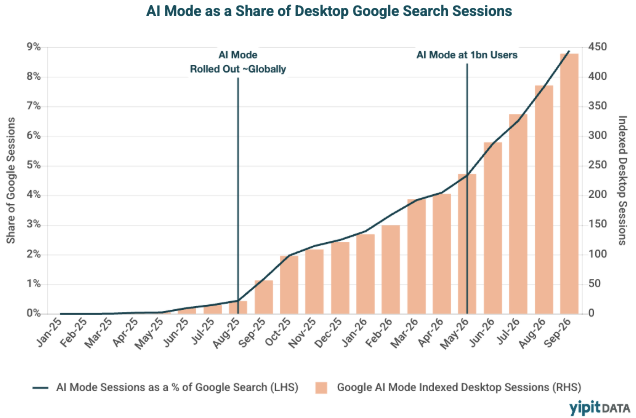
Alphabet $GOOGL 3Q26 Earnings
- Rev $127.6b +25% ↗️🟢
- GP $76.2b +25% ↗️🟢 margin 59.7% +12 bps ✅
- EBIT $40.6b +30% ↗️🟢 margin 31.8% +129 bps ✅
- Net Inc $26.5b -24% ↘️🔴 margin 20.7% -1343 bps ↘️🔴
- OCF $42.3b -13% ↘️🔴 margin 33.1% -1416 bps ↘️🔴
- Capex $51.4b +114% ↗️🟢
- FCF -$9.1b ↘️🔴 margin -7.1% -3101 bps ↘️🔴
Revenue by Segment
- Google Services $96.3b +11% ↗️🟡
- Google Advertising $82b +11% ↗️🟡
- Google Search $63.4b +12% ↗️🟡
- YouTube Ads $11.2b +9% ↗️🟡
- Google Network $7.5b +1% ➡️🟠
- Google Subscriptions $14.3b +11% ↗️🟡
- Google Cloud $30.7b +103% ⤴️🟢
- Other Bets $0.4b +8% ↗️🟡
Google Services
- Rev $96.3b +11% ↗️🟡
- EBIT $39.2b +16.8% ↗️🟢 margin 40.7% +215 bps ✅
Google Cloud
- Rev $30.7b +103% ⤴️🟢
- EBIT $11.1b +209.4% ⤴️🟢 margin 36.2% +1250 bps ✅
- Backlog $561bn +256% ↗️🚀
Other Bets
- Rev $372m +8% ↗️🟡
- EBIT -$2b ↘️🔴 margin -550.3% -13573 bps ↘️🔴
Revenue by Geography
- US $67.7b +39% ↗️🟢
- EMEA $32.7b +9% ↗️🟡
- APAC $19.9b +12% ↗️🟡
- Other Americas $7.1b +17% ↗️🟢
1 | Revenues grew 25% and are now at a $500 billion ARR. Continues to have strong momentum, and AI investments are increasing usage and overall query growth.
Alphabet revenues grew 25% YoY. We are now at $0.5 trillion annual run rate. That's remarkable growth. Search has strong momentum. Our AI investments are driving increased usage and overall query growth, including commercial queries. In fact, our YoY query growth rate is the highest it's been in the last 5 years.
2 | Core Google revenues continued to grow fairly strongly, across advertising, search, YouTube, and subscriptions.
Google Services revenues increased 11% to $96.3 billion, reflecting strong growth in Search and subscriptions. Total advertising revenues were up 11% with growth across all major verticals….Google Search and other advertising revenues increased by 12% to $63.3 billion, with retail driving the largest contribution followed by finance. YouTube advertising revenues increased 9% to $11.2 billion, with brand driving the largest contribution and notable strength in living room. Network advertising revenues of $7.5 billion were up 1%. Subscription, platforms and devices revenues increased 11% this quarter to $14.3 billion, driven by strong growth in YouTube subscriptions, particularly in YouTube Music and Premium and strong demand for AI plans in Google One.
3 | Noise in slower growth of search/advertising revenues from FX, APAC advertisers Impacted by the EU eliminating its diminutives exemption and ad spend normalizing after a strong Q2 driven by the FIFA World Cup, and lower monetization of AI mode.
Search grew 12% YoY to $63 billion. And when you look at the change in growth rate from Q2 to Q3, there were a few drivers here. So first, there was FX. It was the single largest driver of Search deceleration relative to Q2. Second, there were vertical-specific dynamics.
In retail, some of our APAC advertisers were impacted by the EU eliminating its de minimis exemption. In media and entertainment, spend normalized after an unseasonably strong Q2, driven by the FIFA World Cup, which had more matches and therefore, more advertising budgets allocated in June than actually in July. It's also -- to the next part of your question, it's worth noting that the strong growth in AI Mode queries had an impact because of the lower monetization we were seeing in AI Mode. To be clear, we feel very good about our trajectory here. Our ad experiments have shown promising results, and we're now scaling ads within both AI Overviews and AI Mode to more users and more queries, including, as I mentioned, international markets and multiturn ads in the U.S.
4 | Higher costs due to TPU sales increase in depreciation, content acquisition cost, and technical infrastructure operation cost, and an $8.2bn unrealized loss from SpaceX.
Other cost of revenues was $35.1 billion, up 32%, driven by hardware costs primarily related to the sales of TPU systems, increase in depreciation, content acquisition costs and technical infrastructure operations costs. Total operating expenses were up 20% to $35.6 billion.
Other income and expenses was negative $8.2 billion due primarily to unrealized loss from our investment in SpaceX from a decline in its stock price in the third quarter.
5 | Saw lower OCF due to the buildup of TPU inventory and the $5.2 billion cash fine.
We generated strong operating cash flow of $42.3 billion in the third quarter and $179.6 billion for the trailing 12 months. Operating cash flow was negatively impacted by the buildup of inventory for TPU system sales as well as a $5.2 billion cash payment for a 2018 EC fine following the conclusion of the appeal process.
6 | 2/3 of capex was for servers and networking equipment, and the remaining was for data centers.
CapEx was $51.4 billion in the third quarter with the vast majority of the spend in technical infrastructure to support our investments in AI. Approximately 65% of our investments in technical infrastructure in Q3 was related to servers and networking equipment, which generally have useful lives of 6 years. The remaining 35% was for data centers, which have useful lives of 7 to 40 years. We had negative free cash flow of $9.1 billion in the third quarter, driven by our investments in CapEx. Free cash flow in the third quarter was also affected by the aforementioned inventory build to support TPU system sales and payment of the EC fine.
7 | Google has maximum contractual obligations of $1,076bn, $924bn of future purchase commitments and $152b of other leases and obligations, most of which have some variable pricing and volume flexibility, which could result in a lower spend.
We have also entered into multiyear agreements to secure capacity for technical infrastructure and inventory as well as leases and energy. At the end of the third quarter, we had future purchase commitments of $924 billion and pre-commencement leases and other obligations of $152 billion. These dollar amounts reflect the maximum contractual obligations. However, a number of these agreements have variable pricing and volume flexibility, which could result in lower spend.
8 | GCP revenues grew 103%. Seeing strong customer demand for Google TPUs.
Google Cloud revenues grew 103%. Our AI infrastructure and solutions are the major drivers for Cloud growth and our customers see us as the leading provider here, so there's huge demand. We are working hard to bring more capacity online to meet this long-term demand. At the same time, we are seeing strong demand for our TPU systems across a wide range of customers, and we expect that to continue as we scale
9 | TPU system sales were a meaningful contributor, expected to scale in Q4, followed by a meaningful revenue ramp in 2027.
TPU system sales were also a meaningful contributor. GCP accounted for the vast majority of the revenue generated in Q3. The cloud revenue growth rate, excluding the impact of TPU systems, was again incredibly strong.
In Google Cloud, we expect TPU system sales to continue to scale in Q4, followed by a meaningful revenue ramp in 2027.
10 | Third-party bridging capacity only came online at the end of Q3 and had limited negative impact on margins. Expected negative impact to be larger from Q4 onwards, and more near-term as they pay up to get long-term customers.
The third-party bridging capacity, which we discussed on our prior call, came online only at the very end of Q3 and therefore, had limited negative impact to our margin in the quarter.
With respect to Cloud margins, given the supply constrained environment, we started utilizing third-party compute capacity at the end of Q3 and will ramp usage in Q4. We expect margin headwinds in the near term as we utilize this capacity.
11 | Google Cloud backlog is $561b up from $514b, expecting higher capex to match the growth in backlog.
Google Cloud's backlog was $561 billion in the third quarter, with the majority of the backlog related to typical GCP contracts.
Moving to investments. Our full year 2026 CapEx guidance range of $195 billion to $205 billion remain unchanged. We continue to expect our CapEx to increase significantly in 2027, and we'll provide further details on our Q4 call. In terms of expenses, the significant increase in our investment in technical infrastructure will continue to weigh on the P&L in the form of higher depreciation expenses and related data centers operation costs such as energy.
12 | Google expects to generate an attractive ROIC that is meaningfully higher than the cost of capital, which will result in growing OCF.
let me say a few words on how we think about return on invested capital and free cash flow. We're in a unique position to be able to monetize our AI investments across many products that reach billions of users and enterprises. Our AI investments in Search are driving our highest query growth in half a decade. Google Cloud has generated tens of billions of dollars in AI revenues year-to-date, and Google One is our fastest-growing subscription products, driven by demand for AI plans. Throughout this investment cycle, we expect to generate an attractive ROIC that remains meaningfully above our cost of capital and anticipate generating strong cash flow from operations
13 | Customers are using Google's AI models more than ever. 1P APIs are processing 32B tokens per minute, +40% QoQ. Google is back at the frontier.
On our AI models, customers are using our models more than ever. Our first-party model APIs are now processing nearly 32 billion tokens per minute, 40% more than last quarter and more than 4x what we processed a year ago. And with Gemini 4 Argon and now Carbon, which we announced today, we are excited to be leading at the frontier. The Gemini app is now at 1 billion users and is the fastest-growing product in Google's history.
14 | Saw strong demand for Argon, ramped 3.5x faster than Gemini 3. Using Argon internally and shipping 35% more code with 30% fewer errors.
Starting with AI, highlighted by our Gemini 4 series of frontier models. We are seeing strong demand and usage for Argon, which we launched 2 weeks ago. In fact, on our developer platforms, usage in the first week ramped up 3.5x faster than Gemini 3, even with capacity constraints. Argon is proving to do really well in areas like finance, legal, cybersecurity and science. Developers and cloud customers are already using it for things like untangling legacy code bases, accelerating scientific research, robotics, discovering product improvements and domain-specific tasks requiring in-depth reasoning. And at Google, just in the last few weeks, teams across Chrome, Ads and Search have used Argon to write and optimize code much faster, shipping 35% more code with 30% fewer errors. Argon is just the start of the Gemini 4 series.
15 | Carbon brings Google right back to the frontier for AI models.
Today, we announced Carbon. It's our strongest frontier model with state-of-the-art cybersecurity and long horizon capabilities. It ranks #1 on the recently updated artificial analysis intelligence Index at 59. Carbon outperforms Argon across almost every domain like full stack web development, multimodal understanding, complex knowledge work and scientific reasoning. We are rolling Carbon out first to a subset of trusted cyber defenders before we expand access, and it's being tested by the U.S. government.
16 | Genie 4 which simulates safe, realistic, interactive worlds with native audio in real time will be an important building block for training robots and agents.
Beyond our Gemini 4 series, yesterday, we announced Genie 4, our most advanced world model yet that simulates safe, realistic, interactive worlds with native audio in real time. This is an important building block for training robots and agents.
17 | Recursive self-improvement (RSI) is helping Google to increase their training and launch velocity for AI models.
This rapid progress underscores our incredible model momentum. We are at the point where AI is helping us increase our training and launch velocity. I would expect the next 12 months to see continued acceleration because of RSI. We have more models coming soon, including more efficient versions to help developers optimize for speed and cost and to deploy across our billions of users.
18 | Google Cloud now has 18 product lines with more than $1 billion in annual revenue. TPU sales were a meaningful contributor.
Google Cloud now has 18 product lines with more than $1 billion each in annual revenue. And our growth this quarter was driven by strong growth in Google Cloud Platform with strength in both AI and core GCP. TPU system sales were also a meaningful contributor.
19 | Google worked closely with Meta to deliver TorchTPU, allowing developers to port workloads easily from GPUs to TPUs.
To make it easy for developers to port workloads to TPUs, we recently worked closely with Meta to deliver TorchTPU, which allows users to train, serve and deploy PyTorch models on TPUs, using the tools they're already familiar with and rely on. Nearly 100 customers use TPUs today, and we're seeing strong and growing demand from many others.
20 | Google is seeing new customers, like Apple, capital market companies, universities, and public sector companies use TPUs. GCP recently entered into partnerships to deliver TPUs to Crux AI and Oracle.
In addition to our work with Anthropic, both directly and via Broadcom and public reference customers like Apple, who are scaling pretraining of their foundation models on the latest generation of TPUs, we're also working with new frontier model companies, including Mirendil and Physical Intelligence; capital markets firms, including Citadel Securities and Jump Trading; universities like Caltech; and public sector service providers, including Cassava and Cirrascale. Given continued strong and accelerating demand, we've recently entered into partnerships to deliver TPU systems with both Crux AI and Oracle, with more in the works.
21 | Google now has over 100 significant TPU customers across digital natives, AI labs, traditional enterprises, and financial and capital markets customers.
on the demand in Cloud, we are always managing our portfolio to ensure we have a breadth of customers, and we have different types of customers from digital natives, AI labs, traditional enterprises, financial and capital markets customers. So it's a broad set of customers. Many of them have either started with using TPU systems, for example, in our cloud. We have over 100 significant TPU customers who start in our cloud. They learn to use TPUs.
And remember, a TPU system is a combination of hardware, system software, compilers, the whole thing assembled as a system, including optical networking and other things. We've taken a very deliberate approach on how we're bringing TPUs to customers. The first one is to build the right silicon. So we have 8t for training, 8i for inference. They both offer substantial price performance and performance improvements relative to prior generations.
22 | Google has now optimized the software, PyTorch in TPU, and are broadening distribution for customers to use TPUs, not just in Google Cloud but also in their own data centers and to other providers like Oracle and Crux AI.
Second, we've optimized the software. The optimization in the software is not just to make the systems run better and to give you great performance but also to see -- make portability seamless. Recently, we introduced, for example, PyTorch, which opens up a much larger market for us by optimizing PyTorch in the TPU. Third, we are broadening distribution. So in the past, you could use TPUs in our cloud.
Now we make for customers who want TPU systems in their data centers, we're making TPU systems available in their data centers. We're also broadening availability to other providers. For example, we announced a partnership with Oracle and we've launched along with Blackstone an agreement for Crux AI, a joint venture to offer customers TPU systems.
23 | Currently not breaking out any margins for TPU systems, focused on improving margins as they scale the TPU business.
On TPU systems and margins, we don't break out margins for individual products or infrastructure components. However, we see several benefits from designing and manufacturing TPU systems. So first of all, to remind you, the TPU system is not just a chip, but it's a complete system. Given the price performance benefits of TPU systems relative to competitors, growing demand for accelerated compute and the scarcity of accelerated compute, we're very focused on continuing to improve margins as we scale the business.
24 | TPUs are manufactured only after contracts are signed with customers. All inventory is associated with committed contracts. By selling TPU systems, it offsets the need for Google to pre-build data centers to host these TPU systems and allows them to scale faster.
Two additional points. First of all, when Anat mentioned that we procure components to build inventory, we only do that after we have signed contracts. So all of the inventory that -- for TPU systems are associated with committed contracts. Additionally, by putting TPU systems in third-party facilities and in customer data centers, it allows us, one, to broaden our addressable market. Some -- for some industries, they have data in their premise that they cannot move to a cloud, and it allows us to bring accelerated compute to where the data sits. Additionally, it also offsets the need for us to have to prebuild facilities to host these TPU systems.
25 | Gemini is a powerful accelerator for Google Cloud.
Gemini is also driving acceleration for our database, analytics and cybersecurity products. Gemini can now help users find, analyze and visualize information from structured and unstructured data. Gemini uses our knowledge catalog to find the right sources and definitions of information, improving accuracy, lowering token cost and making responses more reliable. Gemini uses our Lakehouse to access information from multiple systems with 0 copy. To respond to agentic analysis, BigQuery improved query speed over 40% YoY while reducing query processing cost by over 50% YoY.
26 | More than 2,600 customers have used at least $100 billion in tokens, and nearly 90% of Fortune 100 use Gemini Enterprise.
Over the past 12 months, more than 2,600 customers have used at least 100 billion tokens and nearly 75 at least 10 trillion tokens on Gemini Enterprise. Nearly 90% of the Fortune 100 use Gemini Enterprise, and customers who use Gemini Enterprise in Q3 2025 more than quadrupled their spend with us year-over-year. One of the important ways in which customers are using Gemini is for knowledge work. Across all our AI services, we have sold more than 100 million seats for knowledge work. Gemini Enterprise now includes the Gemini agent that is deeply integrated across our entire cloud portfolio.
27 | People using Google's AI features have 3x longer queries than traditional searches, and 1 in 5 use voice, images, or documents.
Let's turn to Search, which is bringing the benefits of AI to more people than any other product in the world. Just like our shift to mobile over a decade ago, we are focused on building the best Search user experience, followed by monetization. We are building one seamless experience across AI Overviews, AI Mode and traditional search. And people are using our AI features more searching in entirely new ways. Their queries are longer, personalized and multimodal. Queries in AI Mode are on average 3x longer than traditional searches, and 1 in 5 AI Mode searches globally use voice, images or documents. We have now crossed over 50 billion visual searches per month. One area I'm excited about is helping people get things done, be it booking reservations, filling in forms, scheduling appointments or making purchases.
28 | Google wants to bring agents as a unifying layer across all their products.
People are already using the Gemini app to do more than ask questions. They're using it to do things, including complex multistep agentic queries. Our Gemini 4 series has been a really big step forward here and has already been handling these complex tasks really well. Agents will operate as a unifying layer across our products, so you will see us extend these agentic experiences beyond Search in the Gemini app to Chrome, Android and our Workspace products as well.
29 | Google first wants to roll out Gemini agents for
enterprise, then later on to consumers.
We have been hard at work, and we decided to roll it out to enterprise first, which we announced with our Gemini agent for enterprise, essentially because they have the highest bar for security, governance and controls. And it's been well received, and we are in the process of expanding that. Later this year, we will bring that same experience to consumers, obviously, starting with the 1 billion users in our Gemini app. We already see people in the app moving beyond chat to what are tasks and agent-like experiences.
30 | YouTube continues to lead as the number one streaming platform in the U.S. in terms of watch time. The living room accounted for one-third of total YouTube ad revenues.
On to YouTube, which continues to lead in the living room as the #1 streaming platform in the U.S. in terms of watch time. It's also seeing good subscriber growth as I mentioned. At Made on YouTube last month, we announced more than 30 products and features for creators and viewers. One great example is custom feeds where you can simply pick a topic you love and get a tailored video home feed based on that topic…The third part is monetization starting with ads. Our focus remains on delivering value across the entire funnel. In Q3, living room accounted for over 1/3 of total YouTube Ads revenues.
31 | Amazon is joining YouTube shopping. Creators can now tag Amazon products directly on YouTube.
More than 1.3 million channels are enrolled in YouTube Shopping globally. Building on this momentum, we recently announced that Amazon is joining YouTube Shopping. U.S. creators can now tag Amazon products directly in their videos, shorts and live streams, driving direct conversions. Importantly, our subscription ecosystem continues to complement our advertising business.
32 | Integration of Gemini models into Google's ad infrastructure is improving how they decode user intent and driving growing ad relevance.
First, ads quality. The integration of Gemini models into our ads infrastructure is improving how we decode user intent and drive ads relevance. For example, in Q3, we made the biggest update to product listing ads in a decade, adding new AI capabilities to help users make more confident purchase decisions. Already, we've seen satisfaction increase by 19% and dissatisfaction dropped more than half. We're also seeing AI models enable better prediction of clicks and conversions, stronger overall performance and deeper personalization of ads. For instance, through several innovations and personalization modeling, we delivered 18% incremental advertiser value and an 8% increase in user sentiment on Discover ads in 2026. Overall, AI is accelerating our ads development and drives the majority of our product launches.
33 | AI is also accelerating advertiser tools, allowing every advertiser, regardless of size, to seamlessly participate in all of Google's AI surfaces.
Second, advertiser tools. We're ensuring every advertiser, from global brands to small businesses, can seamlessly participate in our AI surfaces. AI Max and Performance Max continued to see strong adoption. To give marketers even more control, we're now introducing a way to test different budgets and ROI targets across multiple search campaigns in a single AI Max A/B test. To drive better performance, we integrated our AI creative tools directly into AI Max. In Q3 alone, Gemini models helped advertisers generate over 1.5 billion campaign assets, up over 7x YoY.


34 | Many of the queries on AI mode are upper-funnel queries, allowing Google to capture new, high-value commercial intent. Bringing ads into AI mode.
Third, AI user experiences. Sundar mentioned the distinct behavioral changes we're seeing as users ask entirely new categories of questions. We think of search holistically, a unified product spanning traditional results and AI-powered search. On AI Mode, many of these queries are upper-funnel queries, allowing us to capture new high-value commercial intent. In addition, the majority of AI Mode queries are incremental, creating more monetization opportunities over time. Additionally, our user research shows that people are comfortable with ads on these surfaces and find them highly relevant. Click-through rates are already similar between sponsored and organic product list items within AI Mode. Based on these collective results, we're now scaling high-quality ads within AI Overviews and AI Mode to more users and queries. This includes taking our monetization footprint global for the first time. Today, we're announcing the expansion of ads in AI Mode into international markets alongside multiturn ads and AI Mode in the U.S.
35 | UCP is being rapidly adopted by retailers, enabling direct checkout for hundreds of thousands of brands, and with Agent Payments Protocol, it unlocks agentic capabilities for consumers.
The Universal Commerce Protocol, UCP, is being rapidly adopted by retailers. Today, UCP enables direct checkout for hundreds of thousands of brands across Google, including Chewy, Nike, Tapestry and many more. We're combining this with the Agent Payments Protocol as we build for the future of commerce. Our focus spans 2 fronts: unlocking agentic capabilities that act on behalf of the consumer, and designing practical tools that give shoppers confidence and control. We launched Universal Cart this quarter to support that second track, mirroring how people actually shop today across Google.
36 | Google is operating a scaled consumer business and a hyperscale cloud business. Google's full-stack approach continues to drive a lot of efficiency and gives them a lot of optionality across a wide variety of opportunities.
We are operating a scale consumer business that reaches billions of people, a hyperscale cloud business with a lot of momentum and of course, a range of other highly important areas across Google and Alphabet.
We always take a long-range planning. And so each of our business areas submit long-range plans with a very disciplined ROIC framework. And so I would broadly think of all of this as a long-range planning process, not a short-term allocation exercise. Obviously, our AI models underlie everything we do from Search and YouTube to Cloud to Waymo and so on. So it's the foundation and we view it as a highly leveraged approach, the full stack approach drives a lot of efficiency as well as gives us a lot of optionality across a wide variety of opportunities. So obviously, that is the foundation, and we plan for that for the long term, too.
37 | Google remains disciplined on long-range planning and is seeing very robust demand signals across a wide variety of areas, and is hence investing ahead of that.
And about that, as I said, we really look at our businesses and really take a disciplined long-range planning approach. To us, obviously, we are seeing very, very robust demand signals across a wide variety of areas. And so we view it as an extraordinary set of opportunities, and we are investing for that moment.
➡️ Key Takeaways on Alphabet:
The core Google Search / YouTube advertising business and the consumer surface remains intact with AI overviews. Most of the upper funnel, high-value commercial intent queries still continue to remain on Google. Google’s full stack approach towards AI and their clear dominance with their own custom ASICs chips is why we initiated an investment in Alphabet. Increasingly, more of the AI accelerators will be custom ASICs and increasingly Google TPUs as it expands customer adoption and across in more ways. Google is one of our preferred ways to increase our AI exposure instead of via Broadcom (custom ASICs).

Adyen $ADYEN 563Q26 Earnings
- Processed Vol €451b +30% ↗️🟢
- Digital Processed Vol +28% ↗️🟢
- Unified Commerce Processed Vol +22% ↗️🟢
- Platform Processed Vol +55% ↗️🟢
- Net Rev €738m +23% ↗️🟢
- Digital Net Rev €387m +16% ↗️🟢
- Unified Commerce Net Rev €250m +29% ↗️🟢
- Platforms Net Rev €100m +46% ↗️🟢
*Talon.One and Orb acquisitions added 200bps to growth
- Active Business cust 312K +48% ↗️🟢
- Platform Cust >$1bn processed vol 46 +48% ↗️🟢
FY26 Mgmt Guide
- Net Revenue +23% ↗️🟢
- EBITDA margin 50% (lowering from 55%)
- Capex margin 7%
1 | Solid quarter. Adyen's same engine continues to run.
So the financial results are solid. And what I'm very proud of is the fact that the same engine runs as always. We win share of wallet with our existing customers, and we added new logos to the platform. So this combination has always been the core of our growth and it drives on the operational complexity that we are solving for these customers.
2 | Three core engines drove strong revenue growth, increasing share of wallet with existing customers, adding new customers across priority verticals, and acquisitions adding 200 bps of growth.
Three core engines drove this top-line performance: First, we deepened share of wallet with existing enterprise merchants, as longer standing cohorts consolidated more of their global volume onto our single platform. Winning a greater share of volumes from these merchants is the largest contributor to our growth. Second, we onboarded a healthy, high-quality cohort of new enterprise customers across our priority verticals. This year’s cohort is shaping up to be our largest ever. These customers are larger, and many are Platforms. We expect them to ramp significantly over the next year. And third, we consolidated Talon.One and Orb for the first time, which together added about two percentage points to our constant currency net revenue growth in the quarter. Commercial momentum remained strong and broad-based across all three pillars and every region.
3 | Digital saw the slowest growth, driven by OTAs and ride-hailing platforms, and content subscription customers and the major hyperscalers.
In Q3, Digital net revenue grew to €387 million, up 16% YoY, or 14% on a constant currency basis. Volume was up 28%. We delivered particularly strong growth in travel & mobility, which includes major rideshare platforms and Online Travel Agencies, and also across content & subscriptions merchants. This segment includes the major hyperscalers, where we continue to grow our share of wallet. Our tiered pricing is designed so that as our largest merchants scale, they consolidate more volume onto our platform, driving continuous wallet-share gains.
4 | Continue to target larger and more complex global retailers in Unified Commerce. Acquisitions added revenue without payment volumes.
In Unified Commerce, net revenue reached €250 million, up 29% YoY, or 27% on a constant currency basis. Volume grew 22%. Net revenue outpaced volume in the quarter following the consolidation of Talon.One, which contributes recurring revenue but no processed payment volume. We now support 499 enterprise merchants processing across both in-store and digital channels at scale. We intentionally target growth from larger, more complex global retailers. And these multi-channel implementations represent deep customer relationships, where the value we deliver drives substantial share gains.
5 | Platforms grew strongly, expanding it rapidly across SaaS and in complex verticals like financial services and insurance.
Platforms net revenue hit €100 million, up 46% YoY, or 44% on a constant currency basis. Volume grew 55%. We now have 46 platform customers processing over €1 billion annually — a significant step up from 37 last quarter, and 31 a year ago — with active business customers reaching 312,000, up 48% year-over-year. We are growing rapidly across SaaS, and winning share in complex verticals like financial services and insurance, which will be a driver of future growth.
6 | Adyen is well positioned to do well in facilitating Agentic Commerce because they have their own banking licenses in multiple countries and own acquiring licenses on any single platform globally.
And we are very well positioned here with our own banking licenses in multiple countries, with our own acquiring licenses and a single platform globally. I'm often asked what our position is in Agentic Commerce. And it's important to make a distinction between Agentic Commerce and the AI economy that I just talked about. If you look at global commerce, it runs today on Adyen and so will Agentic Commerce in the future. It's still early days, and we are focused right now on making sure that we build that right foundation.
7 | Adyen has built all the different components needed for Agentic Commerce in the past: authentication layers, fraud systems, and efficient settlements.
The reason why we're so well positioned is because we have built all the different components that are needed for Agentic Commerce in the past. So we've built authentication layers. We have built fraud systems. We've built ways to make the settlements as efficient as possible. And that's exactly the infrastructure that you need to build. And no one has this infrastructure like we do, and that's why we're so well positioned. So in summary, over the years, we have built the right rails for Agentic Commerce.
8 | Orb acquisition provides billing and invoices based on user base billings are what the AI-native economy requires.
Yes. So the other big news of the first half year, of course, were the acquisitions of Orb and Talon.One. And I'm very excited to see how integration is going. It's also one of the reasons why we've decided to double down our investments in this area. So maybe to start with Orb.
Orb is a billing and invoice engine focused on user-based billing, which is exactly very relevant for the AI native economy. And what I've seen in the last quarter is that we are now capable of signing up customers at an earlier stage in their life cycle.
Examples here are Vercel and Greptile. But also what I've seen in the last quarter that we were capable of signing up customers that were already an Orb customer, but are now starting to transfer their payments to Adyen. And examples here are Route and Wasabi Technologies. So a lot of progress with Orb.
9 | Talon.One acquisitions solves the persistent problem of in-store loyalty.
Very similar with Talon.One. The moment we announced the acquisition, the feedback from retailers has been very positive. The unsolved problem of loyalty in store is something that they are looking for. And in the past quarter, we have worked together with a lot of retailers to see how exactly we're going to tackle these problems. In a couple of weeks, we have organized an event with 200 global retailers in London to showcase how the future of loyalty will look like. And of course, I'm very excited to see those customers there and to discuss it with them.
10 | Merchant interest is stronger than initially anticipated. Retailers are keen to unify loyalty across every channel. AI-native companies see the value of a single provider for billing and payments.
Second, merchant interest in Talon.One and Orb has been stronger than we initially anticipated. Retailers we talk to are extremely excited to unify loyalty across every channel. AI native companies see the value in a single provider for billing and payments. Only Adyen can provide all of these solutions on a unified platform and at scale. That's what gives us the confidence to act now. Serving our global enterprise merchants takes more product, engineering and go-to-market capacity, so we are accelerating our investment. These are growth acquisitions, and we are doubling down to rapidly achieve their potential.
11 | See these acquisitions as significant parts of Adyen in the future.
the revenue pools or the expected revenues from both Talon.One and Orb will be significant in the future because it's going to be an important part of our business.
12 | Added headcounts from the acquisitions and continue to 1,100 FTEs in total
On the team, in Q3, we added 177 net new FTEs on an underlying basis, bringing us to 426 year-to-date and 399 colleagues joined us from Talon.One and Orb. We ended the quarter with 5,596 FTEs. For the full year, we continue to expect 550 to 650 net new hires on an underlying basis. Including Talon.One and Orb and the additional hiring we are now doing in those businesses, we expect to add 1,000 to 1,100 FTEs in total.
13 | Higher personnel costs will weigh on EBITDA margins in the short term.
So on the costs, people is the largest component. There are some of the nonrecurring costs related to integration as well, but it's relatively small. The thing that I -- the color that I would add around people is we're also increasing in a very competitive marketplace, equity compensation. And I'll call out that within our EBITDA margin guide, we don't back out stock-based comp.
14 | Adyen pursued acquisitions for the first time, not for growth but for adding capabilities.
So if you look at our M&A strategy, we indeed have added 2 companies this year to our family. And the reason why we've done that is because we saw the complexity from our merchants in billing and loyalty, and we want to solve for that complexity. So it's a capability game. We've not acquired them for their short-term revenues. It's really about a long-term capability, and that's how we will continue to look at M&A.
15 | Adyen will always prioritize organic investment first, and if too slow, then will consider M&A.
So if you think about what is important to our customers, the type of challenges that they face, if there is any capability that we think is missing and the time to market is the highest priority, we would consider M&A again. That's how we currently look at it. Our first approach to investment is always organically. That's how we've built. It's also the strength of our single platform. So that's always the first choice. But if time to market is important and it is a capability that our merchants are looking for, we would consider it as a next step.
16 | Don't see a structural change in the course of growth. Decided to use acquisitions as a deliberate opportunity and decision to accelerate investment to capture the immediate large present opportunity.
So on cost of growth, I don't think that there's been a structural change. As we said, it's a deliberate opportunity and decision to accelerate investment in order to capture the overall opportunity ahead, which is, we think, quite large. Pointing to the business overall, you've seen historically that we've generated leverage -- operating leverage, and we expect that over time, but we do want the flexibility to take actions when we see the opportunity ahead of us. Ingo, I guess, in the second one.
17 | The milestones to judge returns will really be growing the overall product offering and increasing customer adoption and cross-sell.
So the milestones to judge return are really around driving sustainable growth and the overall product offering that we are able to deliver. So it's going to be customer adoption. There will be cross-sell associated with it. And then overall, the way we'll talk about it from a company perspective will be on a consolidated basis, ultimately. We don't plan again on breaking out or loyalty or those things individually. But we will give qualitative markers as you go forward.
18 | 2027 management guide will be shared in February.
we look at this as a long-term opportunity to help build a new offering over and above not just loyalty, not just billing, not just payments, but together. So we'll give you that color on a combined basis in February. With regard to the discontinuing of the medium-term guidance going forward, we are -- we will provide an update in 2027 again for 2027. And we are, as we mentioned, discontinuing the EBITDA, the hard EBITDA target. I think that said, we are still very confident in the long-term durability of growth of this company and in the leverage that the company can provide over time…
we'll provide the update for 2027 in February of 2027. The color I can give you today is like, as we said, historically, we have generated margin expansion. We are intentionally deciding in 2026 to pull forward some of that spend. The other thing that I can say is that in 2026, there are some charges related to the acquisitions and other things that we don't expect to recur in 2027 as well.
19 | Adyen is building a company for the long run. They will invest and are okay with lower near-term profitability while retaining stronger long-term growth.
I think the philosophy that we have is that we built the company for the long run, and we want to take investors on that long-term journey. At the same time, we want to be helpful how we think that the business evolves.
And we are a very entrepreneurial business. So if we see an opportunity, we want to act on it. When we gave the 28% EBITDA guidance, we had not acquired Orb and Talon.One, and we did not have the feedback from our customers to see what kind of opportunity this was. We saw the complexity arising. So it was something in the back of our mind.
And we see that we will potentially be hindering ourselves if we would really get to this 55%. Because if you ask me, could we get there, it would be relatively easy to get to the 55%, but that would be at the risk of longer-term growth. So it's really about that longer-term horizon that also what I talked about that we want to create here. That's still also the guidance framework that I apply. If I look back, I think if you want to build a company for the long run, you should take investors along what it will mean for the short term.
20 | Continues to intend to outgrow the market and increase the scope of what they solve for their customers across the commerce life cycle.
To wrap up, we enter the final stretch of 2026 with strong commercial momentum across all 3 pillars, high conviction in our strategic investments and confidence in our unique ability to capture the massive opportunity ahead. We intend to continue to outgrow our market as the scope of what we solve increases across the commerce life cycle. Our actions this year position us to grow our role within customer operations, extend our market leadership and expand our growth opportunity.
Final Takeaway on Adyen $ADYEY:
➡️ Combination of strong durable net revenue growth 20%+, lowest costs, built from scratch superior single platform with data insights, with scaled economics shared (lower take rates), with strong unit economics of low marginal costs, and rising profit margins, with operating leverage, supported by long-term tailwinds. Excited about strong growth across all three pillars, digital, unified commerce, and platforms, North America, and AI native companies. Two acquisitions remain strategic, and prefer to build themselves organically, rather than being a serial acquirer to grow inorganically instead. Adyen looks increasingly well poised to be a secular beneficiary from AI native customers and agentic commerce.

Anthropic's S-1 disclosed US$807bn in committed compute (US$657bn contractual) over the next 10 years.
52.8% of Anthropic's committed compute will be Google TPUs (US$425.7bn), 31.1% will be NVIDIA GPUs via SpaceXAI, Microsoft, Nscale, and Lambda, 13.6% will be Amazon Trainium (US$110bn), and 2.5% will be AMD GPUs (US$20bn).
66.4% will be custom ASICs (Google TPU and Amazon Trainium), and 33.8% will be GPUs (NVIDIA and AMD).
Source: Anthropic S-1, Vision Capital Fund calculations.

I just set up the “Hey Siri” equivalent on my iPhone for these via Accessibility/Voice Shortcuts and Shortcuts. I'm excited to see which one sticks more.
My initial sense is that Grok Bot and Claude are best for daily tasks and work on mobile, and Gemini for most general, speedy consumer questions.
Muse is relatively slow, and its smaller range of connectors than Grok Bot (with Cursor) is limiting my adoption.
Starting to realize why the Cursor acquisition made sense for Grok.


