

Change facilitator, strategist, speaker. Prof. of Practice in Health & Care Improvement @WarwickBSchool. Advisor @HorizonsNHS. Senior Fellow @TheIHI. Views own.
Coventry England
Joined September 2010
- Tweets18.8K
- Following20.9K
- Followers136K
- Likes47.2K



How do we believe change happens in systems?
One of the most positive moves in change practice in our sector is a shift towards “systems change”. By this we mean identifying & addressing the causes of problems in the system rather than treating their symptoms.
Often, we start by identifying methods & approaches for our systems change initiatives. As we build our practices in this area, we should dig deeper. We need to reflect on our “mental models” about how we undertake systems change. This means the beliefs & assumptions we hold about how change happens, shaping what we notice, what we expect & how we act.
I’ve been thinking a lot about this recently, as a result of an international improvement initiative I’m involved in. If we want to make big, positive changes happen in the world, do we start by identifying areas for collective action & “leverage points” for change? Or do we start by building the relationships & connections that create the conditions for change to emerge? By being explicit about our mental models & assumptions, we avoid the risk of different partners in the change operating with conflicting, unspoken views about how systems change and can align all our change activities (strategy, methods, reporting etc) around agreed ways forward.
I have found an article by @JewlyaLynn & Julia Coffman very helpful for my own thinking (all links in comments). They describe two mental models in systems change. “Systems dynamics” assumes a system’s main patterns are predictable. Our change strategy here targets high-leverage points with a theory of change & defined outcomes. “Systems emergence” assumes new patterns grow from the relationships between people. Our change strategy here brings in new voices, builds trust & learns alongside partners.
Neither model is better. Some parts of a system are predictable & others are in flux, so many strategies use both. Problems can start when the models get mixed unnoticed. The most common mismatch is emergent work held to systems dynamics accountability. Boards tend to favour clear predictions & quantitative metrics.
Russ Gaskin sees the same pattern. Initiatives speak the language of co-creation while using consultation methods, & the people involved never come to own the work. Systems maps & theories of change keep their value when they become a starting point for conversation.
Three reflections from me:
1) Whose mental model sits at the centre matters. When leaders impose their own view or process of change on the people closest to the work, they reinforce the power dynamics they set out to shift.
2) Our reporting mechanisms carry a mental model. When the strategy is emergent & the Board asks for predictions, the reporting pulls the work back towards prediction.
3) Naming our mental models is part of the work. Teams that make their assumptions visible can align strategy, methods & reporting with the system for better outcomes.
Links:
Lynn J & Coffman J. Passing in the Dark: Making Visible Philanthropy’s Hidden and Conflicting Mental Models for Systems Change. The Foundation Review, 2024;16(1):142-60. doi.org/10.9707/1944-5660.17…
See also a shorter piece these authors wrote on the same topic: evaluationinnovation.org/pub…
Gaskin R. The Emergence of Dialogic Systems Change. Horizons of Change, January 2026. horizonsofchange.substack.co…

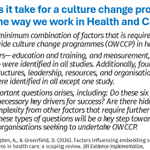
We know that culture change programmes can create the conditions for health & care organisations to be more “change ready”, but what does it take for a culture change programme to become the way we work organisation-wide?
Natalie Wilson & colleagues have published a scoping review in @JBI_EI on embedding organisation-wide culture change programmes in health & care. They screened 7,922 studies but only included 17. One is a review I co-authored with Cynthia Willis & colleagues in 2016, so I read this with particular interest.
The authors separate 3 phases. “Implementing” gets interventions into practice. “Sustaining” keeps the programme & its outcomes going, usually 2 to 6 years after implementation. They also describe a middle phase, “embedding”, when change becomes part of the everyday routines of individuals & teams & part of organisational systems. The evidence for “embedding is particularly lacking.
10 factors emerged. “Education & training” & “measurement, monitoring & feedback of outcomes” appeared in every study. “Processes & structures”, “leadership”, “resources” & “cultural alignment” appeared in 16. “Shared, defined accountability” in 15. “An adaptable programme” in 11, “stakeholder engagement” in 8, “alignment with the external environment” in 7.
There is a tension in the design of culture change interventions. Should we initiate a programme that seeks to change culture "directly" through values, attitudes & messages? Or should we seek to change culture "indirectly" by redesigning the daily work, norms of collaboration & routines? It doesn’t say so explicitly, but the conclusions of this article are in the latter camp (as am I generally).
Five implications for leaders of change:
1) Build the change into daily work: Integrating new practices into existing tasks & duties, aligning them with current processes & accounting for the effect on workload.
2) Write it into the organisation’s routines. Reporting systems, governance, people processes, policies & monitoring are where a programme becomes business as usual. 7 studies pointed to defining roles & responsibilities in organisational policy.
3) Support embedding as its own phase. 9 studies named a dedicated budget as a key factor, alongside people & time to do the work.
4) Put new practices into induction & refresher training, so it survives turnover of people.
5) Share leadership across professions & levels, keep it steady & feed outcomes back so people see what the change achieves.
This review shows us how thin the evidence base on organisation-wide culture change interventions in health & care is. All 9 empirical studies focused on nursing. Patients took part in 2. Administrative & corporate colleagues are missing from the research. Culture appears as both the goal & a condition for success. The studies measured whether the programme became embedded, not whether the culture shifted. This knowledge is much needed & there is work to do.
Link: ovid.com/jnls/ijebh/fulltext….

Just a reminder that I'm hosting a webinar with Caroline Webb at 4pm UK time today. We will be discussing her new bestselling book Leadership Intelligence. During the webinar, we will discuss the leadership principles that are behind the book. I love the practical tools and frameworks for leaders that the book covers so I will ask Caroline to take us through some of my favourite ones. There will be time for questions and answers.
The session is aimed at leaders in health and care but the learning is generic so it's open to all leaders who want to improve their leadership practice. There is still time to sign up: events.teams.microsoft.com/e…
I hope to see you there.
Helen

“Change begins with me.”
When the systems we work in feel immovable, it’s easy to feel we have little power to make a difference. What if the part we can influence is bigger than we think?
Next Friday, 16th October, I’ll be in conversation with Caroline Webb about her new best selling book, Leadership Intelligence, exploring what its ideas mean for people working in health and care.
What I particularly value about Caroline’s book is how it draws on science (psychology, neuroscience and behavioural economics) to offer practical tools for making better decisions, helping messages land, strengthening difficult relationships and leading through uncertainty.
The central message isn’t that we can change everything. It’s that we don’t always have to wait for other people or circumstances to change before we can act differently ourselves.
Join Caroline and I for an hour to hear directly from Caroline and explore how we can help people achieve more together.
📅 Wednesday 16 October 2026
🕓 4–5pm UK time
💻 Online via Microsoft Teams
Everyone is welcome from anywhere in the world. For those in the UK, it will be an inspiring way to end your Friday.
Register here: lnkd.in/eZiNspCr
Please share with colleagues across health and care who might find this conversation valuable. You don't need to have read the book.
Here is a previous post that I wrote about Caroline's book: lnkd.in/p/egqjRUni
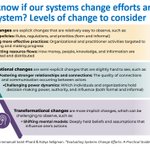
If we are trying to change a system, how do we know if the system is actually changing?
A framework I use often in my change practice is the “Water of Systems Change” from @johnvkania & colleagues. It says that to understand the problems in a system, we should explore six interdependent “conditions” that typically hold the problem in place. These relate to structural conditions (policies, practices & resource flows), relational conditions (relationships/connections; power dynamics) & transformational conditions (mental models - the deeply held beliefs & assumptions that influence our actions).
Now Drew Koleros & colleagues have produced a “Practical Guide to Evaluating Systems Change Efforts”, based on this framework. They translate the six conditions into levels of change. They conclude that efforts to measure whether a change intervention is actually making a difference will more often focus on surface level “structural changes”, because these explicit changes have established indicators & data sources. If we really want to know if a system is changing, we also need signs of change related to relational & transformational changes. These require deliberately developed indicators, multiple methods & validation with the people involved in the change, rather than being treated as secondary or invisible.
Six actions for leaders of change who want to show their efforts are actually changing the system, based on the practical guide:
1) Map the system with the people in it. Agree its boundaries & check whose perspectives are missing, especially people with the least power.
2) Name where your change enters the system. Translate each entry point into the structural, relational & transformational changes you expect. Relationships & mental models" take longer to shift, so set timescales to match.
3) Co-design the signs of change. For each system change, ask those involved: what would it look like if this was changing? What would we expect to see? How would we know? People trust measures they helped to shape.
4) Pair leading & lagging signs. A leading sign of shifting power might be people reporting greater trust or influence. A lagging sign might be people with less formal power shaping decisions, visible in who speaks & who decides in key meetings.
5) Bring numbers & stories together. Performance data & staff surveys show the scale of change. Interviews & focus groups show what it means to the people living it. Make sense of the evidence together, continuously.
6) Review progress with a diverse group.Rrefine the signs as you learn, use a simple measure of progress (emerging, advancing, embedded) & share findings at regular points to adapt the work as it unfolds.
It’s highly unlikely that one change initiative (or one team) will shift all six conditions alone. We will make the strongest case for impact if we describe our efforts, show what changed as a result, across multiple levels & draw plausible links to where the system is heading.
Links and useful resources:
The recent article from Medium that inspired my post titled “How Do You Know When a System Is Changing? : Measuring the signs of systems change” by Drew Koleros, Emmanuel Saint-Phard & Shu Phua: medium.com/@undp.innovation/….
Their “Practical Guide to Evaluating Systems Change Efforts”: drive.google.com/file/d/1-KI….
About the Water of System Change framework created by John Kania, Mark Kramer & Peter Senge: fsg.org/resource/water_of_sy…
The Water of System Change Action Learning Exercise: dev-fsg-advisors.pantheonsit… (I use this exercise often with groups).
An in depth video that explains the Water of System Change framework very effectively from @CIForumTweets : fsg.org/resource/water_of_sy….


How can we navigate more adaptive, continuous approaches to change when our organisations still see change as a series of initiatives?
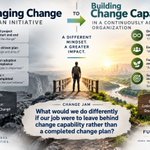
What got me thinking is this graphic that the Change Management Network posted on LinkedIn. It describes a journey "from managing change as an initiative to building change capability in a continuously adaptive organisation". What I write below is not a criticism of the network. I agree that we need more adaptive capability for change and I appreciate that the Change Management Network is enabling this conversation.
My question is: should we frame this as binary "from/to"? Change leaders adopting the adaptive approach promoted by the graphic will still have to continue to work with (and struggle with) most features of the "change as an initiative" approach that the graphic sets it against. In the complex systems most of us work in, this isn't a tension we can resolve. We have to hold and navigate both continuously and that won't change anytime soon.
The direction of travel is towards organisations with the capability to adapt continuously. Yet the systems we work in today still fund, govern and judge change as a series of initiatives. As leaders of change, we are accountable for delivering the project in front of us. We are also the best placed people to build the adaptive change capacity our organisations will need for the evolving future.
I would frame our strategic task as follows. Rather than moving away from “change initiatives” towards a different future, use them to build that future from inside the present. Five ways we can do this:
1) Hold two horizons at once. Seek to deliver what the initiative promises. At every stage, ask what the organisation will be able to do after the project closes that it could not do before.
2) Make capability part of the accountability. Work with programme sponsors to write capability outcomes into business cases, benefits plans and final reports.
3) Design for handover from day one. Share decision making with the people who will carry the change forward. Help build their skills in improvement and data and their sense of agency while the project team is still there to support them.
4) Turn governance moments into learning moments. Milestone reviews and Board papers can ask what we are learning and how we are adapting, as well as whether we are on track.
5) Connect the initiatives. Many organisations (especially in health and care) run dozens of change programmes in parallel. If we link them, share learning across them and grow a common change community, we can build adaptive capacity across the whole system.
The future of change leadership is being shaped now, inside the initiatives we lead today. We want each project to leave people more able to spot problems, test ideas, take action and adapt. This isn’t “from/to”. It’s “both/and”: the initiative can become the vehicle and the adaptive capability can become the legacy.
Graphic comes from a post by the Change Management Network on LinkedIn: linkedin.com/posts/change-ma…

To what extent do we use the wisdom of the whole workforce when it comes to resolving difficult issues?
I'm a big fan of organisational network analysis (ONA). It maps and measures how communication, collaboration and influence really flow between people. It reveals the "hidden organisation": the informal networks that org charts never show.
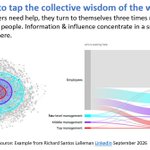
In leadership circles, we talk a lot about "collective” or "distributed” or “empowering” leadership. ONA often shows a different picture. @RLalleman77215 from @InnovisorInc recently shared data from an example organisation. The top two layers of leadership make up 4% of the workforce. They absorb roughly a quarter of all the requests for help. When those leaders need help themselves, they turn to each other three times more often than they turn to other colleagues. Because the senior group is so much smaller, person for person a senior colleague is around 70 times more likely to be asked than anyone else. Without ever deciding to, the most experienced people in the organisation have arranged things so almost every problem they struggle with is thought about by the same small group. A closed loop at the top: leadership talking to itself.
This pattern is not unusual. Rob Cross's research across more than 300 organisations found that 20% to 35% of value-adding collaborations involve only 3% to 5% of people. 766,000 people responded to the most recent NHS Staff Survey. More than half did not agree they are involved in deciding on changes that affect their work area, and the proportion who do agree has fallen for the second year running. We measure it from the other end in the NHS, and the answer is the same. Different measure. Same conclusion.
This means that:
- A small group with similar jobs and experience makes the decisions, so they all miss the same things.
- The people closest to the work hold knowledge that is never asked for, so better options go unseen.
- Work queues behind a small number of overloaded leaders, so good decisions arrive slowly or too late.
- People stop offering ideas once nothing comes of them and research shows that organisations with lower engagement tend to get worse outcomes.
Some actions we can take as leaders:
- Audit our own help networks. List the last ten people we went to with a hard problem. Count how many of them do the core work of the organisation.
- Map the “hidden organisation”. ONA shows who people go to in practice and where to focus action. It seldom matches the org chart.
- Change who is in the room. Make it a rule that decisions about a piece of work include someone who does that work.
- Ask the questions only people at the front line or point of care can answer. Go and ask them directly, with nobody summarising in between.
- Show what changed. Visible follow-through keeps people engaged.
There is a massive, untapped well of wisdom within people inside our organisations. It stays largely untapped for as long as we keep turning to each other when we get stuck.
Richard Santos Lalleman's original post (Innovisor organisational network analysis): linkedin.com/posts/richardsa…
Cross R, Rebele R & Grant A. Collaborative Overload. Harvard Business Review, January-February 2016. hbr.org/2016/01/collaborativ…

“Change begins with me”.
As change leaders, we can feel a lack of power or agency when the situation we’re trying to change feels immovable. A new book by @Caroline_Webb_, “Leadership Intelligence” sets out multiple actions we can take to make a difference. We don’t need to rely on (or wait for) other people or other things to change. The change can come from within us, by thinking & acting differently. She shows us how the part we can control is bigger than it often feels.
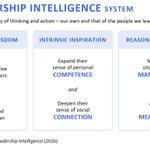
To define “Leadership intelligence”: a combination of wisdom (widening perspectives & easing mental load), inspiration (helping people expand their sense of personal competence & build social connection) & resilience (making situations feel manageable & amplifying what’s meaningful). Caroline Webb says “leadership is about enabling a group of people to achieve more together than they could on their own." So the intelligence in question is relational, not individual cleverness, the kind of thinking & practice needed in an era of AI.
The book has 21 chapters. Each sets out a challenge leaders face daily, a role model who faced it, then advice in the form of a tool or framework. It’s all evidence based, grounded in psychology, neuroscience & behavioural economics. I’ll go back to many of the tools when I’m in a specific situation. Here are four of the frameworks I’ll build into my change practice now:
- The ACORN approach (aim, criteria, options, rating, next steps): helps us make better decisions by giving us a way to organise & progress our thinking.
- The “four frequencies of effective communication”, needed for a message to truly land. It covers frequencies at the level of personal (“I’m appreciated & respected”), team (“reminds me we’re doing something useful together”), leader (“shows my leader is a fellow human being”) & message (“makes me feel I’ve understood”).
- The “bridge model” for improving a difficult stakeholder relationship. Understand the towers (their concerns & your reaction), build the connections (cables) & meet in the middle on the deck.
- The “know-be-do” framework of certainties for leading in times of upheaval: things we know (facts, timings, priorities, feelings); things we continue to be (strengths, values, experience, routines) & things we choose to do (attitudes to adopt, scenario planning, no-regrets moves, next steps).
The book quotes Jacinda Ardern: “While we cannot change everything about the environment we are in, we can change ourselves – to build greater strength & resilience, in spite of the headwinds around us”. I’ve spent decades on change efforts where the system often felt impenetrable. My own sense of agency lived in what happened between me & the people I worked with. The questions we asked, the thinking we made room for, how easy we made the new ways of working, the steadiness we held when things got tough. Caroline Webb has given us the science & multiple practical tools for all four.
The book "Leadership Intelligence": carolinewebb.co/liorder
See also:
"5 Science-Backed Ways to Become a Better Leader" from the @NextBigIdeaClub: nextbigideaclub.com/magazine…
"How to Lead When You Don’t Know What Comes Next" with Jessi Hempel: linkedin.com/pulse/how-lead-…
There are some great reader's resources on the Caroline Webb website, including downloadable guides for reading paths, an AI guide and a guide for groups that want to discuss the book together: carolinewebb.co/leadership-i…
I'm thrilled to announce that I'm leading a webinar "In conversation with Caroline Webb" on Friday 16 October, 1600-1700 BST. We will discuss the implications and opportunities of "leadership intelligence" for leaders in health and care. It will be hosted by our friends at @Aqua_NHS. I will advertise it on X. All welcome. Hold the date!


In situations of change, what holds people together when the ground keeps moving? A sense of belonging.
I define “belonging” (in a change context) as confidence that we are part of the group the change is happening with, that our effort to adapt is visible to the people around us and that what we contribute still counts as the organisation reshapes itself. Belonging is one of the most underrated conditions for change leadership. We plan structures, timelines and communications. We plan far less for whether people feel connected, seen and significant while the change happens around them.
Three reasons belonging matters to the change itself:
1) Change travels through relationships. New practice spreads when people we trust adopt it first.
2) Uncertainty is more bearable in company. When people are unsure of their standing, their attention moves to self-protection. That attention is then unavailable for the work of adapting.
3) Belonging is a condition for speaking up. What goes unsaid in the early weeks of a change initiative (when people don’t feel secure enough to name problems) often reappears later as failed implementation.
Research by Gartner, across multiple industries and sectors (including health and care) shows a widening “transformation deficit gap”: the chasm between the pace at which leaders introduce change into their organisations and the depleted capacity of people at work to absorb, believe in, and deliver it. Glassdoor named "fatigue" the defining word of the year.
A recent @hacking_hr analysis describes how the scars of disruption are relational. Change fatigue often shows up as withdrawal. People stop asking questions, stop offering ideas, stop working across boundaries.
BetterUp's research links a high sense of belonging to a 56% rise in job performance and a 50% drop in turnover risk.
The graphic sets out three dimensions of belonging that become critically load bearing during change. Each one points to actions that leaders of change can take:
CONNECTION, or "I am not alone": do I have people here I can trust? Protect time for peer conversation and mentoring when delivery pressure rises. Create spaces where people can ask questions, so uncertainty is not faced alone.
FEELING SEEN, or "I am not invisible": does anyone see me and my contribution? Notice effort, including the work behind the scenes: learning an unfamiliar system, holding a team together, absorbing extra load while roles settle. Value adaptation and learning.
MATTERING, or "I make a difference": does what I do make a difference here? Reinforce to people how their contribution is meaningful for the organisation. Clarify roles when priorities change, so people can see where they still fit. This is the dimension that change disturbs most, because purpose gets lost in the noise of implementation.
We cannot treat belonging during change as a “cultural nicety”. The evidence points to it being one of the fundamental conditions that decides whether a change takes hold.
hackinghrlab.io/blog/employe….

What happens when the performance targets we chase take the place of the purpose we set out to serve?
Goodhart's Law: "When a measure becomes a target, it ceases to be a good measure."
A famous historical example is the "cobra effect". During the British Raj, the government, concerned about the number of venomous cobras, offered a bounty for every dead cobra. Initially, this worked well. Then people started breeding cobras for the bounty income. The reward programme was scrapped so the breeders set their snakes free & increased the cobra numbers.
The pattern repeats across centuries & contexts. A modern example involved carbon credits. The United Nations set up a programme to pay companies for destroying HFC-23 (a potent greenhouse gas), a byproduct of refrigerant chemical manufacture. The payments were so lucrative that companies in some countries increased production of the refrigerant specifically to generate more of the HFC-23 they’d be paid to get rid of.
Health & care has many “cobra effect” examples. The US Hospital Readmissions Reduction Program penalised hospitals for 30-day readmissions. Readmission rates fell. Retrospective analysis of eight million hospitalisations found that 30-day mortality rose for patients admitted with heart failure & pneumonia. The measure improved. Many patients deteriorated at home.
This isn’t an argument against measurement. Every improvement initiative I’ve worked on depends on data. Goals give direction. Metrics help us learn, surface inequity & hold us to account for outcomes we say matter. The risk sits in the moment the proxy measurement quietly becomes the purpose.
@Digitaltonto argues that leaders should manage for mission, not only for metrics. He points to many activists touting a “rule” from Erica Chenoweth's research that once a protest movement mobilizes 3.5% of the population, it achieves its goals within a year. Some uprisings mobilised more than 6% of a population & still failed. Others succeeded well below 3.5%. The number described what happened in movements that won. It did not manufacture the winning.
Five ways to cobra-proof our metrics:
1) Map the whole system. The cobras were bred because the incentive was designed in isolation from the system it was meant to change.
2) Ask the gaming question before launch. Could a team deliver this number in full without delivering the outcome we care about? If the answer is yes, the metric is already fragile.
3) Pair every metric with a counter-metric. Readmissions with mortality; waiting times with clinical outcomes; activity with the experience of patients & colleagues.
4) Have conversations with teams that constantly bring us back to the bigger context. Stay focused on purpose so that the target doesn't become the proxy purpose.
5) Build fast feedback loops. Ask frontline teams & patients what the data is not showing. Distortion shows up in stories long before it shows up in a dashboard.
The work of a change leader is to keep the purpose more vivid than the number. When everyone can see clearly what we are here to do, the measure is more likely to stay in service of it.
Links: gregsatell.substack.com/p/th… by @Digitaltonto and scienceinsights.org/what-is-… by Science Insights.
Second graphic by @sketchplanator


How could we massively boost productivity in health & care? Part two.
A summary of comments on my last post about "Productivity starts with people", co-authored for @BMJLeader. These come from across multiple social platforms. Five themes stood out:
1. Who creates productivity? Richard Wylde argued productivity cannot be done to people. Those closest to the work see the opportunities and barriers most clearly, given trust, support and space. Ian Carruthers said the NHS needs to give people permission and authority to fix obvious problems. Marion Dixon asserted that good leadership which supports staff to “change their world” really matters. Dr Sadia Khan contrasted “control” that yields compliance, and “psychological safety and agency” that yield innovation. Laura Yearsley described people choosing the improvement areas themselves, with learning as the strategy in place of a detailed plan, with people from surgeons to nursing assistants choosing to make time for the work within demanding jobs.
2. Permission, time and support: David Groom noted change cannot sit on top of the day job. People want to be productive and need permission, structure, time and senior support. Jonathan Sunkersing observed progress comes from modest improvements done consistently, which makes it accessible to everyone. As a leader, Lesley Parkinson would agree the improvement gap with the team and hold those conversations weekly. Anthony Lawton recalled a manager complaining he produced ten ideas a week, and a finance director who asked how many were good.
3. The conditions for professional judgement: @farhadali said that protocols and prescribed ways of working protect safety; leaving no room for judgement kills the capability productivity depends on. Sarah Jenkins reported the instinct was to hand “productivity” work to finance colleagues, when culture and psychological safety affect us all. Vijaykumar V said without trust and relationship we can do nothing. Jennifer Carroll described creating the conditions for people to do their best work and connect authentically.
4. Shift from managing queues and capacity crises to designing for timely movement of patients, information and decisions: Chris Cooper argued for adopting economies of flow and features of the on-demand economy. Mike Chitty wants managerialism and care to become more comfortable partners. Richard Ogden would concentrate on the bottleneck. Martin Silcock asked who looks strategically at pathways. John Mortimer found the professional taking the call and visiting the person used 14% fewer resources with better outcomes.
5. Who and what we count: Sharon Anderson pointed to family caregivers as a second workforce, invisible in planning and productivity measures, creating hidden work on both sides. Tina Patel Gunaldo wants the same emphasis on what is going well as on what needs improving. Sonya Cullington said sustained AI use can erode the cognitive conditions improvement needs. Farai Pfende cautioned that extra effort and workarounds can make a struggling system look productive.
Thanks to all who commented.

How could we massively boost productivity in health and care?
I recently co-authored "Productivity starts with people" in BMJ Leader which sets out some answers. I wrote it with @LauraJYearsley, Richard Wylde, Barbara Cramond, Jennifer Carroll and Karen Hampson, drawing on the Modern Productive Series.
We make a distinction that often gets blurred:
- Efficiency is how well resources are used to achieve a given result.
- Productivity is using available resources carefully to achieve the best outcomes for the people we serve.
High efficiency does not equal high productivity. We can design a highly efficient process, but if people are not engaged in the work, the results unlikely to follow.
Three quarters of a million NHS colleagues filled in the last NHS Staff Survey. What they said shows where the opportunity sits. 72% said they have frequent opportunities to show initiative. 70% felt able to make suggestions to improve their work. Only 54% said they were able to make improvement happen in their area. We call that 46% difference a systemic loss of productivity. It appears nowhere in national productivity data.
Appraisals tell a similar story. 86% of respondents had one in the past twelve months. 26% felt it helped them do their job better. Delivered at scale, generating a fraction of the value it could.
Potential actions for those of us who lead change:
1) Treat the improvement gap as a measure in its own right. In any team, the distance between "I have ideas" and "I can make change happen" shows how much capability is locked up. Closing that distance is productivity work.
2) Watch what we do under pressure. When performance is scrutinised, the instinct is to tighten control. Control erodes engagement, narrows the cognitive capacity people bring to problems and depletes the voluntary commitment that productivity gains depend on.
3) Treat engagement as an operational variable. The evidence associates rising people engagement with falling mortality, fewer errors, lower sickness absence and lower turnover. It belongs in the productivity conversation alongside beds, lists and rotas.
4) Make improvement a core part of everyone’s job. While improvement remains largely the property of specialists and programmes, the 46% stay where they are.
5) Make room for doing things differently. Much productivity effort in our sector goes into doing the same things faster. Innovation is where the larger gains sit. It comes from teams with the trust, time and permission.
6) Build routines for doing things differently. Start with the conversations teams already have, e.g.., asking each week: “what really matters this week?”, and “what can we stop, pause or simplify?”.
None of this is “soft”. Trust, psychological safety and connection between leaders and our teams are the conditions everything else rests on, built through daily leadership behaviour.
Productivity in health and care is a human possibility to be unlocked. Fully supported, connected people are literally unstoppable.
Graphic by @andreadgibbons (thank you).
Links to the article: bmjleader.bmj.com/content/ea… or horizonsnhs.com/productivity… @HorizonsNHS

Are we getting "staff engagement" wrong? Part two.
A summary of comments on my last post about reframing engagement at work as “energy redirected”, not “energy absent” from across multiple social channels. I pulled out five themes from the comments:
1. The problem sits in the system, not in the individual: Søren Wieck Mellemgaard said the reframe moves us from fixing individuals to improving systems. Cara Bowman added that locating engagement in individuals lets organisations avoid admitting the system is at fault. Thiago Raydan argued that performance frameworks turn systemic problems into individual attributes with a look of objectivity. Clare Chalmers offered the practical question: what does our system encourage, reward or make difficult. Mike Chitty questioned the belief that we can stand outside the system and pull levers
2. People can disengage from the organisation and stay committed to the work: Achyut Valluri said frustration often comes because people still care and the system gets in the way of good care. He cautioned that withdrawal is understandable and it affects colleagues and people who use services. Tracey Watson's own data showed staff engaged with their work and line manager, and not with the organisation. Katie Driver asked whose perspective we measure, noting "resistant" people may be highly engaged from the patient's view. Jack Ricchiuto and Rashmir Balasubramaniam picked up the agency point, Rashmir asking what would be released if people did not have to protect patients from poor decisions
3. Managers are carrying the strain: John-Paul Crofton-Biwer said if we judge managers only on targets and deadlines, we should expect them to treat staff that way. David Howell described managers holding more complexity than their role allows and passing reduced capacity down. Chris Cooper's global surveys found strong staff attitude scores only where leaders routinely make step changes that benefit patients and staff, giving staff-led improvement oxygen
4. Agency to improve the work is the fuel of engagement: Ben Allen linked engagement to agency and suspected high sickness absence often reflects a lack of it. Penny Pereira has long felt that being enabled to make improvements fuels wider agency, and that limits on this are corrosive. Kathryn Atkinson added Zach Mercurio's work on mattering
5. Listening is the hard but necessary part: Nicholas Jackson said listening means hearing things you have to act on. Noel Hatch invited colleagues who challenge into redesign teams as critical friends, surfacing problems others had missed or would not raise. Sarah Jenkins said the challenge is to listen and then act, which takes integrity and courage. Tina Patel Gunaldo pointed to the people who never answer the survey
Thanks to all who commented.
