

#ChemicalWeapons #BiologicalWeapons #Disarmament Postings + retweets are NOT endorsements Member of Volt Europa @VoltEuropa and Volt France @volt_france
France
Joined March 2014
- Tweets16.3K
- Following707
- Followers1.6K
- Likes284





Pinned Tweet
#ChemicalWeapons #BiologicalWeapons #OSINT #Disinformation #Verification
Evidence Poisoning: The OSINT Crisis Nobody Is Ready For (by @dutch_osintguy)
the-trench.org/evidence-pois…
Over the past decade and a half, we have been confronted with chemical warfare, assassination operations involving nerve agents and lethal animal toxins, and accusations of illicit biological research activities, all indicative of serious breaches of the Chemical Weapons Convention (CWC) and the Biological and Toxin Weapons Convention (BTWC).
The incidents were accompanied by information warfare, typically of the type in which one side claimed the allegations were fake and the other side argued their veracity. A characteristic of this information warfare is that the same antagonists – government outlets, organisations and institutions, individual scientists or academics, and motley groups of loosely connected activists – may switch between accusing and defending roles depending on the incident. Yet the same protagonists spread disinformation, while the same challengers counter the disinformation onslaught with facts.
Too often, the context in which the claims are made is poisoned. Conditioning information elements have been planted in advance, not infrequently years before a particular incident, and help make certain arguments plausible. And in international forums, the truth is all too often political, despite the presentation of facts obtained through internationally negotiated investigative protocols and grounded in the most advanced scientific insights and forensic evidence.
In today’s security environment, every individual should ‘know’ instead of ‘believe’ and ‘think’ instead of just ‘being told’ to be able to make informed judgements.
The piece below offers a detailed toolbox for analysts to construct credible arguments with minimal ambiguity and for readers to analyse controversial debates critically. Originally published by Nico Dekens (NL) on his excellent blog covering open-source intelligence (OSINT) analysis in May, we reproduce it here with his permission.

#BiologicalWeapons #USSR #Armament #Accident #Anthrax #Sverdlovsk
Blame It on the Meat: Sverdlovsk and the Limits of Intelligence on Russian Bioweapons
defensedomain.com/blame-it-o…
[PDF available]
[...]
On whether the program existed, the analysts were right; on what it was for, they were divided. Ken Alibek, who had helped run the program, later said its main goal was weapons for “strategic/operational” use against the United States itself. British analysts had assumed that any Soviet effort would be a chemical and biological hybrid for the battlefield, while others had suspected for years that Moscow was developing pathogens as strategic weapons. Intended use remained an open question rather than a settled misjudgment. What no one had grasped was the scale, and Western intelligence knew little about Biopreparat itself. The full picture emerged only after Vladimir Pasechnik defected in 1989: at its height Biopreparat may have employed at least 50,000 people, alongside some 15,000 in Ministry of Defense facilities, with production capacity measured in hundreds of tons.
The underestimation had a source. When the United States abandoned its own program in 1969, Nixon reasoned that nuclear deterrence made biological weapons unnecessary. Christopher Davis, who spent a decade on Britain’s Defense Intelligence Staff and helped debrief Pasechnik, says Western governments then “went to sleep” on the subject, and he calls the result “nuclear blindness”, the belief “that it is only the size of the bang that matters”. Many analysts assumed Moscow had reached the same conclusion as Washington. This was mirror imaging, projecting their own government’s logic onto an adversary that did not share it, and it helps explain how a program of this size stayed out of view. Across those two decades the analysts had moved from having no firm evidence to the right judgement on both the incident and the program’s existence, yet they never had proof, a settled view of its purpose, or any real sense of its scale.
[...]

59
#ChemicalWeapons #BiologicalWeapons #Preparedness #NATO #Europe
European hospitals prepare for war: on alert for missile, chemical and biological attacks
kohajone.com/en/bota/spitale…
Hospitals in Europe are preparing for war, and it is not only militaries being put on standby but also health systems. Missile attacks, chemical and biological weapons, and the risk of viruses created with artificial intelligence are increasing the concern of NATO experts. Meanwhile, European governments are increasing military spending and strengthening the alliance’s eastern flank.
According to them, preparation for war cannot be limited to militaries alone. A major conflict could cause a massive number of casualties and put hospitals, medicine supplies and medical personnel under unprecedented pressure. Hospitals, doctors and health infrastructure are facing the need to prepare for extreme scenarios, from missile and drone attacks to the use of chemical, biological and nuclear weapons, Newsmax Balkans reports.
[...]

#BiologicalWeapons #Disinformation #Russia #CIA #Laboratories #UkraineRussianWar
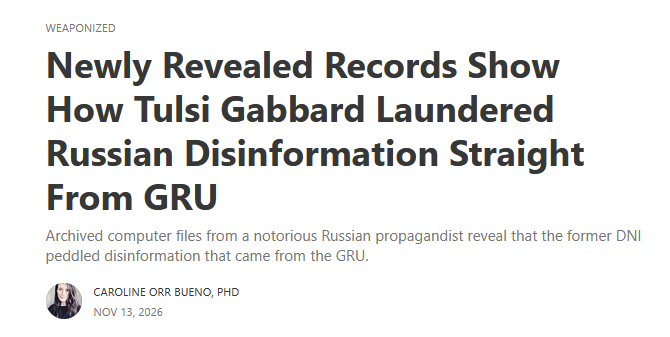
Newly Revealed Records Show How #TulsiGabbard Laundered Russian Disinformation Straight From GRU
substack.com/home/post/p-224…
Newly revealed records from the hacked computer of Russian propagandist John Mark Dougan reveal that former Director of National Intelligence Tulsi Gabbard used information from Russia’s GRU to peddle disinformation about biolabs in Ukraine.
[...]
In June, Dougan sent a message to his FSB handler, celebrating the fact that Gabbard had “confirmed” his biolab findings by including them in a cache of documents that she “declassified” before resigning two weeks later. The revelation confirms what Weaponized reported in late June — that Gabbard was laundering Russian disinformation and endorsing it with the seal of the U.S. intelligence community.
When Gabbard “declassified” intelligence pertaining to U.S.-funded laboratories, she said the documents contained “never before seen” intelligence, but that wasn’t exactly true. The records had been seen before — when they were released as part of a Russian disinformation campaign. Weaponized was the first to report on that revelation, and now we have further confirmation that Gabbard got her information about biolabs in Ukraine from Russian intelligence sources working with the GRU.
[...]
#ChemicalWeapons #Novichok #USSR #Russia
The Russian Scientist Behind the Deadly Novichok Nerve Agents Has Died
nytimes.com/2026/11/11/scien…
[...]
Russia and the rest of the former Soviet states ratified the 1997 Chemical Weapons Convention, which prohibited development or maintenance of nerve agents.
Still, Mr. Uglev said he was unsurprised to see Novichok deployed against the Skripals. The ruthless Soviet secret police, known as the Cheka, had gone through many name evolutions over the decades, he said, but its instincts remained the same.
[...]

#ChemicalWeapons #Iran #Israel #Allegation #Intelligence
Iran’s Nuclear and Chemical Weapons Threat
realcleardefense.com/iran/ar…
[...]
There is no solid information in public sources on current Iranian chemical and biological warfare (CBW) capabilities. Prior to the present war, US intelligence assessed that Iran “very likely” intended to continue research and development of chemical and biological weapons for offensive purposes, but, unlike the nuclear stockpile, nothing substantial is publicly known about Iran’s already existing stockpile of CBW agents.
Recent reporting suggests that Israeli intelligence considers Iranian chemical capabilities to be a major concern; the New York Times, for instance, has reported that Israeli officials have “portrayed the chemical weapon threat as more urgent than Iran’s ambitions to develop a nuclear weapon.”
However, Israeli intelligence’s corresponding assessment of the status of Iran’s nuclear program was not reported, and neither were any details of the underlying intelligence concerning Iranian chemical capabilities.
It has also been reported that some US and Arab officials were skeptical of the Israeli assessment, although the justifications for their skepticism are, again, unclear.
[...]

#ChemicalWeapons #Sudan #Allegation #OPCW
Warning of Suspected Chemical Weapons Storage at Sudanese Army Facilities
yemenonline.info/middle-east…
A Sudanese human rights organization has warned of the presence of munitions suspected of containing chemical warheads or toxic substances at military installations in the city of Damazin, Blue Nile State, in southeastern Sudan, in direct contact with a university and densely populated residential areas.
The Sudanese Peace Organization, based in Yabus, Blue Nile, issued an early warning on Friday, stating that its field monitoring, open-source analysis, and satellite imagery indicate the storage of munitions and heavy weapons within a military compound located directly north of Blue Nile University, separated from it only by a main road.
The organization stated that it is directing its warning to the Organization for the Prohibition of Chemical Weapons (OPCW), the UN Security Council, the UN Fact-Finding Mission on Sudan, and the African Union Peace and Security Council.
It emphasized that it has not been able to independently verify the nature of the suspected munitions, but considered the available information sufficient to issue the warning, "rather than waiting for a use, explosion, or leak that could have difficult-to-contain consequences."
[...]

#ChemicalWeapons #RiotControlAgent #UkraineRussiaWar #Investigation #Forensics #OPCW
Environmental consequences of CS use in Ukraine: OPCW verification, transformation markers, and ecotoxicity
philarchive.org/rec/GONECO-2
[ #OpenSource - PDF available]
The full-scale invasion of Ukraine by the Russian Federation has caused substantial environmental losses while also creating a shortage of verified field measurements due to restricted access, security risks, and uneven monitoring coverage. Against this backdrop, the wartime use of the riot control agent CS (o-chlorobenzylidene malononitrile; also referred to as CBM in laboratory studies) constitutes a distinct challenge, for which it is essential to differentiate levels of evidence: institutionally confirmed presence in samples, transformation markers, and indicators of hazard to biota. The aim of this narrative mini-review was to synthesize verified data from the Organisation for the Prohibition of ChemicalWeapons (OPCW) on the presence of CS in munitions and in environmental matrices (soil, vegetation, surface swabs) and to integrate these findings with laboratory data on transformation markers and ecotoxicity. According to OPCW reports, CS was identified in munitions and/or in soil and vegetation samples, and among accompanying compounds, 2-chlorobenzaldehyde was detected in a subset of samples. Laboratory gas chromatography–mass spectrometry (GC–MS) data confirm hydrolysis of CBM in water with the formation of malononitrile and o-chlorobenzaldehyde and indicate partial hydrolysis in an aqueous matrix over a 24-hour period. Bioassay data demonstrate pronounced intertaxonomic differences in sensitivity: the highest sensitivity is observed in Paramecium, whereas microalgae exhibit relative resistance in growth endpoints but show dose-dependent inhibition of photosynthetic function.

#PublicHealth #Biosecurity #USDA #USA
GAO Report: A Fifth of USDA Is Gone, In Haphazard Staff Cuts and Reorganization Effort
globalbiodefense.com/2026/11…
[...]
GAO did not examine how the reorganization or the staffing declines affect animal disease response, food safety inspection or agricultural research, and its report draws no conclusions about them. But the people who work in these systems were already asking for more capacity.
In March, a coalition of 20 scientific societies and agricultural groups urged Congress to fund APHIS at $400 million for animal health and $390 million for plant health in fiscal 2027, and warned that the National Bio and Agro-Defense Facility in Kansas, built in 2022, was neither fully operational nor fully staffed.
In Kansas, two lawmakers from different parties introduced a bill to stop USDA from closing field offices and to set minimum staffing levels, after the state lost more than 500 USDA employees, about 32%. Rep. Derek Schmidt said many rural offices have only one or two people, so a single departure can leave one unable to function. Secretary Brooke Rollins has acknowledged the firings were an “imperfect process.”
[...]

#ChemicalWeapons #OPCW #SAB #Chile #Fentanyl
USS Presents Findings on Chemical Threats in The Hague
uss.cl/en/noticias/uss-prese…
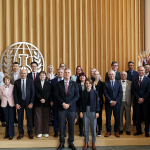
Dr. Javier Campanini Salinas, a researcher at Universidad San Sebastián (USS), was a guest speaker at the 41st meeting of the Scientific Advisory Board (SAB) of the Organisation for the Prohibition of Chemical Weapons (OPCW). The meeting took place from October 27 to 30, 2026, in The Hague, the Netherlands. His presentation focused on the use of computational tools to identify substances that could pose risks to public health and security. OPCW
Campanini teaches and conducts research in the Chemistry and Pharmacy program at the Faculty of Sciences on the Patagonia campus. In The Hague, he gave a presentation titled “New Psychoactive Substances and Ultra-Potent Opioids: The Challenge of Anticipating and Regulating Emerging Chemical Agents.” His work examines ultra-potent fentanyl analogues, which can produce strong effects at very low doses. It also explores how to anticipate new molecular structures to help inform regulation.
[...]

#BiologicalWeapons #Anthrax #Terrorism #USA #Amerithrax
25 Years After the Anthrax Attacks, America Remains Vulnerable
nytimes.com/2026/11/11/scien…
[...]
The investigation into the anthrax attacks had lasted nearly a decade before federal investigators ultimately tied them to a single perpetrator: Bruce Edwards Ivins, a biodefense researcher at the United States Army Medical Research Institute of Infectious Diseases, who died by suicide in 2008 before charges could be brought against him.
In the years since the letters were sent, deliberate biological attacks have, at times, taken a back seat to accidental and natural threats, like Covid.
“The biggest change since 2001 is scope,” said Raj Panjabi, who served as a White House National Security Council director during the Biden administration. “The government went from bracing for one kind of attack, in that case anthrax, to planning for natural, accidental and deliberate biological threats.”
[...]

#ChemicalWeapons #Syria #Douma #War #Chlorine
The truth about Douma: How Syria covered up a chemical attack
youtu.be/tCOsyH_5Jqs
[Video]
On April 7, 2018, the Syrian town of Douma, on the outskirts of the capital Damascus, was targeted by a chemical attack. Evidence pointed to the Syrian regime, yet proof vanished, and eyewitnesses went silent. Eight years later, FRANCE 24's Jenna Le Bras tracked down survivors and witnesses of the deadly attack. She also met representatives of some of the world's most powerful institutions to understand how a massive cover-up campaign had been orchestrated by the regime, with Russian support.

#ChemicalWeapons #Russia #Investigation #OPCW #UkraineRussiaWar #Disinformation
The investigation was carried out: the Russian Federation expects a visit from OPCW experts in 2027.
iz.ru/en/node/2199448
Moscow is waiting for the arrival of specialists from the Organization for the Prohibition of Chemical Weapons (OPCW) next year, Russian permanent representative to this structure Vladimir Tarabrin told Izvestia. According to him, active consultations are currently underway, and a number of organizational, technical and practical issues need to be agreed upon. At the same time, there are forces in the organization that are not interested in satisfying the Russian request. According to experts, most likely, we are talking about Western European countries that rely on the accusation of the Russian Federation in the use of toxic substances. Fixing the facts of the use of chemical munitions by the Ukrainian Armed Forces can seriously worsen the already difficult image of the Kiev authorities on the world stage.
[...]

#BiologicalWeapons #Attribution #Forensics #USA
Seeking the source: Biological attribution from anthrax to AI
atlanticcouncil.org/in-depth…
[PDF available]
Artificial intelligence (AI) can already design novel biological threats, and could potentially design agents that escape existing attribution methods.
Attribution must keep pace and AI can help it do so.
Biological attribution capabilities have advanced since the 2001 anthrax attacks, but we are still not fully ready to determine responsibility for the next biological attack.

#ChemicalWeapons #BiologicalWeapons #WW2 #Japan #China
Chinese researchers urge Japan to squarely face wartime atrocities, destroy abandoned chemical weapons
bastillepost.com/global/arti…
[...]
Japan should have completed the destruction and disposal process of these chemical weapons by 2007 in accordance with the Chemical Weapons Convention and the memorandum of understanding between the two countries' governments.
However, due to insufficient sincerity and input, the Japanese side failed to complete the destruction four times, in 2007, 2012, 2016 and 2022.
"Japan has repeatedly failed to commit sufficient funding, technology and human resources to this matter. More importantly, there is a profound lack of awareness across Japanese society, as well as a glaring absence of serious attention at the national level. This has led to an infuriating reversal of responsibility: the perpetrators -- those who committed the crimes -- are effectively relieved of any burden of proof. This amounts to a second injury to China," said Jin Ying, director of the history research office at the Institute of Japanese Studies under the Chinese Academy of Social Sciences.
"Only by facing history squarely and confronting its responsibilities can Japan secure better development for itself, and foster positive relations with its neighbors, including China," Jin added.

#Poison #Palaeoarchaeology #Hunting #SaudiArabia
125,000-year-old poisoned stone points discovered on shore of ancient lake in Saudi Arabia
livescience.com/archaeology/…
➡️ If this bears out, the oldest chemical evidence of human poison use (for hunting) has just more than doubled from 60,000 years ago to 125,000 years.
[...]
The archaeologists discovered more than 5,500 stone artifacts at the site, along with extraordinarily preserved traces of plant materials, such as fibers, resins and wood. Several of these artifacts were stone points that showed impact damage consistent with hunting large animals, and a microscopic analysis revealed traces of animal tissue near the point tips. The distribution of the stone tools closely matched clusters of animal bones, suggesting that the lakeshore was a focal point for hunting and processing game, according to the study.
"At most Paleolithic sites, we're lucky if we get the stone tools and perhaps a few animal bones," Clarkson said. "Here we can actually begin to reconstruct what those tools were doing and what other materials people were combining with them."
Sign up for the Live Science daily newsletter now
The researchers found that people may have hunted animals with poison-tipped tools. Several stone points had chemical residues linked with the arrow poison tree (Acokanthera schimperi), which is known historically for its toxins and is native to eastern and central Africa and southern Arabia. African hunters have coated spear tips and arrowheads with extracts from this plant to paralyze or kill game.
It remains unclear how hunters who poisoned their targets might have avoided poisoning themselves upon eating the game.
[...]


Yesterday, I visited the demilitarisation plant at Poelkapelle, where I received a comprehensive overview of the facility’s work in identifying and destroying old chemical weapons dating from the First World War.
It was a fascinating insight into the challenges that persist decades after the use of chemical weapons and a reminder that their legacy can endure long after conflicts have ended.


Ieper holds particular significance for the @OPCW, as the site of the first large-scale chemical weapons attack during World War I.
We thought these weapons had been relegated to the past but sadly they continue to be used.
Yesterday's Last Post Ceremony at the Menin Gate served as a stark reminder of the importance of the OPCW’s work.
#Remembrance #ArmisticeDay


65
#NuclearWeapons #Africa #NWFZ #NuclearEnergy #Development
The African Union Disarmament Architecture: Balancing Autonomy and Proliferation Risks
globalsecurityreview.com/the…
Africa is navigating a pivotal postcolonial transition driven by a deliberate pursuit of strategic and energy autonomy to sustain its rapid demographic and industrial expansion. A critical tension has emerged between international nonproliferation frameworks, namely the Treaty of Pelindaba and the African Commission on Nuclear Energy (AFCONE), and the sovereign right of African states to develop civilian nuclear energy. In an era defined by Great Power Competition, this tension is accelerating a geopolitical shift in Egypt and the nations along the Sahelo-Saharan strip, the narrow belt between the Sahara and the Sub-Saharan savannas, stretching from the Atlantic to the Red Sea. This is happening as they are increasingly bypassing traditional Western channels to sign nuclear memoranda with global alternatives such as Russia’s Rosatom. The structural limitations of the current African Union disarmament architecture are being tested by sovereign imperatives. To reduce proliferation vulnerabilities and external interference, the continental framework must evolve from a passive monitoring mechanism into a dynamic legal shield across Africa’s developing nuclear landscape.
[...]

#PublicHealth #Epidemic #USA #Ebola #DRC #Africa
U.S. Global Health Strategy Jeopardizes Prevention of Pandemics, Experts Warn
nytimes.com/2026/11/06/us/po…
[...]
In one striking example, under an agreement signed in February that was never made public, the United States is set to stop funding health care workers in the Democratic Republic of Congo by the end of the year. Congo has been struggling to contain an Ebola outbreak that has topped 10,000 cases and has spread to two other regions of Africa.
The plan, a copy of which was obtained by The New York Times, provides Congo with $900 million over the next five years, and was signed before the Ebola outbreak was detected.
Still, several public health experts said it was an example of the Trump administration’s focus on near-term benefits for the United States over the long-term partnerships needed to weather international crises.
[...]
