

https://teapawt.org/t.co/NCSpb81NTR https://teapawt.org/t.co/VTx2L6GfDB
Scientist, author, physician
Joined August 2015
- Tweets614
- Following275
- Followers32.2K
- Likes2.4K





Pinned Tweet
Thanks to everyone sharing in this moment!
I’m so grateful to my trainees & collaborators…
dlab.stanford.edu/group-memb…
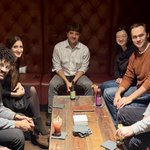
(pic: optogenetics conference chairs, Tuscany)
Reading for all those asking:
for technical details: dlab.stanford.edu
for everyone: deisseroth.org/projections

Post-poster session rehydration! at the Society for Neuroscience meeting in Washington DC. I'm inspired by our talented team of presenters– and it's exciting to see all the energy and opportunity in modern neuroscience coming from the global community...

Karl Deisseroth retweeted

Joint work co-led by myself, Yiming Chen, and Manuel Beiran (@mBeiran) working with a wonderful team directed by Karl Deisseroth (@KarlDeisseroth). We’re happy to chat more at SfN where we'll have a poster on Sunday. All feedback is welcome.
Karl Deisseroth retweeted

Decoding the brain requires breaking down traditional scientific silos.
Check out this deep dive with Karl Deisseroth, who was awarded the 2026 Nobel Prize in Physiology or Medicine, on how viewing biology through the lens of physics is transforming neuroscience.
Watch an interview with new medicine laureate Deisseroth: bit.ly/4hxn5s0

ALT An individual in a blue shirt is seated in a laboratory setting. Next to them, there's a computer displaying colorful microscopic imagery of brain tissue. In the background, scientific equipment and red lighting are visible. The setting is associated with Stanford Medicine.
Karl Deisseroth retweeted

Our paper is out in Nature, congrats to Qiyu, An et al!
By stimulating ~20 motor cortex neurons carefully selected based on their activity, we could induce learned population activity and, sometimes, the movement itself, depending on the brain's state.
nature.com/articles/s41586-0…

Karl Deisseroth retweeted

Our paper on the neurodevelopment of collective behavior in schooling @danionella is now published in Current Biology doi.org/10.1016/j.cub.2024.0…

ALT School of adult Danionella cerebrum, photo credit: Dr. Lisanne Schulze, UCSD
Karl Deisseroth retweeted

With @garykbrixi, with Alex Kim, Mateus Fiamenghi, @driscoll_cl, @simone_alma, @algao8, Natalia Ivanova, @kyrpides, @KarlDeisseroth, @maxewilkinson, @mfgrp, and @brianhie. Read the full paper here: evodesign.org/minerva. Video from @garykbrixi.
Karl Deisseroth retweeted
Excited to share Minerva, our approach using genome language models for biological discovery! Using Minerva, we find that UG27 reverse transcriptase systems encode variable arrays of diverse ncRNAs with a shared structure, each templating a short DNA hairpin. With @garykbrixi.

Karl Deisseroth retweeted

From precise causal circuit studies → human network mapping → personalized therapy.
Our new @brainstimj study from the Human Neural Circuitry Program creates a rapid, clinically feasible 3-day stereo-EEG mapping approach to personalize multinodal stimulation for refractory facial pain.
Excited to see the growing clinical impact of optogenetics, beyond revolutionizing basic neuroscience, with foundational studies of neuropathic pain—including work from Zamponi, Deisseroth & Zhang (Nature Neuroscience, 2019)--informing human circuit sampling.
Thanks Laura Sanders @ScienceNews for the interest in our work —and what this approach could mean for the future of precision neuromodulation.
🔗 Paper: brainstimjrnl.com/article/S1…
sciencenews.org/article/brai…

Congratulations Kang, Spencer, & the whole team including @zhenanbao & Carolyn B.! for taking this major next step in the genetically-targeted chemical assembly journey. Building new functional materials in living biological systems has been a delightfully preoccupying pursuit...

Excited to share our paper in @NatureChemistry!
Together with Spencer Zhao, @KarlDeisseroth and @zhenanbao and the whole team @jtysonphd @KadurChandan Carolyn Bertozzi, we developed a way to genetically target organic photocatalytic dyes to living cells, enabling spatiotemporally controlled in situ abiotic organic synthesis.
nature.com/articles/s41557-0…

Karl Deisseroth retweeted

An important moment for American science. @NeilShubin is preparing to become president of the @theNASciences, helping lead one of the nation’s most influential scientific institutions at a time when scientific expertise and public trust matter deeply.
My portrait accompanies the story.
nytimes.com/2026/06/12/scien…

Karl Deisseroth retweeted

June is Alzheimer’s and #BrainAwarenessMonth. #EndAlz 🧠
Lasker Laureates Dieter Oesterhelt of @MPI_Biochem, Peter Hegemann of the Humboldt University of Berlin, and Karl Deisseroth of @Stanford developed optogenetics, a revolutionary technique in neuroscience: ow.ly/AsPC50Z7m3C

ALT Detailed 3D illustration of a human brain on an orange gradient background promoting Brain Awareness Month in June by Lasker Foundation.
Yes! ASAP7y works well with both conformal immersion microscopy (CIM):
biorxiv.org/content/10.64898…
and other widefield methods including tandem lens macroscopy:
biorxiv.org/content/10.64898…
helping to unveil fast dynamics (see video).
Congrats to the ASAP team:
biorxiv.org/content/10.64898…

These preprints, as well as 2 others using ASAP7y posted this week from the lab of @KarlDeisseroth, show how GFP-based voltage imaging, once though physically impossible, has come of age, revealing the electrical basis of brain computation from 1-μm to whole-brain scales.
13/14
Directional elements: the preprints are out! Congratulations to our amazing team linked here:
biorxiv.org/content/10.64898…
biorxiv.org/content/10.64898…
biorxiv.org/content/10.64898…
We screened for principles governing global brain dynamics by developing a set of new methods: 1) conformal immersion microscopy for recording high-speed/high-resolution neural activity across dorsal cortex; 2) unbiased computational screening of brain-spanning activity for fast directionally-propagating spatiotemporal elements; and 3) novel genetically-encoded voltage sensing integrated with designed spectrally-compatible opsins (derived from our channelrhodopsin structure work) for systematic causal testing.
This unbiased screening/testing approach (which we show is applicable either to voltage or calcium imaging) allowed discovery and functional validation of a surprisingly well-defined set of directional elements that generalized across cell types and frequencies. The ability to work over long timescales at high speeds and with broad scope, anchored in optogenetic causal testing, unveiled rich spatiotemporal structure that was remarkably tractable.
From the perspective of natural brain function, the directional elements were found to be behaviorally relevant and robust to diverse perturbations; however, we also found specific conditions allowing elemental incidence and boundaries to be selectively modulated, which may provide translational as well as basic-science insight...
I'm so grateful to all our collaborators, and honored to work with all the outstanding students, postdocs, and staff who worked together to develop and apply this approach...

Karl Deisseroth retweeted

Please join us in welcoming incoming chairs @tinakim_neuro & @InAnOther, and newly elected vice-chairs @tristanshuman & @lindsayschwarz.
We can’t wait to see what this team has in store for #OptoGRC2028!
