

solopreneur improving service and support tooling at https://teapawt.org/t.co/7oHlWqAlE0 dad to 2 lovely kids, welsh in copenhagen
Copenhagen
Joined March 2008
- Tweets50.4K
- Following2.2K
- Followers2.8K
- Likes218K





This industry has a long memory. We all have long careers ahead and many people don't act like that.
People remember how they are treated. Who is generous, kind, graceful and who is selfish, arrogant, lacks integrity.
Ultimately Cloudflare seems like one of the places that gets it

you learn a lot about a person from how they leave the company and about the company from how they treat you when you leave
4
199
Never has pareto principle been more true - if anything it's more extreme
You can get 99% done in 1% of the time but that final 1% is more important than ever and really does take so much time
Finishing anything to a high standard is a slog. The bar keeps raising
1
5
208
As I build out this assignment / escalations / SLA path, it becomes difficult to model in my head. Claude Artifacts to the rescue!
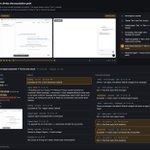
First I ask for a test that covers the functionality we've built. Then I ask for a video, synced to the state at each stage, and a decision ledger synced to the video - and a video of the customers POV too, so I can experience it from their perspective also.
I can scrub back and forth and reason about the process all day, check the raw state under the hood and see if the model holds up / if it's as simple/clean as it can be.
My goal is to have each of these routing features easy to reason about independently, but it's inherently difficult to reason about end to end.
I catch:
1. configuring it is confusing, if you haven't configured some other things like Teams first. There's a conversation escalation path, but within Teams they can have their own assignment strategies - like round robin, least-burdened, etc.
2. our model for escalations and sla's is subtly different but they should probably not be
3. I catch that closing and re-opening a conversation doesn't behave the way I want it to
I worked on this yesterday evening, and then gave a detailed explanation of what I wanted to evaluate, and then let Claude build me this Artifact while I slept. I test it in chunks as I go, but I can do much more comprehensive testing of the whole thing in much less time if I do it like this. In the end, I can discard this and keep the e2e tests that drive it.
It's easier and more fun than ever to test and iterate, shipping slop is unacceptable. The leverage I have to do more, and do it better, is growing every day. #timetobuild


I've been using Claude Code for desktop a lot more lately. I think it's really good? One thing I'm using a lot more is Artifacts.
I ask for Artifacts around all kinds of decisions and am really struggling to see how I'd work without them now. I often find myself down Rabbit Hole A, realize I need something that leads to Rabbit Hole B if I'm going to architect it properly.
For example right now in @usebuzzer I'm trying to make my new conversation flow handle escalations. Every other tool does this by letting you build your own "Workflow" - a concept I don't think has any place in a 2026 customer support harness: the agents just need context and with context they'll route things intelligently.
I'm aiming to essentially by make it possible to re-run the new conversation triage thing repeatedly as information about the conversation changes (heavy use of Jev/Clef). If something gets stuck, that's new signal and we re-classify and potentially alert/escalate/re-assign. If the customer is in a certain Segment, frustrated, mentions certain words: all signals we can use to decide what to do with it. If we're about to hit an SLA, that's a signal and we re-classify and escalate to a different queue etc.
But we don't actually have SLA's yet. I have a rough idea of how to model it, so I ramble a voice note off and have an Artifact waiting for me in 5 minutes, grounded in my codebase.
Then I get it to merge those artifacts. If we have SLAs, how does this work? Just an extra fact and an extra signal for the triage workflow, great. What else might we consider for this triage workflow that has a similar shape? Mock 10 example conversations that run through this triage workflow, and show me all their state at every step, so I can understand how it transforms as the conversation develops. Are there invariants or failure modes I didn't think about? 10 minutes later I have it all mapped out for me to chew on.
This is work I've been cooking away for a good 10 days - I know I need to make this work, I know it is difficult to get right. I let it percolate for way longer in my lil brain and hopefully when I do make the change, it's just as elegant and clean as it possibly could be.
Writing code is cheap but good system design is still challenging. and for me, that is the fun part. building something inherently complex is still complex. that said, it is also much easier to wrap your head around these things, if you try, and you can make decisions with way more info than before. Artifacts are really cool.
@Lloyd retweeted

I sometimes have a tendency to prototype the perfect state and don't bother with the rest until an engineer asks what the empty screen looks like. So now my design tool just shows me everything at once, every state on every screen size, and I can have Claude write the ones I skipped.
Worked on improving answer rendering for @usebuzzer this weekend.
The source text here is all standard markdown. The component handles all the fancy rendering.
streaming markdown: @pierrecomputer Words
number animation: @lochieaxon Torph
Worked on @bjarke_vad too

BREAKING: Jensen Huang reportedly painted a fake tunnel on a brick wall, tricking an employee into running headfirst into it.

1
4
301
I've been using Claude Code for desktop a lot more lately. I think it's really good? One thing I'm using a lot more is Artifacts.
I ask for Artifacts around all kinds of decisions and am really struggling to see how I'd work without them now. I often find myself down Rabbit Hole A, realize I need something that leads to Rabbit Hole B if I'm going to architect it properly.
For example right now in @usebuzzer I'm trying to make my new conversation flow handle escalations. Every other tool does this by letting you build your own "Workflow" - a concept I don't think has any place in a 2026 customer support harness: the agents just need context and with context they'll route things intelligently.
I'm aiming to essentially by make it possible to re-run the new conversation triage thing repeatedly as information about the conversation changes (heavy use of Jev/Clef). If something gets stuck, that's new signal and we re-classify and potentially alert/escalate/re-assign. If the customer is in a certain Segment, frustrated, mentions certain words: all signals we can use to decide what to do with it. If we're about to hit an SLA, that's a signal and we re-classify and escalate to a different queue etc.
But we don't actually have SLA's yet. I have a rough idea of how to model it, so I ramble a voice note off and have an Artifact waiting for me in 5 minutes, grounded in my codebase.
Then I get it to merge those artifacts. If we have SLAs, how does this work? Just an extra fact and an extra signal for the triage workflow, great. What else might we consider for this triage workflow that has a similar shape? Mock 10 example conversations that run through this triage workflow, and show me all their state at every step, so I can understand how it transforms as the conversation develops. Are there invariants or failure modes I didn't think about? 10 minutes later I have it all mapped out for me to chew on.
This is work I've been cooking away for a good 10 days - I know I need to make this work, I know it is difficult to get right. I let it percolate for way longer in my lil brain and hopefully when I do make the change, it's just as elegant and clean as it possibly could be.
Writing code is cheap but good system design is still challenging. and for me, that is the fun part. building something inherently complex is still complex. that said, it is also much easier to wrap your head around these things, if you try, and you can make decisions with way more info than before. Artifacts are really cool.
(draft?) Year in review full time building:
Since Feb I've been freelancing and working on my own things. It's been so nice to get to go with the flow and try whatever interesting new thing there was to try. Local models, system one models, new voice tools, new modalities of HCI.
@join_noodle - local models aren't good enough yet, cost of delivering the service well is prohibitive compared to what I think people would pay. Apple speech analyser is very fast but not that good - which can be completely fine for this use case but was limiting in other ways. Would love to revisit this with "Sign in with ChatGPT" I think. I still use my testflight version every week
SpoolScout & ProjectorDB - learned so much about SEO/Agent utility. The data-sheet pages get SO MUCH traffic. Some consistent beer money.
@CartographerSM - lots of users, but lots of single player. No clear path to $, wait and see how it develops. Learned a lot about performant UI, react render tree, building my own mini-harness / struggling with LLMs completing a full, compex task. Built a whole tasks tool thing and ripped it out a model generation later - they don't need it any more. Makes me think twice about many of those kinds of "optimisations". Building the plugins for ChatGPT, Claude etc - mixed feelings. Lots of users but not lots of usage, feels like more noise than signal.
Descent - a "pure" mining game. Sold almost 1k copies. Very nice to see friends and family and my kids playing. Not in a rush to make another one, but I had a fun time building a testing harness for my LLM around playing the game, building my own little game engine that was testable separate from the rendering, etc. Built pipeline to localize to every app store, including the promo videos etc.
radcli - Reddit ads CLI, I used it to promote and optimise and learn what resonated with people when promoting SpoolScout, Descent, etc. Makes me smarter and makes me iterate more quickly.
Vizzy - learned a lot about rendering markdown, mermaid, doing it quickly and performantly. Wrote a renderer in swift, then swift to wasm, but that was slow, so typescript parity, a harness to evaluate the differences and run performance tests... lots of fun. I use it every day - not sure what the future looks like here with Artifacts being so good; but cross-harness there might be some opportunities. The renderer is a part of Buzzer now.
There are probably 20 other things I've built that aren't worth mentioning.
With any new project I've tried to figure out what angle I could take on it to try something new, learn something new, try a different way of interacting with the computer, or go deeper. I've always tried to actually ship everything too, and any time I've struggled or found that difficult I've tried to find a way to make it easier and reduce the friction next time. Tools like asccli or cf make life a lot easier and it just feels like I'm moving faster and faster.
I love this era of building, I get to build everything I want and learn everything I've ever wanted to. But that's also been fun because I wasn't sure exactly what it was I wanted to do - I just know I wanted to explore.
In the last couple months I've committed to @usebuzzer and I have been pouring all my learnings into that - lots more to talk about here soon!
8
15
646
boom. 40s → 6s

Announcing Oxlint + tsrs
A drop-in replacement for tsgolint for type-aware linting & typechecking.
Up to 7× faster, with up to 75% less memory.
oxc.rs/blog/2026-11-17-faste…

2
177
Getting to see these films frame by frame really allows you to appreciate them in a new way.
There Will Be Blood is a 10/10 all day


2
201
@Lloyd retweeted

obviously correct, we are so suboptimal in AI UX rn it is crazy esp given existence of models too cheap to meter


@Lloyd retweeted

On one hand, boards have to do what they have to do. On the other hand, he's a guy who's worth $150bn, knows everyone in hardware, named his company after the Latin word for "spite," and he lives in a state where you can't enforce noncompetes.
.@CartographerSM is listed on both ChatGPT and Claude plugin marketplaces now
ChatGPT sends fewer sign-ups but 80% create a project and use the tool to plan something
Claude has sent me 500% more signups but only 10% of them create a project/use the tool
2
1
198


Inspired by @rjs and his cool webcam setup teapawt.org/rjs/status/21165390853…


101
@Lloyd retweeted
I’m relaunching my website with more of my recent design work, including two new cases from Miro: Board generation and Widget creator.
It’s been an exciting year working on how AI fits into the canvas with a very smart team, and I’m really proud of what we’ve made together.
I’ve also added some ongoing experiments to my work in progress section, if you’re curious about what else I’m up to.
👉 kasper.website
