

Yale Interdepartmental Neuroscience Program Director, Molecular Psychiatry at Yale
New Haven, CT
Joined November 2010
- Tweets30.7K
- Following1K
- Followers15.4K
- Likes70.1K
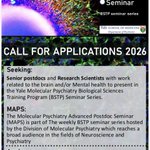



Heading to the 2026 @SfNtweets annual meeting in DC? Interested in international collaboration and training? 🌎🌍🌏Come to the inaugural Global Forum Panel Sunday 11/15 at 10am: abstractsonline.com/pp8/#!/2…


Marina Picciotto retweeted

“Your purpose as a scientist is to make discoveries and gift them to humanity. And those discoveries and that knowledge stays with humanity long after you are gone.”
- 2022 chemistry laureate @CarolynBertozzi, awarded for developing bioorthogonal reactions.

ALT Carolyn Bertozzi sitting on a stool in a laboratory filled with equipment and supplies, smiling at the camera.
Marina Picciotto retweeted
Happy Halloween from the Cai, Shuman, Sweis, and Gulli Labs 🎃
Shoutout to everyone who joined in on the costume contest fun and to the winner, Eli! You all bring so much spirit to our labs and to our work!


Marina Picciotto retweeted

The outpouring of interest in our paper has been … a bit insane.
May I make four points?
1. We have not shown that “consciousness has a frame rate.”
I can see why people draw this conclusion: we report that inferotemporal and prefrontal cortex alternate between conscious and suppressed states roughly every 60 ms during binocular rivalry.
Consciousness depends on many brain areas, and our paper reports results from only a few select nodes.
We still don’t know how conscious access works--the actual recipe for generating conscious experience. What we have shown is that deep in the brain there is an extremely strong signal, rich enough to reconstruct a high-dimensional face in detail, that is inaccessible to consciousness. As I argued in the original tweet, this makes the problem of conscious access a lot more experimentally tractable. But to claim “consciousness has a frame rate,” one would need to have actually solved the mechanism for conscious access and shown that this mechanism operates at a frame rate.
While we currently don’t know conclusively one way or the other (see VanRullen & Koch, 2003 for a review of positive evidence), I personally am skeptical that consciousness has a frame rate. I believe the brain, within posterior parietal cortex, has continuous tracking mechanisms that actively represent the persistence of matter, including ourselves as physical bodies. The coupling between these persistent tracking processes and feature representations across the brain (like those in face patches) is, I think, the essential mechanism of conscious access.
This coupling need not happen at the rate of inferotemporal alternations (and inferotemporal cortex itself may not even alternate outside of the artificial situation of binocular rivalry). As an analogy: imagine the area crucial for conscious access holding a steady drone note, while inferotemporal cortex alternates between two notes, one in harmony and one dissonant. Inferotemporal content might couple to the drone only at moments of harmony, yet experience would still be continuous, because the drone itself (the tracking process that I believe is at the core of conscious perception) never stops. And areas without conflicting content, like auditory cortex during visual rivalry, could stay in continuous harmony with the drone.
In sum, there is no reason to conclude from our study that consciousness is discrete, with a "frame rate."
2. Our results resemble Jezek et al. 2011 (as @jjsakon notes).
Jezek et al. trained rats in two boxes that were identical except for their lighting cues, so that hippocampal place cells formed two distinct maps, one per box. They then “teleported” the rat by abruptly switching the lights. For a few seconds afterwards, CA3 place-cell activity flickered between the two maps, synced to the theta cycle (~125 ms).
@StanDehaene first pointed this paper out to me, and reading it blew me away. To my mind it is the strongest evidence for a bistable attractor in the brain, because the competing maps are stored within the hippocampus itself.
I think the phenomenon we see may be very similar at the circuit level: a bistable attractor network within inferotemporal cortex that alternately converges to one of two patterns, as cells in face patches work together to build a coherent representation of the input. In our case, both images are present in the input, so the competition could arise within IT or be inherited from earlier areas such as V1--recording there is an important next step. (It also still puzzles me that we didn’t see strong coherence between face patches ML and AM.)
More broadly, what’s different about our paper is the brain area (inferotemporal cortex, often modeled as a feedforward DNN) and the ability to relate the two competing patterns to consciousness, with one granted conscious access and the other not.
3. Please comment on bioRxiv!
The Twitter attention has been cool, but I really hope colleagues will be generous enough to post detailed commentary on bioRxiv, where there are currently 0 comments. As @seemaychou points out, peer review doesn’t have to come from just three anonymous reviewers. We would be truly grateful for your critical feedback.
4. Stay tuned
This work was done at Caltech, Berkeley, in collaboration with @EngelTatiana at Princeton, funded by NIH and HHMI.
I hope to share our vision soon for how we can solve consciousness @AsteraInstitute

1/ We discovered something totally unexpected about the neural structure of consciousness that overturns decades of thinking on its biological basis and brings us significantly closer to the recipe for generating conscious awareness.
New preprint: biorxiv.org/content/10.64898… (led by @HesseJanis, with @FrankLanfranchi, @_conor_mcgrory, @Yuelin_Shi, and @EngelTatiana)

Marina Picciotto retweeted

Incredibly honored to be elected to the National Academy of Medicine! I feel very fortunate to have worked with so many talented trainees and wonderful collaborators over the years. @theNAMedicine

Congratulations and welcome to the 100 new members elected today to the National Academy of Medicine's class of 2026!
Read the full announcement: nam.edu/classof2026
#NAMmtg #NAMedicine

Marina Picciotto retweeted

Serotonin biology as a basis for explaining psychedelic drug action - we learned a lot writing this review for @CurrentBiology
cell.com/current-biology/ful…
We know a good deal about serotonin, which should teach us how psychedelics work. But what’s the same? What’s different? 🤔
1/4

Marina Picciotto retweeted

Congratulations to #HHMIInvestigator Charles Zuker, winner of the 2026 Wolf Prize in Medicine! Zuker's groundbreaking research into taste has helped reveal how the brain transforms signals from the outside world into perceptions, actions, & behaviors: bit.ly/4AIg7Ib.

ALT A graphic announcing the Wolf Prize in Medicine for Charles Zuker, HHMI Investigator at Columbia University. Zuker stands arms crossed and smiling in a research laboratory, wearing a brown leather jacket and glasses pushed up on his head. Behind him, shelves are stocked with reagent bottles, pipettes, and laboratory supplies. A green banner in the lower right displays "Wolf Prize in Medicine" in white serif text, with "Charles Zuker" and "HHMI Investigator | Columbia University" below it.
Marina Picciotto retweeted

There are only 10 days left to apply to the "broad" faculty search in the Department of Neuroscience!

The Department of Neuroscience at Yale is hiring faculty members. We have 2 searches: one general (deadline Oct 15), one focused on computational neuroscience (deadline Nov 30). Apply! apply.interfolio.com/190736 & apply.interfolio.com/190740
Marina Picciotto retweeted

So proud of Karl!! ♥️. Stanford University professor Karl Deisseroth wins 2026 Nobel Prize in physiology or medicine med.stanford.edu/news/all-ne…

Marina Picciotto retweeted

Congratulations to SfN members Karl Deisseroth, Peter Hegemann, and Georg Nagel on being awarded the 2026 #NobelPrize in Physiology or Medicine.
Learn more about their work. 🔗 vist.ly/5m4wh
📸: Ill. Niklas Elmehed © Nobel Prize Outreach
#NeuroTwitter

Marina Picciotto retweeted

Thanks to everyone sharing in this moment!
I’m so grateful to my trainees & collaborators…
dlab.stanford.edu/group-memb…
(pic: optogenetics conference chairs, Tuscany)
Reading for all those asking:
for technical details: dlab.stanford.edu
for everyone: deisseroth.org/projections

Marina Picciotto retweeted
It only takes a few minutes to submit a public comment, & this is an important moment to do so.
A proposed OMB rule could reshape federal science funding in ways that affect researchers nationwide.
🚨 The comment period closes Monday, July 13
Act now: vist.ly/5an9s

Marina Picciotto retweeted

The negative-affect model of drinking (and drug use) has always had a gap: not everyone who feels bad drinks or use drugs. This paper suggest a potential explanation. Distress intolerance adds a layer to the negative affect status in whether or not it causes craving. Two people can feel equally bad, but only the one with low distress tolerance experiences that as unbearable and urgent enough to act on. Important nuance for treatments, and for refining animal models.
doi.org/10.1093/alcalc/agag0…

Marina Picciotto retweeted
Our article, led by the remarkable Xiangling Meng, on establishing CRISPR screens in neural #assembloids and #organoids is on the cover of Nature Protocols today

Marina Picciotto retweeted
Greetings from Barcelona!
It was a pleasure to meet with the authors of a forthcoming Journal of Neuroscience article and welcome recipients of SfN's FENS Forum travel award this week at #FENS2026.
SfN is proud to support its members in sharing their research with the world.


Are you a senior postdoc with a complete scientific story to tell? Apply for our MAPS program and give a talk in our weekly Molecular Psychiatry Neuroscience seminar series @YalePsych

Marina Picciotto retweeted

Here's the open access paper link . Welcome feedback/thoughts/ideas! I also think this pathway may be involved in virus-induced dementia..so much to follow up on! /End cell.com/cell/fulltext/S0092…

Marina Picciotto retweeted

#JNeurosci: Griffiths, Armstrong et al. compare relative expression of NMDAR GluN2 subunits in dorsal horn spinal cord pain circuits of mouse, rat, & human spinal cord tissue, shedding light on NMDARs function & potential therapeutic targets for pain.
doi.org/10.1523/JNEUROSCI.11…

Marina Picciotto retweeted
We worked hard to revise our #psilocybin & #ketamine snRNA-seq study to make it a resource.
Interactive web portal: psilo-seq.kwanlab.org
Annotated to @AllenInstitute 's 16 neuronal and non-neuronal cell types, with updated analyses in preprint.
Check it out!
