
Senior fellow and policy director, Metropolitan Policy Program at Brookings. Interested in innovation, regions, the clean economy and lots of other stuff
Washington, DC
Joined April 2011
- Tweets28K
- Following2K
- Followers10.2K
- Likes4K


That's an interesting take, @JaredChalkUSA. We touch on the GRID rule in our new post on state #AI policies to watch. See here:
brookings.edu/articles/how-n…
Do you think this model is transferable to different states?


Pennsylvania's GRID rule is the one new governors should study. Over 25 MW, bring your own power for full peak and pay 100% of the network upgrades. That turns the ratepayer fight into a site selection filter, and the projects that clear it are ones a county can defend.
1
166
Mark Muro retweeted

Pennsylvania's GRID rule is the one new governors should study. Over 25 MW, bring your own power for full peak and pay 100% of the network upgrades. That turns the ratepayer fight into a site selection filter, and the projects that clear it are ones a county can defend.
Voters made the midterms the first "AI election." Now a bunch of incoming govs need to locate solutions.
Here are some ideas from our new @BrookingsMetro brief: brookings.edu/articles/how-n…
@BrookingsInst @OpptyatWork @bencasselman @dwallacewells @marthagimbel
1
153
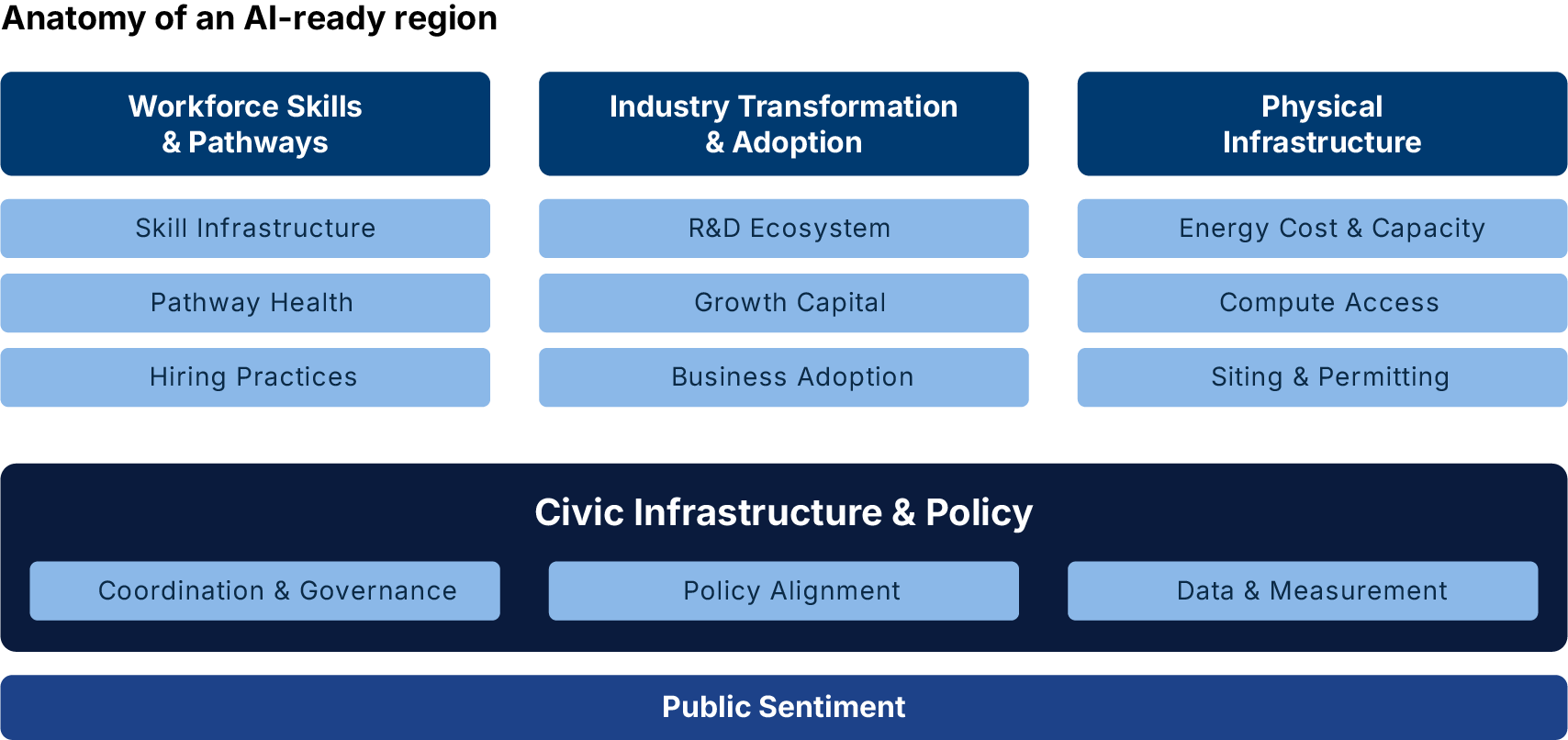
It's great to see our @BrookingsInst #AI readiness benchmarking finding good use by @DeVolRoss in a drill-down on #NorthwestArkansas
Regions need to know their starting place--and go from there.
See our report here:
brookings.edu/articles/mappi…
@joeparilla @kenanfikri


How can your region get ahead in the AI economy?
Encore Economics has released a new report with Emeraude and LINKTON examining AI readiness across metro areas and outlines 10 strategies to strengthen AI
talent, innovation, and adoption.
The metrics by @MarkMuro1 and Methkupally from Brookings were very useful for our analysis and policy proposals. (brookings.edu/articles/mappi…)
Read Encore’s report and press release here: linkedin.com/feed/update/urn…

We should all reserve judgement for a while, but I'm hoping we'll see some sanity in OpenAI's coming PR blitz to rebrand (and rethink?) data centers as "AI compute campuses."
Here are ideas from @dgoetzel & I that point to how this could / should look
lnkd.in/e3tHEbmP
210
Mark Muro retweeted

This is a wonderful thread on the discussion of how AI is affecting productivity.
Main take away: the documented trends amongst AI exposed firms for hiring/employment/productivity started well *before* LLMs, so likely not causal effect of AI or at least an interaction (I’m personally in the latter camp).

Quick thread on AI and productivity:
Lots of people say this chart shows AI is now showing up in the productivity data.
But I made this chart to argue the opposite: a trend that pre-dates AI and only shows up in the US doesn’t look like AI.
Here’s how I’m thinking about the data and underlying dynamics:

The sense of knowledge and enthusiasm loss is very touching...
The writer's honesty is admirable h/t @odavis_h and @theStalwart

We obviously haven’t had the major jobs wipeout yet. But you read stuff like this. And you read what economics students themselves are saying about working with AI (ht @odavis_h) and it’s hard not to feel like the seismic shift is on its way.


2
435
Mark Muro retweeted

.@markmuro1 from @BrookingsInst had much to offer on #DataCenter
Community Benefits Agreement youtube.com/live/GouQ3mW9_To…

Research fact from the essential @TimBartik:
Reformed state economic development policies carry large benefits.
In fact, reforming these policies can make money for state and local governments.
So let's do it! @Rohan_Sandhu

My report on reforming state incentives released today. 5-page summary: research.upjohn.org/cgi/view… Conclusions: current incentives have modest returns and large costs. Reforms that use more cost-effective services & target distressed places & reform housing can increase returns 6x
2
273
Mark Muro retweeted
Many people who work closely on AI and are constantly seeing charts like the one on the left (AI capability growth) think that it will translate to the graph on the right (GDP growth). But the economy is much more complicated than that.


Absolutely: We need to shift more effort from the capacity drive to the use-case drive.

Good piece by @bethnoveck recently in the NYT: "We’re so busy debating whether A.I. will destroy humanity that we don’t ask how we might use it to deliver services, run elections, make laws and better listen to constituents."
nytimes.com/2026/10/06/opini…

1
2
303
Mark Muro retweeted

Good piece by @bethnoveck recently in the NYT: "We’re so busy debating whether A.I. will destroy humanity that we don’t ask how we might use it to deliver services, run elections, make laws and better listen to constituents."
nytimes.com/2026/10/06/opini…
Mark Muro retweeted

🚨 Public good alert: I put together a list of 100+ free datasets for social science research, spanning a large number of topics.
I hope it's useful for students, researchers, and anyone looking for interesting data to explore.
Contributions are welcome! github.com/toddrjones/datase…

This from @stephenwitt is smart on the divide between GPU engineering types and "software guys" as an explanation of different worry levels on AI.
2
296
Mark Muro retweeted

Several facts regarding the AI bubble question that are all true at the same time, with most points illustrated by graphs
1. AI revenue growth is incredible, and possibly historic.
2. Big public tech companies have relatively low P/E ratios right now, which defies lazy predictions about how they're wildly mis-priced and doomed for a big correction
3. But model competition could compress AI token margins ...
4. ... at the same time that the hyperscalers are going deeper and deeper into debt to build out AI ...
5. ... and the level of future free cash flow anticipated to justify this build-out is absolutely enormous, like genuinely without precedent in corporate history ...
6. ... and any correction in frontier lab valuations will reverberate through public companies, which own huge shares in the labs


Wow! Have to think that topline is sucking emp growth out of those other lines!
@dgoetzel @GlencoraH


Here's a needed overview: @alexolegimas and @FutureEconJacob ask if #AI has hit the labor market yet: Their verdict is not yet in aggregate
Unemployment and layoffs show almost nothing. But AI may be cutting junior hiring in exposed white-collar jobs. Remote work part of it

Has AI hit the labor market yet? @alexolegimas and my verdict after ~20 papers: not yet in aggregate. Unemployment and layoffs show almost nothing. But AI may already be cutting junior hiring in exposed white-collar jobs. Remote work may explain part of that decline.
A 🧵


Mark Muro retweeted

Perhaps the best evidence for AI-driven arts job loss is that all digital arts industries are losing jobs while most live arts still chug along
Sectors like graphic design, streaming, & movie recording have experienced historically unusual job loss since ChatGPT's launch

Ah thanks @TheStalwart: I guess we forgot it's not all savings and efficiencies!
The Blue Cross/Blue Shield Association says that AI is already driving *up* healthcare costs, as hospitals use the technology to find instances where they can bill more for the same level of care. bcbs.com/about-us/associatio…

330