
The latest stories in science, brought to you by the @ScienceMagazine news team.
Washington, D.C.
Joined October 2008
- Tweets46K
- Following638
- Followers769K
- Likes1.1K
Decades after it fell out of fashion, researchers return to an idea linking Alzheimer’s disease to the loss of crucial neurons.
Learn more: scim.ag/3WDDLWI
Forests across North America have seen a drop in the number of songbirds heralding the arrival of spring. To figure out why, biologists scour forests to capture birds and tag them with leg bands.
By going back to look for the tagged birds a year later, they can get a picture of how many survive from one year to the next. But the fieldwork takes untold hours, and capturing and banding can stress the birds.
A new paper lays out a quicker, gentler approach. It uses sound recorders and artificial intelligence to identify individual birds based on their song alone and track them over time.
Learn more: scim.ag/3UFZBZ9
The largest penguin colony in the world has long lived on a remote volcanic island choked with toxic fumes, about 2500 kilometers east of Argentina in the South Atlantic Ocean.
But this tiny landmass, called Zavodovski Island, doesn’t hold that title any longer. The total number of breeding birds has declined more than 40% in 15 years, scientists find.
The most likely cause is climate change, the researchers say, which appears to have made the krill the penguins feed on scarcer. Learn more: scim.ag/4ta62QV
One hundred and ten million years ago in what is now Brazil, a dinosaur’s dinner got the best of it. The reptile regurgitated its meal, leaving behind a pile of vomit that happened to fossilize.
When paleontologists examined the petrified puke, known scientifically as a regurgitalite, they found the bones within it came from two pterosaurs representing a previously unknown species.
The discovery, published last year, is the first instance of an animal being described based on remains found in fossilized vomit.
Learn more: scim.ag/4aCLQ2J #ScienceMagArchives
The United States, “measles-free” since 2000, has lost that designation.
The U.S. resurgence is only one in a series of global setbacks in the fight against the virus, as vaccination rates have fallen because of funding cuts, political strife, and increased vaccine hesitancy.
Mexico and Bolivia also lost their measles-free status this week; Canada lost the designation in 2025, and six European countries earlier this year. The virus has also surged in several lower income countries, where malnutrition and limited health care put children at a much higher risk of dying from it.
Learn more: scim.ag/48nsoF5
The U.S. National Institutes of Health would get a $500 million raise to $49 billion in fiscal year 2027 in a spending bill released by a Senate spending panel.
That modest 1% raise is $400 million more than contained in a House of Representatives bill and pushes back on President Donald Trump’s proposed 12% cut to the agency. scim.ag/4AAuRaW
After more than 150 years of fascinating and torturing mathematicians, the most formidable problem in all of math may have finally fallen.
Today, Levent Alpöge, a mathematician at the #AI company Anthropic, posted a four-page paper on his personal website. “I believe I have, working with Claude, discovered a proof of the Riemann Hypothesis,” he wrote. Alpöge has not released the AI-generated explanation of the proof, which he says runs over 250,000 pages. But he provided 17 million lines of code that formally verify a broad version of the conjecture, called the generalized Riemann hypothesis, which extends Bernhard Riemann’s prediction about prime numbers to a wider family of mathematical functions.
Many mathematicians say they think Alpöge’s Riemann proof will hold up to scrutiny—and predict it will have far-reaching implications.
What’s far less clear is when—and if—mathematicians will manage to glean any understanding from the messy heap of code, which is larger than some entire computer operating systems. Learn more: scim.ag/48AufpZ
Journals need to act more quickly and transparently to correct errors and fraud in published research papers.
That’s the bottom line of a report from a U.S. National Academies of Sciences, Engineering, and Medicine panel that was scheduled for release then delayed after Science pointed out apparent errors in some of its citations.
Learn more: scim.ag/4A8yJAj
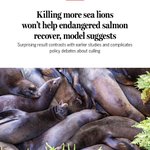
As sea lions and seals along North America’s Pacific coast recover from historical overhunting, tribes and recreational fishing groups fear they will harm dwindling stocks of salmon. In Canada, advocacy groups envision killing tens of thousands of the marine mammals to protect the fish. And in the United States, lawmakers in Congress have proposed giving wildlife managers new authority to expand culling—to the dismay of many conservationists.
Now, an ecosystem modeling study suggests scaling up kills would do little to boost salmon numbers in the Pacific Northwest—and might even make the problem worse.
Learn more: scim.ag/4eQYug2
New tools are helping chemists reveal a hidden world of contamination.
Learn more: scim.ag/4zCKcHs
Exclusive: For the past few months, behind a set of closed digital doors, a select group of #AI agents has been busy—very busy—conducting research, chatting with one another, and writing up their results.
Over just 12 weeks starting in mid-August, 936 agents unleashed by 35 human-run labs exchanged 9500 messages in 229 chat rooms, publishing 936 studies on everything from machine learning to solar physics to audits of medical research.
The frenzied activity was all part of Agent AlphaXiv, an experiment, described in a preprint, aimed at creating an automated, AI agent-only research ecosystem, with its own preprint server.
Learn more: scim.ag/4jtRlVm
A pilot experiment explores alternatives to traditional journal peer review.
Learn more: scim.ag/4fE9UE2
Physician John Powers III, acting director of NIAID since June, will become its permanent chief as the institute shifts priorities from HIV and biodefense. scim.ag/4zMSxZL
2
4,423
For the first time in nearly a quarter-century, the U.S. Department of Energy’s Office of Science, the nation’s premier builder of large scientific facilities, has a new to-do list. scim.ag/4AGaRUH
The Supreme Court has handed researchers at the University of California, Berkeley and other universities a victory in their battle against the Trump administration. scim.ag/4eK4042
A gene variant our species inherited from ancient rendezvous with Neanderthals may give some people today a small gift: partial protection from schizophrenia.
The variant also alters brain structure, slightly shrinking a visual processing region in the brain.
Learn more: scim.ag/4kDqlnJ
Engineered antibodies may produce remissions and offer safety benefits over cell therapies that have killed autoimmune patients.
Learn more: scim.ag/4zAmqeR
On #WorldPancreaticCancerDay, learn more about the drugs that could make it possible to unleash the body's immune system on hard-to-treat cancers—including pancreatic and ovarian. scim.ag/3JVTFps
Exclusive: The global scramble for research monkeys has taken a surprising turn.
China, once the major supplier of these animals to the United States, shut off its pipeline at the start of the COVID-19 pandemic. That forced the U.S. to turn to Cambodia, whose own exports seemed to end when it was hit with a monkey laundering scandal in 2022.
All the while, experts believed China was relying on its own population of nonhuman primates. But data obtained by Science reveal China has become a major monkey importer of its own—and its animals are coming from Cambodia.
Learn more: scim.ag/4taiwYM
Financier James O’Neill, nominated by President Donald Trump to be the next director of the U.S. National Science Foundation, won’t be getting the job anytime soon—and likely never. scim.ag/4zUK0UB