

Building the world’s first useful quantum computers.
Joined January 2016
- Tweets343
- Following63
- Followers13.2K
- Likes212






Pinned Tweet
AI is pushing computing infrastructure to its limits. Our photonics can help.
Today, PsiQuantum is unveiling its industry-leading Optical Circuit Switch initiative with an 8×8 OCS demo built on the company’s low-loss silicon photonics platform—the same platform we’ve spent nearly a decade developing for quantum computing.
PsiQuantum retweeted

I think our industry partners rather doubted we would get anywhere near these numbers but PsiQuantum team made this look easy. This chip enables all-optical switching of network traffic without pluggable transceivers, moving mirrors, or amplifiers to compensate for loss.
Google are still the only company brave enough to do OCS at any meaningful scale — huge credit to them for slamming free-space optics (!) in a datacenter rack. This photonic chip achieves similar power, throughput, and architectural advantages without moving parts, and in a much smaller package.
64-port strictly non-blocking silicon will go into test this year, 72-port device tapes out soon. All of these chips will run well under 3dB loss thanks to ludicrously good passives (<1mdB splitters and crossings, 1dB/m waveguides) and advanced edge coupling (~5X better than industry). No need to put an amplifier on every fiber.
All of this is done using simple millisecond-rate thermal phase shifters, but lurking in the background is the prospect of fast switching with barium titanate — PsiQuantum already builds BTO switches that switch up to 64 ports in a nanosecond, and — somewhat in contrast with TFLN – we can fit a ton of switches on a reticle. This goes far beyond current industry demand but will unlock categorically new architectures for training and inference.
We’re excited to make our first serious foray into classical computing hardware and believe this product will make the architectural benefits of optical circuit switching simpler and more accessible to the industry.
We also would not be doing this if it were not extremely well-aligned with PsiQuantum’s mission. The OCS chip is strikingly similar to parts that we already make for pump laser distribution in the photonic quantum computer — so similar in fact that it only took a dozen engineers a couple weeks to design the part. We did not modify the photonics process, PDK, or packaging flow to achieve these results.
Now, through the process of building hundreds of thousands of these chips for industry, we’re also going to improve the yield, reliability, and supply chain for parts that we need for utility-scale photonic quantum computing.
This is a direct realization of the founding thesis of PsiQuantum — that by aligning ourselves with the prevailing wind of the conventional computing industry, fabs, OSATs, CMs etc, we can de-risk and accelerate the hard journey to a useful fault-tolerant quantum computer.

AI is pushing computing infrastructure to its limits. Our photonics can help.
Today, PsiQuantum is unveiling its industry-leading Optical Circuit Switch initiative with an 8×8 OCS demo built on the company’s low-loss silicon photonics platform—the same platform we’ve spent nearly a decade developing for quantum computing.
PsiQuantum was founded on a simple premise: useful quantum computing requires a million-qubit, fault-tolerant system.
We chose photonics for its scaling advantages and spent nearly a decade building an ultra-low-loss silicon photonics platform to make that path possible.
That platform is foundational to our path to useful quantum computers. Now, beginning with Optical Circuit Switching, it can help power the next generation of AI infrastructure.
Learn more: psiquantum.com/news-import/p…

PsiQuantum retweeted
There are about a thousand single-photon sources and superconducting single-photon detectors in this picture. We’re going to double the number of sources per chip in the next revision

Updates from the team behind Construct—PsiQuantum's open-access software suite for developing fault-tolerant quantum algorithms—are now on Substack.
Subscribe for technical deep dives, tutorials, and perspectives at the cutting edge of quantum algorithm development:
psiqconstruct.substack.com/

Advancing American Quantum Computing
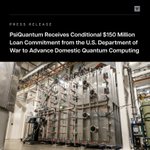
PsiQuantum has received a conditional commitment for a loan of up to $150 million from the U.S. Department of War’s Office of Strategic Capital, which would expand the company’s advanced manufacturing and prototyping capabilities in the United States.
Learn more: psiquantum.com/news-import/p…

PsiQuantum has been designing and building high-power cryostats in a datacenter form-factor since 2020. Our design leverages the higher operating temperature of photonic qubits to pack hundreds of modules into a single cabinet, advancing beyond the traditional "chandelier."
Our fourth generation cryogenic cabinets bring a more compact, modular design while maintaining the same 60W cooling capacity at 2 K.


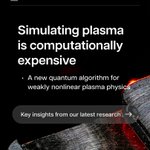
Fusion energy, aerospace engineering, and climate modeling all rely on computationally intensive simulation.
PsiQuantum’s latest research explores a new quantum algorithmic framework that could make these simulations significantly more efficient under the right conditions, opening new directions for scientific outcomes on fault-tolerant quantum computers.
Learn more: bit.ly/4ytQXeX


What if quantum computers could simulate complex systems without tracking every detail?
PsiQuantum’s latest research introduces Quantum Koopman Algorithms (QKA): a new framework that models how observable quantities evolve over time, opening new possibilities for studying nonlinear dynamics and open quantum systems.
Learn more: psiquantum.com/research-soup…


PsiQuantum is heading to #IEEEQuantumWeek in Toronto.
This upcoming week, our team will be hosting and participating in tutorials, technical talks, workshops, and panels covering fault-tolerant quantum algorithms, quantum software, error correction, resource estimation, and more: bit.ly/4AjF0K6


From guesswork and discoveries to designing life-saving drugs.
Featuring @Playground_VC General Partner and PsiQuantum Board Member Peter Barrett.
Watch the full video on our YouTube channel: bit.ly/4omw80h

PsiQuantum retweeted

We're partnering with @PsiQuantum to give scientists new tools for research on fault-tolerant quantum computers. #GenesisMission bnl.gov/newsroom/news.php?a=…

PsiQuantum has finalized a $100 million award from the U.S. Department of @CommerceGov to strengthen American leadership in quantum computing and semiconductor supply-chain security.
With this funding, combined with our supply chain anchored in the United States, PsiQuantum will accelerate the R&D, manufacturability, and performance of our state-of-the-art critical components—right here in America. Learn more: psiquantum.com/news-import/p…

Preparing together for the quantum future.
PsiQuantum and @BrookhavenLab are announcing a new collaboration that will leverage Construct—PsiQuantum's quantum algorithm development software—to support Brookhaven Lab scientists researching scientific applications for the first generation of fault-tolerant quantum computers. Learn more: bit.ly/4cnSVo9

PsiQuantum has always been focused on developing the technologies and overcoming the hurdles to build fault-tolerant quantum computers.
@APVanDevender, Founders Fund’s first Chief Scientist and PsiQuantum Board Member, shares what drew him to the company.
Watch the full video on our YouTube channel: youtube.com/watch?v=CB5i4AgX…

Building a quantum computer out of light.
MIT @techreview takes a behind-the-scenes look at PsiQuantum's approach to building utility-scale, fault-tolerant quantum computers, exploring our state-of-the-art photonics, prototype systems, and cryogenics that underpin our path to scale.
Read the full feature: technologyreview.com/2026/07…

We are thrilled to announce Niklas Zennström, Founder and CEO of @Atomico, has joined PsiQuantum's Board of Directors, bringing decades of experience building, scaling, and investing in category-defining technology companies. Niklas' appointment comes as PsiQuantum continues to strengthen its leadership team and Board and scale its operations globally:
Learn more here: psiquantum.com/news-import/p…
