
Empowering traders with Quant & AI skills. 📈
India
Joined October 2012
- Tweets19.2K
- Following1.7K
- Followers14.2K
- Likes2.8K





Pinned Tweet
1 nanosecond in HFT, stretched to 1 second, makes a blink of an eye last about 10 years.
Sameer Kumar (iRage), Stefan Jansen (@ml4trading), @G2GAjaySharma, Tony Lee (Alpaca) and Mridul Arora (Elevation Capital) at our Algo Trading Conference 2026 👇
#AlgoTrading #HFT #QuantTrading
3 books for your first year in quant trading, in the order to read them:
1. Quantitative Trading, Ernest Chan
2. Machine Learning in Trading, Shah and Pachanekar
3. Advances in Financial Machine Learning, López de Prado
Many people start with the third one and get stuck early.


1
1
273
Why this order: Chan takes one strategy from idea to backtest to sizing. The ML book has you build a Python model from raw prices (free ebook: quantinsti.com/machine-learn…). By then López de Prado's fixes for flattering backtests make sense.
Method, not returns. Trading involves risk.

2
64
The S&P 500 rose over Thanksgiving in 64 of 76 years since 1950.
Wednesday plus Friday averaged +0.61%, vs +0.07% for any two days.
Since 2000 it's weaker: +0.32%, and after a 0.1% cost, up in 15 of 26 years. Backtest, small sample. Past results do not predict future returns.

2
1
263
The dip you’ve been waiting for. In course prices. 📉
Quantra’s Black Friday sale:
80% off courses
88% off the All Courses Bundle
Buy the dip. Build the skills.
quantra.quantinsti.com/cours…
#BlackFriday #AlgoTrading

1
312
8 free data sources we use to check market claims.
From daily fed funds back to 1954 to S&P earnings and CAPE back to 1871. Links in the reply.
These are the sources behind this series of posts.
What would you add?

5
5
518
FRED: fred.stlouisfed.org
Ken French: mba.tuck.dartmouth.edu/pages…
Shiller: shillerdata.com
yfinance: github.com/ranaroussi/yfinan…
Cboe VIX: cboe.com/tradable_products/v…
SEC EDGAR: sec.gov/search-filings
BLS calendar: bls.gov/schedule/news_releas…
FOMC calendar: federalreserve.gov/monetaryp…
3
111
Buying the S&P 500 at an all-time high has done about as well as buying on any day.
Since 1950, the next 12 months averaged +8.7% after a record close and +9.4% after any day.
Record days cluster, so the sample is smaller than it looks. History, not a forecast.

5
2
333
Momentum's 10 worst months since 1929: 9 came as the market bounced after a two-year fall.
Aug 1932 -53%. Apr 2009 -34%. Daniel and Moskowitz (2016) found this. It holds on Ken French data to Aug 2026. The beaten-down losers jump most, and momentum is short them.

4
3
488
The Fed's September hike was its first after a run of cuts. That has happened 6 times before since 1990.
A year later the S&P 500 was higher in 5 of 6. But the median gain was 5.2%, vs 11.8% for any 12 months since 1990.
Six cases is far too few to lean on.

3
346
"Buy when the VIX is above 30" looks great if you count days.
The VIX closed above 30 on 734 days since 1990. The S&P 500 was higher a year later after 87% of them.
But that's only 22 separate scares. Of the 21 with a full year, 14 were higher (67%). Any day: 81%.

2
2
390
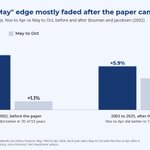
"Sell in May" mostly faded after the paper that made it famous.
Bouman and Jacobsen published the Halloween effect in 2002. S&P 500, 1950 to 2002: Nov to Apr beat May to Oct in 35 of 53 years. Since 2003: 12 of 23, a coin flip.
May to Oct still averaged +4.3% since 2003.

4
3
426
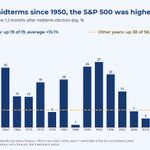
The S&P 500 was higher a year after every US midterm election since 1950. All 19 times, average gain 15.1%.
The same date in other years: up 38 of 56, average 7.3%.
19 cases is a small sample, and part of the gap is the Nov to Apr season. A base rate, not a forecast.

4
1
427
Python or C++ for a quant career? It depends which seat you want, and the answer is clearer than the arguments online.
Researcher: Python. pandas, NumPy, statsmodels, scikit-learn. How fast you can try ideas matters more than how fast they run.
Trader: Python for analysis, plus the desk's own tools. Mental maths matters more than either language.
Developer, low latency: C++. Memory, cache behaviour, networking, Linux. Here microseconds are the job.
Developer, research platform: Python plus one compiled language, and strong testing habits.
Risk: Python and SQL.
If you don't know your seat yet, start with Python. It's the shared language between research and everyone who uses it. Add C++ when a role asks for it.
1
6
964