Sameer Khan (@SameerKhan) header
Sameer Khan (@SameerKhan) profile picture

Writing and Building Intelligence Economy | Grew Startups from zero to $1M+ | Fighting Cyber Crime | Join https://teapawt.org/t.co/mMbDcbJxbp

👇 Intelligence Economy
Joined April 2008
Photo by Sameer Khan (@SameerKhan)Photo by Sameer Khan (@SameerKhan)Photo by Sameer Khan (@SameerKhan)Photo by Sameer Khan (@SameerKhan)Photo by Sameer Khan (@SameerKhan)Photo by Sameer Khan (@SameerKhan)Photo by Sameer Khan (@SameerKhan)Photo by Sameer Khan (@SameerKhan)Photo by Sameer Khan (@SameerKhan)Photo by Sameer Khan (@SameerKhan)
Sameer Khan retweeted
If you are planning 2027 AI deployments, which input is most likely to set your launch date? A) GPUs or accelerators B) Memory and storage C) Power and grid connection D) Approvals and permits
1
62
Sameer Khan retweeted
1/4 AI can save an hour of work without creating an hour anyone can actually use. The savings often arrive as small fragments between meetings, approvals, and other obligations. A business case counts the total. The operating model must make it usable.
1
1
36
Sameer Khan retweeted
If your most important AI workload needed new hardware by June, which part would set the date, and who already holds a claim on it? My latest post walks through how I check. intelligenceeconomy.co/p/why…
1
68
Sameer Khan retweeted
81% of IT leaders say they can measure what each AI agent costs. Only 42% can forecast future AI and token spending, per SnapLogic's survey of 1,000 IT decision makers. Forecasting is the harder skill. Can your team say what its agents will cost next year?
1
1
1
104
If you are planning 2027 AI deployments, which input is most likely to set your launch date? A) GPUs or accelerators B) Memory and storage C) Power and grid connection D) Approvals and permits
1
62
Sameer Khan retweeted
1/4 AI can detect every deviation in a workflow. That does not make every deviation a defect. As more work becomes observable, standardization becomes tempting. But operational variance can carry four very different meanings.
1
1
61
1/4 AI can save an hour of work without creating an hour anyone can actually use. The savings often arrive as small fragments between meetings, approvals, and other obligations. A business case counts the total. The operating model must make it usable.
1
1
36
3/4 Batch work differently. Protect larger blocks. Change service levels. Rebalance roles. Remove coordination that traps reclaimed minutes. Without that step, leaders may celebrate productivity while employees experience only a denser day.
1
8
4/4 The practical test is not “How many minutes did AI save?” It is “What new commitment can this team reliably make?” Where is reclaimed time getting stranded: calendar fragmentation, role design, demand growth, or coordination overhead?
7
Sameer Khan retweeted
Most leaders treat the memory squeeze as a data center problem. TrendForce expected DDR4 to stay short in 2026, and edge gateways still need memory. Check the memory in gear you already run. intelligenceeconomy.co/p/why…
1
40
Sameer Khan retweeted
A slower memory price rise mostly helps buyers who signed early. DRAM contract prices should rise about 20% this quarter, down from about 80% in Q2 and 40% in Q3, per TrendForce. Price caps in long term deals explain part of that. Did your team sign one?
1
125
81% of IT leaders say they can measure what each AI agent costs. Only 42% can forecast future AI and token spending, per SnapLogic's survey of 1,000 IT decision makers. Forecasting is the harder skill. Can your team say what its agents will cost next year?
1
1
1
104
Sameer Khan retweeted
Most enterprises treat cutting a weak AI pilot as a pure saving. In 2021, AlixPartners raised its estimate of lost auto revenue from the chip shortage from $110B to $210B. Before a pilot is cancelled, check where its reserved capacity would go.
1
1
115
Most leaders treat the memory squeeze as a data center problem. TrendForce expected DDR4 to stay short in 2026, and edge gateways still need memory. Check the memory in gear you already run. intelligenceeconomy.co/p/why…
1
40
Sameer Khan retweeted
Calling every tight AI market rationing stretches the word. I use two tests. Lead time reaches your planning horizon, and prior commitments decide who gets supply. Which of your dependencies passes both? intelligenceeconomy.co/p/why…
1
1
81
If your most important AI workload needed new hardware by June, which part would set the date, and who already holds a claim on it? My latest post walks through how I check. intelligenceeconomy.co/p/why…
1
68
Sameer Khan retweeted
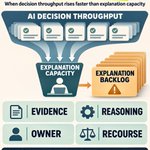
1/4 AI can reduce the work of making a decision while increasing the work of explaining it. A system can screen, rank, approve, route or recommend at machine speed. The people affected still need a clear answer.
1
1
69
1/4 AI can detect every deviation in a workflow. That does not make every deviation a defect. As more work becomes observable, standardization becomes tempting. But operational variance can carry four very different meanings.
1
1
61
3/4 The risk: automation can turn useful local judgment into noncompliance before anyone asks why it emerged. A workflow may become more consistent while becoming less capable of handling reality.
1
19
4/4 The leadership decision is not whether to reduce variance. It is which variance destroys reliability, and which contains information. Where is the harder judgment: distinguishing noise from adaptation, or adaptation from advantage?
1
14