

Chief Strategy Officer @ADI_Foundation | Writing Enterprise Onchain. Previous: EF, Founder (2 exits, 1 flop).
Joined April 2021
- Tweets2.6K
- Following1.5K
- Followers10.1K
- Likes7.1K






In March I said Tether isn’t a stablecoin company anymore.
Since then KPMG has signed off on the audit, rates have gone up, and Tether is still diversifying fast: more gold, Hadron, QVAC etc
It’s not hedging out of fear. It’s using a fat float to build a bigger business.

Tether just released its quarterly USDT attestation for Q3 2026.
Tether had a great third quarter of 2026, with ~1.5B in net operating profit. Tether’s reserve buffer continued to strengthen, nearly doubling to $7.95 billion from $4.1 billion at the end of Q2, an increase of $3.8 billion.
USDT is today, without any doubt, the biggest financial inclusion success story in the history of humanity, with its user base reaching the new all-time-high of 700M+, across all emerging markets.
USDT has become a monetary social network, connecting people, families, communities and entire countries at the speed of light.
Highlights as of 30 September 2026:
~1.5B in net operating profits for Q3 2026.
~183.5B total issued USDT, end of Q3 2026.
~7.95B excess reserves, on top of the 100% reserves in liquid assets that back all issued tokens, end of Q3 2026.
Generating $1.5 billion in net operating profit while maintaining nearly $8.0 billion in excess reserves gives us a strong foundation for that work.
We are building Tether for the long term, with the liquidity to meet redemptions of any size and the financial strength to support infrastructure people can rely on amidst the chaotic geopolitical environment we live in. @tether

2
461


James S retweeted

Boarding pass issued for @Snapcrackle. See you at the gate.

ALT An Aero boarding pass issued to James S (@Snapcrackle, verified), seat 15184, from Anywhere, Oct 2026.
Most people’s mental model of Polygon is still 2021: the cheap Ethereum sidechain where Aave deployed and Reddit and Starbucks ran their NFT experiments.
Given all the things going on, I went looking into it and that company has mostly gone.
The zkEVM stopped producing blocks on 3 July. The $1bn ZK bet built something technically serious that customers didn’t choose.
In its place, Polygon Labs paid more than $250m for Coinme (regulated US on- and off-ramps) and Sequence (wallets), hired Stripe’s former crypto lead as its first CPO, and now describes itself as a payments company. Its own About page says that after nine years, the bottleneck turned out to be wallets, compliance and ramps.
It also leaves POL with a problem.
There are now three separate money flows:
Apps like Polymarket pay gas to the chain. Base fees feed the POL burn (100m POL burned on 23 September, roughly half a year of new issuance)
Polygon Labs earns revenue from ramps, wallets and routing. None of it automatically reaches POL
PIP-87, still a draft, would sell payment companies blockspace at a fixed dollar price and use that revenue to buy POL for stakers and the burn
Last week’s TRON deal shows the tension. The main flow it describes takes USDT from a bank to a TRON wallet and back out through Coinme, without touching Polygon Chain. Good for Polygon Labs, less so for POL.
Polymarket is the other dependency: 38.7% of Polygon transactions and 62.2% of its gas in the 30 days to 9 August, according to Bitquery. My bet is that share falls over the next year.
My call: by this time next year, Polygon looks even more like a payments company with a blockchain underneath it.
Full piece: enterpriseonchain.com/p/poly…

Stablecoins in countries where the currency is debased is survivial mode.
I sat down with @Snapcrackle from @ADIFoundation and asked about where enterprise blockchain goes next.
> As AI agents start executing transactions for enterprises, what infrastructure sets their identity, authority and spending limits?
> In corridors like Nigeria, FX conversion plus cross-border fees can eat a real share of every transfer. What brings stablecoin settlement close to the actual cost of moving money?
Full Q&A👇
Pilot to Singapore announced he was South African - is this a new trend or they’ve always said it out loud?
2
4
490

Finally got my X account back (was hacked, even with 2FA).
Left the Ethereum Foundation after nearly five years.
Moved to Abu Dhabi as Chief Strategy Officer at ADI Foundation. Focus is on stablecoins, RWAs, and digital ID across the Middle East, Africa, and Asia.
Back to writing Enterprise Onchain and new article drops on Sunday.
James S retweeted

This is an incredible chart. This is the changing face of crypto.

From August 2021 through 2023, blockchains captured 90%+ of monthly crypto revenue.
By mid-2026, that share dropped to 25%.
The new breakdown:
🔸 Finance apps: exceeded 50% in most months
🔸 Consumer apps: steady meaningful share
🔸 Blockchains: down to ~25%
🔸 Physical and crypto infrastructure: rounding errors
The economic center of crypto moved from the base layer to the apps running on it.
Early cycles were infrastructure-focused because infrastructure was the only place value could accrue.
Users paid L1 gas fees because there was nowhere else for the money to go. Ethereum's high fees, Solana's spikes, Bitcoin's security budget drove revenue.
As blockchains became cheaper, more scalable, and more reliable, apps could finally support real users and capture their own revenue streams.
Finance apps (perp DEXs, lending protocols, stablecoin issuers, trading tools) earn fees from trading volume, not just gas.
Consumer apps (memecoin launchpads, wallets, social tools) turn engagement into sustained revenue as they find market fit.
The internet followed the same arc.
In the 1990s, ISPs and backbone providers made the money. By the 2010s, applications and platforms captured most of the value.
Crypto is following that path, faster and with full transparency because everything settles onchain.
You can't value L1s solely on the claim that they capture all fees anymore.
App-layer protocols have proven that lean teams can generate hundreds of millions in revenue across:
🔸 @HyperliquidX -style derivatives platforms
🔸 @Pumpfun -style consumer platforms
🔸 The wider DeFi stack
These products now capture economic surplus that once flowed almost entirely to validators and miners.
That diversification is healthy. Crypto no longer depends on one revenue source or one narrative.
The infra succeeded, which is why its revenue share fell. Finance and consumer apps now generate the majority.
That's where the next decade of value compounds.
h/t: @Blockworks

Ethereum whole energy footprint is less than famous landmarks such as the British Museum.
The result is 'Ethereum after the Merge – A Change in Power', out today from the Cambridge Centre for Alternative Finance, Cambridge Judge Business School at Cambridge Judge Business School – direct wall-plug measurements across 20 client configurations and two hardware profiles, and a far sharper picture of the network itself.
📊 Read the full report: lnkd.in/ejWZuUtJ

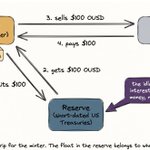
I followed $100 through OUSD. (the new stablecoin on the block.)
TLDR: The coin won't circulate, because every one of its 140 backers is paid to stop it moving off their platform.
Read the full article here:
news.enterpriseonchain.com/p…

James S retweeted

This week, @OpenStandard launched as a consortium of 140+ companies across 25+ countries.
Months ago, @Snapcrackle already called it. The consortium model wins against single issuers due to no single points of failure.
🎥 @Snapcrackle from @EnterOnchain explains at Bluechip25.

The stablecoin race doesn't depend on better technology. It depends on better "compliance liability architecture."
Who can comply with multiple regulators at once, especially when they disagree with each other?
🎥 @Snapcrackle from @EnterOnchain explains at Bluechip25.


James S retweeted

🧵 Ethereum is preparing its biggest upgrade since The Merge.
It’s called Glamsterdam.
And it changes three things that affect anyone using Ethereum, even if they don’t notice. A thread with examples:
(1/5)

James S retweeted

Announcing Ethlabs: a non-profit R&D lab for Ethereum and ETH
Our mission is to make Ethereum the settlement layer of the global economy.
The internet became global because shared protocols created a common language between networks. Private systems remained useful, but bounded. Finance is approaching a similar moment. As value, assets, and markets become digital, the world needs shared settlement infrastructure.
Ethereum is uniquely positioned to become that shared base layer, the neutral foundation on which users, institutions, and agents can transact without intermediation.
What we believe:
• We believe credible neutrality matters. Ten years of uptime and the lowest counterparty risk. Ground that cannot be pulled away by any one country, institution, company, or person.
• We believe ETH matters. The most valuable, programmable store of value. A decade of broad distribution, deep liquidity in onchain markets, and maximally trustless asset on Ethereum.
• We believe DeFi matters. Markets, liquidity, credit, exchange, and coordination, open to anyone.
• We believe adoption matters. Principles do not change the world until people benefit from them.
We sit between two worlds: real usage from the builders at the frontier, and the protocol that has to support it. We work with users, applications, wallets, L2s, infrastructure teams, institutions, ETH holders, core devs and researchers, then turn what they actually need into protocol work, shared standards, infrastructure, and shipped products.
Ethlabs is independent but Ethereum is a shared project. We are one node in a much larger network of stewards. This is the multi-node future.
We have spent the better part of the past decade contributing to Ethereum core research and development.
We are opinionated and transparent. We move with urgency, learn in public, and course-correct when we’re wrong.
We are building a lean, talent-dense team for people who want to do the most important work of their careers: [email protected]
James S retweeted

No win for the Netherlands unfortunately but cool to see @ADIChain_ 's prediction market active at the world cup!
Ethereum Everywhere

getting on a plane to eat an enormous amount of bagels. while i'm there: ethconf. who's around?
1
9
1,048
James S retweeted

1/ The EF App Relations team is putting out an open RFP for a neutral DeFi risk intelligence aggregator.
Public good, open source, no composite scoring. If you're the team to build this, applications close June 15.
Apply here: esp.ethereum.foundation/appl…
Here's how we got here 👇