
The official account of Stanford Medicine
Stanford, CA
Joined July 2009
- Tweets22.9K
- Following265
- Followers373K
- Likes1.2K




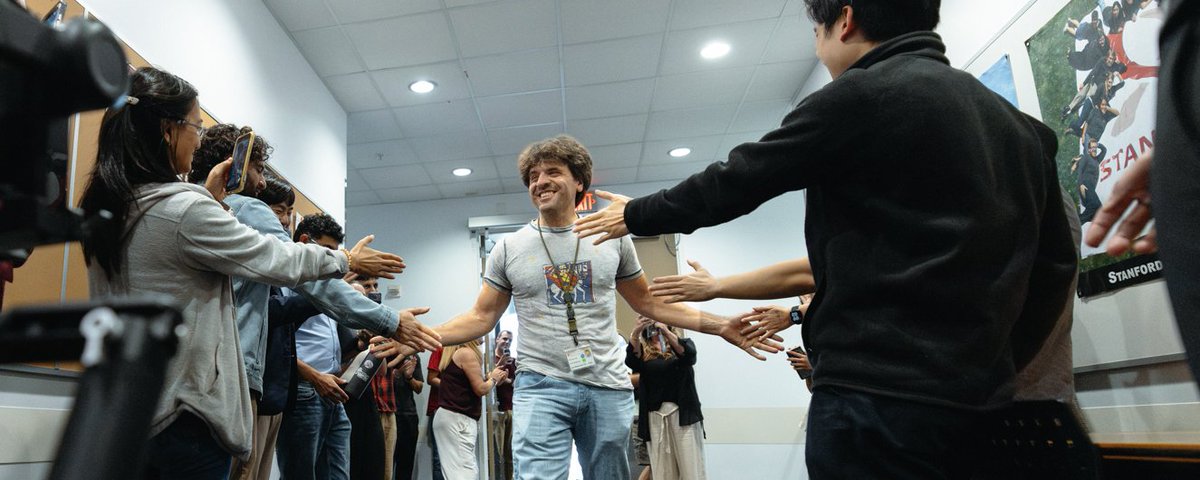
This Thanksgiving, we’re grateful for every member of our Stanford Medicine community and the dedication, curiosity and compassion that bring us together. 🍂

ALT Happy Thanksgiving from Stanford Medicine

Do retinoids really work? On Health Compass, Stanford Medicine dermatologist Zakia Rahman, MD, joins host Maya Adam, MD, to explore the science behind skincare, from sunscreen and retinoids to red light therapy. youtu.be/bKEzbzMhG-k
E-bike and e-scooter injuries are rising nationwide. A Stanford Medicine-led study found more hospitalizations and roughly twice the rate of traumatic brain injuries. In the latest 90 Seconds, learn what's at stake and how riders can stay safe. youtube.com/watch?v=ztKniwWF…


Meet A.J. Phillips, Ibukun Ajifolokun, Colette Benko and Ziv Lautman, the four PhD candidates who led the pack in the Three Minute Thesis competition by bringing their human health research to life.
stanmed.stanford.edu/three-m…

A new Stanford Medicine-led study challenges decades of thinking about concussions, finding that straight-line head motion may be more predictive of brain injury than rotational motion.
med.stanford.edu/news/all-ne…

Game changers: The innovations that keep college and professional athletes in top form are benefiting the rest of us.
stanmed.stanford.edu/innovat…

What habits can help us live healthier, longer lives?
Stanford Medicine's Michael Fredericson, MD, professor of orthopaedic surgery, joins host Maya Adam, MD, to share how exercise, nutrition, sleep and recovery support healthy aging. Watch the latest Health Compass episode: med.stanford.edu/health-comp…

A Stanford Medicine-led study identified three distinct brain activity patterns, or biotypes, in children with ADHD, anxiety or both. The findings could help improve early diagnosis and guide more personalized treatments. med.stanford.edu/news/all-ne…

What do the trillions of microbes living in your gut have to do with your health? And do popular gut health trends actually work? In this Health Compass podcast, Stanford Medicine microbiologist Justin Sonnenburg, PhD, discusses how the gut microbiome influences our health, why fiber matters and what the science really says about probiotics, prebiotics, fermented foods and microbiome testing. med.stanford.edu/health-comp…

Walk with Me: What inspired Karen Adams to start a menopause clinic? And what’s her favorite hot flash anthem? Meet the director of the Stanford Program in Menopause & Healthy Aging. bit.ly/4Atn7rw
A recent clinical trial raised questions about the effectiveness of colonoscopies. Stanford Medicine experts explain why colonoscopies remain important for colorectal cancer screening and prevention.
stan.md/4yOlyUl
Stanford Medicine orthopaedic surgeon and U.S. Army veteran Constance Chu, MD, uses advanced imaging technologies to detect early signs of joint disease and improve patient care, including for fellow veterans. Learn how her military experience continues to shape her clinical practice and research.
med.stanford.edu/news/insigh…

How does CAR-T cell therapy work? This animated explainer breaks down how this innovative cancer treatment uses a patient's own immune cells, reprogramming them to recognize and attack cancer cells. youtube.com/watch?v=v5FvGzdR…
Stanford Medicine researchers and their colleagues are studying whether patterns of brain activity could help identify people at risk of developing Alzheimer’s disease, potentially allowing for earlier interventions.
stan.md/4A7vzfK

How does the body change during perimenopause and menopause? In this episode of Stanford Medicine’s Health Compass podcast, gynecologist Karen Adams, MD, explains what happens during this transition, explores treatment options and shares how women can thrive through midlife and beyond. med.stanford.edu/health-comp…

At a Stanford University symposium, leaders from Stanford Medicine and Stanford Law School explored how artificial intelligence is transforming medicine and law, including its impact on education, public trust and access to care and justice. stan.md/4jSo2N3
@StanfordLaw

ALT George Triantis and Lloyd Minor speak at the symposium.

ALT Russ Altman, Stanford University; Megan Ma, Stanford Law School; Kent Walker, Google and Alphabet; and John Whyte, American Medical Association, at a Stanford University symposium on artificial intelligence in law and medicine.
“We’re setting ourselves on a new trajectory based on our incredible foundation,” said Mary Hawn, MD, the chair of the department and the Emile Holman Professor in Surgery. “The resources we have at Stanford, in terms of being on a major research university campus, accelerate our discoveries, and it’s making a difference for our patients every day.” stan.md/4j04DIY
@StanfordSurgery @maryhawn

ALT 100 years of surgery at Stanford Medicine

ALT 100 years of surgery at Stanford Medicine

ALT 100 years of surgery at Stanford Medicine