

Founder of https://teapawt.org/t.co/5U1TqGoScI - AI for football staffs Former P4 Assist State Champ 5x Head Coach | ✝️
Joined June 2009
- Tweets7.4K
- Following4K
- Followers30.2K
- Likes5K




Pinned Tweet
UPDATE on how football staffs are using AI now.
Book a zoom to learn more at rooski.com/update
We have spent this season implementing AI with programs from P4 to high school. We know what's going on around the country and how staffs should be approaching AI. Learn more👇
You can change lives with football.
AND you better be winning ball games.

20 years of coaching football taught me this:
Nothing else matters if you don't win.
If you don't win, you don't keep your job.
If you don't keep your job, you can't use this game for good.
I don't care what admin says during the hiring process.
They can talk about character and sportsmanship and all the cliche things.
But if you don't win they will get tired of dealing with the noise from the outside and they will get rid of you.
And there is one thing you must do above all else if you want to win...
UPDATE on how football staffs are using AI now.
Book a zoom to learn more at rooski.com/update
We have spent this season implementing AI with programs from P4 to high school. We know what's going on around the country and how staffs should be approaching AI. Learn more👇
I just turned 40.
One of the biggest lessons I learned in 20 years of coaching:
I cared too much about changing lives.
I know how that sounds. I'll explain:
I still believe in using football for good. The game can help young men grow in life, and winning isn't necessarily what causes that.
What I'm really saying is I didn't put enough emphasis on winning.
I learned the hard way that if you don't win, you won't be doing this very long. And you won't get to have the impact you wanted to have.
Any administration can say winning doesn't matter. But what matters to decision-makers is the bottom line, and the bottom line is often money but also headaches. At some levels, football and the money it brings in help keep the whole institution going.
Where money isn't as big a deal, it comes down to headaches. Most administrators just want to deal with less of them, and losing ball games is one of the fastest ways to hand them more. Parents complain when you're winning too. But more of them are upset, and they complain more, when you're losing.
So it isn't either/or. It's a both/and. You want to change lives, and you have to do it while winning games. Winning keeps the job and it lifts the spirit of a whole community.
A lot of coaches are finishing their seasons right now. You're thinking about how this one went and what next year looks like. Some of you are deciding whether to stay, take another job or get out.
If you're staying in the game, this is what I had to accept before I could decide anything about next year:
The number one lesson in winning is talent.
Talent sets the ceiling.
Coaching, culture, the weight room, scheme, etc all decides how close you get to it.
I'm not saying those other things don't matter. You can be the best motivator in the world or the best play caller around, but you have to have a certain level of talent to work with. Below that level, everything else is close to a zero factor, and anything multiplied by zero is zero.
When I was a young high school head coach, I accepted whoever came out and tried to do the best we could with those guys. I didn't think enough about the kids walking our hallways who weren't playing. I didn't think enough about our youth and feeder programs, or about promoting our program within the rules.
In college, it means recruiting, and it means hiring your staff. In high school it's really no different. It's just a matter of who you're allowed to recruit and what resources you have for a staff.
So the way you raise the ceiling is people, both the players and the coaches you bring in.
And you bring in people by inspiring them to believe in a vision. It's about getting the right people to join the cause, buy in and work hard.
If you have to win to change lives, and you need the right people to win, then inspiring people to believe in your vision is one of the most important skills you can have as a coach.
I learned how much this matters by studying John Boyd. He wrote that:
"What is needed is a vision rooted in human nature so noble, so attractive that it not only attracts the uncommitted and magnifies the spirit and strength of its adherents, but also undermines the dedication and determination of any competitors or adversaries."
A vision starts with clarity. It's seeing far enough into the future to make a plan and go after it. A lot of coaches never step back and figure out where they want to go themselves, let alone where they want to take dozens of young men.
It has to be big enough that a player or a coach sees himself in it and wants to invest his life in it. That's what makes people willing to work hard and suffer to make it real.
Then you have to get others to believe it. You don't do that like a car salesman. You do it with enthusiasm. People can feel your enthusiasm, and it sparks them to go after something.
And you're never done selling it. You sell it to the decision-makers who hire you, to the kids in your hallway, to the recruits, to the coaches you want on your staff and to the community that backs you.
What's one thing you're doing this off-season to get more of the right players and coaches into your program?
UPDATE on how football staffs are using AI now.
Book a zoom to learn more at rooski.com/update
We have spent this season implementing AI with programs from P4 to high school. We know what's going on around the country and how staffs should be approaching AI. Learn more👇
Jake Dickert...

Jake Dickert is 17-5 at Wake Forest.
Wake was 4-8 the year before he got there.
In 2007, the former Division III quarterback had a math teaching job lined up.
Today, Wake is 8-1 and No. 13 in the CFP rankings. Thursday, it extended his contract.
He grew up in Wisconsin, the son of a school administrator, and the family moved every few years as his father, Jeff, worked his way up. He played quarterback in Oconto and then in Kohler his senior year. At Wisconsin-Stevens Point, a Division III school, he lost the starting job to Brett Borchart. He visited another school and thought about transferring. He stayed. When Borchart had to learn to hold for kicks, Dickert showed him how. "Our coaches didn't teach me how to do it," Borchart said. "Jake did." Dickert moved to receiver and made all-conference as a senior.
He finished with a degree in math education and a teaching job waiting. His father had never tried college coaching, and he called it his one regret. "If that's what you want to do, you gotta do it now," Jeff told him. Once the paycheck, the house and the family came, Jeff said, there was no going back to a grad assistant's $5,000 a year. So Jake walked into head coach John Miech's office and asked for a graduate assistant job. His brother Jesse was still the team's center, and Miech wanted the brothers apart. Dickert remembers Miech's words: "If you're going to get into this coaching deal, I want you to be on the other side of the ball." He figured it was temporary. "The thought was I'd always get back to coaching offense," he said.
He never did. He went to North Dakota State as a GA under Craig Bohl, then South Dakota, Southeast Missouri, Augustana, Minnesota State, South Dakota State and Wyoming. He painted lines on fields. By his count, it was 11 moves in 17 years, a lot to ask of his wife, Candice, and their three kids.
Side note: Dickert started out cutting VHS tapes by hand. Staffs today are handing more and more of that grunt work to AI. I just put out a short video on how football staffs are using it right now. Learn more at rooski.com
In 2014, his first year running Minnesota State's defense, the Mavericks went 14-1, gave up 12.9 points a game and played for the Division II national title, and lost it 13-0. Jason Eck coached that offense. He had found Dickert by the Augustana bus after a game in 2013. "I thought he did a good job against us," Eck said. When Minnesota State's top three candidates turned the job down, Eck asked about "that guy at Augustana." After the title game, Eck took the loss himself. "He held them to 13," he said. "I got nothing for us."
In 2017, Bohl brought him to Wyoming to coach safeties and made him defensive coordinator two years later. The Cowboys went 8-5, gave up 17.8 points a game and won the Arizona Bowl. "Wickedly smart," Bohl said of him. Dickert calls Bohl his greatest mentor.
Washington State hired him as its defensive coordinator in 2020. On Oct. 18, 2021, in the middle of the season, the school fired head coach Nick Rolovich and four assistants for not complying with the state's vaccine mandate. Dickert got the team. He talked about the players first. "They built this opportunity of what we can still accomplish this season," he said. "I love Pullman. It fits me. It fits our family." He went 3-2 the rest of the regular season, and on Nov. 27 the interim tag came off.
It wasn't a straight line from there. WSU went 7-6 in 2022. In 2023 it started 4-0, then lost six in a row and finished 5-7. Instead of hitting the road to recruit, Dickert kept his staff in the office for seven straight days to watch the season's film. "This is going to be more important than going out and recruiting who's next, because we need these answers," he said. He wanted every coach's opinion. "It led to tons of hard conversations, things that needed to be said."
He shows freshmen the first college reps of players who went on to make it, including Abe Lucas, an offensive lineman, getting thrown on his first one. The world works in a microwave, he tells them, and "football players go in slow cookers."
WSU went 8-4 in 2024, its first season after the Pac-12 broke apart. In December, 23-20 in Pullman, he left for Wake Forest before the bowl game.
The year before, Wake had given up 32.5 points a game. Dave Clawson, who built the program, spent four hours on the phone with him about the job. "Coach to coach, there's something where you feel like you're not getting sold a bag of goods," Dickert said. His first team went 9-4, gave up more than 10 fewer points a game and beat Mississippi State 43-29 in the Mayo Bowl.
He doesn't win at Wake by outspending people. Asked where Wake's roster spending ranks in the ACC, he said, "Lower third." So he sells a plan. Recruits get shown how they'll develop, year by year. "Everyone just says, 'Hey come in and play.' We have a vision and a plan," Dickert said. He and general manager Rob Schlaeger mapped a five-hour radius around Winston-Salem to recruit from. "We trust our development," he said.
He changed how he runs camp, too. At WSU he went too hard too early. This August he gave the players a day off after the first contact day. "Our guys can handle hard coaching," he said. "But they can't handle unclear coaching."
This year Wake is 8-1 and 5-1 in the ACC. Its offense, run by coordinator Rob Ezell and co-coordinator Dan Enos, is fourth in the country in scoring at 43.3 points a game. The defense gives up 15.9, 12th in the country. "We didn't come here to leave," Dickert said this week. On Thursday, Wake gave him a long-term extension. On Friday, Ezell got one too.
Today at noon, Wake plays at SMU. Nineteen years and 11 moves after he passed on a math teaching job, he's coaching a top-15 team on a new contract.

Kirk Herbstreit asked Jake Dickert what he would do different with college football on College Gameday:
"I just think the purity of the game, we've got to make sure we're fighting to preserve that each and every day.
Like the dropping of the conference championship games... what's the next phase of it? We've got to be able to adapt and adjust. We've got to take the players and their self-interest, and what they want to do ultimately to be a better person and player.
At the end of the day, we've got to all come together to do what's best for the sport.
And I think we need more coaches on panels and committees, making sure we're preserving what really makes this sport the best sport on the planet."
Jake Dickert is 17-5 at Wake Forest.
Wake was 4-8 the year before he got there.
In 2007, the former Division III quarterback had a math teaching job lined up.
Today, Wake is 8-1 and No. 13 in the CFP rankings. Thursday, it extended his contract.
He grew up in Wisconsin, the son of a school administrator, and the family moved every few years as his father, Jeff, worked his way up. He played quarterback in Oconto and then in Kohler his senior year. At Wisconsin-Stevens Point, a Division III school, he lost the starting job to Brett Borchart. He visited another school and thought about transferring. He stayed. When Borchart had to learn to hold for kicks, Dickert showed him how. "Our coaches didn't teach me how to do it," Borchart said. "Jake did." Dickert moved to receiver and made all-conference as a senior.
He finished with a degree in math education and a teaching job waiting. His father had never tried college coaching, and he called it his one regret. "If that's what you want to do, you gotta do it now," Jeff told him. Once the paycheck, the house and the family came, Jeff said, there was no going back to a grad assistant's $5,000 a year. So Jake walked into head coach John Miech's office and asked for a graduate assistant job. His brother Jesse was still the team's center, and Miech wanted the brothers apart. Dickert remembers Miech's words: "If you're going to get into this coaching deal, I want you to be on the other side of the ball." He figured it was temporary. "The thought was I'd always get back to coaching offense," he said.
He never did. He went to North Dakota State as a GA under Craig Bohl, then South Dakota, Southeast Missouri, Augustana, Minnesota State, South Dakota State and Wyoming. He painted lines on fields. By his count, it was 11 moves in 17 years, a lot to ask of his wife, Candice, and their three kids.
Side note: Dickert started out cutting VHS tapes by hand. Staffs today are handing more and more of that grunt work to AI. I just put out a short video on how football staffs are using it right now. Learn more at rooski.com
In 2014, his first year running Minnesota State's defense, the Mavericks went 14-1, gave up 12.9 points a game and played for the Division II national title, and lost it 13-0. Jason Eck coached that offense. He had found Dickert by the Augustana bus after a game in 2013. "I thought he did a good job against us," Eck said. When Minnesota State's top three candidates turned the job down, Eck asked about "that guy at Augustana." After the title game, Eck took the loss himself. "He held them to 13," he said. "I got nothing for us."
In 2017, Bohl brought him to Wyoming to coach safeties and made him defensive coordinator two years later. The Cowboys went 8-5, gave up 17.8 points a game and won the Arizona Bowl. "Wickedly smart," Bohl said of him. Dickert calls Bohl his greatest mentor.
Washington State hired him as its defensive coordinator in 2020. On Oct. 18, 2021, in the middle of the season, the school fired head coach Nick Rolovich and four assistants for not complying with the state's vaccine mandate. Dickert got the team. He talked about the players first. "They built this opportunity of what we can still accomplish this season," he said. "I love Pullman. It fits me. It fits our family." He went 3-2 the rest of the regular season, and on Nov. 27 the interim tag came off.
It wasn't a straight line from there. WSU went 7-6 in 2022. In 2023 it started 4-0, then lost six in a row and finished 5-7. Instead of hitting the road to recruit, Dickert kept his staff in the office for seven straight days to watch the season's film. "This is going to be more important than going out and recruiting who's next, because we need these answers," he said. He wanted every coach's opinion. "It led to tons of hard conversations, things that needed to be said."
He shows freshmen the first college reps of players who went on to make it, including Abe Lucas, an offensive lineman, getting thrown on his first one. The world works in a microwave, he tells them, and "football players go in slow cookers."
WSU went 8-4 in 2024, its first season after the Pac-12 broke apart. In December, 23-20 in Pullman, he left for Wake Forest before the bowl game.
The year before, Wake had given up 32.5 points a game. Dave Clawson, who built the program, spent four hours on the phone with him about the job. "Coach to coach, there's something where you feel like you're not getting sold a bag of goods," Dickert said. His first team went 9-4, gave up more than 10 fewer points a game and beat Mississippi State 43-29 in the Mayo Bowl.
He doesn't win at Wake by outspending people. Asked where Wake's roster spending ranks in the ACC, he said, "Lower third." So he sells a plan. Recruits get shown how they'll develop, year by year. "Everyone just says, 'Hey come in and play.' We have a vision and a plan," Dickert said. He and general manager Rob Schlaeger mapped a five-hour radius around Winston-Salem to recruit from. "We trust our development," he said.
He changed how he runs camp, too. At WSU he went too hard too early. This August he gave the players a day off after the first contact day. "Our guys can handle hard coaching," he said. "But they can't handle unclear coaching."
This year Wake is 8-1 and 5-1 in the ACC. Its offense, run by coordinator Rob Ezell and co-coordinator Dan Enos, is fourth in the country in scoring at 43.3 points a game. The defense gives up 15.9, 12th in the country. "We didn't come here to leave," Dickert said this week. On Thursday, Wake gave him a long-term extension. On Friday, Ezell got one too.
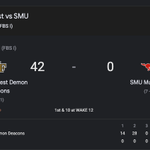
Today at noon, Wake plays at SMU. Nineteen years and 11 moves after he passed on a math teaching job, he's coaching a top-15 team on a new contract.
Jack Dickert said the only reason he played D3 was because they didn't have D4.
And he was so good at quarterback they moved him to wide receiver.
🤣
From College Gameday.
Jake Dickert is 17-5 at Wake Forest.
Wake was 4-8 the year before he got there.
In 2007, the former Division III quarterback had a math teaching job lined up.
Today, Wake is 8-1 and No. 13 in the CFP rankings. Thursday, it extended his contract.
He grew up in Wisconsin, the son of a school administrator, and the family moved every few years as his father, Jeff, worked his way up. He played quarterback in Oconto and then in Kohler his senior year. At Wisconsin-Stevens Point, a Division III school, he lost the starting job to Brett Borchart. He visited another school and thought about transferring. He stayed. When Borchart had to learn to hold for kicks, Dickert showed him how. "Our coaches didn't teach me how to do it," Borchart said. "Jake did." Dickert moved to receiver and made all-conference as a senior.
He finished with a degree in math education and a teaching job waiting. His father had never tried college coaching, and he called it his one regret. "If that's what you want to do, you gotta do it now," Jeff told him. Once the paycheck, the house and the family came, Jeff said, there was no going back to a grad assistant's $5,000 a year. So Jake walked into head coach John Miech's office and asked for a graduate assistant job. His brother Jesse was still the team's center, and Miech wanted the brothers apart. Dickert remembers Miech's words: "If you're going to get into this coaching deal, I want you to be on the other side of the ball." He figured it was temporary. "The thought was I'd always get back to coaching offense," he said.
He never did. He went to North Dakota State as a GA under Craig Bohl, then South Dakota, Southeast Missouri, Augustana, Minnesota State, South Dakota State and Wyoming. He painted lines on fields. By his count, it was 11 moves in 17 years, a lot to ask of his wife, Candice, and their three kids.
Side note: Dickert started out cutting VHS tapes by hand. Staffs today are handing more and more of that grunt work to AI. I just put out a short video on how football staffs are using it right now. Learn more at rooski.com
In 2014, his first year running Minnesota State's defense, the Mavericks went 14-1, gave up 12.9 points a game and played for the Division II national title, and lost it 13-0. Jason Eck coached that offense. He had found Dickert by the Augustana bus after a game in 2013. "I thought he did a good job against us," Eck said. When Minnesota State's top three candidates turned the job down, Eck asked about "that guy at Augustana." After the title game, Eck took the loss himself. "He held them to 13," he said. "I got nothing for us."
In 2017, Bohl brought him to Wyoming to coach safeties and made him defensive coordinator two years later. The Cowboys went 8-5, gave up 17.8 points a game and won the Arizona Bowl. "Wickedly smart," Bohl said of him. Dickert calls Bohl his greatest mentor.
Washington State hired him as its defensive coordinator in 2020. On Oct. 18, 2021, in the middle of the season, the school fired head coach Nick Rolovich and four assistants for not complying with the state's vaccine mandate. Dickert got the team. He talked about the players first. "They built this opportunity of what we can still accomplish this season," he said. "I love Pullman. It fits me. It fits our family." He went 3-2 the rest of the regular season, and on Nov. 27 the interim tag came off.
It wasn't a straight line from there. WSU went 7-6 in 2022. In 2023 it started 4-0, then lost six in a row and finished 5-7. Instead of hitting the road to recruit, Dickert kept his staff in the office for seven straight days to watch the season's film. "This is going to be more important than going out and recruiting who's next, because we need these answers," he said. He wanted every coach's opinion. "It led to tons of hard conversations, things that needed to be said."
He shows freshmen the first college reps of players who went on to make it, including Abe Lucas, an offensive lineman, getting thrown on his first one. The world works in a microwave, he tells them, and "football players go in slow cookers."
WSU went 8-4 in 2024, its first season after the Pac-12 broke apart. In December, 23-20 in Pullman, he left for Wake Forest before the bowl game.
The year before, Wake had given up 32.5 points a game. Dave Clawson, who built the program, spent four hours on the phone with him about the job. "Coach to coach, there's something where you feel like you're not getting sold a bag of goods," Dickert said. His first team went 9-4, gave up more than 10 fewer points a game and beat Mississippi State 43-29 in the Mayo Bowl.
He doesn't win at Wake by outspending people. Asked where Wake's roster spending ranks in the ACC, he said, "Lower third." So he sells a plan. Recruits get shown how they'll develop, year by year. "Everyone just says, 'Hey come in and play.' We have a vision and a plan," Dickert said. He and general manager Rob Schlaeger mapped a five-hour radius around Winston-Salem to recruit from. "We trust our development," he said.
He changed how he runs camp, too. At WSU he went too hard too early. This August he gave the players a day off after the first contact day. "Our guys can handle hard coaching," he said. "But they can't handle unclear coaching."
This year Wake is 8-1 and 5-1 in the ACC. Its offense, run by coordinator Rob Ezell and co-coordinator Dan Enos, is fourth in the country in scoring at 43.3 points a game. The defense gives up 15.9, 12th in the country. "We didn't come here to leave," Dickert said this week. On Thursday, Wake gave him a long-term extension. On Friday, Ezell got one too.
Today at noon, Wake plays at SMU. Nineteen years and 11 moves after he passed on a math teaching job, he's coaching a top-15 team on a new contract.
Jake Dickert says this Wake Forest football team was "built in the dark".
And "If you don't have that toughness to show up every day and do what's required, you're just not going to make it at Wake Forest."
The full clip:
"Our biggest messaging is built in the dark. We define it as a style of play that nobody wants to face and a process a few can handle.
I love studying greatness. So I studied Mike Macdonald and what he did with the Seattle Seahawks. Everything he talked about was style of play and creating clarity for your whole organization, from your front office to your coaches to your support staff. Most importantly, defining it for the players. This is how we're going to win. This is what it looks like. This is your role. So our guys know exactly their piece of that puzzle.
The bottom line is the back half. Not everyone can do the process the way we want to do it. If you're just built on the prize and you don't understand the discipline towards the process... this is the greatest developmental game in the world.
And 18 to 23 years old is the greatest developmental time.
If you don't have that toughness to show up every day and do what's required, you're just not going to make it at Wake Forest.
I think we know who we are better than most teams in the country."
— Jake Dickert on College GameDay
Jake Dickert is 17-5 at Wake Forest.
Wake was 4-8 the year before he got there.
In 2007, the former Division III quarterback had a math teaching job lined up.
Today, Wake is 8-1 and No. 13 in the CFP rankings. Thursday, it extended his contract.
He grew up in Wisconsin, the son of a school administrator, and the family moved every few years as his father, Jeff, worked his way up. He played quarterback in Oconto and then in Kohler his senior year. At Wisconsin-Stevens Point, a Division III school, he lost the starting job to Brett Borchart. He visited another school and thought about transferring. He stayed. When Borchart had to learn to hold for kicks, Dickert showed him how. "Our coaches didn't teach me how to do it," Borchart said. "Jake did." Dickert moved to receiver and made all-conference as a senior.
He finished with a degree in math education and a teaching job waiting. His father had never tried college coaching, and he called it his one regret. "If that's what you want to do, you gotta do it now," Jeff told him. Once the paycheck, the house and the family came, Jeff said, there was no going back to a grad assistant's $5,000 a year. So Jake walked into head coach John Miech's office and asked for a graduate assistant job. His brother Jesse was still the team's center, and Miech wanted the brothers apart. Dickert remembers Miech's words: "If you're going to get into this coaching deal, I want you to be on the other side of the ball." He figured it was temporary. "The thought was I'd always get back to coaching offense," he said.
He never did. He went to North Dakota State as a GA under Craig Bohl, then South Dakota, Southeast Missouri, Augustana, Minnesota State, South Dakota State and Wyoming. He painted lines on fields. By his count, it was 11 moves in 17 years, a lot to ask of his wife, Candice, and their three kids.
Side note: Dickert started out cutting VHS tapes by hand. Staffs today are handing more and more of that grunt work to AI. I just put out a short video on how football staffs are using it right now. Learn more at rooski.com
In 2014, his first year running Minnesota State's defense, the Mavericks went 14-1, gave up 12.9 points a game and played for the Division II national title, and lost it 13-0. Jason Eck coached that offense. He had found Dickert by the Augustana bus after a game in 2013. "I thought he did a good job against us," Eck said. When Minnesota State's top three candidates turned the job down, Eck asked about "that guy at Augustana." After the title game, Eck took the loss himself. "He held them to 13," he said. "I got nothing for us."
In 2017, Bohl brought him to Wyoming to coach safeties and made him defensive coordinator two years later. The Cowboys went 8-5, gave up 17.8 points a game and won the Arizona Bowl. "Wickedly smart," Bohl said of him. Dickert calls Bohl his greatest mentor.
Washington State hired him as its defensive coordinator in 2020. On Oct. 18, 2021, in the middle of the season, the school fired head coach Nick Rolovich and four assistants for not complying with the state's vaccine mandate. Dickert got the team. He talked about the players first. "They built this opportunity of what we can still accomplish this season," he said. "I love Pullman. It fits me. It fits our family." He went 3-2 the rest of the regular season, and on Nov. 27 the interim tag came off.
It wasn't a straight line from there. WSU went 7-6 in 2022. In 2023 it started 4-0, then lost six in a row and finished 5-7. Instead of hitting the road to recruit, Dickert kept his staff in the office for seven straight days to watch the season's film. "This is going to be more important than going out and recruiting who's next, because we need these answers," he said. He wanted every coach's opinion. "It led to tons of hard conversations, things that needed to be said."
He shows freshmen the first college reps of players who went on to make it, including Abe Lucas, an offensive lineman, getting thrown on his first one. The world works in a microwave, he tells them, and "football players go in slow cookers."
WSU went 8-4 in 2024, its first season after the Pac-12 broke apart. In December, 23-20 in Pullman, he left for Wake Forest before the bowl game.
The year before, Wake had given up 32.5 points a game. Dave Clawson, who built the program, spent four hours on the phone with him about the job. "Coach to coach, there's something where you feel like you're not getting sold a bag of goods," Dickert said. His first team went 9-4, gave up more than 10 fewer points a game and beat Mississippi State 43-29 in the Mayo Bowl.
He doesn't win at Wake by outspending people. Asked where Wake's roster spending ranks in the ACC, he said, "Lower third." So he sells a plan. Recruits get shown how they'll develop, year by year. "Everyone just says, 'Hey come in and play.' We have a vision and a plan," Dickert said. He and general manager Rob Schlaeger mapped a five-hour radius around Winston-Salem to recruit from. "We trust our development," he said.
He changed how he runs camp, too. At WSU he went too hard too early. This August he gave the players a day off after the first contact day. "Our guys can handle hard coaching," he said. "But they can't handle unclear coaching."
This year Wake is 8-1 and 5-1 in the ACC. Its offense, run by coordinator Rob Ezell and co-coordinator Dan Enos, is fourth in the country in scoring at 43.3 points a game. The defense gives up 15.9, 12th in the country. "We didn't come here to leave," Dickert said this week. On Thursday, Wake gave him a long-term extension. On Friday, Ezell got one too.
Today at noon, Wake plays at SMU. Nineteen years and 11 moves after he passed on a math teaching job, he's coaching a top-15 team on a new contract.
UPDATE on how football staffs are using AI now.
Book a zoom to learn more at rooski.com/update
We have spent this season implementing AI with programs from P4 to high school. We know what's going on around the country and how staffs should be approaching AI. Learn more👇
Here’s the full breakdown of what’s in the video:
This past summer we met with over 200 staffs, from the NFL to high school. Most of them are at their own 2-yard line with AI.
At the college level, most staffs have one or two guys starting to build something, but no real system. At the high school level, most coaches just don’t have the time to figure it out.
During the season we started working with some of those programs. For the ones we work with, the whole workday looks different than it did a year ago. And that’s what matters: the actual football work a staff does every day.
What we do at Rooski has four parts:
1) Foundation: In person or remote, we organize the building so everything talks to each other and everyone on staff can actually use AI.
2) Training: We train your people, split into power users and everybody else.
3) Connection: We connect your knowledge and your data (scouting, recruiting, load management, etc) through a custom Rooski plug-in that works with the best AI models out there and is built to understand football work.
4) Solutions: We hand you the work itself, starting with scouting reports and game plans, then building into recruiting, personnel and strength with you. For high school coaches, we even help with the teaching side.
That gets you from your own 2 to the red zone. The last 20 yards is your football: your words, your program, your philosophy. We do that part with you, and we teach your staff to build its own solutions.
We’re doing this right now for programs from P4 to high school.
And no, we’re not seeing anyone cut jobs. We haven’t talked to a single staff that’s hiring fewer people because of AI. The same staff is just getting more done. Staff of 60 or staff of 6.
But this won’t be optional for long. Right now there’s a window to get an edge. Soon it’s just the floor. And you can’t rely on one or two guys in the building to carry it. You need a real system that survives turnover, including the day your AI guy wants to go be a coach.
Budgets are different at every level, so we have options.
With seasons ending, we’re opening the calendar back up.
Book a Zoom and we’ll show you what this looks like and what we’re seeing across the country: rooski.com/update

4
610
"Do you have a spy that can get the guy's ass on the ground?"
Here's Nick Saban talking about spying the QB on College Gameday.
Chris Ash runs the #1 defense in college football.
In 1997, he slept in a football building because he had nowhere to live.
Saturday, he'll be on the sideline at Notre Dame Stadium, calling the defense against the No. 1 team in the country.
It has been a long road, and he took more than one step back along the way. Ash grew up in Ottumwa, Iowa, a town of about 25,000. He got up at 4 a.m. to deliver newspapers, and after school and on weekends he painted houses or worked in the cornfields. At Drake he played safety through knee injuries. "He was not the fastest or the most skilled player, but he was one of those guys you couldn't take off the field," said Rob Ash, his head coach there and no relation. "He was smart and ruthlessly competitive."
Drake kept him on as a graduate assistant in 1997, and the football building was the only place he had to stay. There was no TV. At night he read the coaching clinic manuals that lined the office walls, more than a thousand articles in about a month. Rob Ash noticed he was always there when he got in and always there when he left. "Coach, I'm sleeping here," Chris finally told him.
The next year he was Drake's defensive coordinator. After two seasons in that job, he became a graduate assistant again, at Iowa State. Dan McCarney kept him for seven years, made him the secondary coach and then the recruiting coordinator. "Chris was willing to do anything," McCarney said. "It didn't matter how little a task might be or how big the responsibility might be, he'd jump in there and take it and go with it."
From there he went to San Diego State, back to Iowa State, then to Wisconsin. The Badgers went to three straight Rose Bowls, the last two with him as co-defensive coordinator. He followed Bret Bielema to Arkansas in 2013. Then Urban Meyer called McCarney about him. "I don't need just a guy," Meyer told him, as McCarney tells it. "I don't need somebody solid. I don't need somebody good, Mac. I need somebody elite."
Ohio State made Ash its co-defensive coordinator, and that season the Buckeyes won the national title. Before the title game, Meyer found McCarney on the sideline. "You were right, Mac," he said. "He's done a hell of a job." Ohio State beat Oregon 42-20 and held the Ducks scoreless for the last 22 minutes.
A year later, Rutgers made him its head coach. He said the football facility felt like a prison the first time he walked in. He put $1.65 million into the weight room, added a nutrition program and brought more than 350 prospects to campus for three junior days before his first spring. If one player missed class, his whole unit spent Friday night in study hall from 10 to midnight. "We also grade players on everything—attitude, effort and even hydration," he wrote that summer. "Every coach you talk to says they want to build a tough, accountable and disciplined football team. But how many train to actually make it happen?"
It never showed up on the scoreboard. Rutgers went 2-10, 4-8 and 1-11. On Sept. 29, 2019, the day after a 52-0 loss to Michigan, Rutgers fired him four games into his fourth season. He was 45 and 8-32.
Tom Herman, who had worked with him at Iowa State and Ohio State, made him Texas' defensive coordinator for 2020. Then he went to the NFL. He coached safeties for Meyer in Jacksonville and defensive backs for two years with the Raiders. In 2024 he wasn't coaching at all. He was a pro scout in the Jaguars' personnel department. He was 50.
Then Marcus Freeman needed a defensive coordinator. Al Golden had left for the Cincinnati Bengals. Freeman hired Ash in February 2025. "If it's not broke, don't fix it," Ash said at his first press conference. "That was really the conversation that Coach Freeman and I had."
He didn't bring a single position coach with him. He kept the staff that was already there. "Show people you care about them, and they trust you, and you can explain the why of why you want to do something, and it makes sense to them," he said.
He was clear about whose defense it was, too. "This isn't my defense. This is the Notre Dame defense," he said that August. "It's not about a call, it's not about a scheme, it's about the mindset of the players, how fast and how violent they play, the fundamentals they play with."
It didn't start well. His first game was at Miami, and Notre Dame lost 27-24. Two weeks later, Texas A&M won 41-40 in South Bend. He had been out of college football for four years. "New players that I had not recruited or been around," he said later. "There was a big learning curve for me."
Notre Dame didn't lose again that season. The Irish won their last 10 games and finished 10-2.
He calls the defense from the sideline now, and he traces that back to Rutgers. "Where it changed for me is after I was a head coach at Rutgers on the sideline, and I became a lot more comfortable being down amongst the players and in the action," he said this September. "I could see the game better. I could talk to the players."
This year he has his own staff. Charlie Partridge, who has known him since Drake and ran Wisconsin's defense with him, coaches the defensive line. Aaron Henry, who played for him at Wisconsin and was Illinois' defensive coordinator for three years, coaches the secondary. "Coach Ash does a great job opening up, taking comments and at the end of the day, he'll make that decision," special teams coordinator Marty Biagi said. "He thinks about everything," Henry said. When Notre Dame hired him, McCarney put it this way: "He'll coach 'em hard, but he'll love 'em up."
Through eight games, Notre Dame is 7-1 and leads FBS in total defense at 236.2 yards a game. Since that 0-2 start, the Irish are 17-1.
Saturday night, No. 1 Miami comes to South Bend. It's the team that beat him in his first game back.

ALT Cover: AI portrait of Chris Ash in a Notre Dame headset and white coaching top, with his stops from Drake safety to Notre Dame defensive coordinator (AI portrait)
Coaches of all sports are starting to realize what AI can do.
I also prefer Claude over the others for most of my work right now. But I use them all.
Out of the box they’re good for coaches.
Then when you add a layer of training on your sport it gets scary at what it can do.
That’s what we have done at Rooski. We have went all in on building the best football intelligence to put into any AI.
We are currently implementing it with a few teams at all levels and we’ll be opening it up to more football coaches and staff members soon.

Joe Mazulla says he uses AI everyday to help coach his team
“I use Claude everyday for coaching thoughts. I love Claude. I’m all in on Claude. It was beneficial in the offseason for my personal development and where I wanted to take things psychologically for our team.”
“I’ll throw in last year’s practice plan and be like, was this efficient? Because you don’t know in the present moment if it was an efficient practice plan or if it was an efficient use of your time. If you throw in, here’s our halftime process, how can our halftime process become more efficient? We watch film sometimes and it’s a reactive film session because we’re watching film of plays that already happened, not of plays that may happen.”
Radio Host: “But it is going to kill all of us, you do know that? It’s coming for all of us.”
“Something is coming for all of us. I just went to confession Monday so I’m in good shape.”
“I think it’s more just helping organize, helping become more efficient, helping understanding. I use it a lot just for conversation and riffs on, ‘Okay, here’s what I’m wrestling with. What does this look like from a psychological perspective? What is the research and the data?’ You can quickly get so much research and data on things. Are you verbalizing things? Can they be verbalized in a much more efficient way?”
“Like I talked about with practice planning, it really helps you test your processes that you think are efficient. Is our halftime process really the most efficient way to watch film getting ready for the second half? Is our pregame process the most efficient way to make sure our guys have retention of the game plan, understand what we need to do, and are in the right space mentally and psychologically?”
“As a coach, you develop these processes and rituals that you think give you the best chance to win. I think a platform like that tests your efficiency. Is this really the best way? How we watch film on a practice day, is the way we watch film, the template of each clip, the best opportunity to build retention and understanding? What does it look like to have the most efficient film session you can? What type of questions are you asking when you’re going through film? Do I ask the right questions to check for understanding and build retention?”
“I think it just really tests your processes. You may think you’re doing something the right way, but there’s definitely a more scientific or more efficient way of going about how to do things, and I think that gives us a platform that allows you to do it. Really, it was over the last year or so. Every offseason, and really this offseason, it was like, ‘Okay, let’s test all of our processes. Is our pregame film process the right way? Is our halftime film process the right way? Is our film room set up for learning the right way? How should our film room look?’”
“You’re constantly testing. You always ask, ‘Where are we getting better?’ I think the best way for coaches to get better is in the processes of how they go about doing stuff. Are they the most efficient way? It also helped with combining sports. I’ve always talked about soccer being a passion of mine to watch, and I got into a little bit of handball this year. So I was able to say, ‘Tell me the similarities between soccer, handball and basketball. What elements of play are involved in all three of those things, and how can that work in a five-on-five setting?’”
“To me, it tests your process. It tests your efficiency. It tests what you think you may know and how you can do it better.”
Jason Eck is 41-18 as a head coach.
Idaho was 4-7 when he got there.
New Mexico was 5-7.
Both made the postseason in his first season.
Now his name is on every P4 opening shortlist.
It took him a long time to get the chance. Before Idaho, Eck spent 23 seasons as an assistant at 10 schools. Three times, at Ball State, Western Illinois and Montana State, the head coach he worked for was let go. At Western Illinois, Eck was kept on the payroll and moved off the football staff. "We've been in bad debt, bad financial shape," he said of those years.
In December 2015, Montana State's new head coach brought in his own staff. Eck was 38, had four kids under 13 and was looking for his 10th coaching job. He had left a coordinator job at Minnesota State to go there. "Leaving Minnesota State probably wasn't a good idea," he said that month.
South Dakota State hired him that January to coach its offensive line. In the interview, he was told to teach the staff like they were his players. So he gave each coach a lineman to play, called them up, put them in stances and taught footwork until sweat showed through his suit.
His head coach there, John Stiegelmeier, left a mark on how he leads. "He taught me that if you believe in guys, they will exceed your expectations," Eck said.
In 2019 the Jackrabbits made him their offensive coordinator and play-caller. He turned down more money to coach Houston's offensive line to keep that job. That fall he was named the AFCA's FCS assistant coach of the year. In the spring of 2021, his offense played for the national title.
All the moving had taught him something too. "I've seen a lot of different ways to do things," Eck said. "I've tried to take some of those things I thought were really good, and also learn from the places where they missed."
Idaho hired him in December 2021, after five straight losing seasons. He called it a sleeping giant, and he built it from the region. He liked kids from small, rural towns who played three sports and sometimes developed later.
He also didn't keep the offense for himself. He hired Luke Schleusner to run it. "Knowing we have him here really frees me up to oversee the whole program and not get bogged down in the offense," Eck said.
He hired young coaches on the rise and made developing them part of his job. On the field, he wanted every drill tied to the game. "The players have got to know, and they have got to be able to see that the drill they are doing is important," he said.
Idaho won 16 games in his first two seasons. No Vandals coach had won that many in a two-year span since 1998 and 1999. The Vandals made the FCS playoffs all three years he was there and went 26-13. His last team lost its starting quarterback and 81.5% of its catches, then went 10-4 and reached a second straight quarterfinal.
Before his first season at Idaho, he said, "I've always thought it is better to have an overconfident team than an underconfident one." A loss in 2023 taught him where that confidence comes from. Idaho led Cal 17-0, gave up two late scores before halftime, and the mood in the locker room turned. Cal won, and Eck decided a team gets its confidence from its head coach.
He knows how to work with less, too. Eck says splitting partial scholarships at lower levels was practice for NIL. "You've got to find value within your budget if you're not the team that has the most money," he said.
"There were some reasons I thought I could win here," Eck said of New Mexico. When he took over, he says, he told people the same thing in 90% of his meetings: "We're going to a bowl game this year." Then he went out and sold the program. He drove a low rider around Albuquerque, wore a bolo tie and pitched tickets himself.
The Lobos went 9-4 in his first season, only the third nine-win season at New Mexico this century. They won 35-10 at UCLA, didn't lose at home and played in the Rate Bowl. A win over San Diego State drew the first November crowd of more than 30,000 at University Stadium in about two decades.
Season-ticket sales are up 39% this year, and University Stadium has been allocated $28 million in upgrades. "He has an ability to inspire belief," New Mexico athletic director Ryan Berryman said. "Getting guys collectively to believe and all the people around us to believe is probably my biggest strength," Eck said.
At Idaho in 2022, Eck said of a quarterback race, "We can't wait until it's a landslide." This September, New Mexico opened the season rotating quarterbacks. After three games, Eck ended it. "What we were doing wasn't working," he said. Toa Fa'avae got every first-team rep, and the game plan went from 80 plays to 60.
New Mexico hasn't lost since. The Lobos are 6-1, with the fifth-best total defense in FBS.
That's why his name is everywhere as the coaching carousel starts to spin. Baylor, Maryland and NC State have already fired their coaches, and more Power 4 jobs are expected to open. This week, Eck topped a national list of the 35 names to know this cycle.
He saw it coming. In August, he said he had already talked to his team about handling distractions, including "my name being linked for stuff." He and his wife sincerely like it in Albuquerque, he said. "But, you know, the better you do increases the chances you're not here."
In December 2015, Jason Eck was 38 and looking for his 10th coaching job. This December, he could be the first call for more than one Power 4 school.

I really like Bob Chesney.
UCLA found themselves a good football coach.
Maybe an even better person.
Been trying to tell you guys.
We’re doing this with P4 teams right now. 25,000 square foot facility not required.
Book a call with us :
rooski.com/ai
Utah is doing some creative stuff on offense.
Here's Desmond breaking down a couple plays on Game Day.
Been trying to tell you guys.
We’re doing this with P4 teams right now. 25,000 square foot facility not required.
Book a call with us :
rooski.com/ai
"If your ass thinks you can just show up on any Saturday and win because you have a logo or label you're out of your mind."
Mario Cristobal doesn't mince words on College Gameday today talking about Miami being ranked #1.
"What do you do with your team to try to establish consistency and performance when everybody's shooting at you?
You go at 'em right between the eyes with truth, honesty, and transparency.
You make practices really challenging.
You make sure you highlight all the areas you gotta get better at and make it real clear if we don't get better at those things, we won't be able to accomplish our goals."
Been trying to tell you guys.
We’re doing this with P4 teams right now. 25,000 square foot facility not required.
Book a call with us :
rooski.com/ai