

Breakthrough Institute is a global research center seeking technological solutions to environmental challenges. Subscribe: https://xitter.cf/t.co/plFVR4poOL
Berkeley, CA
Joined July 2009
- Tweets20.2K
- Following2.5K
- Followers20.4K
- Likes5.3K




Breakthrough retweeted

Stay ahead of the curve: listen to @TheBTI before the conventional wisdom catches up in a decade or so.


Breakthrough retweeted
"BAAJA fixes a broken permitting system that needlessly raises the cost, risk, and time it takes to develop mines and build processing plants."
via @TheBTI's @PeterCookBTI
breakthroughjournal.org/p/cr…

"The bill does not solve all the problems that mineral supply chains face. But BAAJA fixes a broken permitting system that needlessly raises the cost, risk, and time it takes to develop mines and build processing plants."
The latest from @PeterCookBTI:
breakthroughjournal.org/p/cr…

Breakthrough retweeted
Can BAAJA Save the Environment?
@JeremiahDJohns interviews @TheBTI's Marc Levitt.
cnliberalism.org/posts/can-b…

“Tech companies, which have pledged to cut their carbon footprints as they build hyperscale data centers, are backing technologies that are far more ambitious, and far different from what the utilities are accustomed to operating.”
nuclearnotes.org/p/two-steps…

Breakthrough retweeted

Can BAAJA help save the environment?
@TheBTI's Marc Levitt joins @JeremiahDJohns to talk about what's in the new bill, how it makes building clean energy easier, and why permitting reform is so important to reaching our climate goals.
podcasts.apple.com/us/podcas…

Relative to the scale of wind, solar, and battery capacity waiting in interconnection queues, the volume of projects currently “slow-walked or stalled” by the Trump administration is small.
breakthroughjournal.org/p/pe…

Breakthrough retweeted

I genuinely hope that @fervoenergy is correct here and the short seller is wrong. But @heatmap_news publishing what is basically an extended debunking of what the short seller is claiming here is a marked contrast to how Heatmap and other clean tech media treat similar stories about next generation nuclear, where every short position and dip in share prices is treated as proof that its all a gigantic bubble built on hype while the founders, unlike Latimer, are framed not as climate heroes but tech bros and con men.
Maybe Fervo will succeed and advanced nuclear will fail. But the double standard is noticeable and reflects I think, the latent anti-nuclearism that has been baked into environmental and energy discourse for a several generations and that is so normalized that many well-meaning and "not anti-nuclear" people are completely unaware of it.
I see this across many related domains. I can't tell you how many times over the last decade I've heard philanthropists and program officers proudly proclaiming that they are making big investments under the banner of clean energy abundance, underresourced climate strategies and technologies, or effective altruism who then proceed to explain that while they are making big philanthropic commitments to geothermal, carbon capture, carbon removal, geoengineering, and similar, they aren't investing in nuclear because nuclear is already covered.
This notion is laughable. Even today, a decade and a half after we launched the pro-nuclear movement, there is a pittance of philanthropic money going into nuclear compared with any of the above technologies. But making big philanthropic bets on nuclear is considered to be gauche, a fool's errand, or just not something that environmentally or climate concerned philanthropists do.
At this point I don't think any of this is going to change. Environmentalism is the secular religion of the western, post-industrial, knowledge class and it comes with a particular imaginary about the future. As I wrote a few years ago:
"At the heart of modern environmental identity and consciousness is an imaginary and utopian future, easily recognizable in contemporary iconography, of bucolic landscapes with low density housing in the foreground, agricultural lands teeming with wildlife and dotted with windmills and solar panels in the middle ground, and magnificent mountains, wilderness, and wild rivers in the background. Somewhere in this world there are cities and lithium mines, factories and sewage treatment plants. But they are literally not in the picture."
It is remarkable that even today, carbon capture and removal, enhanced geothermal sprawling across vast landscapes to frack hot water from deep below the earth's surface, and spraying sulfur particles into the upper atmosphere are all more welcome amendments to that imaginary than dense, land and material efficient, always on nuclear energy. If nuclear succeeds it will do so in spite of climate-industrial complex, and its many pragmatic and abundance-ish offshoots, not because of it.
heatmap.news/energy/fervo-sh…

Breakthrough retweeted

In case you missed it from last week: a new data-based report from my team provides a one-stop, mineral-by-mineral primer on which critical minerals have low potential for production from mine waste tailings, and which minerals (a very limited set), possess higher potential.

Despite hype, reprocessing of mine tailings is generally unlikely to yield economic production of critical minerals.
Shown here: global mine site sample data for antimony, gallium, lithium, and tin. Economic ranges in blue.
It’s rare for a single report to put an end to a bad policy idea, but I’m hopeful this tour de force from my colleague @PeterCookBTI does just that. Policymakers should not misinterpret mine tailings as a meaningful solution for critical minerals security. 🧵

Breakthrough retweeted

Trump has ordered regulators to fast-track new nuclear plants.
Democratic senators call that dangerous.
“That's just a bunch of crap," says Ray Rothrock of @TheBTI, "They're afraid of something they don't need to be afraid of.”
My video below covers some of their fears:


"There is growing scientific consensus that removing flammable fuels with thinning and prescribed fire projects can bring down the severity of wildfires. But federal efforts have barely made a dent."
The latest from @EmilyJane_Bass: breakthroughjournal.org/p/tw…

Breakthrough retweeted
Despite hype, reprocessing of mine tailings is generally unlikely to yield economic production of critical minerals.
Shown here: global mine site sample data for antimony, gallium, lithium, and tin. Economic ranges in blue.
It’s rare for a single report to put an end to a bad policy idea, but I’m hopeful this tour de force from my colleague @PeterCookBTI does just that. Policymakers should not misinterpret mine tailings as a meaningful solution for critical minerals security. 🧵
Breakthrough retweeted
Pleased to say @TheBTI is a signatory in this effort:

Down with the invasive mosquitoes and ticks.
Proud to lead a coalition letter to @EPA today recommending pro-innovation reforms for advanced pest control tech, from gene drives to Wolbachia, along with my @JoinFAI colleagues @ZacharyGraves, @maxbodach, and @banksianr.

"The studies simply do not prove anything about cancer incidence."
Read @thebti's @Dr_A_Stein and @econpragmatist excerpted in the Wall Street Journal: wsj.com/opinion/notable-quot…

"The clean energy benefits of permitting reform to the United States over the coming decades far outweigh whatever remaining influence Donald Trump has on the country’s energy system in his last two years in office."
New from @wang_seaver:
breakthroughjournal.org/p/pe…

"To the extent law and policy impose penalties on emitters, those penalties need to be legislated, not litigated, and they need to be prospective, not retroactive."
New from @atrembath and @3lizabethMcC: breakthroughjournal.org/p/th…

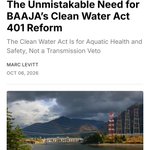
"The Bipartisan American Affordability and Jobs Act (BAAJA) creates a clear and credible path to building the infrastructure we need to decarbonize our electricity sector and stabilize prices."
breakthroughjournal.org/p/th…

Breakthrough retweeted
Climate change is real and is having impacts. But "the determination by the climate movement and its allies to reduce the issue to a manichean struggle to save lives by reducing fossil fuel use" has undermined straightforward measures to improve public health outcomes associated with climate change and pollution.


"The climate issue has always been a politics taker, not a politics maker—the sort of issue that benefits or suffers from various shifts in political fortune but does not determine them."
@TedNordhaus reflects on climate politics in the Summer of 2026: breakthroughjournal.org/p/ab…
