

Building a local newsletter to $1M/year.
Joined June 2016
- Tweets11.8K
- Following389
- Followers33.8K
- Likes13.1K






Should I start this account back up?
If we’ve chatted before or you remember me, comment below!
2
4
1,471
If we’ve ever chatted and want to dm me again…
Follow me on my new account!

30 year old's need to cut the bullsh*t.
30s are not the new 20s.
I'm 23 and tired of hearing "you're so lucky, you have so much time".
It sounds fake.
Like they wish they were my age.
Why am I "lucky"? Because I'm 23?
- I'm building a business
- writing content everyday
- and in the gym 6x/week
So when someone says "You're so lucky"
It’s not about luck. It’s about choice.
The choice to not waste this decade.
The choice to not use my 20s as an excuse.
So don’t call it “luck”.
Because it never was.
1
2,527
Your reminder:
If you don’t follow my new account!
Go do it!
I made my $1 dollar online at the age of 14.
An influencer before they were even a thing.
Imagine making your first dollar, not from a lemonade stand.
But from social media.
At 14, I did that.
Here’s how:
I started an anime theme page, purely out of passion…
and watching it grow to over 35k followers.
I thought either I was a genius or just very lucky.
Looking back, probably a bit of both.
Using my followers. I started selling shoutouts for $3-5 each.
Might not sound like much today.
But to a 14-year-old, I was on track to be a billionaire.
I had set up a PayPal under my mom's name.
Thinking the CRA (Canadian IRS) might catch me.
Looking back, it taught me more than just the $300 dollars I made.
It showed me how to create value.
VALUE the core of any business.
In this case:
It was an audience, offering visibility to artists wanting to grow.
And that was how I began.
From there, it led me to:
- Growing and selling 5+ IG accounts. (each 100k+ followers)
- Setting up an e-commerce store.
- And even a small media business.
All by the age of 17.
This wasn't your typical school education.
This was the real-world.
Hands-on learning at its best.
At 14, I was learning things some don't see till their 20s.
And this is true even today.
I try things. A lot of things. That’s my strength.
You never know which one can be the one that works.
So, If you're ever unsure where to start. Or feel trapped in a job.
Just try something. Anything.
You never know, your next random thing could be the next big one.

2,618
I NEED YOUR HELP!
This is my new page and if you even somewhat like the content I post...
Follow @CreatingJas
I became the CEO of a company making $300,000/year...
While growing my X account to 38,000 followers.
All by the age of 23.
So, let me reintroduce myself:
I'm Jas. I used to flip burgers and study buildings.
Now at 23, I just co-founded my first company.
Here's how it happened:
After I finished my Bachelor's of Architecture at 21.
I made a hard switch to Marketing.
Learning everything from:
- Websites (SEO & Design)
- Facebook Ads
- Copywriting and so on
That’s when I found AI and Twitter. I started writing every day.
Results: 10,000 followers in 45 days.
(And no, it wasn't just my mom's friends)
Viral niche + good writing.
Next obvious step? I quit my regular job.
Not the obvious step. But that’s what I did.
I knew I had to bet on myself.
So I left my safe job paying me $70,000/year. Why?
Because I thought building an audience was a smarter bet.
So I went all in...
I was a full on AI influencer:
- Money from sponsors
- Digital products
- And consultations
It felt like a dream that could at any time...
So I ended it myself. Pivoting again.
This time, it wasn't about how many followers I had.
It was about making my dream come true.
Dream of starting my own business.
That's when I met Walker. (My now co-founder, he was doing SuperTalent as a side thing)
This guy's amazing:
- Jacked
- 10M dollars revenue/year.
- Raised $16M Dollars.
And he did all this before turning 30.
He was looking for a CEO for SuperTalent.
He asked, and it was automatic yes.
He believed in me…
A 23 year old...
With some small win, but nothing major yet.
And I couldn’t ask for anything more.
So I took over.
Our goal:
Help you (SMB owner) hire offshore employees.
With the same or better skills as your local talent, but
at 70% less costs.
Helping them scale and grow your business 10X faster.
So my ask to you is…
If you’re an entrepreneur or want to be one.
I’d love to chat regardless of if you want to hire or not.
I love meeting new cool people.
So if I don’t know you and you’re cool. DM me!

2
3,327
I've been inactive on here...
But wow what a read... Can't wait for Yong-Soo's new adventure.
Best of luck with fatherhood brother!

I sold my first business. And became a first-time father. All in the blink of an eye (less than 30 days).
And that business that I sold?
It was cash-flowing… negative.
That’s right. I sold a cash-flow negative business. Whaaaaat?
It’s not what I had originally planned.
July 17th, 2023. We find out that my wife is pregnant.
My immediate thought? I need to prune my Personal HoldCo. I had too much on my plate. I wasn’t ready.
On that day, I decided to sell my e-commerce business, @urbanedcsupply.
It was my most “sellable” business asset:
- Cash-flow positive
- Capable team in place
- Highest potential EBITDA multiple
In my past posts, I’ve talked about how I work “4 hours per week, making $300,000 per month in revenue.”
This was Urban EDC. Great team. Healthy revenue. Growing year over year.
Here are the revenue numbers:
2016: $412,069
2017: $966,725
2018: $1,110,298
2019: $1,774,240
2020: $2,076,480
2021: $2,394,022
2022: $3,411,402
Trailing 12-month revenue? $3,336,833 with EBITDA of $600k.
Not quite hockey-stick curve growth, but still, not too shabby… as a solo bootstrapped founder.
I partnered up with an M&A advisor. By late October, Urban EDC was up for sale. Our go-to-market strategy was simple: target strategics first, then open up to the broad market after.
After some enthusiasm at the start, November rolls around… nothing.
Now, we’ve officially entered turkey & football week… nothing.
Now, it’s Santas, eggnogs, and cookies… nothing.
While this is all happening, there’s a fire. Not a literal fire. But for me, it might have been worse than a real fire. My 3PL (third-party logistics) company GrowthJet, one of my portfolio companies in my Personal HoldCo, was in trouble.
There’s a dispute in my lease agreement and my landlord is demanding that I pay an extra 35% in rent starting in November.
I hire an attorney. He’s almost certain that we’ll win if this thing went all the way to court.
But, there was one small, teeny-little problem. My landlord also provides all the labor for my 3PL business. It’s a strange arrangement, but it worked out quiet well… until it didn’t.
On Black Friday Cyber Monday weekend, my landlord pulled his entire labor staff in protest. I was holding out on the 35% increase in rent. So he pulled the only lever he had… his labor force.
Imagine. Our busiest day of the year. No one working. I said earlier that a fire would might have been easier to handle. I wasn’t kidding.
I went in to fulfill as many orders as I could, while frantically trying to hire more staff. Of course, it's the worst time to hire. Because none of them are experienced. They had no idea what they were doing. Mis-shipments are worse than no shipments.
I avoided contact with my landlord who also happened to be sharing the space with us. It was complete chaos. Everything that could go wrong, did.
My attorney told me to pay the full amount of rent “in distress” which is fancy way to say that I wouldn’t set a new precedent legally by paying the full amount.
So, I paid the whole damn thing. 100% of the rent for December. Actually, more like… 135% of the rent? You get the idea.
I’ll never forget… at the peak of this craziness, my General Manager (Operator) for GrowthJet pulled me aside and asked me if I ever considered selling GrowthJet. I never thought about it because we were still cash-flowing negative. My plan was to reinvest the sale proceeds from Urban EDC to grow GrowthJet into a positive cash-flowing company.
But, now… my GM is telling me, I can sell this thing off? No way, Jose.
Surprise! He had spoken to the landlord and apparently, my landlord was interested in buying GrowthJet. Wait. Did I hear that right? My landlord wants to buy this negative cashflow business? What in the world…
I was shocked. Why would he want to buy this business?
I set up a meeting to meet with the Founder & President of the organization, aka Labor Supplier, aka Mr. Landlord himself.
Surprisingly, the talks went smoothly. Perhaps, too smoothly (I should have known). He agreed to purchase the business outright because he wanted to own a business he could run himself using his labor force.
After several meetings, all parties verbally agreed on the sale. I couldn’t believe it. I had done it. I had sold my first business. Just like that.
I paid expensive legal fees to draft up the agreement that all parties agreed on.
But then, a week later, they pulled the original deal. I was furious.
They structured an alternative deal that was so unfavorable, that it pissed me off. Essentially, they were getting the business for free. AND they could walk away from the deal after 90 days if they didn’t feel like it. Like a “try-before-you-buy” sorta thing. Worst part? They tried to jam this deal down my throat.
They brought in their attorney and while they knew I was represented by another attorney, they sat me down and said they wouldn’t let me leave the room until I signed paperwork.
It felt like I was in an interrogation room at the police station being grilled to admit to something I never did. Only this time, I was being grilled to sign paperwork for something I never agreed to.
Of course, I refused to sign the paperwork. After several hours of them yelling at me, I was tired as hell, but I had half a brain to know this was a tactic (unethical practice) to break me down psychologically. What assholes.
By this point, I had decided I wasn’t going to sell GrowthJet to these clowns. They were unpredictable, unreasonable, and guaranteed to run this business to the ground.
That’s not the type of people I wanted handing off a business I’ve worked so hard to build for the past 4 years.
So, what did I do? I found new buyers. By myself.
I don’t recommend self-brokering a deal like I did. It will eat you alive.
But, here I am telling you this story. So I survived, didn’t I?
Before we get into how I self-brokered this deal, let’s address the elephant in the room:
Why didn’t I use the same M&A advisor as the ones I hired for Urban EDC?
Well… a few reasons:
- It would have delayed the deal
- Deal size was too small for them
- I wanted them to focus on Urban EDC
So, what did I do?
I recalled an email I received earlier that year. It almost felt like a spam mail back then. A random M&A advisor was cold pitching 3PLs to see if we’d be open to selling. At the time, I had no interest in selling GrowthJet because I didn’t think it had any value.
So, I dug into my inbox and pulled out this piece of crumpled up digital paper. Before you know it, I was on a phone call. He had 3-4 other 3PLs interested in buying GrowthJet.
This goes without saying… but your valuation is 95% determined by how others perceive you’re worth.
Negative cash flow? Didn’t matter. I had multiple potential buyers and that kept pushing the stakes higher. I was in the driver’s seat.
Each strategic buyer brought something different to the table.
One buyer wanted our client list. But they wanted us to terminate the lease and move everything over to their warehouse. (Yeah, about that lease…)
Another buyer wanted the business but they were still using software so archaic that it felt like we traveled back into the 70s. Our clients had to relearn everything.
Finally, we found a buyer who would take over our lease and move into our warehouse. They also used the same software we were already using so the handoff would be seamless. And they had great reviews from other clients. We had finally found our dance partner. Let’s roll.
This process was like dating. We talked about our values over fancy meals. We imagined our future together. Our goals, hopes, dreams.
But, little did I know… this was all a trap. All that courting upfront was only for show. Before I knew it, I was negotiating the biggest deal of my life. Each line item in the Purchase Agreement was scrutinized by scary, expensive attorneys.
Because I was self-brokering this deal, they didn’t play nice. They wanted to chew me up and spit me back out.
Negotiation was painful. Psychological warfare. Sometimes physical.
In fact, amidst negotiations, my landlord somehow came right up to my face and spit into my face with 3 of his staff members surrounding me. No rhyme or reason. I wasn’t even negotiating with him anymore. I was shocked. I wondered if the buyer sent them in to mess with me.
In hindsight, I suspect he wanted me to punch him in the face, reacting to his action. That would have given him leverage against me.
Of course, I kept my cool... his plan had backfired.
I recorded the whole thing and headed straight to the local police station to file a police report. I could also file a restraining order against him in the future, if I needed to, much quicker.
You never know when it might come in handy.
Back to the buyer... Both sides wanted the deal done. They wanted us. I wanted out.
So, in the end… the deal was made. Deal structure was quite complicated so I won’t dive into the details.
So... what happened to Urban EDC?
Well, if you can guess by now… we had no interested buyers. Can you believe it?
So let's get this straight… a business that’s cash-flow negative sells with multiple potential buyers… but a business with $600k EBITDA with $3m+ in revenue doesn’t sell?
Ironically, Urban EDC is the business asset that I am confident that I can grow to $10m+ in a few years.
But to be honest, by the end… I was exhausted. I had a baby on the way. I thought about shutting down Urban EDC. Fuck it.
Maybe my fatherly instincts were kicking in. Who knows.
But at the end of the day, I decided to keep Urban EDC… for now.
So, I’m going to step in as operator and focus entirely on growing this thing to what it can be while being there for my newborn son.
Of course, I'll share everything that I learn publicly (follow me @YongSooChung if you're not already).
To finish this story on a high note, here’s Logan Alexander Chung on his first day on Planet Earth.
Fatherhood here I come.

3
2,762
7 Insane Lessons from Liquid Death That'll Blow Your Mind…
The lessons that turned canned water into a $700 Million Dollar company:
1/ The Pre-Game.
Liquid Death spent $1.5K to see if they even have any customers…
No product, just a cool video that went viral.
Lesson here? Make sure there’s a crowd before you crank up the volume.
2/ "No" Just Means "Not Yet."
Got laughed out of the investor's office? Same.
Liquid Death's pitch was a hard pass at first.
But they flipped the script with a video so dope it couldn't be ignored.
Turning their “No” in to a “Not yet”
3/ Be Unapologetically You.
Liquid Death ain't just water; it's a slice of the founder's soul.
Punk rock, laughs, a sprinkle of mayhem.
Your brand should be so you, people can't help but notice.
4/ Merch? Yeah, It's Like Free Money.
Imagine a simple shirt being so dope, it brings in 10% of your revenue.
Liquid Death made wearing a water brand as badass as band merch.
Getting free marketing where ever their customers went.
5/ Failing Forward.
Before the glory, there was a liquor brand that tanked and a crowdfunding attempt that flatlined.
But hey, what’s a success story without a couple of faceplants along the way?
So nothing is ever a overnight success…
Not even canned water.
6/ Customers First, Then the Pitch.
Liquid Death waited for the fans before even bothering with a pitch deck.
When your product's hot, let that buzz open doors for you.
Your product will be best investment pitch.
7/ Haters Gonna Hate
Liquid Death literally turned their troll comments into a vinyl record.
They turned a $12K investment into a mixtape of hate comments.
They sold over 700 at launch.
It's kinda like when Elon Musk was like, "Let's sell some flamethrowers," and boom, sold out.
Turning internet trash talk into marketing? Genius.
Who needs ads when you've got hater singing your songs.
Liquid Death took the most basic product (water) and turned it into a brand.
So, what’s you biggest takeaway from this?
How will you be different…
comment below!

2
10
1,598
My strategy for building a 50 people offshore team in the next 24 months…
Here’s how I’m going to do it:
1/ People at the core.
Think of every new team member is family.
Doing the small things like:
Virtual hangouts where everyone learns, grows, and maybe even shares a meme or two.
It's not just about the skills they bring but the vibes, too.
We're setting up a system where everyone can level up their game—think a portal with free courses, webinars, and video that work.
2/ Long time horizon
We want to build for the long term, and not be a one-hit wonder.
Offering stuff like 100% coverage on benefits, good severance packages, PTO and more that most offshore companies wouldn't even dream of doing…
So actually thinking of them like your local employees.
And not some robots.
3/ Shout from the roof about what we do.
If we're doing something awesome, you bet everyone's gonna hear about it.
Social media, blogs, podcasts—you name it, we're on it.
It's all about putting the spotlight on our people, our culture, and the dope stuff we're creating together.
Talking about even the small wins they get!
4/ Sweat the small stuff.
Yeah, the devil's in the details, and we're practically on a first-name basis with him.
Above-market pay? Check.
100% benefits? Double check.
We're talking about making life outside of work as sweet as it is when you're clocked in.
Flex hours, wellness programs, virtual team retreats—because who said you can't have a work-life balance?
But that’s how I plan on building my offshore team…
When are you thinking of starting?
3
9
1,744
The bar is set so low in offshore hiring.
That you can hire most employees for $6/hour and still be…
in the top 1% of employers.
While building offshore teams, too many companies in the U.S. are missing the mark on actually providing value to their employees.
Understanding the cultural nuances.
Celebrating their achievements and milestones.
Communicating clearly and regularly, beyond just emails.
Making efforts to integrate them into your company culture.
Investing in their development, just as you would for local employees.
It sounds straightforward, but most companies still don’t do it.
This is where companies willing to actually invest and care about their offshore teams can set themselves apart.
One word, VALUE.
By actually caring and building genuine relationships, respecting cultural differences, and offering real growth opportunities, you don't just bridge the global gap; you breed loyalty.
Employees that will go above and beyond just for you.
That’s called loyalty.
So want to provide better opportunities?
Be that employer and start hiring offshore.
Here's how Blank Street Coffee Turned a $.75 Saving into a $177M Dollar Company.
You've seen it. The green hues, the minimalist design, popping up in every corner of your city.
Founded in 2020, in the midst of the pandemic, Blank Street seized vacant spots across NYC, London, Boston, and DC.
Now, with over 50 locations, they're not stopping.
Their secret? A blend of fortunate timing, savvy fundraising ($67M from giants like General Catalyst and Tiger Global), and a simple vision: great coffee shouldn't be a luxury.
Issam Freiha and Vinay Menda, the venture capitalists behind this vision, saw a gap.
Starbucks was for convenience, Dunkin' for the price, specialty shops for the quality.
But what about those craving quality without the price tag? Enter Blank
Street, where a cappuccino isn’t $9.
Sure, a $.75 saving might not sound like a revolution.
But in a city where coffee is a daily ritual, it adds up. And it's not just about the coffee.
Blank Street's model is lean and mean, focusing on speed, efficiency, and a tech-enabled experience that keeps costs down.
They're redefining what a coffee shop can be, turning a quick coffee run into a seamless part of city living.
But Blank Street isn't stopping at coffee.
Their model hints at a future where they could become the go-to for not just your caffeine fix but tacos, sunscreen, and more.
They're building a platform, a network of quick-pickup spots for an urban lifestyle on the go.
They're not just selling coffee; they're selling convenience, and quality made easy.
And that, my friends, is how Blank Street is brewing a revolution, one cup at a time.
Follow me for more brand stories like these…
If this story peaked your interest, share or reply to let more people in on the coffee revolution.

In the hiring world, businesses love to say:
"We prioritize local hiring"
"We believe in nurturing talent within our community"
"We're committed to boosting the local economy through employment"
While the sentiment may come from a good place, it's my conviction that leveraging offshore talent far surpasses the benefits of sticking strictly to local hiring.
The reality is that many businesses, particularly those in the tech and service sectors, pour an inordinate amount of resources—time, money, and energy—into recruiting locally. This approach, however, often overlooks the immense advantages that come from tapping into the global talent pool.
Before you double down on your local hiring strategy, consider whether you've fully explored and understood the potential of offshore hiring.
• Access to a broader talent pool: Offshoring opens your doors to a world of talent.
• Cost efficiency: Up to 70% cost reduction.
• Scalability: Quickly adjust your workforce based on business needs without the logistical and financial constraints of local hiring.
Here's what you think about before hiring offshore:
• Operational framework that creates smooth collaboration of offshore teams into your business processes.
• Proven success in your core operations, demonstrating that your business model is solid and ready to be supported by a global team.
• Leadership and management to effectively oversee, and communicate with, a global team.
In conclusion, while local hiring has its merits, the strategic benefits of offshore hiring cannot be overlooked.
By embracing a global perspective on talent acquisition, businesses can unlock more growth, at a way faster rate.
It’s time to look beyond the local labor market and harness the power of the global workforce.
This is the greatest business movement in the last 10 years – and no, it's not crypto or AI.
In the middle of thousands of trends in the last decade, one stands out for its impact and practicality: offshore hiring…
Don’t believe me?
Let's break it down:
1. Super Low Prices for A-List Talent
Imagine hiring a superstar for the price of a coffee a day. Okay, maybe a bit more, but offshore hiring can help cut your cost by 70%.
If given an option why would you pay a $100,000 salary, if you can get the same talent for $30,000.
It's like flying economy but getting bumped up to first class – who wouldn't want that?
2. The World Is Your Oyster (And Your Talent Pool)
The days of posting a job and hoping someone in your zip code fits the job description are far gone...
With offshore hiring, the world is your recruitment playground.
Want a developer go to India. Want a SEO Expert go to Brazil.
It's like building a football (soccer) roster from around the world.
3. 24/7 Work
Do you want to make money when you sleep? and no I’m not some “here in my garage, got my new Lamborghini here” guy.
Offshore teams work across time zones, keeping the work going even when you’re asleep. But they’re not limited, if you want them to work your hours…
they can do that too.
4. Flexibility
Scale up or down without the drama.
Need to beef up your team for a big project? Easy.
Want to slim down for the summer? No problem.
Ideally you want to keep the employment stable for your employees, but if needed you have the options to scale up or down as your business needs.
It’s like having a gym membership for your business – but without the guilt of never going.
5. Brainstorming Across Borders
Collaboration with a diverse, global team means you're brainstorming on steroids.
With so many diverse mindsets and experiences, you’re able to receive a variety of feedback.
Ensuring your business stays ahead of the curve (or at least doesn't fall flat on its face).
6. Disaster-Proof Your Biz
By spreading out your team, you spread out your risk.
If one location goes down (thanks, Mother Nature), your business keeps running.
It's like having backups for your backups – because you can never have too many.
7. Customer Service That Never Sleeps
A little role specific but, you can offer 24/7 customer service without burning out your team.
It's like having a friendly face ready to help, whether your customers are early birds or night owls.
Because nobody likes being put on hold, especially not by a robot.
8. Do Good, Feel Good
As companies care more about the impact they make…
Offshore hiring can be a force for good.
Providing quality jobs in different parts of the world can make a real difference.
It's not just about saving a dollar; it's about making a dollar and making an impact. Win-win.
Now that’s my opinion of course…
What are your thoughts about offshore hiring?
Comment below!
This 2-min video trick saved me over 300+ hours of interviewing just in the last month…
Don’t believe me? Here’s how:
In addition to the usual resumes, we asked for something simple: a 2-minute loom video from each candidate. Sounds simple right?
Here's the deal:
We had this big role to fill, right? The thought of scrolling through a zillion resumes was making me procrastinate.
So, we flipped the script. Told applicants, “Hit us with your best 2-min shot. Tell us why you're the one for this role.”
It was like hitting the fast-forward button on the boring parts.
Suddenly, we’re not just staring at words on a page. We’re getting a vibe check straight off the bat. Seeing real people, hearing how they talk about themselves, and getting a sense of who they really are.
The cool part? We cut down the “meh” pile right away. Instead of wading through hundreds of maybe's, we were only talking to the real contenders.
Imagine you’ve got 100 hopefuls. Old-school, you’re locked in for 20 minutes/candidate, chewing through hours and hours.
With the 2 min video? You’re only deep-diving into the ones who truly pop. Saves you a mountain of time and keeps you from interview burnout.
And the best part? It’s all on your time. No back-and-forth trying to match calendars. You watch, you decide, you move on. Simple.
If you're sick of the old ways and ready for a shortcut to the good stuff, give this a shot. Trust me, your future self (and your team) will thank you.
And if you like these tips…
Follow me for more ways to work smarter, not harder.
And if you think this could help someone out, hit share or drop a reply. Every bit helps.
How Dollar Shave Club Turned a Single YouTube Video into $1 Billion...
A masterclass in marketing:
They started with a dream and a warehouse full of razors.
Dollar Shave Club wasn't just selling razor blades; they were starting a revolution against the overpriced, over-hyped giants of the grooming industry.
Their weapon? A single, hilarious YouTube video that cut through the noise like a fresh blade on a five o'clock shadow.
In a market dominated by brands like Gillette and Schick, Dollar Shave Club made an audacious entrance.
With a no-nonsense approach, cheeky humor, and an unbeatable offer, they weren't just offering a shave; they were carving out a new way of thinking about grooming.
Their founder, Michael Dubin, didn't just star in their viral ad; he became the face of the brand.
For a small $4,500, they produced a video that didn't just go viral; it took them into the homes (and hearts) of millions, crashing their website with demand.
Forget about fancy features or celebrity endorsements.
Dollar Shave Club's ads poked fun at the razor market, resonating with consumers tired of paying premium prices for blades locked behind glass cases.
Their model was simple: high-quality razors delivered to your door for a few bucks a month.
No gimmicks, no upcharges, just straightforward value. And it worked. Within five years, they went from a startup to a household name, eventually catching the eye (and checkbook) of Unilever, which bought them out for a cool billion dollars.
Dollar Shave Club's journey is a masterclass in marketing genius.
For more razor-sharp stories, follow me, Jas!
If this story doesn't make you rethink your marketing game, what will? Share or reply, and let's slice through the old ways together.
Here are the 9 questions I get asked the most about hiring offshore (from hiring in the Philippines to how to get started):
1/ What's the key to a successful offshore hire?
Start with clear expectations.
Know what you want in terms of skills and work culture.
The clearer your requirements, the better the fit you'll find.
It's all about matching your needs with the right talent pool.
- Do you want them working in your time zone?
- How many years of experience?
- Will they be customer-facing?
Ask yourself similar questions before making the hire.
2/ Why do you hire in the Philippines?
The Philippines offers a unique blend of…
- High English proficiency
- Cultural compatibility with Western countries,
- and a strong work ethic.
Plus, the cost efficiencies are an added plus.
It's a win-win for businesses looking to scale.
But it’s not the only country you should look at when hiring…
your hiring place should depend on the role and skills you’re looking for.
3/ How do I start the process?
1. Define the role and skills needed
2. Decide: Do you want help from offshore staffing agencies or do prefer to go solo.
3. Post your job or directly engage with candidates using cold outreach.
4. Conduct thorough interviews and tests
5. Onboard with clear communication and support
4/ What are the common mistakes to avoid?
Underestimating cultural fit and communication can lead to multiple challenges.
Ensure regular, clear communication and understand the cultural nuances that might impact work.
These are some of the things that are typically looked over when hiring offshore.
5/ How do I ensure productivity with remote teams?
Use tech to your advantage.
- Implement project management tools (Notion, Monday(dot)com)
- Set clear KPIs
- and maintain regular check-ins. (communication)
Trust, but verify through transparent work processes.
6/ What about legal and compliance issues?
2 options:
1. Partner with local experts or agencies that understand the legal landscape of hiring offshore.
2. Research them yourself.
From contracts to compliance, it's critical to get it right…
or they come to bite you later.
7/ Can I find a managerial position offshore?
Absolutely. The global talent pool is hugeeee.
With the right approach, you can find the perfect person in nearly any field.
It's all about looking in the right places and offering competitive packages.
Use places like LinkedIn, social media, and local job boards to make sure you’re accessing the right talent.
8/ How do I manage time zone differences?
It’s not simple but…
here are a few options:
- Hire from locations with similar time zones (Latin and central America)
- Set overlapping hours for real-time collaboration
- and lastly, get some employees to work overnight
Time zones can be a challenge, but also an advantage for round-the-clock productivity.
9/ What's the secret to long-term success with offshore teams?
Build relationships.
Treat your offshore team as a key part of your team.
Treat them like your on-shore team.
Invest in their development, understand their career goals, and foster a sense of belonging.
They are humans, so treat them like one.
For more hiring tips like this, follow me, Jas Singh!
If you found this helpful, share or reply, it goes a long way.
Here’s how Manscaped trimmers became every man's secret weapon overnight…
Ever scrolled through your feed and thought, "Why am I seeing ads for ball trimmers?”
That’s Manscaped.
Imagine this: It's just a shaver, but suddenly, it's the must-have accessory for every bathroom.
Manscaped did what Apple did for phones, but for your private regions.
They didn't just sell a product; they sold a movement.
Here's the playbook they used to shave their way into a billion-dollar valuation:
1/ Finding the Gap: They talked about what no one else would – male grooming below the belt. By owning the conversation, Manscaped became the go-to, turning a once-whispered-about task into a badge of honor.
2/ Being Everywhere You Look: From podcasts to social media, Manscaped's ads are impossible to miss. Their strategy? Be so present that you start thinking manscaping is just part of the daily routine, like brushing your teeth.
3/ The Deal You Can't Ignore: Ever seen a Manscaped ad without a promo code? That's by design. They made everyone feel like they're getting an exclusive deal, making the purchase just that much sweeter.
4/ Humor That Cuts Through: Manscaped knows life's serious enough. Their marketing? A blend of cheeky jokes and puns that make you laugh before you realize you're considering buying a niche trimmer.
5/ Quality That Speaks Volumes: Behind the laughs and discounts lies a product that people actually love. High-quality trimmers that get the job done, making Manscaped not just a choice, but the choice for grooming.
And just like that, Manscaped turned a shaver into a lifestyle, proving that with the right marketing, even the most boring products can become a household name.
For more brand stories like this, follow me, Jas Singh!
If you found this fun/cool, share or reply, it goes a long way.

Winning at offshore hiring is 99% about recognizing talent. Speaking the universal language of respect, offering competitive pay, clearly defining the role, being clear in your communication, automating routine processes, valuing contributions over location, engaging regularly despite time zones, targeting talent in emerging tech hubs, crafting job descriptions that resonate, investing in individuals who show potential, focusing on your core competencies, leveraging unique strengths, giving direct ownership of responsibilities, thinking about long-term value creation, breaking out of your hiring bubble, communicating with authenticity, hosting international meetups to network, envisioning a global "company vision", and most importantly, enjoying the journey of building a world-class, borderless team.
3
11
1,664
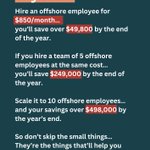
If you hire an offshore employee this month for $850/month…
you’ll save over $49,800 by the end of the year.
How? Let’s do some math.
Let’s say you hire Joe, a Digital Marketing Manager in the U.S.
Costing you a salary of $60,000/year.
Doing everything from:
• Managing paid ads
• SEO
• Overlooking a team of 2-3
• With 4-6 of experience
Now you can make that exact same hire in Columbia for $850/month…
or a salary of $10,200/year.
Saving you $49,800/year.
Now here’s where it get’s really fun…
If you hire a team of 5 offshore employees at the same cost…
you’ll save $249,000 by the end of the year.
Scale it to 10 offshore employees…
and your savings over $498,000 by the year’s end.
So don’t skip the small things…
They’re the things that’ll help you scale.

10 months or to be exact 313 days of becoming a entrepreneur….
Feb 8, 2023: 16 followers
Feb 8, 2024: 39,353 followers
Feb 8, 2023: $0 revenue
Feb 8, 2024: $300,000 revenue
Feb 8, 2023: $0 MRR
Feb 8, 2024: $25,000 MRR
Feb 8, 2023: I only need myself
Feb 8, 2024: Multiple mentors
Feb 8, 2023: Alone
Feb 8, 2024: Team of 12
Feb 8, 2023: No online friends
Feb 8, 2023: 100+ friends made
These past 10 months have been more than anything I could’ve asked for…
From an Architecture student (2022) → Marketing Jobs + Solopreneurship (2023) → CEO/Entrepreneur (2024).
These past 10 months have taken a lot out of me, but were worth it in every way.
Would for sure do it all again.
Have any questions? Comment below.


1 year of Indie Hacking
My journey from Meta to $0 to making the entire year’s salary in 2 months!
Feb 3, 2023: 25 followers
Feb 3, 2024: 26,479 followers
Feb 3, 2023: $0 revenue
Feb 3, 2024: $676,413 revenue
Feb 3, 2023: $0 MRR
Feb 3, 2024: $120,000 MRR
Feb 3, 2023: 1 product
Feb 3, 2024: 12 products to 3 and just launched my 4th
Feb 3, 2023: $0 profit
Feb 3, 2023: $405,618 profit
Feb 3, 2023: I will do everything
Feb 3, 2024: I trust my team!
Feb 3, 2023: Solo!
Feb 3, 2024: Partnership and building a team!
Feb 3, 2023: Didn’t believe in building a personal brand to build a business.
Feb 3, 2024: Personal brand is everything!
Feb 3, 2023: No friends
Feb 4, 2023: Thousands!
This journey has been an awakening for me as a designer. It turned an introvert and a scaredy cat into a founder, marketer, risk taker and I wholeheartedly want to thank the indie community for accepting me and making all of this possible.
Last one year has been a year of opportunities, year of helping people, supporting founders and making things happen. I couldn’t have asked for a better 1 year than this!
Feel free to ask me anything!

8
14
2,811
This Marketing Campaign Killed Over 200,000 People in the U.S.
The story of how a medical breakthrough…
turned into an epidemic:
OxyContin, a drug promising relief from endless chronic pain.
But it wasn’t just another painkiller.
This thing was marketed like the newest iPhone.
Except, instead of upgrading your phone, you’re getting hooked on a pill that’s a step away from heroin.
Suddenly, the pain relief wasn't about managing symptoms…
it was about a pill that could make all the pain go away.
That’s when the marketing came in play.
Purdue Pharma, knew exactly the pain points to hit.
They made this thing sound like it was as harmless as popping an Advil.
Spoiler alert: it wasn’t.
They hit the nail on the head by targeting everyone who so much as complained about a backache.
Got pain? There’s a pill for that. And it’s got your name on it.
Patients found themselves in a cycle of addiction.
The doctors weren’t stopping either, with the endless perks Purdue was giving.
They kept prescribing it for even moderate pain.
and so the cycle continued.
Fast forward, and small towns across America were addicted.
It’s like every other person either knows someone or is personally fighting to kick Oxy.
Purdue Pharma turned from being the hero to the villain in a heartbeat…
all thanks to their marketing.
They didn't just create a health crisis; they engineered a marketing catastrophe.
If you like this story, follow me for more stories like these!
and share or reply to this so more people can understand the impact of marketing.
