

Data Editor, @thetimes ✍ Free newsletter https://teapawt.org/t.co/fl2KQ2YbfP 🇬🇧 How's Britain doing? https://teapawt.org/t.co/jdqY7y0Tj7
London
Joined November 2013
- Tweets4.5K
- Following2.4K
- Followers16.5K
- Likes11.8K



Pinned Tweet
A Friday reminder for Brits who enjoy monitoring the situation: we have a dashboard for you!
🇬🇧 thetimes.com/data

Tom Calver retweeted

Is the ‘reset’ really worth 0.5% of GDP?
I've taken a closer look at the government's claim that the UK-EU 'reset' will boost UK GDP by 0.5% in the long run.
⚠️ Spoiler – it won’t. In fact, I think they have got the sign wrong... 🧵(1/12)
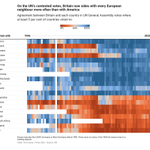
This week's column is on the collapse of the old world order. I looked at 80 years of UN votes to see who is friends with whom, and how that has changed.
The US no longer votes with its European allies at the UN. But it's not really moving towards China and Russia either
1/3

Here's the 80-year view of UN vote agreement with Britain (note I've only included votes that were "contentious", ie had more than 5% disagreement).
The US went from being one of our closest allies, to to no closer than the Argentinians
2/3

I'm also struck by how often Britain and its allies are now on the losing side of UN votes.
Our diplomatic view of the world is increasingly a global outlier - especially so when we weight each country's vote by their population
More in my column thetimes.com/article/34b8942…

Tom Calver retweeted

A thought on the productivity revamp - if the big problem is not working enough hours (vs output during those hours), doesn’t it make tackling tax/benefit cliff edges even more important? Artificially constraining hours worked all over the place.
Tom Calver retweeted

I voted Remain, but these counterfactuals are nonsense - British growth has been going down since 2008 due to structural problems with the economy that have gone unaddressed and have frequently been worsened by government policy.

You are going to see a lot of claims that the UK has grown faster than France, Italy and Germany since Brexit and therefore it is “unbelievable” that Brexit could have cost a 4% hit on GDP.
This is misleading because the UK before Brexit grew even faster than those countries and more in line with the Netherlands and Sweden which I’ve add in red to show how they’ve grown since. As you can see it’s entirely in line with the OBR estimate .


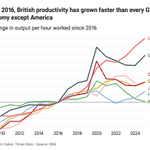
There's more. New ONS data published today shows Britain has actually experienced the second-fastest growth in productivity of any G7 country since 2016!


We spend endless time debating the economic impact of Brexit. But look at the chart.
If you think Britain should have grown like the US after Brexit, the impact seems huge.
If instead you think we would've grown like the other big European nations, the impact is negligible.
Brexit is a real inconvenience to holidaymakers and business owners, and steps to mitigate this hassle is good. But it seems silly to sell closer alignment along purely economic lines. Brexit isn't the real reason your taxes are rising and you can't get a pay rise.
2/3

Tom Calver retweeted

Ahead of tomorrow's Milburn review, a summary of what has increased the cost of hiring a young person vs 2011/12.

In case you're wondering where Burnham's "4% hit to the economy" from Brexit comes from 👇
We spend endless time debating the economic impact of Brexit. But look at the chart.
If you think Britain should have grown like the US after Brexit, the impact seems huge.
If instead you think we would've grown like the other big European nations, the impact is negligible.
Brexit is a real inconvenience to holidaymakers and business owners, and steps to mitigate this hassle is good. But it seems silly to sell closer alignment along purely economic lines. Brexit isn't the real reason your taxes are rising and you can't get a pay rise.
2/3
Tom Calver retweeted

Thread 🧵
Ahead of the Milburn report, I spent a few days talking to young people who are or have recently been “NEETs”
I found it a worrying but also moving experience, listening to how they are navigating a dizzying array of challenges. Here is some of what they had to say:

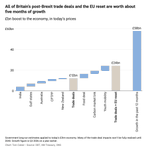
This week's column: closer EU alignment may be worth doing if it genuinely makes a tangible difference to people's lives.
But let's not kid ourselves: the economic impacts of doing so are tiny. Every trade deal and proposed realignment measure to date will lift the economy by about 0.8% by 2040 – equivalent to about five months of growth!
1/3

We spend endless time debating the economic impact of Brexit. But look at the chart.
If you think Britain should have grown like the US after Brexit, the impact seems huge.
If instead you think we would've grown like the other big European nations, the impact is negligible.
Brexit is a real inconvenience to holidaymakers and business owners, and steps to mitigate this hassle is good. But it seems silly to sell closer alignment along purely economic lines. Brexit isn't the real reason your taxes are rising and you can't get a pay rise.
2/3
How much will the Brexit reset really boost the economy?
thetimes.com/article/d748db7…
3
8
2,262


✍️ I'm starting a newsletter!
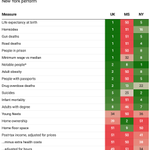
In the first weekly issue of Trendline, launching this afternoon, I compare life in Britain with life in the US.
The UK is often compared with Mississippi, America's poorest state. I argue that we're much more like New York instead.
You can sign up for free here: thetimes.com/newsletter/sign…

Tom Calver retweeted

Government imposed policy costs make up 57% of the clearing price of a new flat in London and 42% of a new home in the Home Counties.
Despite a big housing shortage and positive planning reforms, new home starts in England are declining from 182,000 in 2022 to under 125,000 last year.
While the macroeconomic context has worsened with build cost inflation and high interest rates, the Government is imposing more burdens on new homes, not fewer.
Taxes, levies, planning, and mandates add over £440,000 to the cost of delivering a home in London and nearly £225,000 nearby, with several of these imposed recently like the Second Staircase, Future Homes Standard, Building Safety Levy, Biodiversity Net Gain and Residential Property Developer Tax.
Individually these may be justified, but together they are making new homes unviable.
As a result, large developers are buying less land and small builders are going out of business; nearly 4,000 construction firms went bust just last year.
If we want to build more homes, we should be easing the burdens on them, not adding more.
Making housebuilding viable again is the most important issue in housing policy and my co-author, Edward Donovan, has completed excellent modelling showing how big the challenge is.
Read the full report: cps.org.uk/wp-content/upload…
And simulate what changing the policies does with Edward's modelling here: easing-the-burdens.cps.org.u…


Tom Calver retweeted

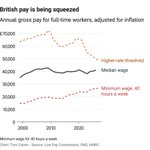
Wage compression is a massive and under-rated issue in the UK

Tom Calver retweeted

More importantly, if we break productivity down into its components — output and employees — we see the US acceleration starting 2022 is primarily a tech layoffs story.
Output remained on trend, and unlike other sectors/countries where employment flatlined, in US tech it fell and has kept falling in a straight line.
