

Aquatic foods for healthy people and planet, and shared prosperity
Penang, Malaysia
Joined March 2011
- Tweets17.5K
- Following801
- Followers20.4K
- Likes11.8K




Pinned Tweet
🐟 28 years in India.
10M+ mola hatchlings distributed.
~20,000 women's groups in aquaculture.
48% income increase for fish-farming women.
This is @WorldFish's India impact—and we are sharing more on our journey.
🎬 Watch the video. More to come. 👇
#WorldFish #India #Aquaculture #FoodSystems #CGIAR #AquaticFoods #FoodSystems #BlueEconomy
At an ASEAN-CGIAR dialogue in Phnom Penh, co-organised by WorldFish and @irri, partners explored how research, finance, farmer services and supportive policies can help scale these innovations.
WorldFish Principal Scientist Prof. Eddie Allison highlighted the importance of combining technical innovations with the right support systems to make adoption possible.
Read more:
on.cgiar.org/48buN5D
#WorldFish #CGIAR #ASEAN #AquaticFoods #RegenerativeAgriculture #ClimateResilience


121
🐟 What goes into fish feed and who has access to those ingredients?
A new WorldFish study examines how women and men smallholder fish farmers in Western Kenya differ in their use and sourcing of fish feed ingredients.
Research finds that women rely more on household organic by-products, such as poultry waste, cassava waste and maize powder. Men are more likely to access plant leaves, rice bran and other inputs through wider networks and market connections.
These differences reflect more than feeding practices. They are shaped by access to resources, mobility and the division of household and farming responsibilities.
📖 Read the study: on.cgiar.org/4euAbnR

Climate-resilient food systems must include aquatic foods.
Yesterday, WorldFish Director General Dr. Essam Yassin Mohammed joined a panel of global agricultural scientists at the Bharat Agriculture Conference, organised by the India Today Media Group in New Delhi.
Sharing his perspectives on resilient and sustainable aquatic food systems in the context of climate change, Dr. Essam highlighted the importance of bringing fisheries and aquaculture into wider conversations about the future of food and agriculture.
#WorldFish #AquaticFoods #Aquaculture #ClimateResilience #SustainableFoodSystems #Bharat #India


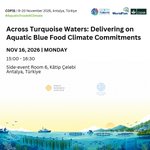
Aquatic foods are gaining recognition in global climate discussions. Now, it's time to turn commitments into action.
At #COP31, join Dr Michelle Tigchelaar, WorldFish Lead Scientist and Impact Area Lead for Climate & Environmental Sustainability at WorldFish, for a high-level dialogue on Across Turquoise Waters: Delivering on Aquatic Blue Food Climate Commitments.
The session will bring together leaders from SIDS and developing countries, policymakers and partners to explore how fisheries and aquaculture can be better integrated into national climate plans, adaptation finance and food systems policies.
📅 16 November 2026
🕒 3:00–4:30 PM (Türkiye time)
Find out more: on.cgiar.org/4At2c7P
#COP31 #AquaticFoods #ClimateAction #BlueFoods #Aquaculture #BlueFoods
In Timor-Leste, the IKAN Adapt project is working with coastal and inland communities to strengthen the resilience of people whose livelihoods depend on fisheries and aquaculture.
Through locally led approaches, the initiative supports communities in responding to climate risks while strengthening food security, livelihoods and the sustainable management of aquatic resources.
See how resilience is taking root in Timor-Leste, as featured by the Global Environment Facility (GEF).
➡️ Watch the story: on.cgiar.org/4j7PRA2.
#WorldFish #TimorLeste #ClimateResilience #ClimateAdaptation #Fisheries #Aquaculture #FoodSecurity
How can Pacific countries build more resilient food systems?
It starts with better evidence and stronger connections across sectors.
WorldFish is working with the Pacific Community (SPC) and the University of Wollongong’s ANCORS to strengthen understanding of Pacific food systems, bringing aquatic foods into the wider conversation on food, nutrition, trade and climate.
The partnership brings together expertise in fisheries, agriculture, statistics, public health and climate change to build a more connected picture of Pacific food systems.
📖 Read more:
on.cgiar.org/4ArRpeh

Are fishers and fish farmers getting the support they need as El Niño intensifies?
In Zambia, WorldFish and partners are turning weather forecasts into practical SMS advisories to help fish farmers anticipate climate risks and protect their ponds and livelihoods.
At #COP31, WorldFish is calling for greater investment in locally led adaptation and stronger recognition of fisheries and aquaculture in national climate plans and finance.
➡️ Read more:
on.cgiar.org/4857JW7
#COP31 #ClimateAdaptation #AquaticFoods #ClimateAction #BlueFoodSystems #SmallScaleFisheries #SustainableAquaculture

1
1
171
How can better-connected data help strengthen food systems across the Pacific?
WorldFish is working with the Pacific Community (SPC) and the University of Wollongong’s Australian National Centre for Ocean Resources and Security (ANCORS) to bring together information on food production, trade, nutrition and health.
At a recent workshop in Suva, Fiji, partners explored ways to connect data across sectors and strengthen the evidence available to inform decisions for more resilient island food systems.
Read SPC’s story: on.cgiar.org/4ArRpeh
Explore WorldFish’s Island Food Systems research: on.cgiar.org/4zvgC6J
#IslandFoodSystems #Pacific #FoodSystems #Research #Aquaculture #WorldFish
🐟 When it’s time to harvest, good preparation matters.
Harvesting is an important stage of the production cycle and how it is carried out can affect both fish quality and returns for farmers.
Episode 8 of WorldFish’s Best Management Practices for Fish Farming series provides practical guidance on harvesting fish.
▶️ Watch Episode 8 and explore the full series:
on.cgiar.org/4zvu3Up
#AquacultureTraining #FishFarming #FishHarvesting #SustainableAquaculture #WorldFish

Fisheries and aquaculture are essential to global food security, yet they remain significantly underfunded in climate adaptation efforts.
As COP31 begins in Antalya, Türkiye, WorldFish is calling on governments and funders to turn climate commitments into practical action for the millions of people who depend on aquatic foods to:
➡️ Include aquatic foods in national climate plans and finance.
➡️ Invest in locally led adaptation that reaches fishing and farming communities.
➡️ Strengthen South-South collaboration to share knowledge and practical solutions.
WorldFish scientists are joining partners and policymakers at COP31 to advance these priorities and explore opportunities for greater investment and collaboration.
Explore our call to action and climate solutions: on.cgiar.org/4AaEgG1

1
147
Reducing fish loss and waste starts with understanding where and why it happens across the value chain
In Solomon Islands, a new WorldFish brief examines post-harvest fisheries in Lau Lagoon and Malu’u Fisheries Center in Malaita Province, identifying key challenges related to food safety, fish handling, and food loss and waste.
Using a fisheries profile approach, the study maps the fish supply chain and assesses potential hazards and loss points. The findings provide an evidence base to help identify practical gaps and guide targeted interventions to improve food safety and reduce losses.
Strengthening post-harvest practices can help ensure more fish reaches consumers safely, supporting livelihoods, food security and more resilient aquatic food systems.
📖 Read the brief:
on.cgiar.org/3WYrrjP
#Aquaculture #SolomonIslands #Fisheries #FoodSafety #FoodLossAndWaste #AquaticFoods

Young people are leading the way for sustainable fisheries and resilient coastal livelihoods in Timor-Leste.
Through WorldFish’s IkanAdapt project, over 270 youths from Lautém, Covalima and Oecusse are building knowledge and leadership skills in sustainable fisheries, climate adaptation, environmental stewardship and livelihood opportunities.
Working with national and municipal partners, the initiative is helping young women and men become changemakers for healthier aquatic ecosystems, resilient communities and sustainable livelihoods.
The activity is supported by the Global Environment Facility (GEF) and implemented by FAO and WorldFish.
#TimorLeste #YouthLeadership #ClimateResilience #SustainableFisheries #CoastalLivelihoods #AquaticFoods


Strong community leadership is key to sustainable fisheries
A new WorldFish brief explores the role of community facilitators in community-based resource management (CBRM) in Malaita Province, Solomon Islands.
Working alongside communities, these facilitators support awareness, engagement and collective action to sustainably manage marine resources.
CBRM helps build more sustainable fisheries and resilient coastal livelihoods.
📖 Read more: on.cgiar.org/4sGPvDy
#WorldFish #SolomonIslands #CommunityLed #FisheriesManagement #SustainableFisheries #CoastalLivelihoods

From policy to school meals: getting aquatic foods onto Zambia’s children’s plates
This week, the Government of Zambia and WorldFish, through the CGIAR Better Diets and Nutrition Program, brought together government, research, development and private-sector partners at the 2026 Global Child Nutrition Forum to explore practical ways to integrate aquatic foods into the country’s Home-Grown School Meals Program.
#AquaticFoods #SchoolMeals #ChildNutrition #FoodSystems #Zambia #Aquaculture


Healthy aquatic ecosystems are essential for resilient fisheries, coastal livelihoods and food security
Junior Gama Pinto, Research Analyst at WorldFish Timor-Leste, represented WorldFish at the 2026 Biodiversity Science Forum in Kuala Lumpur, Malaysia last month.
The forum brought together ASEAN researchers, policymakers and practitioners to explore science-based approaches to biodiversity conservation, climate mitigation and ecosystem restoration.
Junior reflected on the importance of regional knowledge exchange, sharing that nature-based solutions are helping build resilient fisheries and aquaculture systems, support coastal livelihoods, strengthen food security and protect aquatic ecosystems in Timor-Leste.
#WorldFish #BSF2026 #Biodiversity #ASEAN #IkanAdapt #ClimateResilience #NatureBasedSolutions #TimorLeste


Rough seas are keeping fishers ashore in eastern Indonesia, putting catches, incomes and livelihoods at risk.
A new @Mongabay report from the Maluku Islands features insights from WorldFish Senior Scientist Dr Michelle Tigchelaar on the growing climate risks facing fishing communities and why fisheries and aquaculture must be part of climate preparedness.
As COP31 approaches, stronger recognition and investment are needed to help fishing and fish-farming communities adapt.
Read the story: on.cgiar.org/4AkgXKh
Explore WorldFish’s COP31 priorities: on.cgiar.org/4AaEgG1
How can countries learn from each other to build more sustainable food systems?
Participants from Papua New Guinea, Timor-Leste and Solomon Islands exchanged practical solutions at WorldFish’s Nusatupe Innovation Hub, from seaweed-based biostimulants to turning organic waste into valuable resources.
Sharing knowledge today can spark collaboration for a more sustainable future.


170
How can communities sustainably manage fisheries while strengthening local livelihoods?
At Canal 78 in Cambodia’s Siem Reap Province, WorldFish and partners are piloting a community-based catch-share model that gives fishing groups a role in managing access to fisheries and sharing benefits.
The initiative aims to support sustainable fisheries management while reinvesting revenues into community priorities, including fish refuge management, education and social welfare.
By strengthening local governance and collective action, the pilot offers a promising approach to more sustainable and community-led inland fisheries management.
📖 Read more: on.cgiar.org/4iYfvpV
#WorldFish #Cambodia #Fisheries #CommunityLed #SustainableFisheries #Livelihoods

127
📋 Good records can help farmers make better decisions
Managing a fish farm involves more than feeding and stocking. Monitoring what happens on the farm can help farmers understand performance, identify challenges and improve their practices.
Episode 7 of WorldFish’s Best Management Practices for Fish Farming series offers practical guidance to support better day-to-day farm management.
▶️ Watch Episode 7:
on.cgiar.org/4zvu3Up
#AquacultureTraining #FishFarming #FarmManagement #SustainableAquaculture #WorldFish
Better farming practices. Stronger businesses. More fish on the table. 🐟
Through the CASA Project, 450 farmers across Kakamega, Meru and Tharaka Nithi counties in Kenya are receiving practical training in aquaculture production, fish health, feeding, harvesting and farm business management.
The goal? More productive, climate-resilient farms and stronger livelihoods, while improving access to nutritious fish.
#WorldFish #Aquaculture #Kenya #ClimateResilience #FoodSecurity


