

The XRP Ledger Foundation is a non-profit organization that contributes to, grows, and advocates for the XRP Ledger and its community
Worldwide
Joined September 2018
- Tweets415
- Following369
- Followers82.5K
- Likes4.6K






Pinned Tweet
Launching the @XRP Ledger Education Month.
Up to $40,000 in awards for educators and content creators who explain upcoming amendments like the Lending Protocol, or teach how the XRP Ledger works, the role of XRP and the core protocol philosophies.

The XRP Ledger Education Month continues.
Teach an amendment up for vote, how the ledger works, tokenization, DeFi or the role of XRP. Explain it your way.

Launching the @XRP Ledger Education Month.
Up to $40,000 in awards for educators and content creators who explain upcoming amendments like the Lending Protocol, or teach how the XRP Ledger works, the role of XRP and the core protocol philosophies.
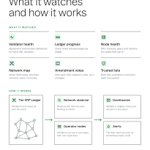
Together with @Peersyst, we built new network monitoring for the XRP Ledger.
It tracks validator health, ledger progress, log data, amendment votes, the UNL and about 900 nodes across the network, and feeds the dashboards and alerts our team uses every day.
Validators can opt in and see their own node next to the whole network: start.monitoring.xrplf.org

The XRP Ledger Lending reference app we built with @vs1_finance is now open source.
Five XRP Ledger amendments in one working market: Credentials, Permissioned Domains, Single Asset Vault, Lending Protocol and Batch.
Take any role on Devnet. Every step settles on-ledger.
Reference implementation:
github.com/XRPLF/XRPL-Lendin…

The XRP Ledger Foundation has completed the attestation of the XRP Ledger against the Global Layer One (GL1) Market Infrastructure Toolkit.
It is the first public, permissionless layer-1 blockchain to have the toolkit's Architecture and Resiliency principles independently verified.
GL1 is a multilateral initiative between global financial institutions and policymakers to foster an ecosystem of compatible financial infrastructures upon which tokenised assets can be transacted seamlessly across borders.
The toolkit assesses networks for tokenised assets across ten principles, built on international standards such as the Principles for Financial Market Infrastructures (PFMI) and emerging industry best practices.
For banks and asset managers, it is a standards-based reference for their own due diligence on the XRP Ledger.
More details:
pages.xrpl.foundation/xrp-le…

The upcoming Lending Protocol and Single Asset Vault are "big unlocks" for liquidity on the @XRP Ledger.
@soil_farm is building out lending infrastructure on the XRPL, allowing XRP to be used as collateral to borrow RLUSD in institutional lending.
XLS-65 SAV gives you a liquid token representing your position in a vault, which you can then use further in the XRPL DeFi ecosystem.
Nick explains how it works:
AI agents need access to open financial infrastructure that provides fast settlement, predictable transaction fees, and standardized primitives.
@chandler_agi from @t54ai "XRPL is super efficient for microtransactions"
The XRP Ledger delivers all of this out of the box and adds payment channels to scale these capabilities for (micro) payments.
We expanded public XRP Ledger infrastructure with free access to XRPL nodes via @ankr.
They now handle over 1,700,000 developer requests every 24 hours.

We're constantly improving the @XRP Ledger.
Since XRPL 3.3.0, we've reduced memory consumption by up to 23% on nodes.
A two-part deep dive by RippleX Core Engineer @Cyber_V71 on how this was achieved.

Part 1: dev.to/ripplexdev/memory-in-…
Part 2: dev.to/ripplexdev/memory-in-…
XRP Ledger Foundation CTO @angell_denis covering a lot of ground live @CoinDesk.
Strong demand from institutional partners to unlock liquidity with the upcoming Lending protocol and native compliance on the XRP Ledger.
We are "ahead of the game and well prepared" for quantum readiness.
We welcome @FlareNetworks to the recommended XRP Ledger validator list published by the XRPL Foundation.
Flare aligns with the core values of the @XRP Ledger, is actively participating in governance, and contributes to the broader ecosystem.

We also have removed @AnodosFinance from the XRPL Foundation recommended validator list at their own request, following the sunset of their XRPL Validator by the end of the month.
Thanking the team at Anodos for their contributions and collaboration with the XRP ecosystem.
Welcome to 🇺🇸 New York City, @XRP family!
@RippleSwell starts tomorrow.

New era.
Welcome home, @XRP!
We’ll be at @RippleSwell, looking forward to seeing the community there!

Thank you to the official partners of Swell 2026:
@evernorthxrp
@Ondo
@RedotPay
@SALTConference
@Water
@XRPLF
@xrpl_commons
ZILO
We also thank @CoinDesk, our media partner.
⌛ Registration closes on Tuesday, October 20, so please register before then: on.ripple.com/4k1Ary9

ALT Event banner for "Swell hosted by Ripple" in New York City, October 27-29, 2026. Official partners include Evernorth, Ondo, RedotPay, SALT, Water.org, XRP Ledger Foundation, Commons, and Zilo. Media partner is CoinDesk. The background is a gradient of blue and purple tones.
$RLUSD on the XRP Ledger is now integrating into @crossriverbank's core banking platform.
This lets institutions settle cross-border payments 24/7 through one integration, using the XRP Ledger's proven reputation for fast, efficient settlement


🪙 We’re excited to announce that we’re partnering with @Ripple to expand our stablecoin optionality and integrate RLUSD into our banking core infrastructure, with support for transactions on the XRP Ledger.
Together, we’re combining traditional payment technology with RLUSD on the XRPL, giving issuers and acquirers greater flexibility to settle intraday and reduce settlement latency. By bringing stablecoins’ programmability and near-instant settlement into the same environment as traditional rails, we’re creating a unified payments experience where businesses can leverage the strengths of both.
We’re proud to enable faster payment capabilities and give our partners greater choice and flexibility.
Learn more: crossriver.com/newsroom/cros…

The XRP Ledger's foothold in traditional finance continues to accelerate.
Bringing the XRP community and institutional players together for XRP conferences at key locations of XRPL adoption.
It starts in Australia and London.

XRPL wallets are now live in @privy_io.
Spin up embedded XRPL wallets, sign transactions, and control what each wallet can do with built-in policies.
From payment apps to AI agents paying over x402, the fastest way to ship wallets on XRPL.
docs.privy.io/wallets/using-…


1/ We're partnering with @Ripple to bring Privy wallets to the XRP Ledger (XRPL).
This makes it easier for developers to build stablecoin payments, fintech applications, and agentic commerce on XRPL.

The recent XRP Ledger security fix raised a lot of questions and some misconceptions. Let's clear them up.
1. Was any XRP created?
No. XRP's supply was fixed at 100 billion when the XRP Ledger launched, and no transaction is allowed to create more. This bug was a way around that rule, and 3.4.1 fixed it 2 weeks ago.
You don't need to trust us on this. All ledger data is public, and explorers and data sites read it every day. New XRP would show up in account balances for everyone to see. There is no hidden place for XRP on the XRP Ledger, every balance is public.
We monitor the XRP Ledger 24/7 and have verified the supply throughout the history of the ledger. Others in the community verified this too, and anyone can do the same.
Transaction fees are destroyed, so the supply is deflationary. About 99.986 billion XRP exist today.
2. How did this go unnoticed, and what's next?
No normal payment comes anywhere near triggering it. It took hundreds of deliberately constructed operations.
AI makes bugs like this faster to find, for the bad guys and the good guys.
Together with RippleX and the community, we will ensure the XRP Ledger is protected against such vulnerabilities. This means radically applying Formal Verification and AI adversarial testing, collaborating closely with security researchers, and strengthening the bug bounty program.
You'll hear a lot more about this as we progress.
3. XRP Ledger decentralization at the core of this.
A public fix shows attackers where the bug is, and AI makes that fast. With a normal amendment vote, the fix would have been public for weeks before it took effect, risking network security.
As a reaction to this, the XRPL community came together, and among them the XRP Ledger Foundation, RippleX, core devs and validators formed a social consensus and agreed on a path forward that involves shipping the fix directly. Patching a live network is never trivial, so the plan was also designed to minimize disruption for everyone running on it.
We shared the build with the default UNL validators, using the contact details each one publishes in its xrp-ledger.toml file. Public binaries followed the same day, September 25.
No single party could make that call alone. Every validator and node operator chooses what software to run, and 3.4.1 only became required through a normal amendment vote with more than 80% validator support for two weeks. Protocol changes still go through amendments.
Big thanks to Cayden Liao and Veria AI for finding and reporting this responsibly, to the XRPL core developers for building and testing the fix, and to every node operator who upgraded so quickly, especially the validators.
Full report: xrpl.org/blog/2026/vulnerabi…
